QUICK ANSWER
Choose an online Florida 63-hour course if you can self-schedule, finish assignments without outside pressure, and add separate exam practice after the course. Choose an in-person or live classroom format if you need a fixed calendar, instructor interaction, or accountability to finish. The non-obvious truth is that the format does not pass the Florida sales associate exam for you. A FREC-approved online course and a FREC-approved classroom course can both satisfy the education requirement, but neither automatically builds test-day recognition.
OFFICIAL SOURCES
Provider pricing, schedules, refund windows, and delivery formats still change by school, so confirm the provider's current FREC approval before paying.
Official source map
Florida's 63-hour pre-license course requirement is official. The online versus in-person recommendation is a practical format decision layered on top of that requirement.
| Claim used in this guide | Primary source |
|---|---|
| Sales associate pre-license education is 63 classroom hours, inclusive of exam | F.S. 475.17 and F.A.C. 61J2-3.008 |
| Approved distance learning can count as an option to classroom hours | F.S. 475.17 and DBPR FREC Educational Requirements |
| A Florida-approved 63-hour course is valid for licensure purposes for two years from completion | DBPR Real Estate Associate Requirements and DBPR pre-licensing course FAQ |
| You may submit the license application before completing the course, but need valid proof before sitting for the state exam | DBPR pre-licensing course FAQ |
| The sales associate state exam passing score is at least 75 | DBPR Real Estate Associate Requirements |
| Provider schedules, prices, course format labels, and refund rules are school-specific | Provider documents, not DBPR exam-prep advice |
"Online" and "in-person" are not single categories
Online usually means self-paced distance learning, in-person usually means a scheduled classroom, but live online and hybrid options sit between them. Mixing those sub-formats up is the most common course-selection mistake.
This is a practical buyer's taxonomy, not an official DBPR list of course categories. Providers name their products differently. Before enrolling, read the actual course page and confirm whether the course is self-paced, live-streamed, cohort-based, classroom-based, hybrid, or some mix of those features.
| Sub-format | What it actually is | Schedule control | Accountability built in |
|---|---|---|---|
| Self-paced online (text + video) | You log in any time, watch or read, take quizzes when you want | Highest | Lowest |
| Self-paced online with deadlines | Same as above, but the provider sets weekly module deadlines or expiration windows | High | Medium |
| Live online (livestream classroom) | Scheduled class sessions on Zoom or similar, instructor present, classmates visible | Medium | Medium-High |
| Recorded live class with cohort | Recorded versions of a live class with a fixed enrollment cohort and shared deadlines | Medium-High | Medium |
| In-person classroom (multi-week) | Physical classroom, fixed weekly schedule, instructor and classmates in the room | Low | High |
| In-person classroom (intensive / weekend) | Compressed in-person format over consecutive days or weekends | Lowest | High |
| Hybrid (online + in-person) | Some sessions online, some on campus, often with a fixed cohort | Medium | Medium-High |
When this article uses "online," default to self-paced online (text + video) unless noted, because that is the most common online format candidates buy. When this article uses "in-person," default to multi-week classroom unless noted. The sub-formats in between (live online, recorded with cohort, hybrid) often combine the schedule advantages of one side with the accountability advantages of the other.
If you have already abandoned a self-paced online course once, be cautious about buying another self-paced course without changing the support system. The sub-format may not match your completion pattern. Consider live online, hybrid, in-person, or a self-paced course with a real outside accountability plan.
The schedule accountability fit rule
Pick the course format that solves your completion problem, then add exam prep that solves your score problem.
The Schedule Accountability Fit Rule is simple: treat course completion and exam performance as two separate problems.
The 63-hour course is the education requirement. For most Florida sales associate candidates, it is the gate before the state exam. The course teaches the curriculum and gives you the completion proof you need for the license path.
The state exam is a different filter. On the Florida sales associate exam, you have to recognize rules inside scenarios, avoid trap wording, set up math correctly, and answer under time pressure.
That is why "online vs in-person" should not start with which course looks more polished. It should start with this question:
Which format will I actually finish, and what will I use afterward to turn course knowledge into exam points?
Online vs in-person in 60 seconds
Online is usually the better first fit for schedule control. In-person or live online is usually the better first fit for accountability.
| If this sounds like you | Better first fit | Why |
|---|---|---|
| You work irregular hours | Online self-paced | You need schedule control more than a classroom calendar |
| You procrastinate without a fixed appointment | In-person or live online | The calendar creates external pressure |
| You learn best by replaying lessons | Online | Rewatching beats trying to reconstruct a live lecture from notes |
| You learn best by asking questions live | In-person or live online | Instructor access can prevent small confusion from becoming a course delay |
| You want the cheapest path | Usually online | Basic online courses often cost less, but verify current provider pricing |
| You need local networking | In-person | A classroom can introduce you to local candidates, instructors, and school staff |
| You are trying to finish before a deadline | Depends | Online is flexible, but in-person prevents drift if you show up consistently |
| You are already strong at self-study | Online | You can move steadily and save energy for exam prep |
The key phrase is "first fit." A format can be good and still be wrong for your life.
An online course can be perfect for a disciplined working adult and terrible for someone who keeps saying "I'll do two chapters this weekend." An in-person course can be perfect for a candidate who needs a calendar and frustrating for someone whose work schedule changes every week.
What Florida actually requires
Florida cares less about online versus in-person than approval. A FREC-approved 63-hour sales associate pre-license course can satisfy the education gate in classroom or distance education format, but a generic real estate course may not.
Florida's sales associate pre-license path generally requires a FREC-approved 63-hour pre-license course, unless an exemption applies. DBPR's requirements page says the course is valid for licensure purposes for two years after the completion date.
Florida law also recognizes distance learning as an option to classroom hours when approved by the commission. FREC's education materials describe sales associate pre-licensure courses as possible in classroom and distance education environments.
That gives you a practical rule:
| Question | What matters |
|---|---|
| Does online count? | It can, if it is the right FREC-approved Florida sales associate pre-license course |
| Does in-person count? | It can, if it is the right FREC-approved Florida sales associate pre-license course |
| Does a generic real estate course count? | Do not assume so. Verify Florida approval before paying |
| Does Pass Florida replace the course? | No. Pass Florida is exam prep only, not a 63-hour course |
| Does course completion mean exam readiness? | No. Completion proof and state-exam readiness are different |
For real-world action, verify the provider's current approval and delivery format through DBPR or the provider before you enroll.
COMPLETION IS NOT READINESS
A finished course is not a passing score.
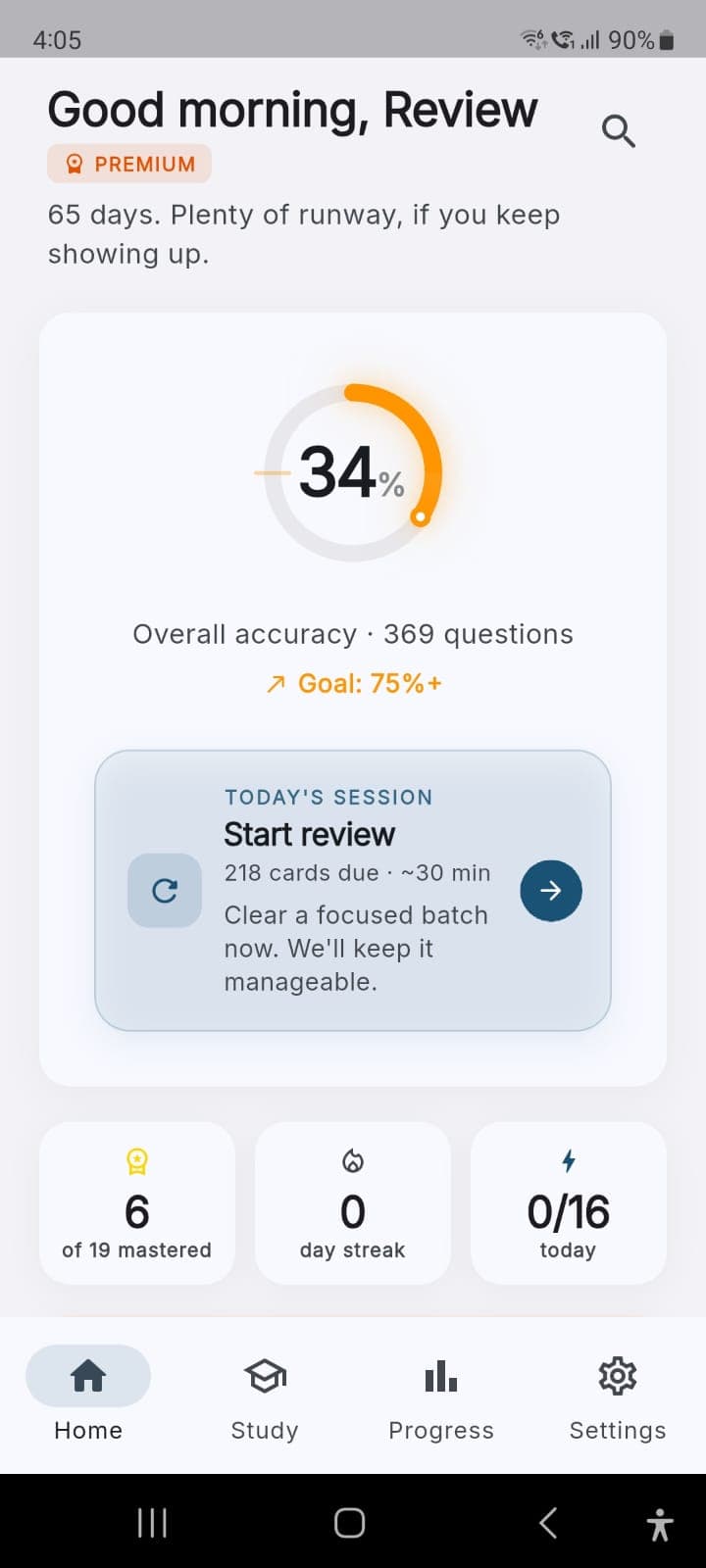
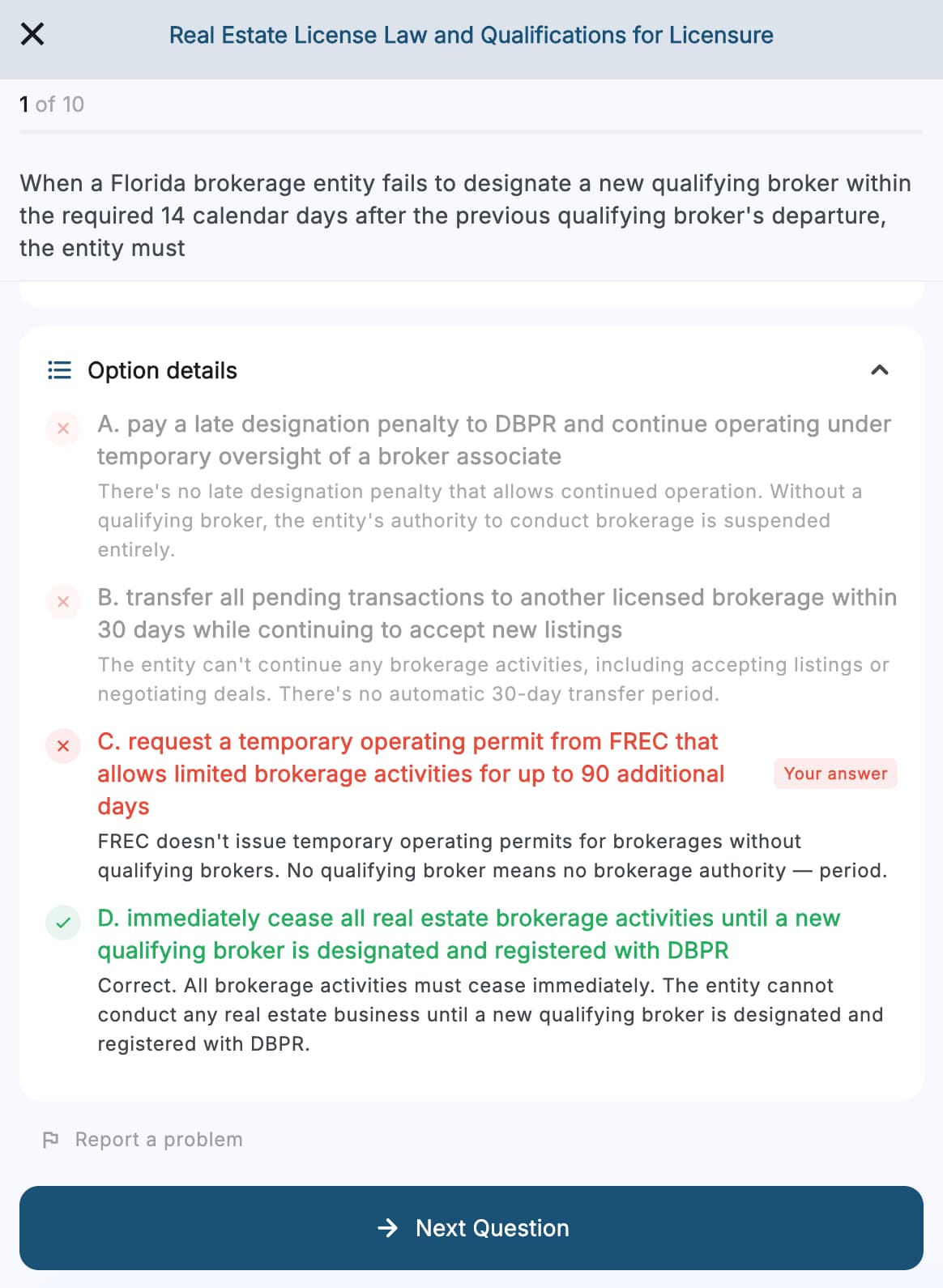
Whichever format you pick, the Florida sales associate exam is a separate filter that tests scenario recognition, trap wording, and math setup. Pass Florida is exam prep only: 1,142 Florida-specific practice questions, a 19-topic diagnostic, Math Coach across the 14 Florida math calculation types, and a Trap Library, for one $39.99 purchase. No subscription. No copied exam questions.
The online course case
An online Florida 63-hour course is usually the better fit when schedule control is the main problem and you can self-manage the work.
You can study early, late, during lunch breaks, or on weekends. You can pause around work, childcare, school, travel, or military schedules. You can revisit lessons that felt dense. You can often finish faster if you already understand basic real estate ideas and can keep a steady pace.
The hidden exam trap is false comfort.
Online courses can make progress feel cleaner than it is. You move through modules. You pass quizzes. You check boxes. Then the state exam asks a scenario about brokerage relationships, escrow, disclosure, or financing, and the answer is not sitting in the same order as the lesson.
Use online if you can do these four things:
| Online success check | Why it matters |
|---|---|
| You can schedule study blocks before the week starts | Self-paced means self-managed |
| You can take notes without copying whole slides | The exam rewards recognition, not transcription |
| You can finish even when no one is watching | Online courses punish vague intentions |
| You can add separate mixed practice after the course | Course quizzes are not the same as the state exam |
If any of those are weak, online can still work, but you need a stronger outside structure.
The in-person course case
An in-person Florida 63-hour course is usually the better fit when accountability, live questions, and a fixed calendar matter more than flexibility.
The biggest benefit is not the chair, the room, or the whiteboard. It is the appointment. You have to be somewhere. The instructor moves the class forward. Other students are working through the same material. Questions come up in real time.
For many candidates, that is worth the extra time or cost.
The hidden exam trap is passive attendance.
Sitting in class does not mean you are building exam recognition. It is possible to attend every session, highlight every handout, and still miss application questions because you never practiced choosing between two tempting answer choices.
Use in-person if you need these supports:
| In-person success check | Why it matters |
|---|---|
| You finish better with fixed class dates | The calendar prevents drift |
| You ask questions when confused | Live clarification protects the foundation |
| You learn from examples and discussion | Instructor stories can make rules stick |
| You need local school staff or networking | Some candidates benefit from a local launch point |
If you choose in-person, still build a separate exam-prep window. The classroom teaches the material. Practice turns it into points.
The format decision table
Choose the course format by your real failure risk: drifting without structure, missing fixed sessions, needing live explanation, or skipping post-course exam practice.
| Decision factor | Choose online if | Choose in-person if |
|---|---|---|
| Schedule | Your calendar changes often | You can commit to fixed class times |
| Motivation | You complete independent work | You need outside pressure |
| Learning style | You like reading, replaying, and pacing yourself | You like live explanation and questions |
| Budget | You need the lowest course cost | You can pay more for structure if needed |
| Speed | You can move consistently without stalling | You would otherwise procrastinate for months |
| Exam readiness | You will add separate practice after completion | You will add separate practice after completion |
| Risk | You might abandon an online dashboard | You might attend passively and not test yourself |
Notice the exam-readiness row.
It is the same on both sides.
That is the point.
The first two weeks of any format: a completion routine
The first two weeks decide whether the course format is working, because early missed modules usually predict later course drift.
Format choice does not finish the course. Whatever sub-format you picked, the first two weeks decide whether you will actually complete on schedule or become one of the candidates who pay for a 63-hour course and never finish it.
| Week 1 | What to do | Why |
|---|---|---|
| Day 1 | Calendar the completion target. Put a "course final by [date]" event on every calendar you use. | Self-paced courses without a finish date drift indefinitely. Even live and in-person formats benefit from a personal target inside the provider's schedule. |
| Day 2 | Block 4-6 weekly study windows on your calendar through the completion date. Each block 60-90 minutes. Treat them like work meetings. | The 63 hours land softer when broken into 8-12 weeks of consistent blocks than when crammed. |
| Day 3 | Complete Module 1 or the first scheduled class. Take handwritten notes, even online. | Day 3 completion is an early fit test. If you miss it, diagnose why before blaming yourself: work emergency, platform issue, unclear instructions, or format mismatch. |
| Day 4-5 | Identify your accountability mechanism. Tell one person your finish date. Optional: schedule a check-in halfway through. | External commitment beats internal intent for most candidates. |
| Day 6-7 | Take your first low-stakes self-test. 10-15 questions from Module 1 material. Do not grade yourself harshly; just confirm the material is sticking. | Catches "I watched the video but cannot answer questions about it" early, while the fix is one re-watch instead of an end-of-course panic. |
| Week 2 | Maintain the 4-6 weekly blocks. Complete the next 2-3 modules. Re-test Module 1 alongside Module 2-3 material. | Mixed retesting is the difference between course completion and course retention. |
If you cannot finish Modules 1-3 in the first two weeks at the pace you planned, do not just push through with the same vague intention. Pause, diagnose the gap (time, accountability, comprehension, motivation), and either restructure the schedule or switch sub-formats. A self-paced online course that has stalled in week 2 usually needs a visible change: fixed study appointments, outside check-ins, instructor support, or a different delivery format.
The score gate after the course
After the 63-hour course, use mixed Florida practice scores to decide whether you are exam-ready, not the fact that you completed the course.
Ask, "Can I answer mixed Florida questions without a chapter label?"
Use this score gate:
| Signal after the course | What it means | Next move |
|---|---|---|
| Under 60% on mixed practice | You are still learning, not reviewing | Rebuild weak topics before scheduling |
| 60% to 74% | You know pieces, but the exam can still catch you | Drill weak areas and trap wording |
| 75% to 79% | Passing range, but thin cushion | Take timed practice and repair misses |
| 80%+ twice in timed mixed sets | Stronger readiness signal | Check logistics and keep review light |
The 75 score is the official passing threshold. The 80% practice target is a Pass Florida readiness framework, not a DBPR rule. It gives you a cushion because practice at home is usually calmer than exam day.
Common traps
The biggest trap is treating format choice as exam prep. The course gets you eligible, but mixed practice is what exposes weak recognition.
Trap 1: Buying the course that sounds most complete
More features do not automatically solve your problem.
If you need accountability, a cheap online course may cost you time. If you need flexibility, a classroom course may make you miss sessions. If you need exam practice, a course with more lessons may still leave you short on application questions.
Repair step: name the problem first: schedule, accountability, explanation, cost, or exam practice.
Trap 2: Treating online as easier
Online is flexible. It is not automatically easy.
Self-paced courses shift the management job to you. If you do not create deadlines, the course can stretch until the material goes cold.
Repair step: pick a course-completion date before you enroll and put study blocks on your calendar.
Trap 3: Treating in-person as safer
In-person feels safer because someone is guiding the room.
But for exam purposes, attendance is not proof of readiness. If you do not practice mixed questions, the exam can still expose weak recognition.
Repair step: after each class week, answer a small set of mixed questions from earlier material.
Trap 4: Forgetting the certificate clock
DBPR says the Florida-approved 63-hour course is valid for licensure purposes for two years after the course completion date.
That clock matters if you finish the course, then wait months before applying, fingerprinting, or scheduling the state exam.
Repair step: save the completion date and use the course certificate expired guide if your exam timeline is getting close.
A simple timeline that works with either format
You can often run the DBPR application, fingerprints, 63-hour course, and early review in parallel, but you still need valid course-completion proof before sitting for the state exam.
| Stage | Online course plan | In-person course plan |
|---|---|---|
| Week 0 | Verify FREC approval, enroll, set finish date | Verify FREC approval, enroll, save class calendar |
| Early course | Submit DBPR application and schedule fingerprints if you are ready to start the licensing path | Submit DBPR application and schedule fingerprints if you are ready to start the licensing path |
| Mid-course | Start light review of earlier chapters | Review class notes with small mixed sets |
| Course final | Pass the provider's end-of-course exam | Pass the provider's end-of-course exam |
| After completion | Start dedicated Florida exam prep | Start dedicated Florida exam prep |
| Before Pearson VUE | Use scores, not vibes, to decide whether to test | Use scores, not vibes, to decide whether to test |
DBPR says the course completion certificate is not required when you submit the license application, but you must show valid proof of completing a Florida-approved 63-hour course at the exam site before sitting for the state exam. That is why many candidates run the application and course in parallel rather than stacking every step.
For the full order, use the Florida real estate license step-by-step guide. If fingerprints slow you down, use the fingerprints delay guide.
AFTER THE 63-HOUR COURSE
Turn course completion into exam recognition.
Use the approved course for eligibility and exam prep for readiness. One cannot replace the other.
Worked-scenario walkthrough: Marcus, rotating shifts, procrastination, format choice
The stem. Marcus is a 32-year-old emergency room nurse who works three 12-hour shifts per week on a rotating schedule (some weeks two day shifts and one night, other weeks the reverse). He has ADHD and knows task initiation is hard for him. His previous attempts at self-paced online learning (a coding course, a continuing-ed nursing course) both stalled after week 4 and were never completed. He has a six-month timeline to get his Florida sales associate license because he wants to start showing properties part-time before the next leasing season. Which 63-hour course format actually works for him?
Step 1: Apply the schedule-accountability fit rule. Marcus's primary problem is not only schedule control. Rotating 12-hour shifts mean he has 4 days per week without work commitments, plus the off-shift hours on workdays. His primary problem is accountability and task initiation. The two prior self-paced courses he abandoned are strong personal evidence. Buying another self-paced online course without new accountability would likely repeat the failed pattern.
Step 2: Eliminate the sub-formats that match the failed pattern.
| Sub-format | Verdict for Marcus | Why |
|---|---|---|
| Self-paced online (text + video) | High risk unless rebuilt with accountability | Matches the two prior abandoned-course patterns closely |
| Self-paced online with deadlines | Risky | Provider deadlines help, but only if Marcus has a real plan for acting on them |
| Live online (livestream classroom) | Strong candidate | Fixed schedule creates external pressure; he can join from home around shifts |
| Recorded live class with cohort | Maybe | Cohort accountability helps, but the recording flexibility may recreate the self-paced trap |
| In-person classroom (multi-week) | Strong candidate if schedule aligns | Maximum accountability, but rotating 12-hour shifts may conflict with most weekly class evenings |
| In-person classroom (intensive / weekend) | Strong candidate if the dates fit his shift schedule | Compressed format may finish before Marcus's prior week-4 stall pattern has time to repeat |
| Hybrid | Maybe | Depends on how much is live + cohort-based vs how much is self-paced |
Step 3: Pick the top option. Two strong candidates: live online (livestream classroom) with a fixed weekly schedule, or in-person intensive / weekend format. If he can protect the dates around his shifts, the intensive weekend format is probably the strongest first pick because it is compressed, cohort-based, and harder to drift away from. If the dates conflict with his hospital schedule, live online with attendance requirements is the safer backup.
Step 4: Add the format-specific supports. Whatever Marcus picks, three supports increase his completion odds:
- Calendar protection. Put every class session on his work calendar AND personal calendar with conflict-flagged status. Tell his charge nurse he is unavailable for shift swaps that conflict.
- External accountability. Tell his partner and one nurse colleague his target completion date. Ask one of them to check in after week 1.
- Day-3 completion test. If he cannot complete the first module or first session on time, do not ignore it. Diagnose the cause immediately. If the cause is the same task-initiation pattern that stalled the prior courses, switch support or sub-format quickly.
Step 5: Plan the post-course exam prep. Marcus is choosing the course format that solves his completion problem. After the course, he still needs to solve the score problem. The 30-day post-completion exam prep window (mixed Florida-specific practice, math setup drills, trap-wording drills, timed full exams) is independent of which course format he picked.
The expensive mistake. Marcus's most expensive mistake would be buying the cheapest self-paced online course because "it fits his rotating schedule" without adding accountability. It would also fit his abandoned-course pattern. The savings on the course price could be eaten by another abandoned enrollment plus the six-month timeline slipping past leasing season. A higher-cost in-person intensive or live online format with strong accountability may be cheaper than a self-paced course he does not finish.
What the worked scenario shows. Format choice is a self-knowledge problem, not a feature-comparison problem. Marcus's prior abandoned-course history is more diagnostic than any course-feature list. This is not medical advice and it is not a claim about all candidates with ADHD. A candidate with a different pattern (high completion rate on independent work, predictable schedule, strong outside accountability) might make the exact opposite choice from the same facts.
Exam-style question
A candidate works rotating hospital shifts and cannot attend a Tuesday/Thursday classroom course. She is disciplined, studies from checklists, and plans to do mixed practice after finishing the course. Which format is the better fit?
- A. In-person, because classroom courses are always better for exam prep
- B. Online, because schedule control is her main constraint and she has self-study habits
- C. Online, because online courses replace the need for state exam practice
- D. In-person, because online courses do not count in Florida
Answer
Correct answer: B. The controlling fact is her schedule plus her self-study discipline. Online can be the better format if the provider and course are properly approved and she adds separate exam prep. A is too broad. C confuses course completion with exam readiness. D is wrong because Florida recognizes approved distance learning as an option.
What not to do
Do not pick a course only because it is cheapest.
Do not pick a course only because it is local.
Do not assume a national real estate course satisfies Florida's sales associate requirement.
Do not treat the provider's end-of-course exam as proof you are ready for Pearson VUE.
Do not wait until the certificate is near expiration before building a real exam plan.
Do not ask Pass Florida to replace the 63-hour course. It does not. It starts where course completion leaves off: application-level practice for the Florida sales associate exam.
FAQ
Is the Florida 63-hour real estate course better online or in-person?
Neither format is automatically better. Online is usually better for disciplined candidates who need flexibility. In-person is usually better for candidates who need a fixed schedule, live questions, and accountability.
Does an online Florida 63-hour course count?
It can count if it is the correct FREC-approved Florida sales associate pre-license course. Verify approval before paying. Do not assume a generic online real estate course qualifies.
Is the in-person course easier than the online course?
Not necessarily. The required course content comes from the Florida pre-license curriculum. The difference is delivery: self-paced online study versus live schedule and instruction.
Should I choose the cheapest Florida 63-hour course online?
Only if it is approved and you can finish it without outside pressure. If the cheap course creates delay, confusion, or no exam-prep plan, the low price can become expensive.
Does the 63-hour course prepare me for the Florida state exam?
It teaches the required material and includes the provider's end-of-course exam. Many candidates still need dedicated state exam prep because the Florida sales associate exam tests recognition, scenario logic, trap wording, and math setup.
Can I submit the DBPR application before finishing the 63-hour course?
DBPR says the course completion certificate is not required when you submit the license application, and you may submit the application for state exam approval before completing pre-license education. You still need valid proof of course completion before sitting for the state exam.
How long is the Florida 63-hour course certificate valid?
DBPR says the Florida-approved 63-hour sales associate pre-license course is valid for licensure purposes for two years after the course completion date.
Ready to turn course completion into a Florida exam pass?
The 63-hour course gets you to the test-center door. The state exam is a separate filter that rewards Florida-specific scenario recognition, trap-wording discipline, and math setup under time pressure. Whichever course format you pick, plan a dedicated exam-prep window after completion.
Verify the official licensing step first, then use exam practice only for the knowledge test.
Take the free Florida practice exam | Run the readiness calculator | Download Pass Florida
Sources & Methodology
This guide was written for Florida sales associate candidates who are deciding how to complete the 63-hour pre-license course before preparing for the state exam. The course-format advice comes from a practical exam-prep question: which delivery method helps you finish the requirement without losing momentum before Pearson VUE? That is why the article focuses on schedule control, accountability, sub-format distinctions, course certificate timing, and the gap between course completion and exam readiness.
The factual anchors come from primary sources: F.S. 475.17 and F.A.C. Rule 61J2-3.008 for the 63-hour pre-license education rule and distance learning recognition, the DBPR Real Estate Associate Requirements for Licensure for two-year course validity and the 75 passing score, the DBPR FREC Educational Requirements document for classroom and distance education delivery, and the DBPR FAQ on application timing.
The schedule-accountability fit rule, the sub-format breakdown, the four common traps, the first-two-weeks completion routine, the score-band readiness gate, the worked-scenario walkthrough, and the format-decision tables are practical study patterns derived from common candidate mistakes, not DBPR, FREC, Pearson VUE, course-provider rules, or medical guidance. The seven sub-formats are a practical market map, not an official DBPR taxonomy. The Marcus scenario is based on an individual completion-pattern diagnosis, not broad medical research. The 80% practice readiness target is a Pass Florida exam-prep benchmark, not a DBPR rule.
This article does not promise a passing result on the Florida sales associate examination, does not rank specific course providers, and does not replace DBPR, FREC, Pearson VUE, the course provider, or qualified licensed Florida professional guidance. Outcomes depend on candidate-specific scheduling, self-knowledge, course-provider quality, and the underlying post-course exam prep effort.
Product note. Pass Florida publishes this guide and offers the exam-prep app linked on this page. We do not claim to use copied exam questions, promise passage, replace the 63-hour FREC-approved pre-license course, or replace DBPR processes, FREC rule interpretation, Pearson VUE scheduling, course-provider records, or qualified licensed Florida professional guidance.
Primary sources reviewed:
- DBPR Real Estate Associate Requirements for Licensure
- F.A.C. 61J2-3.008, Pre-licensing Education for Broker and Sales Associate Applicants
- F.S. 475.17, Qualifications for Practice
- DBPR Real Estate FREC Educational Requirements
- DBPR Real Estate Commission Education
- DBPR FAQ: When should I take the pre-licensing course?
This post is exam-prep and licensing-decision content for Florida sales associate candidates. It compares 63-hour pre-license course formats and is not a guarantee of passing the exam, not legal advice, not licensing advice, not a course-provider endorsement, and not a substitute for DBPR, FREC, Pearson VUE, the course provider, or a qualified licensed Florida professional. Verify any rule, fee, course-provider approval, or admission requirement against the primary source before enrolling. Pass Florida is an educational study tool sold for one $39.99 purchase with no subscription.