VERIFY BEFORE RELYING
This article is exam-prep and licensing-decision content. F.A.C. (Florida Administrative Code) Rule 61J2-3.008 (pre-licensing education, end-of-course examination requirements, 70% threshold, retake limits, 1.8-minutes-per-item rule, 100-item minimum), F.A.C. Rule 61J2-3.015 (course completion certificates), DBPR (Department of Business and Professional Regulation) Candidate Information Booklet rules, Pearson VUE policies, and course-provider exam policies can change. Always verify the current rule against F.A.C. 61J2-3.008, F.A.C. 61J2-3.015, and your course provider's current end-of-course exam policy before relying on any specific number in this article.
QUICK ANSWER
To pass the Florida real estate course final, study in application mode: review chapter objectives, rebuild missed quiz questions, and drill math setups. Then take one timed final-style set before the provider exam. A passing score only means course completion, so switch to mixed state-exam practice immediately after.
WHO THIS GUIDE IS FOR
Use this if you are near the end of a Florida 63-hour sales associate course, have chapter quizzes or module reviews behind you, and need a clean plan for the provider's final exam. If you already passed the course final and are preparing for Pearson VUE, use the state-exam guide or the readiness-score guide instead.
What this guide covers
- The final-gate practice loop
- Should you take the course final today?
- What the course final is really testing
- Course final vs state exam, for this moment
- The 5-step study plan for the course final
- 7-day course-final sprint
- What to ask your provider before the final
- What if you fail the course final?
- After you pass: protect the handoff
- Exam-style question
- What not to do
- FAQ
The final-gate practice loop
The best course-final study loop is missed-quiz repair, math setup practice, one timed final-style set, and then an immediate handoff into mixed Florida state-exam practice after you pass.
If you are near the end of the 63-hour course, the question underneath the question is usually: "Can I get through this final without starting the whole course over?"
That is a fair concern. The course final is the first gate. It is not the state exam, but it still matters because passing it is part of satisfying the course requirement.
The Final-Gate Practice Loop has five moves. Use them in order so you are not just rereading the material and hoping it sticks:
- Review the course objectives.
- Rebuild missed quiz questions.
- Drill math and rule setups.
- Take a timed final-style set.
- Save the certificate, then shift into state-exam practice.
The loop works because the course final rewards course coverage and application. It also protects you from the biggest mistake: rereading everything without finding what you actually miss.
Should you take the course final today?
Take the Florida real estate course final when you have completed the required course work, reviewed your missed quizzes, practiced math setups, and confirmed your provider's retake and proctoring rules.
Do not take the final just because the button is available. Take it when your evidence says you are ready.
| Readiness signal | Green light | Slow down |
|---|---|---|
| Course progress | All required sessions complete | You are trying to skip or rush remaining modules |
| Quiz review | You can explain missed answers in plain English | You only remember answer letters |
| Math | You can set up the problem before touching the calculator | You get the right answer only when the example looks familiar |
| Timing | You have done at least one mixed timed set | You have only studied open-book or untimed |
| Provider rules | You know the format, retake rule, and allowed materials | You are guessing about proctoring, ID, or retake timing |
If two or more items are in the "slow down" column, spend another focused study block before the final. A one-day delay is much cheaper than a 30-day retest wait.
What the course final is really testing
The course final is not supposed to be pure definition recall. Rule 61J2-3.008 requires application-oriented questions, so you need to explain rules in new scenarios.
Rule 61J2-3.008 says a 70% or higher grade on the Commission-prescribed end-of-course examination constitutes satisfactory course completion. That is the number that matters for the course final.
The same rule also says sales associate end-of-course examinations must use multiple-choice questions with 4 answer choices, and at least 70% of the questions on each form must be application oriented. No more than 10% may be at the knowledge level.
For a candidate, that means the course final is not supposed to be only definition recall. It can ask you to apply rules, policies, methods, computations, laws, theories, or other course material in a new situation.
That is why "I read the chapter" can still produce shaky scores if you never practiced using the chapter.
Course final vs state exam, for this moment
This post is about passing the provider's internal end-of-course exam. If you need the full comparison, read Florida real estate course final vs state exam after this.
Here is the practical difference while you study for the first gate. Keep the two tests separate even when the topics overlap:
| Question | Course final answer | State exam answer |
|---|---|---|
| What are you trying to prove? | Satisfactory course completion | Licensing exam readiness |
| What score matters? | 70% or higher under Rule 61J2-3.008 | 75 points or higher under DBPR requirements |
| What material should lead your study? | Your provider's course, objectives, quizzes, and final-review materials | Mixed Florida sales associate exam practice |
| Main danger | Memorizing course quiz wording instead of learning the rule | Assuming a course pass means Pearson VUE will feel familiar |
| Best next move after passing | Save completion proof and switch to mixed practice | Keep score data stable before testing |
The course final is usually more familiar because you just took the course. The state exam usually feels less familiar because topics are mixed, answer choices are close, and the setting is separate from your school. Do not let that make you careless about the course final.
The 5-step study plan for the course final
Step 1: Pull the course objectives back into view
Start with the course syllabus, module objectives, chapter headings, and provider review guide. Your goal is not to reread every sentence. Your goal is to see the map again.
Make a short list of topics that have produced misses during the course. Most candidates already know where they felt slow: contracts, brokerage relationships, financing, appraisal, license law, math, property rights, or closing costs. For exam purposes, weak topics are not moral failures. They are directions.
Step 2: Rebuild Missed Quiz Questions
Your best course-final study material is usually your own missed quiz work. Do not copy the question and memorize the answer letter. Rebuild the miss:
| What you missed | Repair question |
|---|---|
| Definition | What is the rule in one plain sentence? |
| Scenario | Which fact controlled the answer? |
| Math | Which number was the base? |
| EXCEPT or NOT wording | Did I answer the opposite of what was asked? |
| Similar answers | Why is the tempting answer wrong here? |
The repair question matters more than the original answer. If you can explain why the right answer is right and why the tempting wrong answer is wrong, the next version of the question becomes easier.
Step 3: Drill math as setups, not calculations
Most course-final math errors happen before the calculator, so treat the setup as the score saver. A clean setup also makes review easier because you can see exactly where the miss happened.
Write the setup before you solve. Label the base, rate, time period, and operation. For proration, label the date method. For commission, label sale price, rate, and split. For documentary stamps, label the document type and taxable amount.
If you need focused math work after the course, use the Florida real estate exam math formulas guide or the math drill. For the course final itself, your provider's covered examples should stay first.
Step 4: Take one timed final-style set
Do at least one timed set before the course final. It does not have to be a full final if your provider does not offer one, but it should be mixed enough to force topic switching.
Rule 61J2-3.008 says the overall time to complete the end-of-course exam must not exceed the equivalent of 1.8 minutes per item. That does not mean you should race. It means timing is part of the environment.
During the timed set, mark three things so review stays specific. This keeps the final review session from turning into another full-course reread:
- Questions you knew quickly.
- Questions you narrowed to two choices.
- Questions where you guessed because the setup was unclear.
The second and third groups are your final repair list. Do not spread review across every topic if only a few miss patterns keep repeating.
Step 5: Treat a course pass as a handoff
Passing the course final is a real milestone. It means you are through the course-completion gate, assuming the provider and rule requirements are satisfied.
It does not mean you are automatically ready for the Florida sales associate state exam. After the course final, your study changes. Stop studying in course order. Start practicing mixed Florida questions without chapter labels.
The Florida real estate exam readiness score article explains how to use practice data before booking Pearson VUE.
7-day course-final sprint
If your final is about a week away, use a short sprint instead of vague review.
| Day | Focus | Output |
|---|---|---|
| 1 | Course map | List weak modules from quizzes, notes, and chapter objectives |
| 2 | Rules | Rewrite the 20 to 30 rules you missed most often in one sentence each |
| 3 | Math | Drill setup patterns: commission, proration, property tax, doc stamps, area, and valuation |
| 4 | Scenario questions | Review missed quiz questions by controlling fact, not answer letter |
| 5 | Timed mixed set | Mark questions as knew, narrowed, or guessed |
| 6 | Final repair | Fix only the misses from day 5 and any provider-specific weak chapters |
| 7 | Light review | Confirm test logistics, sleep, ID, allowed materials, and exam time |
If your provider final is tomorrow, compress the sprint. Do not attempt a full-course reread. Review objectives, rebuild misses, run math setups, and confirm provider logistics.
What to ask your provider before the final
Provider rules can affect the final more than students expect. Ask these questions before test day, especially if your course is online or self-paced:
| Question | Why it matters |
|---|---|
| Is the final proctored, remote-proctored, locked-browser, or in person? | You need the right setup and ID process |
| What score do I need? | Rule 61J2-3.008 sets 70% as the satisfactory-completion threshold |
| What happens if I fail? | The rule creates a 30-day wait before retesting |
| Is there a retake fee or scheduling delay? | Provider policies vary |
| When do I receive the completion certificate? | Rule 61J2-3.015 makes the certificate important at the state exam |
| What materials are allowed during the final? | Course finals should not rely on hints, back, retry, or course-material aids |
The goal is not to find a shortcut. The goal is to remove logistical surprises so your score reflects your knowledge, not a missed provider instruction.
If you are still choosing a course format, read Florida real estate self-paced vs livestream course before enrolling.
What if you fail the course final?
Do not panic, but do not treat it like a normal quiz. Rule 61J2-3.008 says students who fail the end-of-course examination must wait at least 30 days from the original examination date to retest.
Within one year of the original exam, a student may retest a maximum of one time. Otherwise, the student must repeat the course before being eligible to take the end-of-course exam again.
That rule changes the study decision. A rushed final can cost you a month. A second failed final can force a course-repeat decision.
Use the 30-day wait as a repair window with a simple order of operations. The goal is to fix the miss pattern before the next approved attempt:
- Ask the provider what topic feedback is available.
- Rebuild every remembered miss by rule, not answer letter.
- Spend the first week repairing weak chapters.
- Spend the second week on mixed course review.
- Spend the final week on timed sets and math setup.
Provider retake fees and repeat-course costs vary. Before the next attempt, use targeted repair instead of broad rereading: math setup practice, missed-quiz reconstruction, and trap-wording review.
After you pass: protect the handoff
The moment after passing the course final is where many candidates lose momentum. Treat it like a handoff, not a finish line.
| Action | Why it matters |
|---|---|
| Save the completion certificate in two places | You will need proof later, and the certificate has its own validity window |
| Confirm the completion date | The two-year clock runs from completion, not from when you start state-exam prep |
| Check DBPR application and fingerprint status | Course completion does not automatically mean you are cleared to schedule |
| Switch from chapter order to mixed practice | Pearson VUE will not ask questions in course-module order |
| Take a baseline state-exam diagnostic | A course-final pass does not tell you which state-exam families are weak |
If you pass with a narrow score, do not panic. A 70% course-final pass can still become a strong state-exam result if you shift into mixed Florida practice and repair your misses. The mistake is assuming the first gate and second gate measure the same thing.
AFTER THE COURSE FINAL
Pass the provider exam, then switch into state-exam mode.
Start with the diagnostic, practice the weakest Florida topics, and use timed mixed sets to prove the improvement before test day.
Exam-style question
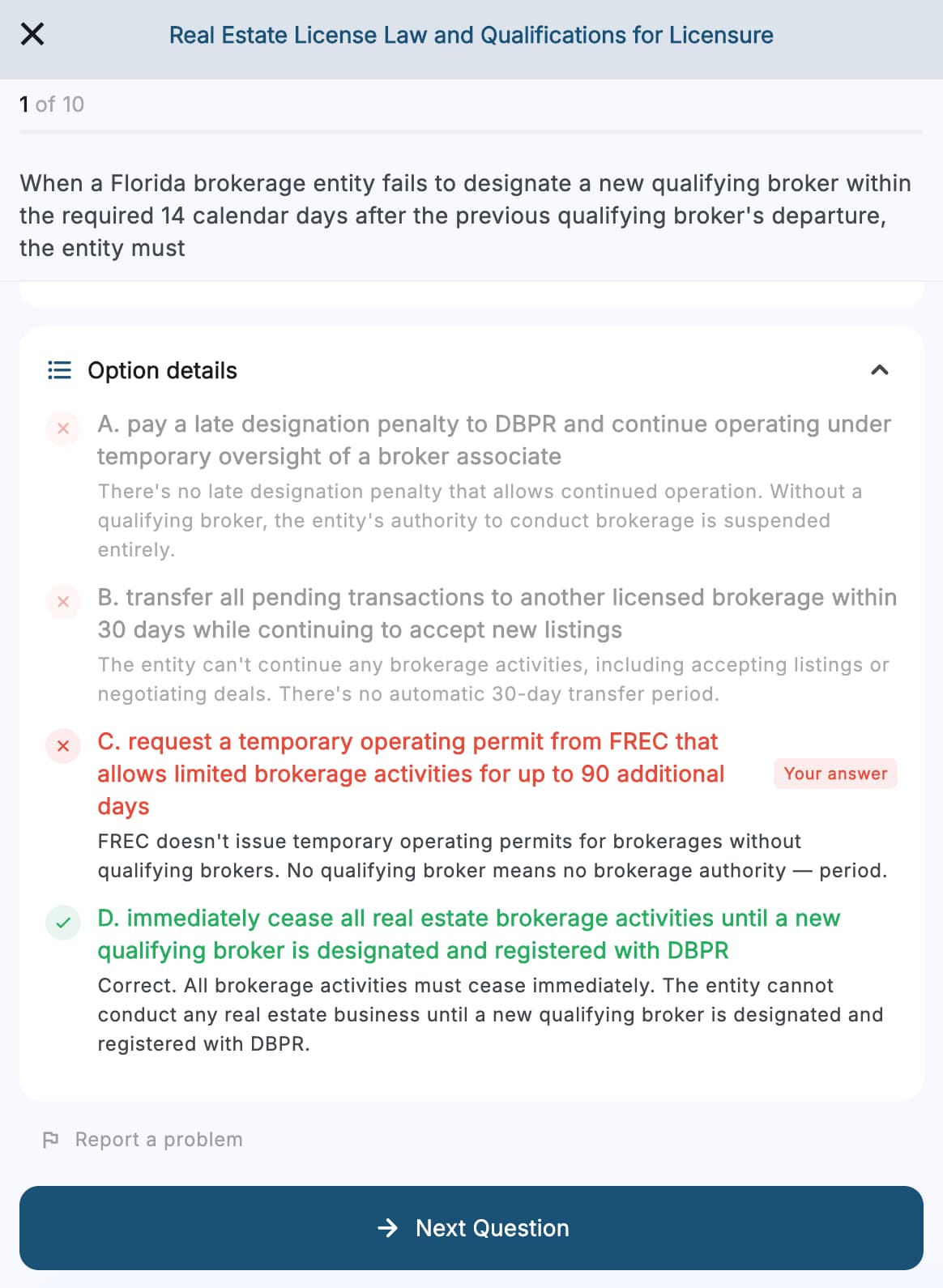
A Florida sales associate candidate is preparing for the 63-hour course final. She keeps rereading the course chapters and scoring well only when the quiz questions look familiar. What is the best next study move?
- A. Keep rereading the same chapters because course finals only test definition recall
- B. Review the provider's old quizzes without checking why each wrong answer is wrong
- C. Rebuild missed quiz questions by rule, controlling fact, and math setup before taking a timed final-style set
- D. Start only with full state-exam simulations because the course final and state exam test identical readiness
Answer
Correct answer: C. The course final can include application-oriented questions, so the safer move is to repair missed patterns and practice under time. A understates the course final. B sounds useful but can leave the same reasoning error in place. D skips the course-final layer and confuses course completion with state-exam readiness.
What not to do
- Do not reread the entire course just because it feels responsible.
- Do not memorize quiz answer letters.
- Do not ignore math until the night before.
- Do not take the course final without knowing the provider's retake policy.
- Do not treat a 70% course-final pass as a 75-point state-exam readiness signal.
FAQ
How do I pass the Florida real estate course final?
Use your provider's course materials first, then study in application mode. Rebuild missed quiz questions, drill math setups, review course objectives, and take at least one timed final-style set before the exam.
What score do I need to pass the Florida real estate course final?
Rule 61J2-3.008 says a grade of 70% or higher on the Commission-prescribed end-of-course examination constitutes satisfactory course completion. Your provider can explain how that score is applied in its platform or classroom format.
Is the course final easier than the Florida state exam?
It is often more familiar because it comes right after your course and is tied to the material you just studied. That does not mean it is only memorization. Rule 61J2-3.008 requires a large application-oriented component in the end-of-course exam.
How many questions are on the course final?
Rule 61J2-3.008 says sales associate end-of-course examinations must contain at least 100 items, or 2 items per instruction hour, and all questions must be multiple-choice with 4 answer choices. Your provider can tell you the exact exam format it uses.
What happens if I fail the Florida real estate course final?
Rule 61J2-3.008 says you must wait at least 30 days from the original exam date to retest. Within one year of the original exam, you may retest a maximum of one time. Otherwise, you must repeat the course before another course-final attempt.
Can I use old course quizzes to study?
Yes, but use them correctly. Do not memorize answer letters. Rebuild the missed rule, controlling fact, and math setup so you can handle a new version of the question.
Does passing the course final mean I am ready for Pearson VUE?
No. Passing the course final means you cleared the course-completion gate. The state exam is a separate licensing exam with mixed Florida questions, separate logistics, and a 75-point passing score.
Should I schedule the state exam right after passing the course final?
Only if your paperwork and practice data support it. After the course final, take mixed Florida-specific practice and check whether you can answer without chapter labels before booking Pearson VUE.
Does Pass Florida replace the 63-hour course or course final?
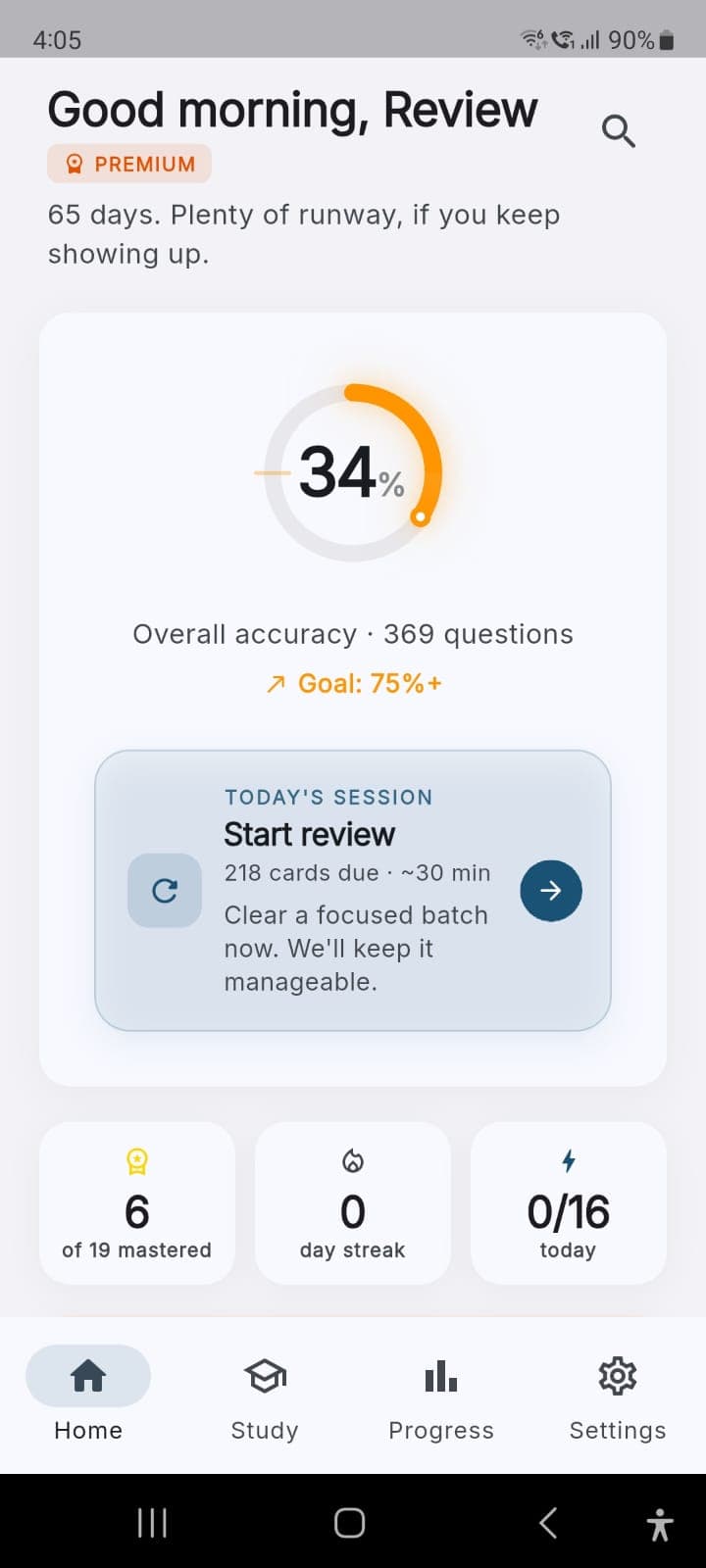
No. Pass Florida is exam preparation for the Florida sales associate state exam. It does not replace the 63-hour pre-license course, the course final, DBPR processes, Pearson VUE scheduling, post-license education, or continuing education.
Ready to clear the first gate, then drill the second?
Once you pass the course final, stop studying in chapter order and use mixed Florida practice to find whether you are ready for the state exam.
Passing the course final is real progress, but it is a course-completion gate, not a state-exam readiness signal. The candidates who move smoothly from the course final to the state exam plan two study cycles, not one: the application-mode repair loop before the course final, then a Florida-specific mixed-practice cycle before Pearson VUE.
Use the next practice set to prove what improved, not to repeat questions you already remember.
Take the free timed practice exam | Run the readiness calculator | Download Pass Florida
Methodology
This guide was written for Florida sales associate exam candidates preparing for a provider's 63-hour course final. The factual anchors come from primary sources: F.A.C. Rule 61J2-3.008 (70% pass threshold for the Commission-prescribed end-of-course examination, multiple-choice 4-answer-choice format, at least 70% application-oriented questions and no more than 10% knowledge-level questions, at least 100 items or 2 items per instruction hour, 1.8-minutes-per-item maximum, 30-day wait after failure, one retake within one year then course repeat), F.A.C. Rule 61J2-3.015 (course completion certificate to student + minimum 5-year school retention), DBPR Real Estate Associate Requirements for Licensure (75-point state exam passing score), the DBPR Real Estate Sales Associate Candidate Information Booklet (test-center admission document context), and Pearson VUE Florida Real Estate materials (state exam logistics).
The final-gate practice loop, the take-it-today readiness check, the course-final-vs-state-exam comparison framework, the missed-question repair pattern table, the math-setup-as-score-saver framing, the three-mark timed-set review system, the 7-day course-final sprint, the provider-questions matrix, the 30-day rescue-window study plan, the after-pass handoff checklist, the exam-style question with the four-choice trap pattern, and the what-not-to-do anti-pattern list are practical study patterns derived from common candidate mistakes, not DBPR, FREC, Pearson VUE, or course-provider rules.
This article does not promise a passing result on the Florida sales associate examination, does not promise course-final passage, and does not replace DBPR, FREC, Pearson VUE, your course provider, or qualified licensed Florida professional guidance. Outcomes depend on candidate preparation, current statutory and rule updates, and provider-specific exam policies.
Product note. Pass Florida publishes this guide and offers the exam-prep app linked on this page. We do not claim to use copied exam questions, promise passage, replace the 63-hour FREC-approved pre-license course, replace the provider's course final, or replace DBPR processes, FREC rule interpretation, Pearson VUE scheduling, course-provider records, or qualified licensed Florida professional guidance.
Sources
- F.A.C. 61J2-3.008, Pre-licensing Education for Broker and Sales Associate Applicants
- F.A.C. 61J2-3.015, Notices of Satisfactory Course Completion
- DBPR Real Estate Associate Requirements for Licensure
- DBPR Real Estate Sales Associate Candidate Information Booklet
- Pearson VUE Florida Real Estate and Appraisers Licensing Exams
- Pearson VUE Florida DBPR Real Estate and Appraiser Fact Sheet
This post is exam-prep content for Florida real estate sales associate candidates preparing for a provider's 63-hour course final. It summarizes the F.A.C. Rule 61J2-3.008 end-of-course examination framework (70% threshold, 30-day wait after failure, one retake within a year then course repeat), the practical study loop, and the handoff from course completion into state-exam practice, and is not a guarantee of passing the exam, not legal advice, not licensing advice, and not a substitute for DBPR, FREC, Pearson VUE, the course provider, or a qualified licensed Florida professional. Verify any rule, score threshold, retake limit, or provider exam policy against the primary source before relying on this article for a real licensing decision. Pass Florida is an educational study tool sold for one $39.99 purchase with no subscription.