QUICK ANSWER
A good Florida real estate exam readiness score is not one number by itself. Before booking, aim for at least 80% on timed mixed practice, no major topic below 70%, and fewer repeat misses from the same mistake pattern. The official passing score is 75, but 75 on easy or untimed practice is too thin a margin. Use readiness as a booking signal, not as an official DBPR rule.
EXAM PREP ONLY
This page gives exam-prep planning guidance for Florida sales associate candidates. The 80% practice target, 70% topic-floor target, and 60/75/80 gate are study-planning recommendations, not DBPR, FREC, or Pearson VUE rules. The official Florida sales associate passing score is 75 points. For scheduling, eligibility, accommodations, and admission rules, verify the current DBPR Candidate Information Booklet and Pearson VUE appointment details.
CHECK BEFORE YOU BOOK
Use your score pattern, not your mood.
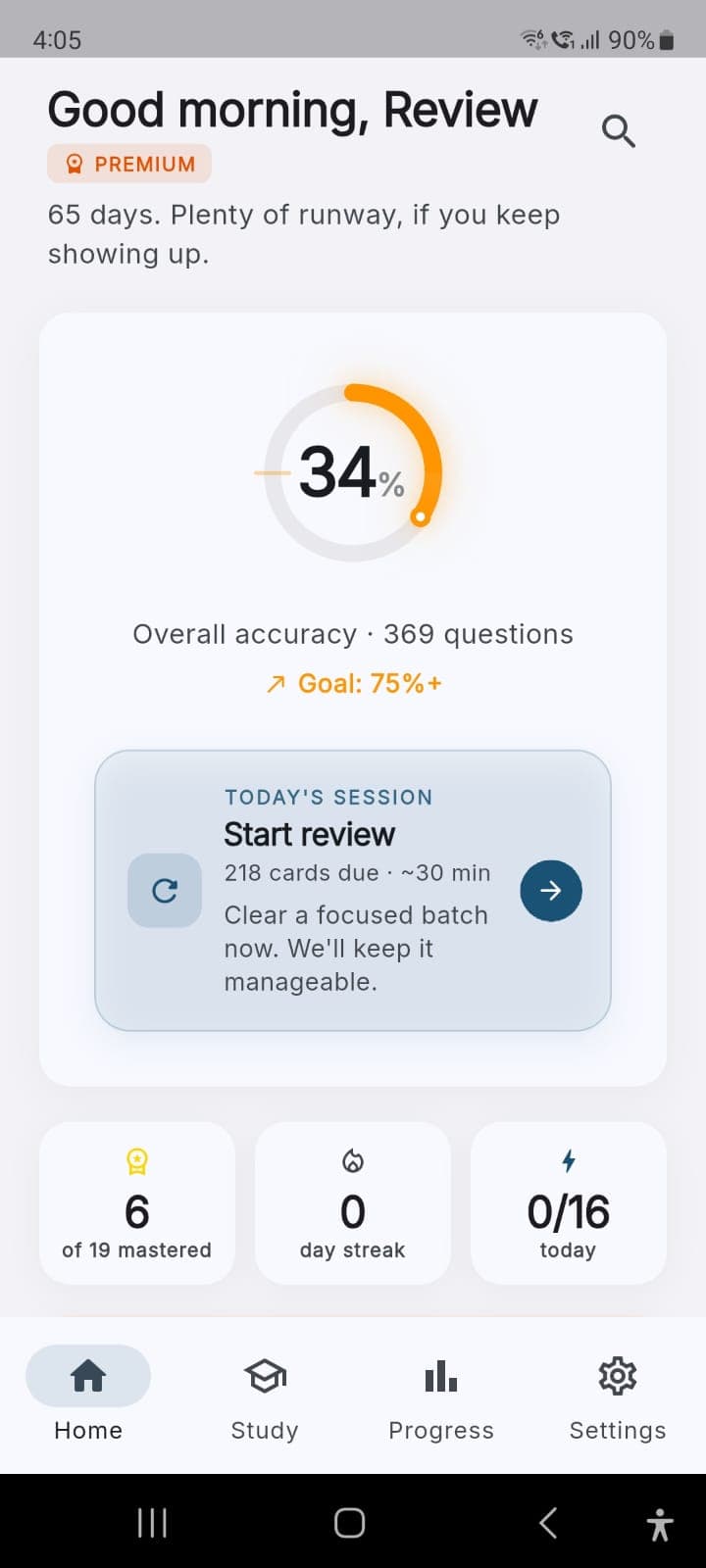
Start with the readiness calculator, then test the signal in a timed mixed set. If your weak areas keep repeating, Pass Florida gives you topic diagnostics, Trap Library review, Math Coach, and the full Florida-specific bank for one $39.99 purchase.
The Florida real estate exam is not passed by feeling ready. It is passed by answering enough questions correctly under timed, mixed conditions.
That distinction matters because many candidates mistake familiarity for readiness. They reread a chapter, recognize the vocabulary, and assume the score will follow. Then the practice test mixes escrow, agency, license law, math, and property rights together, and the score drops.
A readiness score should protect you from that false confidence.
Use it to answer one question:
If I had to sit for the Florida sales associate exam this week, would my current practice results hold up under real test conditions?
This guide explains how to read that signal, what score range to look for, when to book, when to wait, and what to fix if your score is close but unstable.
This article is educational exam prep for Florida sales associate candidates. It is not legal, licensing, brokerage, tax, lending, appraisal, title, or professional advice.
What this guide covers
- What a Readiness Score Should Measure
- The 60/75/80 Gate
- Why 75 Is Not the Best Practice Target
- The Three Signals That Matter
- Booking Decision Map
- How to Improve a Weak Readiness Score
- What to Do If Your Exam Is Soon
- What to Ignore
- Example Readiness Reviews
- FAQ
What a Readiness Score Should Measure
A useful readiness score should measure more than your average quiz score.
A Florida real estate exam readiness score should measure timed mixed performance, the lowest major topic score, and repeated miss patterns. A plain average can hide a weak area that still costs the exam.
For the Florida real estate exam, it should answer three practical questions:
| Signal | What it tells you | Why it matters |
|---|---|---|
| Timed mixed score | Whether you can pass when topics are blended | The official exam is mixed, not chapter-by-chapter |
| Topic floor | Whether one weak area can pull the score down | A strong average can hide a dangerous topic gap |
| Miss pattern | Why you are losing points | Definition misses need a different fix than wording misses |
The Florida Department of Business and Professional Regulation (DBPR) Candidate Information Booklet says the Florida sales associate exam has 100 multiple-choice questions, three and a half hours, and 19 content areas. That means a readiness score based only on short topic quizzes can be misleading.
Topic quizzes help you learn. Mixed practice tells you whether the learning survives exam conditions.
That is the difference.
The Short Version
Use this rule before booking:
Before booking, treat under 60% as foundation repair, 60% to 74% as repair mode, 75% to 79% as caution, 80% to 84% as usually bookable, and 85% or higher as a strong readiness signal.
| If your timed mixed score is | Booking signal | What to do next |
|---|---|---|
| Under 60% | Not ready | Rebuild fundamentals before taking more full exams |
| 60% to 74% | Repair mode | Fix the biggest repeat miss patterns first |
| 75% to 79% | Caution zone | Build a cushion before trusting the score |
| 80% to 84% | Usually bookable | Keep doing mixed review and logistics prep |
| 85% or higher | Strong signal | Maintain accuracy and avoid overstudying |
This is not an official DBPR scoring rule. It is a planning rule.
The official passing score is 75. But if your practice score is exactly 75, one bad stretch, one careless math setup, or one confusing agency question can erase the margin.
That is why 80 is the better readiness target.
The 60/75/80 Gate
The 60/75/80 Gate is a simple way to decide what your next study action should be.
The 60/75/80 gate turns practice scores into next actions: under 60 means rebuild, 60 to 74 means repair, 75 to 79 means add cushion, and 80 or higher means check stability before booking.
It works like this:
| Gate | Meaning | Best next action |
|---|---|---|
| 60 | You know enough to diagnose patterns | Start structured repair |
| 75 | You are near the official passing line | Add a cushion before booking confidently |
| 80 | You have a practical buffer | Move toward booking if weak areas are controlled |
The gate helps because different score ranges need different behavior.
Under 60, the answer is usually not more full practice exams. Full exams can show you that you are struggling, but they do not teach efficiently if the foundation is missing. You need smaller blocks, rule repair, flashcards, and focused topic sets.
From 60 to 74, you are in repair mode. You are close enough that every repeated miss pattern matters. This is where candidates can move quickly if they stop studying randomly.
From 75 to 79, you are close, but the score is fragile. This is the range where candidates often book too early because they technically touched the passing line once.
At 80 or higher, the question becomes stability. Can you hit that score more than once, under timed mixed conditions, without obvious topic collapse?
If yes, you are probably ready to book.
Why 75 Is Not the Best Practice Target
The official exam is graded on a passing score of 75. That does not mean 75 is the practice target you should trust.
A 75 practice score is thin because practice can be easier, untimed practice can inflate confidence, and one weak topic can erase the margin. An 80% timed mixed target gives a more practical buffer.
There are three reasons.
First, practice questions may be easier than the real mix. Even good prep questions may feel more familiar than the official exam because you have seen the app layout, explanation style, and topic language.
Second, untimed practice inflates confidence. A question you can solve in four quiet minutes at home may be a different question after two hours of testing.
Third, one weak topic can show up at the wrong time. The DBPR outline includes 19 content areas. You do not need perfection in every area, but you do need enough coverage that one topic does not knock the whole score under the line.
That is why the better pre-booking target is:
| Readiness marker | Target |
|---|---|
| Timed mixed practice | 80% or higher |
| Lowest major topic | Around 70% or higher |
| Math setup | No repeated formula confusion |
| Agency and disclosure questions | Stable under mixed review |
| Confidence | High confidence should usually match correct answers |
The point is not to chase a perfect score. The point is to avoid booking when your result depends on luck.
The Three Signals That Matter
1. Timed Mixed Score
The most important readiness signal is a timed mixed score.
Not a vocabulary quiz.
Not a chapter review.
Not a set of 10 questions on a topic you just studied.
A timed mixed score matters because the real exam does not label the topic for you. It makes you recognize the rule from the facts.
Use this structure:
| Practice format | What it is good for | What it cannot prove |
|---|---|---|
| Topic quiz | Learning one area | Full exam readiness |
| Flashcards | Fast recall | Fact-pattern judgment |
| Untimed mixed set | Accuracy repair | Timing control |
| Timed mixed exam | Booking decision | Every tiny weakness |
Your booking decision should lean on the last one.
2. Topic Floor
A high average can hide a weak topic.
For example, a candidate might average 82% overall but repeatedly miss escrow, agency duties, and math. That candidate may look ready on paper but still be exposed to high-value questions.
Track your lowest meaningful topic scores.
The goal is not equal strength everywhere. Some content areas are larger than others, and some topics simply matter more for exam performance. But if a topic keeps dropping below 65% to 70%, you should repair it before trusting the overall score.
Watch especially for these areas:
| Area | Why it can hurt readiness |
|---|---|
| Brokerage relationships | Similar terms create attractive wrong answers |
| Escrow rules | Deadlines and who holds the funds matter |
| License law | Small wording changes can change the answer |
| Math | Setup errors can waste time and points |
| Property rights | Estates, ownership, and encumbrances blur together |
| Financing | Candidates often memorize terms without recognizing use cases |
If one of these keeps breaking, your readiness score should be treated as weaker than the average suggests.
3. Confidence Calibration
Confidence calibration means checking whether your confidence matches your accuracy.
This matters because the most dangerous wrong answer is the one you choose quickly and confidently.
After a practice set, mark each missed question:
| Miss type | What it means |
|---|---|
| Low confidence, wrong | You knew it was weak |
| Low confidence, right | You may have guessed correctly |
| High confidence, wrong | This is the dangerous category |
| Changed from right to wrong | You may be overthinking stems |
| Math setup wrong | You need formula recognition, not more rereading |
High-confidence misses deserve special attention.
They usually reveal a false rule, a confused term pair, or a habit of answering before reading the full stem.
Fix those before booking.
Booking Decision Map
Use this map when you are deciding whether to schedule the Florida exam.
Book when recent timed mixed scores are stable near 80% or higher and no major topic is collapsing. Wait if one good score is surrounded by weaker results.
| Your situation | Recommendation |
|---|---|
| You have not taken a timed mixed practice exam | Do not use readiness score yet |
| Your best score is below 60 | Wait and rebuild fundamentals |
| You are scoring 60 to 74 | Wait unless a deadline forces you |
| You scored 75 once but usually score lower | Wait if possible |
| You are scoring 75 to 79 repeatedly | Book only if weak topics are stable and time is short |
| You are scoring 80+ repeatedly | Good booking signal |
| You are scoring 85+ but still studying heavily | Shift to maintenance and test-day prep |
The word "repeatedly" matters.
One good score can be noise. Two or three timed mixed scores in the same range tell you more.
If your scores look like 67, 72, 76, and 79, you are improving but not yet stable.
If your scores look like 81, 83, and 82, you have a much stronger booking signal.
The Best Pre-Booking Checklist
Before you book, you should be able to say yes to most of these:
- I have taken at least one timed mixed practice exam.
- My recent timed mixed score is near 80 or higher.
- My lowest major topic is not collapsing below 70.
- I can explain most misses in one sentence.
- I am not repeatedly missing the same agency, escrow, math, or license law pattern.
- I can finish a full practice session without rushing the last 20 questions.
- I know what ID, appointment, and test-center rules apply to my exam.
The last point is not a study issue, but it matters.
Pearson VUE handles Florida real estate exam scheduling for DBPR, and candidates are responsible for following appointment and test-center rules. A strong student can still create unnecessary stress by leaving logistics until the last day.
How to Improve a Weak Readiness Score
If your readiness score is weak, do not respond by studying everything again.
That is the slowest fix.
Instead, repair by miss pattern.
To improve a weak readiness score, sort misses by cause, fix the top two repeated patterns, then retest with mixed timed questions. Do not restart the whole course unless the foundation is missing.
Step 1: Sort Misses by Cause
After a practice set, put each miss into one bucket:
| Miss cause | Example | Fix |
|---|---|---|
| Definition | You did not know the term | Flashcard and short drill |
| Controlling fact | You missed the fact that changed the answer | Stem breakdown |
| Timing | You knew it but rushed | Timed sets and flag discipline |
| Math setup | You chose the wrong formula | Formula trigger card |
| Similar terms | You confused two concepts | Contrast card |
| Overthinking | You changed away from the correct answer | Review answer-change pattern |
This turns your score into a repair plan.
Step 2: Fix the Top Two Patterns
Do not try to fix six things in one night.
Pick the two patterns costing the most points.
For many Florida candidates, the first repair set is one of these:
| Pattern | Repair drill |
|---|---|
| Agency confusion | Compare transaction broker, single agent, and no brokerage relationship |
| Escrow deadline misses | Drill who holds funds, broker notice, and settlement steps |
| Math misses | Write the setup before calculating |
| License law misses | Build a timeline for application, education, post-license, renewal |
| Financing misses | Match loan type, lien priority, discount points, and qualifying terms |
The goal is not to feel better. The goal is to make the next mixed set behave differently.
Step 3: Retest Mixed
After repair, do not take another quiz on the same narrow topic and declare victory.
Take a mixed set.
The real test is whether you can recognize the repaired rule when the label is gone.
Use this loop:
- Take 20 to 30 focused questions on the weak area.
- Rewrite the missed rules in plain English.
- Take 25 mixed questions.
- Check whether the same miss pattern returns.
- Repeat only if the pattern is still active.
Once the pattern stops repeating, move on.
What to Do If Your Exam Is Soon
If your exam is within a week, your readiness score should guide triage.
This is not the time to rebuild the whole course.
If the exam is soon, use your readiness score for triage: under 60 means fundamentals, 60 to 74 means repair the biggest patterns, 75 to 79 means remove careless losses, and 80 or higher means protect the score.
If You Are Under 60
If the exam is optional or movable, consider rescheduling if allowed under the current Pearson VUE policy and appointment window.
If you cannot move it, focus on the biggest content areas and the easiest point recovery:
- Agency and brokerage relationships
- License law basics
- Escrow and trust account rules
- Core math formulas
- Property rights and ownership terms
Avoid marathon rereading. You need retrieval and recognition practice.
If You Are 60 to 74
You are close enough to improve, but you need discipline.
Use a daily pattern:
| Time block | Task |
|---|---|
| 30 minutes | Review the top miss pattern |
| 45 minutes | Focused questions |
| 45 minutes | Mixed timed questions |
| 20 minutes | Error log rewrite |
Do not add a brand-new prep system unless your current system is clearly broken. New tools can help, but switching late can also waste time.
If You Are 75 to 79
This is the caution zone.
Do not panic, but do not coast.
Your goal is to add a cushion by removing careless losses:
- Slow down on "except" and "most likely" wording.
- Write math setups before calculating.
- Do not change answers unless you can name the rule you missed.
- Review high-confidence misses first.
- Take one more timed mixed set before test day if you have time.
If You Are 80 or Higher
Protect the score.
At this stage, most candidates need less content cramming and more maintenance:
- One timed mixed set.
- One targeted weak-area repair.
- Light formula review.
- Test-day logistics.
- Sleep.
Overstudying late can turn stable rules into second-guessing.
What to Ignore
Not every number deserves attention.
Ignore these when deciding whether to book:
| Number | Why it can mislead |
|---|---|
| Best-ever topic quiz score | It may only show short-term memory |
| Average across old attempts | Early scores can drag the average down after you improved |
| Untimed score only | It does not test pacing |
| Flashcard streak | Recall is useful, but the exam is fact-pattern based |
| Time spent studying | Hours do not always equal point movement |
The cleanest readiness question is still:
What are my recent timed mixed scores, and why am I missing what I miss?
That question is much harder to fool.
Example readiness reviews
Candidate A: 84 Average, One Weak Topic
This candidate has recent scores of 82, 84, and 85 on timed mixed practice. The overall signal is strong. But escrow questions keep landing around 58%.
Booking decision: likely bookable, but escrow needs one focused repair block before test day.
Why: the overall score has cushion, but the weak topic is visible enough to fix.
Candidate B: 76 Once, Usually 68
This candidate scored 76 on one untimed practice exam but usually scores between 66 and 70 on mixed sets.
Booking decision: wait if possible.
Why: the 76 may be a peak score, not the true baseline.
Candidate C: 79 Twice, Math Misses Only
This candidate is scoring 78 and 79 on timed practice, with most missed points coming from commission, prorations, and tax calculations.
Booking decision: close, but repair math first.
Why: math mistakes are often setup mistakes. A short formula-focused plan may move the score above 80 quickly.
Candidate D: 87 Average, Very Anxious
This candidate is scoring 86 to 89 repeatedly but still feels unready.
Booking decision: book if logistics and eligibility are in order.
Why: anxiety is not the same as unreadiness. The score pattern is strong. Keep reviewing lightly and avoid burning out.
How Pass Florida uses this idea
Pass Florida's readiness tools are built around the same principle: a score only helps if it tells you what to do next.
The useful question is not just "What did I score?"
It is:
- Which topic is leaking points?
- Which wrong-answer pattern is repeating?
- Am I improving under mixed conditions?
- Is my confidence matched to accuracy?
- Is my score stable enough to book?
That is why a readiness score should sit next to diagnostics, topic review, trap practice, and timed sets. A single number is helpful. A number plus a repair path is much more useful.
CHECK THE SCORE SIGNAL
Know whether you are close, ready, or guessing.
Start with the diagnostic, practice the weakest Florida topics, and use timed mixed sets to prove the improvement before test day.
Related Exam Concepts
| Need | Use this next | Why |
|---|---|---|
| Score-report repair | Florida real estate exam score report study plan | Turns a failed attempt or weak diagnostic into a study map |
| Three-week rebuild | 21-day Florida real estate exam study plan | Turns readiness data into three weeks of repair, mixed practice, and timed proof |
| Timed mixed practice | Free Florida real estate practice exam | Tests whether your score holds under mixed timing |
| Full-length simulation | Full-length practice exam strategy | Shows when to use longer simulations without burning out |
| Trap wording | Florida real estate tricky questions strategy | Repairs EXCEPT, NOT, BEST, and wording losses |
| Math weakness | Florida real estate exam math formulas | Fixes setup errors before the next mixed set |
| Fast score lift | Raise your Florida real estate exam score 10 points | Helps if you are close but not stable |
| Booking decision | Pass-rate calculator | Converts your current pattern into a go, wait, or repair signal |
Frequently Asked Questions
What readiness score should I hit before booking the Florida real estate exam?
Aim for 80% or higher on recent timed mixed practice, with no major topic collapsing below about 70%. The official passing score is 75, but 80 gives you a more practical cushion.
Is a 75 practice score enough?
Maybe, but it is thin. A 75 is the official passing line, not a comfortable practice target. If your practice is untimed, familiar, or based on easier questions, build more cushion before booking.
Should I book if my readiness score is 70?
Usually not if you can wait. A 70 means you are close enough to improve, but still below the passing line. Use focused repair, then retest with mixed timed questions.
What if my topic scores are uneven?
Uneven topic scores are normal. The danger is a repeated weak area that keeps dropping far below the rest of your performance. Fix the lowest high-impact topic before trusting the average.
How many practice exams should I take before booking?
Take enough timed mixed practice to see a pattern. One score can be noise. Two or three recent timed mixed results are more useful for a booking decision.
Can a readiness score predict my official result perfectly?
No. A readiness score is a planning tool, not an official prediction. Test-day conditions, question mix, timing, and nerves still matter. Use the score to make a better decision, not to treat the outcome as certain.
Should I reschedule if my score drops right before the exam?
Look at the pattern, not one bad set. If the drop repeats, or if it reveals a major weak area, consider whether rescheduling is allowed and practical. If it is one bad session after a run of strong scores, focus on rest and targeted review.
Methodology
It uses the official DBPR Candidate Information Booklet for exam structure and Pearson VUE for scheduling context. The readiness thresholds in this article are exam-prep planning recommendations, not DBPR, FREC, or Pearson VUE rules.
The article does not reproduce official exam questions and should not be used as legal, licensing, brokerage, tax, lending, appraisal, title, or professional advice.
For current official requirements, verify with DBPR, the Florida Real Estate Commission (FREC), Pearson VUE, your pre-license provider, and any qualified professional before making licensing or real-world practice decisions.
Product note. Pass Florida publishes this guide and offers the exam-prep app linked on this page. We do not claim to use copied exam questions, guarantee passage, or provide legal, licensing, brokerage, or testing-policy advice.
This post is exam preparation content for the Florida Real Estate Sales Associate exam. It is not legal, tax, financial, lending, appraisal, brokerage, insurance, title, closing, or professional advice. For real-world decisions, verify current requirements with the official source or consult a qualified licensed Florida professional.