QUICK ANSWER
To get a real estate license in Kissimmee, you follow the Florida sales associate path: be at least 18, have a high school diploma or equivalent, have a Social Security number, complete a Florida-approved 63-hour pre-license course unless exempt, submit the DBPR RE 1 application, complete Livescan fingerprints, pass the Pearson VUE sales associate exam, then activate the license with a Florida broker.
Kissimmee does not have its own city license. The license is statewide. What is different in Osceola County is the market: Walt Disney World drives the regional economy, vacation-rental resort communities (Reunion, ChampionsGate, Storey Lake, Solterra, Windsor at Westside, and others) shape investor demand, short-term rental registration and Tourist Development Tax (TDT) rules are property-specific, Celebration is a separate Disney-built community with its own covenants, St. Cloud and Poinciana are distinct submarkets, and Kissimmee is home to one of the largest Puerto Rican communities on the US mainland (significantly expanded after Hurricane Maria in September 2017).
VERIFY BEFORE RELYING
The Osceola County regulatory and tourism environment (Kissimmee and Osceola short-term rental zoning, business tax receipts, TDT collection, individual resort-community HOA rental allowances, Central Florida Tourism Oversight District (CFTOD) jurisdiction over former Reedy Creek property, insurance eligibility, and post-storm permit status) changes frequently and is property-specific. This guide is an editorial overview, not transaction guidance. Before relying on a specific claim, check with your sponsoring broker, the relevant Osceola County or Kissimmee planning office, the specific resort-community HOA, a licensed Florida property and casualty agent who writes Central Florida risk, and qualified counsel.
What this guide covers
- How to get a real estate license in Kissimmee: the six-step path
- Kissimmee real estate license cost snapshot
- Step 1: Confirm eligibility and your Kissimmee path
- Local market intelligence: Kissimmee ecosystem map
- Where new agents can start in Kissimmee
- Walt Disney World as anchor: how Disney shapes Osceola real estate
- Reedy Creek and the Central Florida Tourism Oversight District (CFTOD)
- Vacation-rental resort communities: Reunion, ChampionsGate, and the rest
- Short-term rental registration, TDT, and the verification habit
- Celebration, St. Cloud, Poinciana, and Old Town Kissimmee distinctions
- Puerto Rican community and Hurricane Maria migration context
- Lake Tohopekaliga and Osceola flood and storm context
- Steps 2 to 4: course, application, fingerprints, and exam
- What Kissimmee actually rewards after licensing
- First-year reality in Kissimmee
- Step 5: Find a sponsoring broker
- Step 6: Activate and start your first 90 days
- Mistakes Kissimmee applicants make
- FAQ
KISSIMMEE DECISION MAP
| Your situation | Best next move | Watch out for |
|---|---|---|
| You want vacation-rental or investor clients | Learn resort-community HOA documents, Osceola short-term rental registration, TDT collection, and property-management boundaries with broker supervision | Short-term rental rights are not universal; they must be verified property by property |
| You want local workforce or first-time buyers | Learn financing, inspections, appraisals, affordability, commute, and buyer education | Local buyers need a different strategy than investor clients |
| You want St. Cloud, Poinciana, or new-construction clients | Learn Osceola growth patterns, commute, CDD vocabulary, and community comparison | Kissimmee, St. Cloud, Celebration, and Poinciana are not one market |
| You want Spanish-speaking or Puerto Rican community sphere | Build genuine relationships, accurate Spanish follow-up, and English document discipline | Verbal fluency does not replace certified translation for binding documents |
| You are choosing a broker | Ask whether new agents work investors, local buyers, relocation, vacation communities, or open houses first | High-lead-volume offices still need strong supervision |
If you searched "how to get a real estate license in Kissimmee," the state checklist is only the first layer. You also need to know when to apply, when to fingerprint, how to prepare for Pearson VUE, which broker model gives a beginner real supervision, and which local lane is realistic in year one.
The official license is the same Florida sales associate license you would get anywhere in the state. The local career is different. Kissimmee is shaped by Walt Disney World, the cluster of vacation-rental resort communities along the US-192 and I-4 corridors, the Central Florida Tourism Oversight District (CFTOD) that replaced Reedy Creek in 2023, a deep Puerto Rican and broader Hispanic community, a Disney-built master-planned community (Celebration) that is technically separate from Kissimmee, the growing St. Cloud suburb, and lakefront geography anchored by Lake Tohopekaliga.
This guide separates official Florida licensing requirements from Kissimmee career strategy so you can avoid stale fee claims, casual vacation-rental advice, and the common mistake of passing the exam without a first-year plan.
How to get a real estate license in Kissimmee: the six-step path
Kissimmee does not issue a separate real estate license. To work as a sales associate in Kissimmee, complete Florida's 63-hour course, apply through DBPR, submit fingerprints, pass Pearson VUE, then activate under a Florida broker.
THE SIX STEPS
Florida sales associate applicants must be at least 18, have a high school diploma or equivalent, have a Social Security number, and answer DBPR background questions accurately.
Use a Florida-approved pre-license provider. This is pre-license education, not exam prep and not continuing education.
DBPR lets you apply before the course is complete. Valid course completion proof is required before you sit for the state exam.
Use an FDLE-registered Livescan provider immediately after submitting the application. Keep the receipt and transaction information.
The Florida sales associate exam is computer based, closed book, 100 multiple-choice questions, and 3.5 hours. You need 75 points or higher to pass. Pearson VUE has multiple Orlando-area test centers within easy drive of Kissimmee.
A sales associate works under a Florida broker. Passing the exam is not the same as being activated to perform licensed services for compensation.
Kissimmee real estate license cost snapshot
Kissimmee candidates pay the same statewide Florida licensing costs as other applicants, then add local startup costs such as broker fees, association or MLS access, E&O, lockbox, signs, transportation, and savings for uneven commission timing.
The state license is statewide, but your planning budget should include both official licensing costs and local startup costs.
| Cost item | 2026 planning amount | Kissimmee note |
|---|---|---|
| DBPR RE 1 application | $62.75 | Listed on the current DBPR sales associate application. Verify inside DBPR before paying. |
| Electronic fingerprints | Often about $50 to $80 | Vendor pricing varies. Use an FDLE-registered Livescan provider and keep the receipt. |
| Pearson VUE sales associate exam | $36.75 per attempt | Listed on Pearson VUE's Florida real estate fact sheet. Pay again if you retake. |
| 63-hour pre-license course | Provider-dependent | Make sure the provider is Florida-approved before you enroll. |
| Exam prep | Optional | Pass Florida is exam prep only. It does not replace the required 63-hour course. |
| Broker, association, MLS, Supra, E&O, lockbox, and tools | Varies widely | Ask your Kissimmee-area broker what is required before your first closing. |
Kissimmee-area agents most commonly join the Osceola County Association of REALTORS (OSCAR) for local board coverage, or the Orlando Regional REALTOR Association (ORRA) if the broker's coverage extends north into the Orlando metro. MLS access is tied to the broker's membership setup. Do not guess on association dues, MLS access, lockbox costs, forms access, or board membership. Ask the broker exactly what is required before you join.
Step 1: Confirm eligibility and your Kissimmee path
Confirm the statewide Florida eligibility rules first, then choose a realistic Kissimmee first-year lane based on broker support, local demand, and the type of clients you can serve repeatedly.
Then Kissimmee adds local decisions that do not appear on the state checklist.
| Local decision | Why it matters in Osceola County |
|---|---|
| First niche | Vacation-rental resort communities, local workforce buyers, Puerto Rican / Hispanic sphere, Celebration, St. Cloud, Poinciana, and investor clients each require different support. |
| Broker model | Team, franchise, vacation-rental specialist, investor, relocation, first-time buyer, bilingual, and local residential offices train new agents differently. |
| Local risk questions | HOA short-term rental allowances, Osceola / Kissimmee zoning, DBPR vacation-rental licensure, business tax receipts, TDT collection, CDD, insurance, financing, international and remote-buyer logistics, inspections, and CFTOD jurisdiction can appear early. |
| Test timing | Pearson VUE has multiple Orlando-area test centers within easy drive of Kissimmee; check the live appointment list inside Pearson VUE after DBPR approval. |
Local market intelligence: Kissimmee ecosystem map
Kissimmee rewards focused local competence more than a generic license. Pick one repeatable starter lane, learn its documents and client questions, and work under broker supervision until the pattern is familiar.
| Local lane | What to learn early | Where new agents often start |
|---|---|---|
| Vacation-rental resort communities (Reunion, ChampionsGate, Storey Lake, Solterra, Windsor at Westside, Encore, Windsor Hills/Palms) | HOA documents, individual community STR allowances, CDD, expense assumptions, remote buyers, management infrastructure | Mentor-supported investor analysis and buyer tours |
| Local workforce and first-time buyers | Financing, inspections, appraisals, commute, affordability, repair negotiations | Open houses and first-time buyer education |
| Puerto Rican and Hispanic community sphere | Spanish-speaking follow-up, English document discipline, cultural respect, community relationships | Sphere and referral systems |
| Poinciana affordability lane | Payment sensitivity, commute, inspections, local services, buyer expectations | Buyer consult practice and open houses |
| St. Cloud growth corridor | New construction, CDD and HOA vocabulary, commute, family relocation, lot and builder questions | Builder inventory tours and buyer support |
| Celebration relocation | Disney-era covenants, polished buyer process, association rules, out-of-area follow-up | Team support and relocation follow-up |
| Old Town Kissimmee historic and downtown | Older inventory, downtown revitalization, walkability, parking | Open houses and listing prep |
| Lake Tohopekaliga lakefront | Waterfront questions, flood, insurance, dock and seawall, fishing-economy buyers | Senior-agent shadowing |
| International and investor clients | Remote communication, funds and lender coordination, tax and legal referral boundaries, documentation habits | Broker-reviewed buyer education |
Where new agents can start in Kissimmee
| Starting path | How it works in Kissimmee |
|---|---|
| Fastest practical start | Open houses and buyer consults for local workforce and first-time buyers |
| Best vacation-rental investor entry | Apprentice with a resort-community specialist on Reunion, ChampionsGate, Storey Lake, or similar deals |
| Best growth-corridor lane | Tour St. Cloud, Poinciana, and new-construction communities with a mentor |
| Best bilingual lane | Build Spanish-speaking sphere relationships with consistent accurate follow-up and clear English document handling |
| Best Celebration / relocation lane | Build a remote-tour and relocation follow-up system for out-of-area buyers |
| Best part-time fit | Weekend open houses plus weekday follow-up, if your broker covers urgent offers and investor questions |
Walt Disney World as anchor: how Disney shapes Osceola real estate
Walt Disney World Resort is the single most important factor shaping Osceola County real estate. Most other local segments (hospitality, vacation rentals, retail, transportation, employment, school enrollment, infrastructure) sit downstream of Disney's footprint, even when individual transactions are not directly Disney-related.
Practical implications for a new agent:
- Tourism corridors (US-192, I-4 from Exit 64 / SR 535 westward, SR 429 / Western Beltway corridor) concentrate vacation-rental inventory, hotels, and visitor-services demand.
- Resort community geography (Reunion, ChampionsGate, Storey Lake, Solterra, Windsor at Westside, Encore Resort, Windsor Hills, Windsor Palms, and many others) is anchored by proximity to Disney's main gates.
- Cast Member housing demand drives a meaningful share of local workforce rental and starter-buyer activity. Disney employs tens of thousands in the broader Orlando area.
- Tourism seasonality (peak holiday and summer demand, plus event weeks) affects vacation-rental income projections and turnover patterns.
- Tourist Development Tax (TDT) revenue funds Osceola tourism infrastructure. STR owners and managers must make sure the correct TDT setup, collection, and remittance process is in place.
A new Kissimmee agent should treat Disney as the background condition for nearly every conversation: even buyers who do not work for Disney or rent to tourists are buying into a market shaped by Disney's presence.
Reedy Creek and the Central Florida Tourism Oversight District (CFTOD)
For decades, Walt Disney World property was governed by the Reedy Creek Improvement District, a special-purpose government created in 1967 that handled local services on Disney property. In 2023, the Florida Legislature renamed and restructured that district as the Central Florida Tourism Oversight District (CFTOD) under ch. 2023-5, Laws of Florida. The restructured district has a state-appointed board with oversight of the former Reedy Creek property in Orange and Osceola Counties.
CFTOD was the subject of significant litigation and political dispute after the 2023 transition. In 2024, Disney and CFTOD reached a settlement in the state-court dispute, and the CFTOD board approved a new development agreement with Walt Disney Parks and Resorts. For a new agent, the practical implications are:
- Most Disney property remains in CFTOD jurisdiction rather than ordinary Orange or Osceola County jurisdiction for permitting, infrastructure, and certain services.
- Property tax base composition on and around Disney property is affected by the transition.
- Infrastructure spending decisions on former Reedy Creek property now run through CFTOD.
- Future board, planning, development-agreement, and infrastructure decisions could still shift the framework. Treat all CFTOD facts as current rather than memorized.
Do not turn CFTOD into a political conversation with clients. Refer regulatory, development-agreement, tax-base, and jurisdiction questions to qualified counsel or the appropriate public office.
Vacation-rental resort communities: Reunion, ChampionsGate, and the rest
Osceola County contains a substantial cluster of vacation-rental resort communities. These are master-planned communities designed largely for short-term rental investor ownership, with amenity packages (pools, restaurants, golf in some, water parks in some) and HOA infrastructure built to support nightly and weekly rentals.
| Community (selected) | What it is | What's distinctive |
|---|---|---|
| Reunion Resort | Large master-planned resort community south of Kissimmee | Golf-anchored; substantial vacation home inventory; CDD-financed infrastructure |
| ChampionsGate | Master-planned community on the Polk-Osceola border, Disney corridor | Golf and resort amenities; high vacation-rental share |
| Storey Lake | Vacation-rental community near Disney | Newer build; substantial vacation home and townhome inventory |
| Solterra Resort | Master-planned vacation-home community | Resort amenities; vacation-rental orientation |
| Windsor at Westside | Vacation-rental community in the Westside corridor | Vacation-home inventory targeted at investor buyers |
| Encore Resort | Vacation-home community | Resort amenities and STR-oriented design |
| Windsor Hills and Windsor Palms | Older vacation-rental communities | Established STR inventory; mature HOA practice |
Other resort communities exist; this is not a comprehensive list. Each community has its own HOA bylaws, CC&Rs, allowed rental terms, and amenity-fee structure. A community that "allows nightly rentals" today may have different rules after a future HOA vote. Confirm the current bylaws and any pending amendments before representing a buyer.
What a new agent should not do:
- Promise that any property is "nightly rental ready" without reading the actual HOA bylaws.
- Quote nightly rates or projected rental income from another listing's marketing without independent verification.
- Treat all resort communities as a single product.
What a new agent should do:
- Read the HOA bylaws, CC&Rs, and any rental-restriction amendments.
- Confirm any required STR registration and Tourist Development Tax setup.
- Refer the buyer to a licensed property manager for income projections.
Short-term rental registration, TDT, and the verification habit
Short-term rentals are subject to a layered set of requirements in Osceola County:
- State law. Florida preemption under F.S. 509.032(7) limits some local bans on existing short-term rentals but does not preempt all local regulation. Florida vacation-rental licensure through the Department of Business and Professional Regulation (DBPR) Division of Hotels and Restaurants may apply.
- County and municipal regulation. Osceola County's STRPD guidance tells owners to verify zoning, apply for the DBPR vacation-rental license when applicable, and obtain a Local Business Tax Receipt through the Osceola County Tax Collector. City of Kissimmee properties may also require City business tax receipt review. Verify current requirements with the relevant jurisdiction before quoting rules to a client.
- Tourist Development Tax (TDT). The Osceola County Tax Collector describes TDT as applying to short-term rentals of less than 180 days and currently shows a 6 percent rate. Verify the current rate and filing process with Osceola County before quoting it.
- Florida state sales tax. State sales tax also applies to short-term rentals.
- HOA and community covenants. Many communities allow short-term rentals; some allow only longer-term rentals; some have minimum stay requirements; some restrict commercial use entirely. The HOA bylaws control regardless of state preemption.
The safe operating principle is: do not represent a property as "Airbnb ready" or "nightly rental ready" without independently verifying state, county, municipal, HOA, and TDT compliance. Route specific tax, license, business tax receipt, zoning, and income-projection questions to a licensed Florida property manager, the relevant Osceola or Kissimmee tax / planning office, and qualified counsel.
Celebration, St. Cloud, Poinciana, and Old Town Kissimmee distinctions
"Kissimmee" is often used loosely to mean all of Osceola County. A new agent should know the distinctions.
| Submarket | What it is | What's distinctive |
|---|---|---|
| City of Kissimmee | Incorporated municipality, county seat of Osceola County | Mix of historic downtown (Old Town), residential, and tourist-corridor inventory |
| Old Town Kissimmee | Historic downtown district within the city | Older inventory, walkable downtown, ongoing revitalization, the historic Old Town attraction is a separate retail / entertainment district |
| St. Cloud | Separate incorporated municipality east of Kissimmee | One of the fastest-growing Florida cities; substantial new construction; family-buyer focus |
| Celebration | Disney-developed master-planned community (technically unincorporated Osceola, separate from City of Kissimmee) | Distinct architectural standards, tight HOA, Disney-era covenants, separate identity from Kissimmee |
| Poinciana | Large unincorporated planned community spanning Osceola and Polk counties | Affordability, commute, mix of resale and newer inventory |
| Lake Nona crossover | Largely Orange County but commute-adjacent for some Kissimmee buyers | New construction, medical / tech corridor, Orange County tax base |
Confirm which municipality or unincorporated area every listing falls under before quoting taxes, code enforcement, building permits, zoning, or police/fire jurisdiction. Kissimmee, St. Cloud, Celebration, and Poinciana behave very differently.
Puerto Rican community and Hurricane Maria migration context
Kissimmee and broader Osceola County are home to one of the largest Puerto Rican communities on the United States mainland. Migration from Puerto Rico to Central Florida has been steady for decades and expanded significantly after Hurricane Maria struck Puerto Rico on September 20, 2017 as a Category 4 hurricane, causing catastrophic destruction and prompting an estimated tens of thousands of Puerto Ricans to relocate to Central Florida.
For a new agent, the practical implications are:
- Spanish is a working language across much of Osceola County, especially in Kissimmee proper.
- Verbal Spanish fluency does not equal document accuracy. Florida real estate contracts are binding English-language documents. Use certified translation for material disclosures and refer the client to bilingual counsel for legal questions.
- Cultural respect matters more than performative outreach. Show up consistently in community spaces (churches, businesses, community organizations) without treating relationships as a lead funnel.
- Fair housing protected classes (race, color, religion, sex, familial status, national origin, disability under federal law) apply to advertising, steering, and showing decisions. Avoid steering even when well-intended.
- The Puerto Rican community is not monolithic. Long-term Central Florida Puerto Rican families, post-Maria arrivals, and second-generation Puerto Rican Americans have different histories and expectations. Listen first.
Broader Hispanic communities (Cuban-American, Dominican, Venezuelan, Mexican-American, Central American) are also significant in Osceola County. Brazilian (Portuguese-speaking) buyers are a meaningful international buyer segment, particularly in vacation-rental resort communities.
Lake Tohopekaliga and Osceola flood and storm context
Lake Tohopekaliga (Lake Toho) is the largest lake in Osceola County and a defining feature of Kissimmee geography. The lake supports a meaningful lakefront residential and fishing-economy submarket.
Osceola County is inland, so it does not face direct Gulf or Atlantic surge. It does face hurricane wind and inland flooding. Relevant recent storms include:
- Hurricane Charley (August 13, 2004). Category 4 landfall at Captiva Island; tracked diagonally across Central Florida including Osceola, causing severe wind damage.
- Hurricane Ian (September 28, 2022). Category 4 landfall on the southwest Florida coast, then crossed Central Florida; caused significant Osceola wind, flooding, and infrastructure damage despite inland location.
- Hurricane Irma (September 2017). Tracked through Central Florida; caused widespread Osceola County wind damage.
The Florida insurance market dynamics affect Osceola too. Wind mitigation reports (OIR-B1-1802), 4-point inspections, roof age, claim history, building age, and Citizens or private-market eligibility can all matter for older homes and investor properties. Some Osceola parcels, especially lakefront and low-lying corridors, are in FEMA flood zones. Route all coverage, eligibility, and pricing questions to a licensed Florida property and casualty agent.
Steps 2 to 4: course, application, fingerprints, and exam
These steps are statewide. Kissimmee does not have a separate course, application, fingerprint rule, or licensing exam. Use the complete Florida licensing guide for the current requirements, sequence, forms, and official sources.
For planning, keep the workflow simple:
- Complete a Florida-approved 63-hour pre-license course unless DBPR confirms that an exemption applies to you.
- Submit DBPR Form RE 1. DBPR allows you to apply while the course is still in progress, but you need valid proof of completion before the state exam.
- Complete electronic fingerprints using the real estate ORI listed by DBPR. Keep the receipt and make sure your name and identifying details match your application.
- After authorization, schedule the statewide sales associate exam through Pearson VUE. Confirm the available test center and appointment in your account because locations and seats can change.
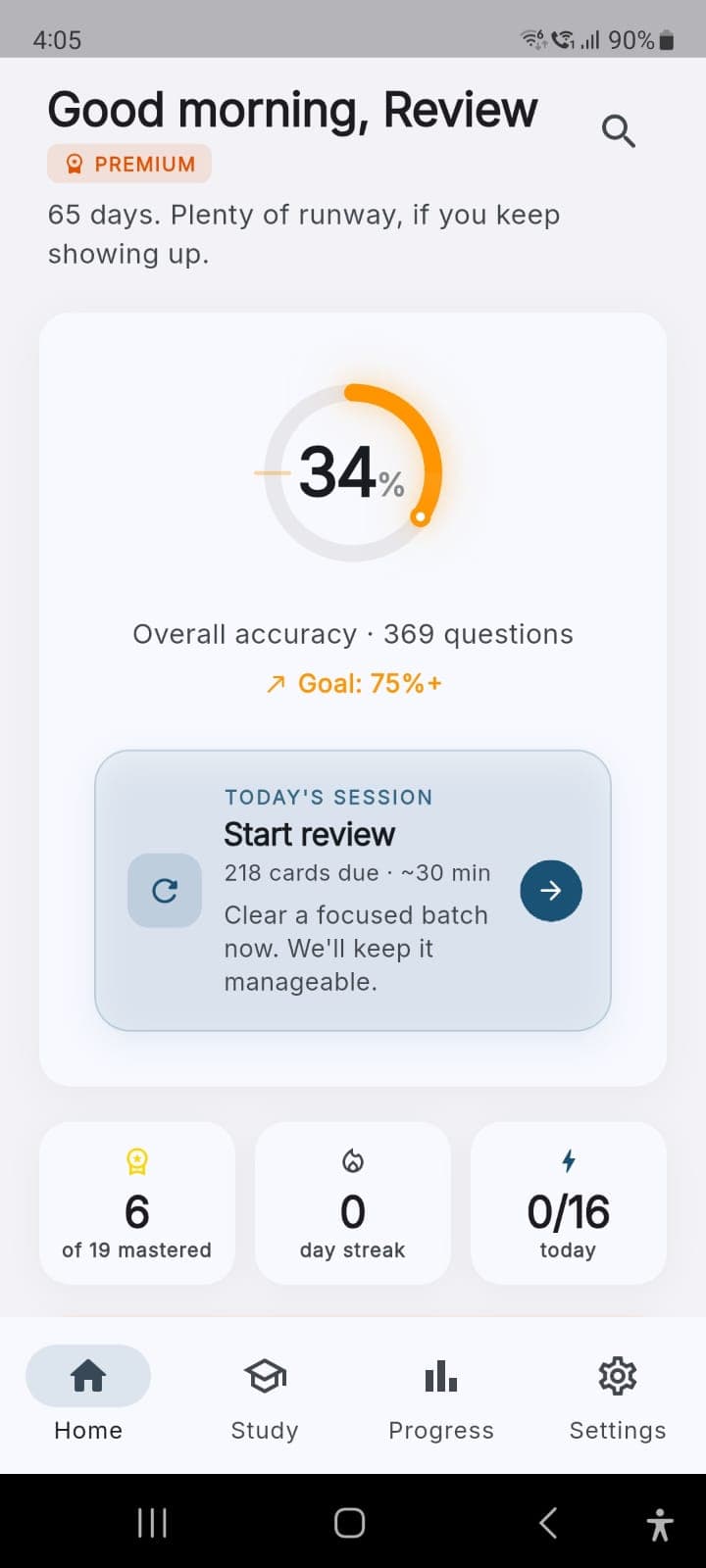
Use the waiting time to prepare across the full DBPR outline. The 19-topic exam map, Florida math formulas guide, and fingerprint delay checklist cover the details without repeating the same statewide material in every city guide.
KISSIMMEE EXAM PREP
Prepare for the statewide exam, then apply the license locally.
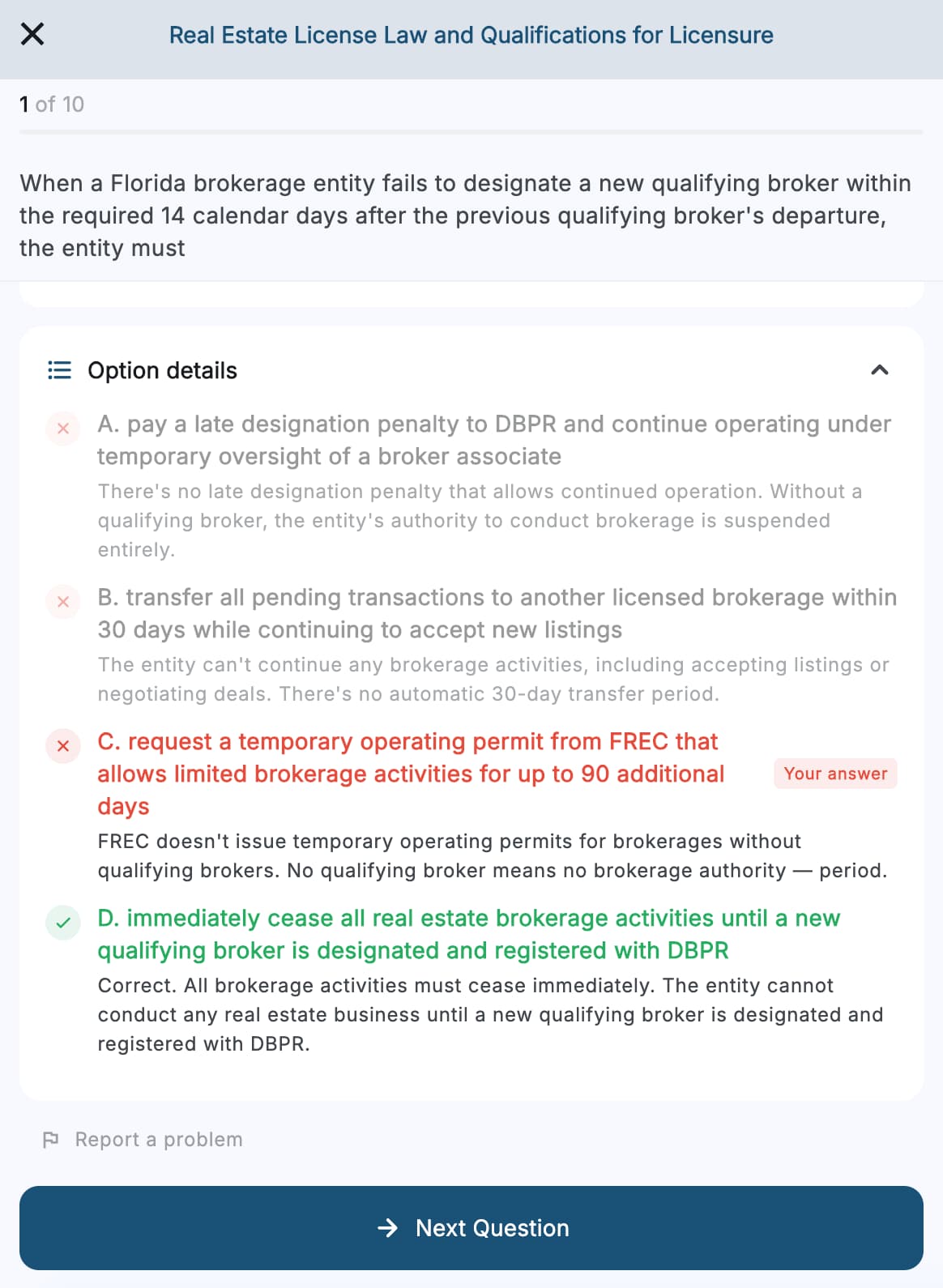
Use Florida-specific practice and a timed readiness check before booking your attempt.
What Kissimmee actually rewards after licensing
After licensing, Kissimmee rewards supervised repetition, local document discipline, safe routing of legal and risk questions, consistent follow-up, and a first-year lane that fits the local market.
| What the market rewards | What that means in practice |
|---|---|
| Jurisdiction precision | Rental rules, community restrictions, and HOA documents vary by community and change |
| Investor math discipline | Rental projections require expenses, vacancy, financing, management, taxes, insurance, HOA fees, and restrictions |
| Local buyer empathy | Workforce, first-time, and Puerto Rican community buyers need process education, not investor-market assumptions |
| Bilingual trust | Spanish-speaking sphere is meaningful; document accuracy and certified translation are non-negotiable |
| Remote communication | Many investor and international clients are out of area |
| Disney literacy | Resort-corridor dynamics, Cast Member commute, and CFTOD context shape conversations |
First-year reality in Kissimmee
New agents often ask whether they can start with vacation rentals, international investors, bilingual sphere, or part-time work. The honest answer is: sometimes, but only with a realistic system.
| Reality | What to expect |
|---|---|
| Income reality | Most new agents should expect uneven commission timing and several months before a first closing unless they join a team or have a warm sphere |
| Lead generation | Open houses, buyer education, team leads, investor-support tasks, bilingual sphere, relocation follow-up, and community tours are more realistic than broad investor branding |
| Broker support | Ask who reviews HOA, STR registration, TDT, property-management, investor math, CFTOD, CDD, financing, insurance, and international-client questions |
| Part-time viability | Possible if your lane is narrow and your broker covers weekday offers, inspections, and document questions |
Step 5: Find a sponsoring broker
Kissimmee candidates should choose a sponsoring broker based on beginner training, contract review, first-transaction supervision, local market support, lead systems, and startup costs, not only commission split.
A Florida sales associate works under a broker. For a new agent, this choice affects training, file review, fees, lead access, transaction supervision, and how quickly you learn the local market.
Ask these before you sign.
| Broker interview question | Why it matters |
|---|---|
| Who reviews my first contracts before they go out? | New agents need supervision before client-facing mistakes happen. |
| How many brand-new agents did you train last year? | Recruiting beginners is not the same as training them. |
| What costs are due before my first closing? | Association, MLS, E&O, signs, lockbox, desk fees, tech, and marketing can add up. |
| Do new agents start with local buyers, vacation communities, investor leads, bilingual sphere, or open houses? | Your first lane should be specific. |
| Who reviews STR registration, TDT, HOA, CDD, property-management, and investor-math questions? | Kissimmee clients ask these early. |
| Do you have systems for remote, international, or Spanish-speaking buyers? | Many buyers are not local full time. |
| How do you handle resort-community HOA review and post-storm permit questions? | These can kill deals late. |
| Can I support an investor or vacation-rental specialist first? | Complex niches need apprenticeship. |
Use how to find a sponsoring broker in Florida before signing.
Step 6: Activate and start your first 90 days
After passing, activate under a Florida broker before performing licensed services. Use the first 90 days to learn systems, pick one Kissimmee lane, build supervised reps, and turn follow-up into appointments.
After you pass, activate with your sponsoring broker before performing licensed services for compensation. Then treat the first 90 days as a practical training sprint.
FIRST 90 DAYS
MLS, forms, file review, showing rules, E&O, compliance, lead process, and who answers live transaction questions.
Choose one local lane from the ecosystem map. One repeatable lane beats vague ambition.
Host open houses, practice buyer consultations, review HOA documents, tour communities, and ask your broker to review hard questions.
Track every lead, schedule next steps, ask for appointments, and keep your broker involved before live questions become client problems.
FIRST RENEWAL WARNING
After your license is issued, do not confuse activation with renewal compliance. DBPR's real estate associate requirements say sales associates must complete a Florida Real Estate Commission (FREC)-approved 45-hour post-licensing course before the initial sales associate license expires. This is separate from the 63-hour pre-license course and separate from ordinary continuing education.
If you already passed, use what to do after passing the Florida real estate exam.
Mistakes Kissimmee applicants make
AVOID THESE
- Waiting until the course is finished to submit the DBPR application.
- Doing fingerprints before understanding DBPR's sequence and provider requirements.
- Treating the course final as proof that Pearson VUE will feel easy.
- Scheduling the exam without checking ID match, course certificate validity, and current Pearson VUE availability.
- Choosing a broker by commission split before asking who reviews first contracts.
- Promising any resort-community property is "nightly rental ready" without reading the HOA bylaws and verifying STR registration / TDT setup.
- Quoting projected vacation-rental income without referring to a licensed property manager for independent verification.
- Treating Kissimmee, Celebration, St. Cloud, and Poinciana as a single market.
- Turning CFTOD into a political conversation instead of a jurisdiction and due-diligence issue.
- Steering bilingual or Puerto Rican community buyers toward or away from specific neighborhoods, even with good intent.
- Giving legal, tax, lending, insurance, rental, HOA, CDD, immigration, property-management, or investment advice outside your role.
- Forgetting that Pass Florida is exam prep, not a 63-hour pre-license course and not continuing education.
Related exam and licensing concepts
| If you need help with | Read this next |
|---|---|
| Full statewide path | How to get a Florida real estate license |
| Timeline and delays | How long it takes to get licensed in Florida |
| Costs | Florida real estate license cost |
| Test-center planning | Florida Pearson VUE real estate testing centers |
| Fingerprint delays | Florida real estate fingerprints delay |
| Course certificate expiration | Florida real estate course certificate expired |
| Exam topics | Florida real estate exam 19 topics |
| Math formulas | Florida real estate exam math formulas |
| Broker choice | Find a sponsoring broker in Florida |
FAQ
How long does it take to get a real estate license in Kissimmee?
Most first-time candidates should plan around 10 to 16 weeks. The timeline depends on course pace, DBPR application review, fingerprints, exam readiness, Pearson VUE availability, and broker activation.
Is there a separate Kissimmee real estate license?
No. You receive a Florida real estate sales associate license. Kissimmee affects your local career strategy, broker fit, and first niche, but not the license itself.
Can I apply to DBPR before finishing the 63-hour course?
Yes. DBPR says the course is not required at application submission. You still need valid proof of course completion before sitting for the state exam.
Where do Kissimmee candidates take the Florida real estate exam?
Pearson VUE administers the Florida real estate exam. Multiple Orlando-area test centers are within easy drive of Kissimmee. After DBPR approval, check current Pearson VUE seat availability in your account. Test-center details and available appointments can change.
What are the major vacation-rental resort communities near Kissimmee?
Selected examples include Reunion Resort, ChampionsGate, Storey Lake, Solterra Resort, Windsor at Westside, Encore Resort, Windsor Hills, and Windsor Palms. Each has its own HOA bylaws, CC&Rs, allowed rental terms, amenity-fee structure, and CDD context. Confirm current bylaws and STR allowances community by community before representing a buyer.
What is the Central Florida Tourism Oversight District (CFTOD)?
CFTOD is the special-purpose government created through the 2023 renaming and restructuring of the Reedy Creek Improvement District framework on former Reedy Creek property in Orange and Osceola Counties. The transition was heavily litigated and politically disputed, but Disney and CFTOD reached a state-court settlement in 2024, and CFTOD approved a new development agreement with Walt Disney Parks and Resorts. Refer regulatory, development-agreement, and jurisdiction questions to qualified counsel and treat all CFTOD facts as current rather than memorized.
What are the short-term rental rules in Osceola County and Kissimmee?
Short-term rentals are subject to layered requirements: state law (including F.S. 509.032(7) preemption nuance and DBPR vacation-rental licensure where applicable), Osceola County and City of Kissimmee zoning / business tax receipt review, Tourist Development Tax (TDT) collection, Florida sales tax, and HOA / community covenants. Osceola's STRPD guidance points owners first to zoning, DBPR vacation-rental licensure, and an Osceola County Local Business Tax Receipt. Verify all layers for the specific property before representing it as "Airbnb ready" or "nightly rental ready." Route specific tax, license, business tax receipt, and zoning questions to the relevant jurisdiction and qualified counsel.
Why is Kissimmee important to the Puerto Rican community?
Osceola County and Kissimmee specifically host one of the largest Puerto Rican communities on the United States mainland. Migration from Puerto Rico to Central Florida expanded significantly after Hurricane Maria struck Puerto Rico on September 20, 2017 as a Category 4 hurricane. Spanish is a working language across much of Osceola County. A new Kissimmee agent benefits substantially from being able to serve Spanish-speaking clients respectfully and accurately, with certified translation for binding documents and bilingual counsel for legal questions.
How does Celebration differ from Kissimmee?
Celebration is a Disney-developed master-planned community in unincorporated Osceola County, technically separate from the City of Kissimmee. It has distinct architectural standards, a tight HOA, and Disney-era covenants. Buyers often conflate Celebration with Kissimmee, but the regulatory and association framework is different. Confirm which jurisdiction every listing falls under before quoting taxes, code enforcement, or municipal rules.
Can I work part time as a Kissimmee real estate agent?
Sometimes. Part-time works best when you choose a narrow lane (often a Puerto Rican community sphere, local workforce, or Celebration relocation pipeline), keep fast follow-up, and have broker or team coverage for weekday urgency, especially for time-sensitive investor and remote-buyer questions.
Which broker should a new Kissimmee agent choose?
Choose the broker that can supervise your first files, explain local risks (resort-community HOAs, STR registration, TDT, CFTOD context, insurance), provide a realistic first lead lane, and tell you clearly what costs are due before your first closing. Brand name and split matter, but training and supervision matter first.
Ready to start the Kissimmee license path?
The Florida license is statewide, but your first year is local. Get the license first, then choose the Osceola County broker, lane, and follow-up rhythm that lets you build supervised reps.
The exam is statewide, so Kissimmee candidates should verify local logistics and prepare against the same Florida outline used across the state.
Try a free Florida question | Run the readiness calculator | Download Pass Florida
Methodology
This guide separates official Florida licensing requirements from local Osceola County career strategy. Central Florida Tourism Oversight District (CFTOD) reference is anchored to ch. 2023-5, Laws of Florida, CFTOD public materials, the 2024 Disney / CFTOD settlement context, and the CFTOD-approved development agreement with Walt Disney Parks and Resorts. Short-term rental preemption is anchored to F.S. 509.032(7). Osceola STR references are anchored to Osceola County STRPD guidance, Osceola County Tax Collector TDT guidance, and City of Kissimmee business tax receipt guidance. Hurricane references include Hurricane Maria (NHC Tropical Cyclone Report, September 20, 2017, Category 4 landfall on Puerto Rico, prompting significant Puerto Rican migration to Central Florida), Hurricane Charley (NHC Tropical Cyclone Report, August 13, 2004, Category 4 landfall at Captiva Island, tracked across Central Florida), and Hurricane Ian (NHC Tropical Cyclone Report, September 28, 2022, Category 4 landfall on the southwest Florida coast, caused inland wind and flooding across Central Florida including Osceola). Insurance references to wind mitigation (OIR-B1-1802), 4-point inspections, Citizens eligibility, and FEMA flood maps are general educational pointers, not coverage, rate, or eligibility advice. Vacation-rental resort community references (Reunion Resort, ChampionsGate, Storey Lake, Solterra Resort, Windsor at Westside, Encore Resort, Windsor Hills, Windsor Palms) are general geographic and product references; specific HOA bylaws, CC&Rs, and STR allowances vary by community and change over time and must be verified property by property. Local market guidance is practical editorial strategy based on stable regional patterns, not volatile price claims. Verify fees, appointment availability, broker costs, association or MLS costs, HOA documents, STR zoning, DBPR vacation-rental licensure, business tax receipts, Tourist Development Tax setup, CFTOD jurisdiction for any former Reedy Creek property, lending, insurance, flood, immigration, and property-management details before spending money, scheduling, or advising a client.
Product note. Pass Florida is our Florida-specific exam prep app. This page references our own product, so the relationship is direct and disclosed. We do not claim to use copied exam questions, guarantee passage, or replace official DBPR, Florida Real Estate Commission (FREC), Pearson VUE, course provider, broker, Osceola County Association of REALTORS (OSCAR), Orlando Regional REALTOR Association (ORRA), local MLS, Walt Disney World, Central Florida Tourism Oversight District (CFTOD), legal, tax, insurance, lending, property-management, fair-housing-counsel, immigration, or professional guidance. Pass Florida is independent exam prep and is not a DBPR-approved 63-hour pre-license course or continuing education.
This post is educational content about Florida real estate licensing and Kissimmee career strategy. It is not legal, tax, brokerage, licensing, fair-housing, insurance, inspection, lending, HOA, condo, rental, vacation-rental, immigration, or professional advice. DBPR application fees, Pearson VUE exam fees, course tuition, fingerprint vendor pricing, Kissimmee-area association and MLS dues, broker startup costs, and local market conditions can change. Always verify your specific path with DBPR, Pearson VUE, your course provider, your broker, your local association, Osceola County or City of Kissimmee planning for STR and TDT questions, the specific resort-community HOA for bylaws and rental allowances, a licensed Florida property manager for income projections, a licensed Florida property and casualty agent for insurance, and qualified counsel before paying fees, scheduling an exam, or making a career decision based on this article.
Sources
- DBPR Sales Associate Initial Application checklist
- DBPR Real Estate Associate Requirements
- DBPR RE 1 Sales Associate Application
- DBPR Real Estate Sales Associate Candidate Information Booklet
- Pearson VUE Florida Real Estate testing page
- Pearson VUE Florida Real Estate and Appraiser Fact Sheet
- DBPR mutual recognition information
- Osceola County Association of REALTORS (OSCAR)
- Central Florida Tourism Oversight District (CFTOD)
- Laws of Florida, Chapter 2023-5
- CFTOD development agreement announcement
- Florida Statutes, F.S. 509.032(7) (state preemption of vacation rental regulation)
- Osceola County STRPD District guidance
- Osceola County Tourist Development Tax
- City of Kissimmee Business Tax Receipts
- National Hurricane Center Tropical Cyclone Report: Hurricane Maria (2017)
- National Hurricane Center Tropical Cyclone Report: Hurricane Charley (2004)
- National Hurricane Center Tropical Cyclone Report: Hurricane Ian (2022)
- Florida Office of Insurance Regulation OIR-B1-1802 Uniform Mitigation Verification Inspection Form
- Citizens Property Insurance Corporation: Get a Policy
- FEMA Flood Map Service Center