QUICK ANSWER
To get a real estate license in Coral Springs, you follow the Florida sales associate path: be at least 18, have a high school diploma or equivalent, have a Social Security number, complete a Florida-approved 63-hour pre-license course unless exempt, submit the DBPR RE 1 application, complete Livescan fingerprints, pass the Pearson VUE sales associate exam, then activate the license with a Florida broker.
Coral Springs does not have its own city license. The license is statewide. What is different in Coral Springs is the market. It is a master-planned city in northwest Broward County, not Miami-Dade, incorporated in 1963 and developed by Coral Ridge Properties under the slogan "The City in the Country." It has about 134,394 residents at the 2020 Census. Coral Springs is known for strict aesthetic and sign codes, deed-restricted master-planned communities, a strong family and school reputation, and a median household income well above the Broward County and Florida figures. The housing is overwhelmingly single-family and townhome, built mostly from the 1970s through the 1990s. For a new agent, the defining local skills are understanding the layered restrictions (city aesthetic codes plus private HOA and deed restrictions), serving family-relocation buyers, and handling aging-home inspection and insurance questions.
CORAL SPRINGS LOCAL SOURCE NOTE
Licensing steps are statewide, but Coral Springs details can vary by community, association, deed restriction, city code, insurance file, and roof age. Use this guide for orientation. Before relying on a specific local claim in a client conversation, verify it with your sponsoring broker, the City of Coral Springs, the HOA or condo association and its current documents and reserve status, a licensed Florida property and casualty agent who writes Broward risk, or qualified counsel.
What this guide covers
- How to get a real estate license in Coral Springs: the six-step path
- Coral Springs real estate license cost snapshot
- Step 1: Confirm eligibility and your Coral Springs path
- The City in the Country: layered restrictions
- Timeline: the realistic Coral Springs path
- Local market intelligence: Coral Springs lanes
- Neighborhoods, gated communities, and adjacent cities
- City codes, signs, and deed restrictions
- HOA documents and reserves
- Aging homes and insurance
- Family relocation and schools
- The western edge and flood zones
- Step 2: Complete the 63-hour course
- Step 3: Submit DBPR application and fingerprints
- Step 4: Pass the Pearson VUE exam
- What Coral Springs actually rewards after licensing
- Step 5: Find a sponsoring broker
- Step 6: Activate and start your first 90 days
- Mistakes Coral Springs applicants make
- FAQ
CORAL SPRINGS LICENSING DECISION
| Your situation | Best next move | Watch out for |
|---|---|---|
| First-time Florida applicant | Take the 63-hour course, submit DBPR early, fingerprint right after applying | Waiting until the course is over to start DBPR review |
| Want master-planned community work | Learn the HOA documents and the city's aesthetic and sign codes | Coral Springs layers city codes on top of private deed restrictions |
| Want family-relocation buyers | Learn the school questions buyers ask first | School boundaries change; do not promise a school assignment |
| Listing or marketing in the city | Confirm the city sign rules before placing any signs | Coral Springs prohibits billboards and restricts signage citywide |
| Licensed in another state | Check DBPR mutual recognition and endorsement paths before buying a 63-hour course | Mutual recognition is for nonresidents from current agreement states and has its own law exam |
If you searched "how to get a real estate license in Coral Springs," you probably want more than the statewide checklist. You want to know what to do first, how long it takes, which costs are real, and what Coral Springs actually rewards once your license is active.
The license is a Florida sales associate license. Coral Springs does not have a separate city license. What makes Coral Springs distinct is how planned it is: strict aesthetic and sign codes, deed-restricted communities, a family-and-schools reputation, and a housing stock that is now several decades old. This guide keeps two ideas separate: official Florida requirements on one side, Coral Springs career strategy on the other.
How to get a real estate license in Coral Springs: the six-step path
Coral Springs does not issue a separate real estate license. To work as a sales associate in Coral Springs, complete Florida's 63-hour course, apply through DBPR, submit fingerprints, pass Pearson VUE, then activate under a Florida broker.
THE SIX STEPS
Florida requires sales associate applicants to be at least 18, have a high school diploma or equivalent, have a Social Security number, and meet DBPR character-review standards.
Use a Florida-approved pre-license provider. This is pre-license education, not exam prep and not continuing education.
DBPR lets you apply before the course is finished. The course certificate is required before you sit for the state exam.
Submit Livescan fingerprints immediately after you submit your application, using an FDLE-registered provider. Keep the receipt and transaction number.
The sales associate exam is 100 multiple-choice questions, 3.5 hours, closed book, and requires 75 points or higher to pass.
A Florida sales associate works under a broker. After passing, your license must be activated before you can perform licensed real estate services for compensation.
The calm version: enroll, apply, fingerprint, finish the course, prepare for Pearson VUE, pass, choose a broker, activate.
The expensive version: finish the course first, wait weeks to apply, discover a fingerprint or document issue, rush the exam with stale course knowledge, then pick the first broker who answers your text.
The difference is mostly sequencing.
Coral Springs real estate license cost snapshot
Coral Springs candidates pay the same statewide Florida licensing costs as other applicants, then add local startup costs such as broker fees, association or MLS access, E&O, lockbox, signs, transportation, and savings for uneven commission timing.
The state license is statewide, but your planning budget should include both official licensing costs and local startup costs.
| Cost item | 2026 planning amount | Coral Springs note |
|---|---|---|
| DBPR RE 1 application | $62.75 | Listed on the current DBPR sales associate application. Verify inside DBPR before paying. |
| Electronic fingerprints | Often about $50 to $80 | Vendor pricing varies. Use an FDLE-registered Livescan provider and keep the receipt. |
| Pearson VUE sales associate exam | $36.75 per attempt | Listed on Pearson VUE's Florida real estate fact sheet. Pay again if you retake. |
| 63-hour pre-license course | Provider-dependent | Make sure the provider is Florida-approved before you enroll. |
| Exam prep | Optional | Pass Florida is exam prep only. It does not replace the required 63-hour course. |
| Broker, association, MLS, Supra, E&O, lockbox, and tools | Varies widely | Ask your broker what is required before your first closing. Broward agents commonly use BeachesMLS and the MIAMI Association of Realtors, which merged with the Broward, Palm Beaches and St. Lucie Realtors in May 2026. |
The total license-only spend (course, application, fingerprints, exam, exam prep) for Florida candidates runs about $260 to $1,200 before first-year business costs, or $220 to $980 without exam prep. The working-agent layer (MLS, association membership, lockbox, E&O, signs, marketing, transportation, and savings to cover months without a commission check) is separate and typically larger.
If a school or brokerage quote sounds unusually low, ask what is missing. Many "cheap license" estimates ignore retakes, fingerprints, broker fees, MLS, association costs, or the months before your first closing. For a full fee-by-fee breakdown, use the Florida real estate license cost guide.
Step 1: Confirm eligibility and your Coral Springs path
Confirm the statewide Florida eligibility rules first, then choose a realistic Coral Springs first-year lane based on broker support, local demand, and the type of clients you can serve repeatedly.
Coral Springs applicants usually have three decisions that do not show up clearly on a generic state checklist.
DECISION 1: LEARN THE RESTRICTIONS
Coral Springs is a heavily regulated residential market. Many homes sit inside a deed-restricted, master-planned community, and the city itself enforces strict aesthetic and sign codes on top of that. Decide early that you will learn both layers, because a Coral Springs deal that ignores the rules is a deal that surprises the buyer later.
DECISION 2: COURSE FORMAT
Coral Springs gives you real choices: classroom, livestream, and self-paced online. Classroom is best if you need structure. Livestream works if you want a schedule without commute time. Self-paced online is cheapest, but only works if you can finish without external pressure.
Coral Springs is a diverse city. If a buyer is more comfortable in another language, build the relationship in that language and keep the binding documents in English, using certified translation for material disclosures when needed.
DECISION 3: BROKER FIT
A new agent working family-relocation buyers needs different training than one working deed-restricted community resales or older homes that need inspection and insurance attention. Choose the broker and mentor for the first 12 months you are actually going to work, not the version of the business that sounds impressive on social media.
The City in the Country: layered restrictions
Coral Springs was built as a master-planned community, and that planning still defines it. The city was developed from the early 1960s by Coral Ridge Properties under stringent master-plan rules, and it has kept that character through strict municipal standards and deed-restricted neighborhoods.
For a new agent, this changes the order of priorities. The first skill is not finding inventory. It is understanding the layered restrictions that govern a Coral Springs property.
In practice, a property can answer to all of these at once:
- City aesthetic and appearance codes. Coral Springs maintains strict standards on signage and community appearance, including a citywide billboard prohibition.
- Private HOA or community deed restrictions. Much of the master-planned inventory sits inside a community with its own governing documents and architectural rules, which commonly govern exterior changes such as paint colors, roofing, and landscaping.
- County and state rules. Standard Broward and Florida requirements apply on top of the local layers.
The agents who do best in Coral Springs treat these restrictions as part of the product, not an afterthought. A buyer who loves a home but cannot make the changes they planned is a buyer who needed to know the rules earlier.
Timeline: the realistic Coral Springs path
Most first-time Coral Springs candidates should plan on 10 to 16 weeks from course enrollment to passing and activation, assuming no DBPR, fingerprint, course certificate, exam scheduling, or retake delays.
Most first-time Coral Springs candidates should plan on 10 to 16 weeks from "I enrolled" to "I passed and can activate," assuming no background, document, or scheduling delays.
| Phase | Practical timing | What to do |
|---|---|---|
| Week 1 | Start immediately | Enroll in the 63-hour course and create your DBPR account |
| Week 1-2 | Same window | Submit DBPR RE 1, then complete Livescan fingerprints right after |
| Weeks 2-6 | Depends on course format | Finish the course and start exam-style practice before the final week |
| Weeks 4-10 | DBPR and fingerprint processing | Watch email and DBPR status, respond fast to any request |
| Weeks 6-14 | Seat availability varies | Schedule Pearson VUE after authorization and course completion |
| Weeks 8-16 | Exam and activation | Pass, interview brokers, activate with the broker you choose |
The biggest timeline mistake is waiting to submit the application until after the course. DBPR's checklist says the pre-license course is not required at application submission. It is required before you sit for the state exam.
The second biggest mistake is treating the course final as proof you are ready for Pearson VUE. The course teaches the material. Exam prep trains retrieval under time pressure.
Local market intelligence: Coral Springs lanes
Coral Springs rewards focused local competence more than a generic license. Pick one repeatable starter lane, learn its documents and client questions, and work under broker supervision until the pattern is familiar.
| Local lane | What to learn early | Where new agents often start |
|---|---|---|
| Master-planned single-family and townhome | HOA documents, deed restrictions, city codes, estoppel | Open houses and buyer leads |
| Gated and golf communities | Association rules, reserves, approval timelines, amenity costs | Mentor-supported community work |
| Family-relocation buyers | School questions handled with official sources, HOA budgets, commute | Sphere and relocation follow-up |
| Older-home resales | Roof age, wind mitigation, permits, insurance routing | Open houses and sphere |
| Healthcare relocation | Broward Health Coral Springs staff moving into the area | Sphere and relocation follow-up |
| Rentals citywide | Lease basics, association approval timelines, fair housing, screening | Broker-supervised rental support |
This local map is not a claim that you should avoid other areas. It is a reminder that a statewide license does not create local competence. The fastest beginner path is usually one narrow local lane plus a broker who reviews your first conversations and contracts.
Neighborhoods, gated communities, and adjacent cities
Coral Springs is a planned grid of subdivisions, with gated and golf communities mixed through it.
| Area | What it is | What is distinctive |
|---|---|---|
| Master-planned subdivisions citywide | Single-family and townhome communities under HOA and deed restrictions | The standard Coral Springs product; learn the documents |
| Eagle Trace | Gated golf community | Association rules, amenities, and reserve questions matter |
| Heron Bay | Gated community that straddles the Coral Springs and Parkland line | Confirm which city a listing falls under before quoting local rules |
| Parkland | Separate city to the north | Newer, lower-density; a different jurisdiction |
| Coconut Creek | Separate city to the east | Distinct rules; confirm jurisdiction |
| Margate, North Lauderdale, Tamarac | Separate cities to the south and southeast | Older and more varied stock; different rules |
| Sunrise | Separate city to the south | Larger and more commercial; different jurisdiction |
| Everglades and Water Conservation Area | Protected land to the west | The hard development edge; the Sawgrass Expressway runs along it |
Confirm which jurisdiction every listing falls under before quoting taxes, code enforcement, permits, zoning, or rental rules. A Heron Bay address can sit in Coral Springs or Parkland, and the rules are not the same.
City codes, signs, and deed restrictions
Coral Springs is unusually strict about appearance, and a new agent runs into that quickly, including in their own marketing.
On the property side, the city enforces strict signage and community-appearance standards, and much of the master-planned inventory also sits under private HOA architectural rules that commonly govern exterior changes such as paint colors, roofing, and landscaping. A seller planning exterior changes, and a buyer planning to renovate, both need to check the city codes and the community documents first.
On the agent side, signage is regulated too. Coral Springs prohibits billboards and controls signage citywide, so a new agent should confirm the city's sign rules, and any community rules, before placing yard signs, open-house signs, or directional signs. Real estate advertising and signage have their own Florida rules as well; see the Florida advertising rules guide for the exam framing.
The practical rule: do not assume a change to a property or a sign is allowed. Confirm the city code and the community documents, and route specific questions to the City of Coral Springs and the association.
HOA documents and reserves
Because many Coral Springs transactions involve an association, the documents are part of the deal. A new agent does not interpret them as a lawyer, but does need to gather them and route the hard questions.
For an HOA transaction, learn to ask for:
- The governing documents: declaration, bylaws, deed restrictions, and rules covering leasing, pets, parking, exterior changes, and use.
- The estoppel certificate: the association's statement of what is owed at closing, including dues and any special assessment.
- The reserve and assessment history: current reserves, any pending special assessment, and recent increases.
- The approval process and timeline: whether the association must approve a buyer or tenant, and how long that takes.
Route legal interpretation, document disputes, and reserve questions to qualified counsel and the association's management company. Some older buildings under condominium or cooperative ownership that are three habitable stories or more also fall under Florida's milestone inspection law (F.S. 553.899) and Structural Integrity Reserve Study (SIRS) requirements, so on those buildings ask for the current milestone report, the most recent SIRS, and the special assessment history before representing a buyer.
Aging homes and insurance
Coral Springs housing was built mostly from the 1970s through the 1990s, with residential build-out reaching completion in the early 2000s. That stock is now several decades old, so inspection and insurance questions matter even on well-kept homes. Broward County also sits inside the Florida Building Code's High Velocity Hurricane Zone (HVHZ), along with Miami-Dade, which applies stricter wind, impact, and roof-assembly standards.
| Topic | Typical Coral Springs buyer question | How to handle it |
|---|---|---|
| Roof age and condition | "How old is the roof?" | Roof age is a routine underwriting question on older homes. Ask for permit, inspection, and wind mitigation documentation. Refer pricing to a licensed property and casualty (P&C) agent. |
| Wind mitigation | "Is there a current wind mitigation report?" | Ask for the OIR-B1-1802 form. Route pricing and eligibility to a P&C agent. |
| 4-point inspection | "Will the carrier require a 4-point?" | Routine on older homes, covering roof, electrical, plumbing, and HVAC. Refer to a licensed home inspector. |
| Open or unpermitted work | "Are the additions and updates permitted?" | Older homes sometimes have unpermitted work. Check the city permit record before offer; open permits can block financing and insurance. |
| Condo master policy | "What does the condo master policy cover versus my unit policy?" | Read the association's most recent master policy and refer specific questions to a P&C agent. |
You do not need to be a building inspector. You do need to recognize older construction and route inspection and insurance questions to the right licensed professional. Do not treat "HVHZ" as shorthand for hurricane-proof. It is a building-code framework, not a guarantee about a specific roof, permit history, or insurance outcome.
For any specific Coral Springs property, verify the jurisdiction, the FEMA flood zone, open permits, roof documentation, wind mitigation, and any prior claims before using the property as an example with a client. Route coverage, eligibility, and pricing questions to a licensed Florida property and casualty agent who actively writes Broward.
Family relocation and schools
Coral Springs has a strong family-suburb reputation, and well-regarded schools are a major reason buyers choose the city. A new agent fields school questions constantly.
Help buyers find the official sources, and never promise a school assignment or placement. School boundaries and program availability change, and assignment is not yours to guarantee. Point families to the Broward County Public Schools school-boundary locator and to the city's own resources, and keep your role to connecting them with the right information.
Healthcare is another relocation anchor. Broward Health Coral Springs, also known as the Coral Springs Medical Center, drives physician, nurse, and clinical-staff relocation. Coral Springs is primarily residential rather than a major corporate hub, so most of your demand will be families and professionals moving for schools, lifestyle, and nearby employment rather than a single large employer.
The western edge and flood zones
Western Coral Springs runs to the Everglades and a water conservation area, with the Sawgrass Expressway along the western edge. Flood is worth understanding, but it is worth keeping in proportion.
When FEMA updated the Broward County flood maps in 2024, University of Florida reporting found the largest changes were in southwest Broward cities such as Miramar and Pembroke Pines, which sit lower and farther into the Everglades. Coral Springs was not among the cities that reporting identified as most affected. Even so, flood zones vary parcel by parcel across any city, so a new agent should still verify the FEMA zone for each property.
For a new agent:
- Verify the FEMA flood zone parcel by parcel on the FEMA Flood Map Service Center, and use the City of Coral Springs flood-zone information as a starting point.
- Explain that flood insurance is a separate policy from the standard homeowners policy, and route pricing and eligibility to a licensed flood-insurance agent.
- Do not promise a flood-zone status or an insurance outcome. Identify the question early and route it to the right licensed professional.
Step 2: Complete the 63-hour course
The 63-hour Florida pre-license course is required education, not a guarantee of Pearson VUE readiness. Coral Springs candidates should choose a course format they will finish and add Florida-specific exam practice.
The 63-hour course is the legal education requirement. It is not a promise that you will pass the state exam, and it is not the same thing as the 45-hour post-license education you must complete after becoming licensed.
Pick the course by your actual risk:
| If this sounds like you | Choose this format |
|---|---|
| "I need deadlines or I will drift." | Classroom or livestream |
| "I work full time and need late-night study." | Self-paced online |
| "I already know real estate but need the credential." | Fast self-paced course, but do not skip state-exam practice |
| "I have been out of school for years." | Instructor-led course plus short daily review blocks |
The best course is the one you will finish, understand, and be able to review quickly before Pearson VUE. If you are comparing providers, read the Florida pre-license course comparison before buying.
Step 3: Submit DBPR application and fingerprints
Coral Springs candidates should submit DBPR RE 1 early, then complete Livescan fingerprints right after applying. Matching legal names across DBPR, Livescan, the course certificate, Pearson VUE, and ID prevents avoidable delays.
DBPR is the licensing agency. Pearson VUE is the exam vendor. A school may help explain the steps, but the license is not issued by the school.
Your application should match your legal documents. Pearson VUE warns candidates to create the testing account with the legal name that appears on government ID. Name mismatches are a very avoidable exam-day problem.
For fingerprints, use an FDLE-registered Livescan provider, and submit them immediately after you submit your application. DBPR's real estate checklist notes that FDLE requires the application to precede the fingerprints, and that results can take up to five days to reach the Department. Keep the Livescan receipt and transaction number.
CORAL SPRINGS DELAY PREVENTION
Use the same legal name across DBPR, Livescan, course certificate, Pearson VUE, and ID. Keep the Livescan receipt. Check your email. If DBPR asks for a document, respond quickly.
Small mismatches create big delays.
If your application is pending because of fingerprints, read the Florida real estate fingerprints delay guide.
Step 4: Pass the Pearson VUE exam
The Florida sales associate exam is statewide, not Coral Springs-specific. Use DBPR approval time to practice Florida law, math, contracts, brokerage, and EXCEPT/NOT wording before booking Pearson VUE.
The Florida sales associate exam is the same no matter where you test. According to the DBPR candidate booklet, it is closed book, has 100 multiple-choice questions, covers 19 content areas, allows 3.5 hours, and requires 75 points or higher to pass.
Coral Springs changes the logistics, not the content. Coral Springs does not have its own test center, but Pearson VUE's Florida real estate fact sheet lists nearby South Florida locations, including Oakland Park, Fort Lauderdale, Boynton Beach, and Hollywood. Confirm current locations on Pearson VUE's site, since centers change.
| Exam detail | Coral Springs planning move |
|---|---|
| Test center location | Check Oakland Park, Fort Lauderdale, Boynton Beach, and Hollywood options for the best date |
| Traffic and parking | Treat the appointment like a flight. Arrive early, especially for weekday morning tests |
| Course certificate | Bring valid proof of pre-license completion every time you test |
| Calculator | Follow the DBPR candidate booklet rules for calculator type |
| ID name match | Use the exact legal name on your government ID |
Do not schedule the exam just because you are tired of studying. Schedule it when your practice work proves you can perform under time pressure.
READINESS CHECK
You are probably ready when you can score 80 percent or better on mixed Florida practice, finish 100 questions without mental collapse, identify your weak topics without guessing, and handle math without hunting for formulas.
If your score is high only because you memorized repeat questions, you are not ready yet.
Use the Florida real estate exam 19 topics breakdown to aim your study time. Use the math formulas guide if documentary stamps, prorations, commissions, or property tax still feel slow.
CORAL SPRINGS EXAM PREP
Practice the Florida exam, not just real estate vocabulary.
The licensing exam is statewide. Coral Springs candidates should practice Florida law, math, and scenario questions before booking a convenient testing center.
What Coral Springs actually rewards after licensing
After licensing, Coral Springs rewards supervised repetition, local document discipline, safe routing of legal and risk questions, consistent follow-up, and a first-year lane that fits the local market.
Passing the exam gets you permission to work. It does not give you a niche.
| Coral Springs lane | What you need to learn early |
|---|---|
| Restrictions fluency | City aesthetic and sign codes plus private HOA and deed restrictions |
| HOA discipline | Governing documents, estoppel, reserves, approval timelines |
| Family and school guidance | School questions handled with official sources, never promised |
| Older-home discipline | Roof age, wind mitigation, 4-point inspection, permit history |
| Jurisdiction precision | Coral Springs vs Parkland, Coconut Creek, Margate, Tamarac, and Sunrise |
| Relocation rhythm | Family and healthcare relocation timing and follow-up |
The local goal is not to sound like an expert on everything. It is to become genuinely useful in one repeatable lane while you build judgment to expand. For Coral Springs, the strongest early differentiator is usually restrictions fluency plus honest, well-routed school answers.
Step 5: Find a sponsoring broker
Coral Springs candidates should choose a sponsoring broker based on beginner training, contract review, first-transaction supervision, local market support, lead systems, and startup costs, not only commission split.
A new sales associate in Florida works under a broker. That makes the broker decision bigger than the commission split.
Ask these questions before you sign:
| Interview question | Why it matters |
|---|---|
| How many brand-new agents did you train last year? | Some brokerages recruit beginners but do not train them |
| Who reviews my first contracts before they go out? | Contract support is not optional for a new licensee |
| What costs are due before my first closing? | Desk fees, E&O, MLS, association, tech, and marketing can surprise new agents |
| How do new agents learn the city codes and deed restrictions here? | Coral Springs layers city rules on top of HOA documents |
| How do new agents get supervised on HOA estoppel and reserve questions? | Many Coral Springs deals run through an association |
| How do you handle older-home inspection and insurance questions? | The housing stock is several decades old |
| Which communities do new agents start in? | Coral Springs is built around master-planned communities |
| Is there a team path, mentor path, or open house system? | "Be self-motivated" is not a training plan |
| What happens if I bring a rental lead? | Rentals are often the first practical reps for new agents |
A 90 percent split with no training can be worse than a 50 percent split with real supervision if the second option helps you close your first few transactions. In year one, closed deals teach more than theoretical income math. For a deeper checklist, use the Florida sponsoring broker guide.
Step 6: Activate and start your first 90 days
After passing, activate under a Florida broker before performing licensed services. Use the first 90 days to learn systems, pick one Coral Springs lane, build supervised reps, and turn follow-up into appointments.
Most new agents do not close immediately. That is normal. What matters is whether your first 90 days create a pipeline or just a license photo.
FIRST 90 DAYS
MLS access, forms platform, broker compliance rules, E&O, showing instructions, and contract-review process.
Master-planned communities, family relocation, older-home resales, or rentals. One lane beats vague ambition.
Host open houses, read HOA documents and city codes with a mentor, practice buyer consults, and log every follow-up.
Turn casual conversations into appointments, appointments into signed agreements, and signed clients into weekly action.
FIRST RENEWAL WARNING
After your license is issued, do not confuse activation with renewal compliance. DBPR's real estate associate requirements say sales associates must complete a Florida Real Estate Commission (FREC)-approved 45-hour post-licensing course before the initial sales associate license expires. This is separate from the 63-hour pre-license course and separate from ordinary continuing education.
If you just passed, use the next-steps after passing guide.
Mistakes Coral Springs applicants make
AVOID THESE
- Waiting until the 63-hour course is finished to submit the DBPR application.
- Assuming a course final score means the Pearson VUE exam will feel easy.
- Treating the city aesthetic and sign codes as optional, when they layer on top of HOA deed restrictions.
- Placing yard signs or open-house signs without confirming the city sign rules and any community rules.
- Promising a buyer they can make exterior changes without checking the city code and the community documents.
- Treating an HOA as a closing-day surprise instead of part of the deal from the first conversation.
- Promising a school assignment or placement that you cannot guarantee.
- Assuming an older home will insure cleanly without checking roof age, wind mitigation, and prior claims.
- Quoting Coral Springs rules for a Parkland, Coconut Creek, or Tamarac address, including a Heron Bay listing that may sit in Parkland.
- Forgetting that Pass Florida is exam prep, not a 63-hour pre-license course and not continuing education.
Related exam and licensing concepts
| If you need help with | Read this next |
|---|---|
| Full statewide license path | How to get a Florida real estate license |
| The neighboring Broward markets | Pembroke Pines and Fort Lauderdale |
| Total cost | Florida real estate license cost |
| Test logistics near Coral Springs | Florida Pearson VUE real estate testing centers |
| Advertising and signage rules | Florida real estate advertising rules |
| Fingerprint delays | Florida real estate fingerprints delay |
| Exam topics | Florida real estate exam 19 topics |
| Broker choice | Find a sponsoring broker in Florida |
FAQ
How long does it take to get a real estate license in Coral Springs?
Most first-time candidates should plan on 10 to 16 weeks. A faster path is possible if you choose a quick course format, submit DBPR early, fingerprint right away, have no application issues, and find a Pearson VUE seat quickly. Delays usually come from application review, fingerprints, course certificate problems, or exam scheduling.
Is there a separate Coral Springs real estate license?
No. You get a Florida real estate sales associate license. Coral Springs affects your market, broker options, commute, and niche, but it does not create a separate city license.
Which county and Realtor association cover Coral Springs?
Coral Springs is in Broward County, not Miami-Dade. Many Broward agents use BeachesMLS and the MIAMI Association of Realtors, which merged with the Broward, Palm Beaches and St. Lucie Realtors in May 2026. Association and MLS access run through your broker's membership, so ask the broker exactly what is required before you join.
Why are the city codes such a big deal in Coral Springs?
Coral Springs was built as a master-planned community and keeps strict signage and community-appearance standards, including a citywide billboard prohibition. Many homes also sit under private HOA architectural rules that commonly govern exterior changes such as paint colors, roofing, and landscaping. Buyers and sellers deal with both layers, so a new agent should learn the city codes and the community documents early. Even real estate signage is regulated, so confirm the city sign rules before placing signs.
Where is the nearest Pearson VUE test center to Coral Springs?
Coral Springs does not have its own center. Pearson VUE's Florida real estate fact sheet lists nearby South Florida locations, including Oakland Park, Fort Lauderdale, Boynton Beach, and Hollywood. Centers can open or close, so confirm the current list on Pearson VUE's Florida real estate page when you schedule.
How much does it cost to get licensed in Coral Springs?
Plan around $260 to $1,200 before first-year business costs, depending on your course, fingerprint vendor, exam attempts, exam prep, and broker setup. Check DBPR and Pearson VUE directly for current official fees before paying.
Can I apply to DBPR before finishing the 63-hour course?
Yes. DBPR's checklist says the pre-license course is not required at application submission. You must show valid proof of course completion before sitting for the state exam.
Is Pass Florida the 63-hour course?
No. Pass Florida is Florida-only exam prep. It is not a 63-hour pre-license course and not continuing education. Use it after or alongside your course to prepare for the Pearson VUE sales associate exam.
Ready to start the Coral Springs license path?
The Florida license is statewide, but your first year is local. Get the license first, then choose the Coral Springs broker, lane, and follow-up rhythm that lets you build supervised reps in a master-planned, deed-restricted Broward market.
The exam is statewide, so Coral Springs candidates should verify local logistics and prepare against the same Florida outline used across the state.
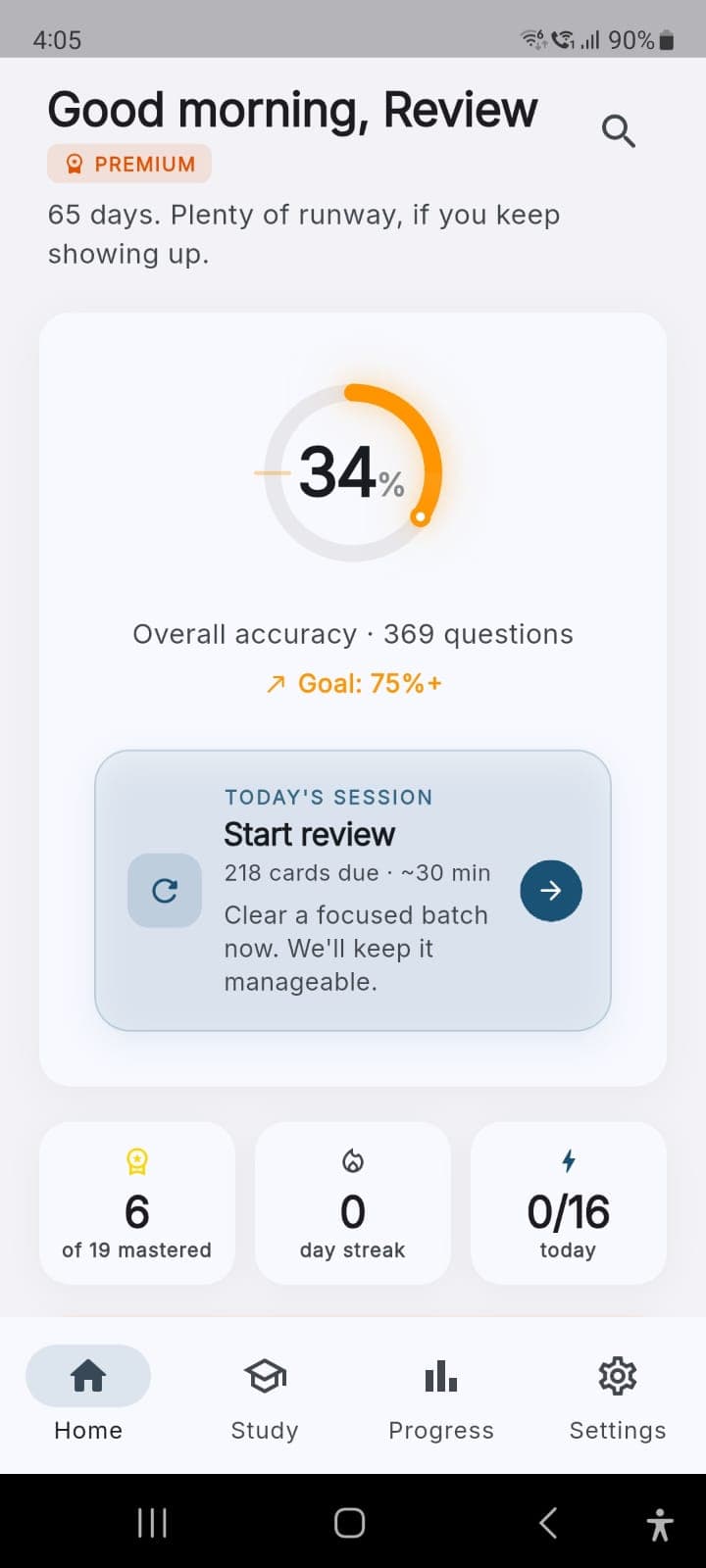
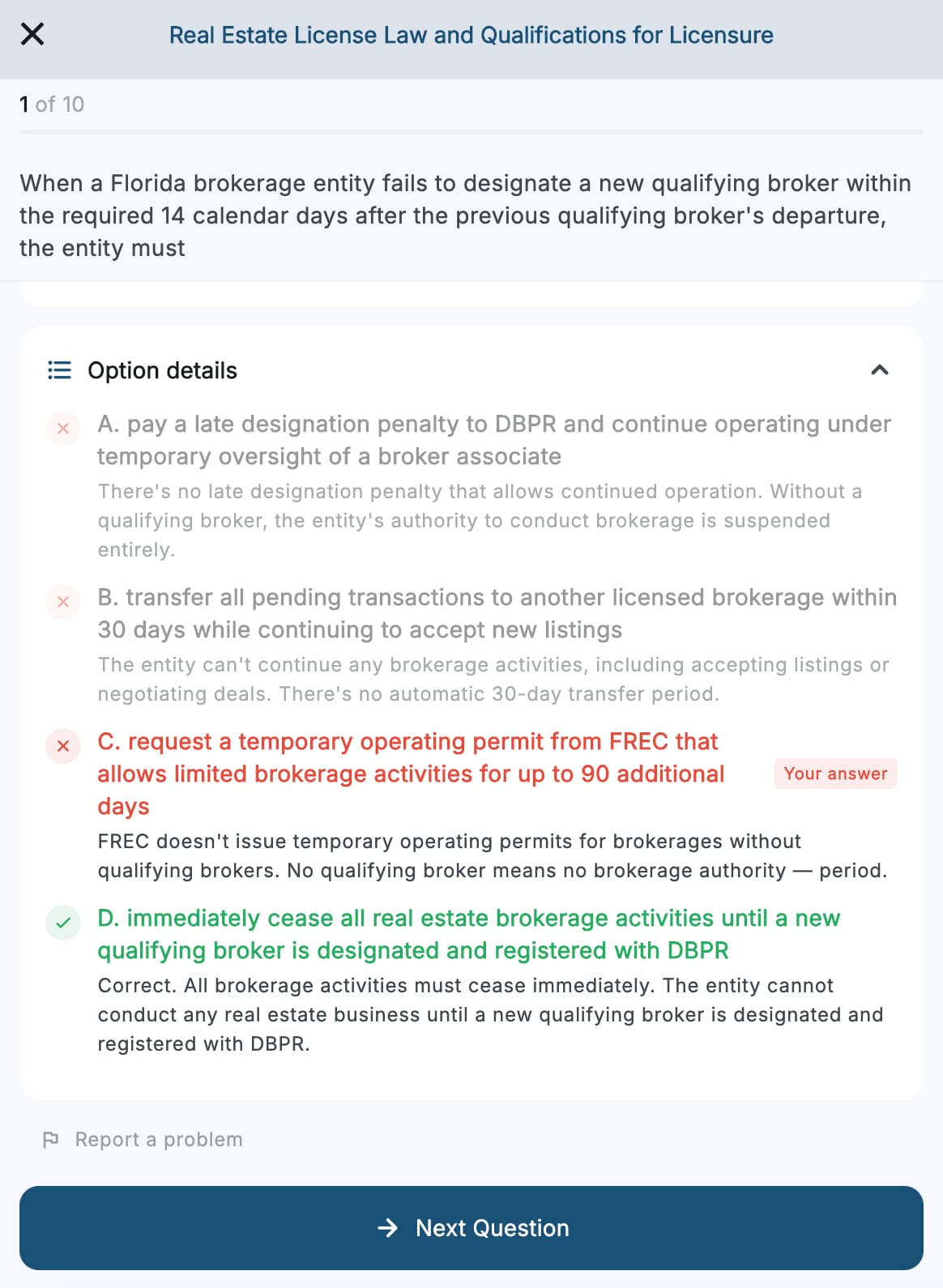
Try a free Florida question | Run the readiness calculator | Download Pass Florida
Methodology
This guide separates official licensing rules from Coral Springs-specific strategy. Statutory anchors include F.S. 553.899 (mandatory structural milestone inspections for condominium and cooperative buildings three habitable stories or more) and Florida Statutes ch. 718 (Structural Integrity Reserve Study requirements). High Velocity Hurricane Zone (HVHZ) references describe the Florida Building Code framework that applies to Broward and Miami-Dade Counties. The city's master-planned origins (developed from the early 1960s by Coral Ridge Properties, incorporated 1963), the "City in the Country" slogan, and the strict signage and appearance standards (including the citywide billboard prohibition) are from the City of Coral Springs and public records. Demographic figures (134,394 residents at the 2020 Census; median household income well above the Broward County and Florida medians, in the low-to-high $90,000s depending on the American Community Survey release; roughly 31 percent Hispanic, about a third White non-Hispanic, and about a quarter Black) reflect the 2020 Census count and American Community Survey estimates; race, ethnicity, and income figures are approximate, vary by ACS release, and should be confirmed against the relevant ACS tables (including B19013 for income) before citing a specific number. Housing is predominantly single-family and townhome (American Community Survey Table B25024, units in structure) built largely from the 1970s through the 1990s (Table B25034, year structure built; exact decade shares not asserted here), with residential build-out completed in the early 2000s per the City of Coral Springs history. The 2024 FEMA Broward flood-map update most affected southwest Broward cities such as Miramar and Pembroke Pines; Coral Springs was not identified among the most-affected cities, but flood zones still vary by parcel, so verify the zone for any specific property. Broward Health Coral Springs is a public fact; Coral Springs is primarily residential rather than a major corporate hub, so this guide does not assert specific top employers. Local market guidance is practical editorial strategy based on stable regional patterns, not volatile price claims. Verify fees, appointment availability, broker and association costs, HOA documents and reserve status, city codes and deed restrictions, flood zone for any specific parcel, jurisdiction for any specific address, and all insurance, lending, and tax details before spending money, scheduling, or advising a client.
Product note. Pass Florida is our Florida-specific exam prep app. This page references our own product, so the relationship is direct and disclosed. We do not claim to use copied exam questions, guarantee passage, or replace official DBPR, Florida Real Estate Commission (FREC), Pearson VUE, course provider, broker, association, MLS, legal, tax, insurance, or lending guidance. Pass Florida is independent exam prep and is not a DBPR-approved 63-hour pre-license course or continuing education.
This post is educational content about Florida real estate licensing and Coral Springs career strategy. It is not legal, tax, brokerage, licensing, fair-housing, insurance, inspection, lending, HOA, condo, or land-use advice. DBPR application fees, Pearson VUE exam fees, course tuition, fingerprint vendor pricing, association and MLS dues, broker startup costs, city codes, and local market conditions can change. Always verify your specific path with DBPR, Pearson VUE, your course provider, your broker, your local association, the City of Coral Springs, the relevant Broward jurisdiction, the HOA or condo association and its current documents and reserve status, a licensed Florida property and casualty agent for insurance, and qualified counsel before paying fees, scheduling an exam, or making a career decision based on this article.
Sources
- DBPR Sales Associate Initial Application Checklist
- DBPR Real Estate Associate Requirements
- DBPR RE 1 Sales Associate Application
- DBPR Real Estate Sales Associate Candidate Information Booklet
- Pearson VUE Florida Real Estate testing page
- Pearson VUE Florida Real Estate and Appraiser Fact Sheet
- DBPR mutual recognition information
- MIAMI Association of Realtors and RWorld merger announcement
- Coral Springs History (City of Coral Springs): master-planned origins, Coral Ridge Properties, 1963 incorporation, "City in the Country"
- City of Coral Springs signage and community appearance
- City of Coral Springs Flood Zone Information
- Broward County Public Schools Find My School boundary locator
- Florida Statutes, F.S. 553.899 (mandatory structural inspections for condominium and cooperative buildings)
- Florida Statutes, Chapter 718 condominium law
- Florida Building Code (Florida Building Commission)
- Florida Office of Insurance Regulation OIR-B1-1802 Uniform Mitigation Verification Inspection Form
- FEMA Flood Map Service Center
- Broward Health Coral Springs
- US Census Bureau QuickFacts: Coral Springs city, Florida
- US Census Bureau, American Community Survey, Coral Springs city, Florida (Census Reporter profile)