QUICK ANSWER
To get a real estate license in Clearwater, you follow the Florida sales associate path: be at least 18, have a high school diploma or equivalent, have a Social Security number, complete a Florida-approved 63-hour pre-license course unless exempt, submit the DBPR RE 1 application, complete Livescan fingerprints, pass the Pearson VUE sales associate exam, then activate the license with a Florida broker.
Clearwater does not have its own city license. The license is statewide. What changes locally is the market you enter: Clearwater Beach, Sand Key, Island Estates, mainland neighborhoods, Belleair, Largo, Dunedin, Safety Harbor, snowbird buyers, condo documents, flood and insurance questions, and Tampa Bay crossover clients.
What this guide covers
- How to get a real estate license in Clearwater: the six-step path
- Clearwater real estate license cost snapshot
- Step 1: Confirm eligibility and your Clearwater path
- Local market intelligence: Clearwater ecosystem map
- Steps 2 to 4: course, application, fingerprints, and exam
- What Clearwater actually rewards after licensing
- First-year reality in Clearwater
- Step 5: Find a sponsoring broker
- Step 6: Activate and start your first 90 days
- Mistakes Clearwater applicants make
- FAQ
CLEARWATER DECISION MAP
| Your situation | Best next move | Watch out for |
|---|---|---|
| You want beach or condo clients | Learn condo documents, reserves, assessments, rental rules, flood, insurance, and financing constraints | Beach enthusiasm cannot replace document review and broker supervision |
| You want mainland buyers | Learn Clearwater, Largo, Dunedin, Safety Harbor, and St. Petersburg comparison points | Pinellas communities are close together, but buyers ask very specific questions |
| You want snowbird or second-home clients | Build remote follow-up habits, seasonal timing, and closing checklist discipline | Out-of-area clients need clarity quickly |
| You are choosing a broker | Ask whether new agents work beach condos, mainland residential, relocation, or investor clients first | A generic Tampa Bay office may not train for coastal Pinellas details |
If you searched "how to get a real estate license in Clearwater," the state checklist is only the first layer. You also need to know when to apply, when to fingerprint, how to prepare for Pearson VUE, which broker model gives a beginner real supervision, and which local lane is realistic in year one.
The official license is the same Florida sales associate license you would get anywhere in the state. The local career is different. Clearwater sits in a tight Pinellas County market where clients compare beach condos, mainland affordability, older homes, Belleair luxury, Dunedin charm, Largo value, Safety Harbor lifestyle, St. Petersburg amenities, and Tampa access.
This guide separates official Florida licensing requirements from Clearwater career strategy so you can avoid stale fee claims, overconfident beach talk, and the common mistake of passing the exam without a first-year plan.
How to get a real estate license in Clearwater: the six-step path
Clearwater does not issue a separate real estate license. To work as a sales associate in Clearwater, complete Florida's 63-hour course, apply through DBPR, submit fingerprints, pass Pearson VUE, then activate under a Florida broker.
THE SIX STEPS
Florida sales associate applicants must be at least 18, have a high school diploma or equivalent, have a Social Security number, and answer DBPR background questions accurately.
Use a Florida-approved pre-license provider. This is pre-license education, not exam prep and not continuing education.
DBPR lets you apply before the course is complete. Valid course completion proof is required before you sit for the state exam.
Use an FDLE-registered Livescan provider immediately after submitting the application. Keep the receipt and transaction information.
The Florida sales associate exam is computer based, closed book, 100 multiple-choice questions, and 3.5 hours. You need 75 points or higher to pass.
A sales associate works under a Florida broker. Passing the exam is not the same as being activated to perform licensed services for compensation.
Clearwater real estate license cost snapshot
Clearwater candidates pay the same statewide Florida licensing costs as other applicants, then add local startup costs such as broker fees, association or MLS access, E&O, lockbox, signs, transportation, and savings for uneven commission timing.
The state license is statewide, but your planning budget should include both official licensing costs and local startup costs. These are the amounts to check before you spend money.
| Cost item | 2026 planning amount | Clearwater note |
|---|---|---|
| DBPR RE 1 application | $62.75 | Listed on the current DBPR sales associate application. Verify inside DBPR before paying. |
| Electronic fingerprints | Often about $50 to $80 | Vendor pricing varies by Livescan provider. Use the correct real estate fingerprint path and keep the receipt. |
| Pearson VUE sales associate exam | $36.75 per attempt | Listed on Pearson VUE's Florida real estate fact sheet. Pay again if you retake. |
| 63-hour pre-license course | Provider-dependent | Course format, school, and support level drive the price. Make sure it is Florida-approved. |
| Exam prep | Optional | Exam prep is separate from the 63-hour course. Pass Florida is exam prep only. |
| Broker, association, MLS, Supra, E&O, lockbox, and tools | Varies widely | Ask before signing. Clearwater-area startup costs can arrive before your first closing. |
Clearwater-area agents may encounter Suncoast Tampa Association of REALTORS, Stellar MLS, and Supra access, depending on broker membership and MLS setup. Do not guess on association dues, MLS access, lockbox costs, forms access, or board membership. Ask the broker exactly what is required before you join.
Step 1: Confirm eligibility and your Clearwater path
Confirm the statewide Florida eligibility rules first, then choose a realistic Clearwater first-year lane based on broker support, local demand, and the type of clients you can serve repeatedly.
Then Clearwater adds local decisions that do not appear on the state checklist.
| Local decision | Why it matters in Clearwater |
|---|---|
| First niche | Beach condos, Island Estates, Belleair, mainland Clearwater, Largo, Dunedin, and Safety Harbor are different beginner lanes. |
| Broker model | Some offices train around beach condo work, some around mainland open houses, some around relocation, luxury, or investors. |
| Local risk questions | Condo reserves, assessments, HOA rules, flood, insurance, rental rules, inspections, and older-home condition questions come up early. |
| Test timing | Pearson VUE availability changes, so confirm open seats inside your Pearson VUE account after DBPR approval. |
Local market intelligence: Clearwater ecosystem map
Clearwater rewards focused local competence more than a generic license. Pick one repeatable starter lane, learn its documents and client questions, and work under broker supervision until the pattern is familiar.
| Local lane | What to learn early | Where new agents often start |
|---|---|---|
| Clearwater Beach and Sand Key condos | Condo documents, reserves, assessments, financing, parking, rental rules, flood and insurance vocabulary | Mentor-supported buyer tours and condo packet review |
| Island Estates and waterfront | Dock, seawall, insurance, inspections, lifestyle buyers, remote follow-up | Senior-agent support and open houses |
| Belleair and luxury-adjacent work | Showing etiquette, proof of funds, inspection coordination, vendor referrals | Team assistant or showing support |
| Mainland Clearwater | Older homes, first-time buyers, schools conversation boundaries, commute, affordability | Open houses and sphere leads |
| Dunedin and Safety Harbor crossover | Lifestyle positioning, walkability, limited inventory conversations, local comparison | Buyer education and open houses |
| Largo and inland Pinellas | Value buyers, condo and townhome inventory, financing, inspection timelines | First-time buyer support and team leads |
Local ecosystem visuals: where new agents can start
| Starting path | How it works in Clearwater |
|---|---|
| Fastest practical start | Mainland open houses where buyers compare Clearwater, Largo, Dunedin, and Safety Harbor |
| Best beach entry | Assist a senior agent with condo packets, buyer tours, and seasonal follow-up before leading alone |
| Best snowbird lane | Build checklists for remote buyers, second-home timing, condo documents, insurance, and closing tasks |
| Best part-time fit | Weekend open houses plus disciplined weekday follow-up, if your broker can cover urgent questions |
Steps 2 to 4: course, application, fingerprints, and exam
These steps are statewide. Clearwater does not have a separate course, application, fingerprint rule, or licensing exam. Use the complete Florida licensing guide for the current requirements, sequence, forms, and official sources.
For planning, keep the workflow simple:
- Complete a Florida-approved 63-hour pre-license course unless DBPR confirms that an exemption applies to you.
- Submit DBPR Form RE 1. DBPR allows you to apply while the course is still in progress, but you need valid proof of completion before the state exam.
- Complete electronic fingerprints using the real estate ORI listed by DBPR. Keep the receipt and make sure your name and identifying details match your application.
- After authorization, schedule the statewide sales associate exam through Pearson VUE. Confirm the available test center and appointment in your account because locations and seats can change.
Use the waiting time to prepare across the full DBPR outline. The 19-topic exam map, Florida math formulas guide, and fingerprint delay checklist cover the details without repeating the same statewide material in every city guide.
CLEARWATER EXAM PREP
Prepare for the statewide exam, then apply the license locally.
Use Florida-specific practice and a timed readiness check before booking your attempt.
What Clearwater actually rewards after licensing
After licensing, Clearwater rewards supervised repetition, local document discipline, safe routing of legal and risk questions, consistent follow-up, and a first-year lane that fits the local market.
| What the market rewards | What that means in practice |
|---|---|
| Beach versus mainland clarity | Buyers need to understand lifestyle, cost, insurance, condo, commute, and availability differences. |
| Condo document discipline | Beach and condo buyers need careful document flow and broker-reviewed explanations. |
| Seasonal follow-up | Snowbird and second-home clients often need remote communication, reminders, and quick summaries. |
| Pinellas specificity | Clearwater, Dunedin, Largo, Safety Harbor, St. Petersburg, and Belleair are not interchangeable. |
First-year reality in Clearwater
New agents often ask whether they can start with beach buyers, work part time, or break into luxury. The honest answer is: sometimes, but only with a realistic system.
| Reality | What to expect |
|---|---|
| Income reality | Most new agents should expect uneven commission timing and several months before a first closing unless they join a team or have a warm sphere. |
| Lead generation | Mainland open houses, condo buyer support, snowbird follow-up, referrals, and team roles are more realistic than broad beach branding. |
| Broker support | Ask who reviews condo documents, flood, insurance, rental, repair, and older-home questions. |
| Part-time viability | Possible if you work a repeatable lane and have backup for weekday showings, offers, inspections, and urgent buyer questions. |
Step 5: Find a sponsoring broker
Clearwater candidates should choose a sponsoring broker based on beginner training, contract review, first-transaction supervision, local market support, lead systems, and startup costs, not only commission split.
A Florida sales associate works under a broker. For a new agent, this choice affects training, file review, fees, lead access, transaction supervision, and how quickly you learn the local market.
Ask these before you sign.
| Broker interview question | Why it matters |
|---|---|
| Who reviews my first contracts before they go out? | New agents need supervision before client-facing mistakes happen. |
| How many brand-new agents did you train last year? | Recruiting beginners is not the same as training them. |
| What costs are due before my first closing? | Association, MLS, E&O, signs, lockbox, desk fees, tech, and marketing can add up. |
| Do new agents start with beach condos, mainland homes, relocation, or investor leads? | Your first lane should be specific. |
| Who reviews condo, flood, insurance, and rental-rule questions? | Clearwater clients ask these early. |
| Do you have systems for seasonal and out-of-area buyers? | Remote buyers need tight follow-up. |
| Can I support a senior beach or condo agent first? | Complex niches need apprenticeship. |
Use how to find a sponsoring broker in Florida before signing.
Step 6: Activate and start your first 90 days
After passing, activate under a Florida broker before performing licensed services. Use the first 90 days to learn systems, pick one Clearwater lane, build supervised reps, and turn follow-up into appointments.
After you pass, activate with your sponsoring broker before performing licensed services for compensation. Then treat the first 90 days as a practical training sprint.
FIRST 90 DAYS
MLS, forms, file review, showing rules, E&O, compliance, lead process, and who answers live transaction questions.
Choose one local lane from the ecosystem map. One repeatable lane beats vague ambition.
Host open houses, review condo packets, practice buyer consultations, shadow inspections, and ask your broker to review hard questions.
Track every lead, schedule next steps, ask for appointments, and keep your broker involved before live questions become client problems.
FIRST RENEWAL WARNING
After your license is issued, do not confuse activation with renewal compliance. DBPR's real estate associate requirements say sales associates must complete a FREC-approved 45-hour post-licensing course before the initial sales associate license expires. This is separate from the 63-hour pre-license course and separate from ordinary continuing education.
If you already passed, use what to do after passing the Florida real estate exam.
Mistakes Clearwater applicants make
AVOID THESE
- Waiting until the course is finished to submit the DBPR application.
- Doing fingerprints before understanding DBPR's sequence and provider requirements.
- Treating the course final as proof that Pearson VUE will feel easy.
- Scheduling the exam without checking ID match, course certificate validity, and current Pearson VUE availability.
- Choosing a broker by commission split before asking who reviews first contracts.
- Talking about beach condos without a system for documents, reserves, assessments, and rental rules.
- Giving legal, insurance, inspection, tax, rental, HOA, condo, or property-management advice outside your role.
- Forgetting that Pass Florida is exam prep, not a 63-hour pre-license course and not continuing education.
Related exam and licensing concepts
| If you need help with | Read this next |
|---|---|
| Full statewide path | How to get a Florida real estate license |
| Timeline and delays | How long it takes to get licensed in Florida |
| Costs | Florida real estate license cost |
| Test-center planning | Florida Pearson VUE real estate testing centers |
| Fingerprint delays | Florida real estate fingerprints delay |
| Course certificate expiration | Florida real estate course certificate expired |
| Exam topics | Florida real estate exam 19 topics |
| Math formulas | Florida real estate exam math formulas |
| Broker choice | Find a sponsoring broker in Florida |
FAQ
How long does it take to get a real estate license in Clearwater?
Most first-time candidates should plan around 10 to 16 weeks. The timeline depends on course pace, DBPR application review, fingerprints, exam readiness, Pearson VUE availability, and broker activation.
Is there a separate Clearwater real estate license?
No. You receive a Florida real estate sales associate license. Clearwater affects your local career strategy, broker fit, and first niche, but not the license itself.
Can I apply to DBPR before finishing the 63-hour course?
Yes. DBPR says the course is not required at application submission. You still need valid proof of course completion before sitting for the state exam.
Where do Clearwater candidates take the Florida real estate exam?
Pearson VUE administers the Florida real estate exam. Pearson VUE's Florida real estate fact sheet lists St. Petersburg and Tampa as test-center locations near Clearwater, but after DBPR approval you should check current seat availability inside your Pearson VUE account. Test-center details and available appointments can change.
Should a new Clearwater agent start with beach condos?
Only with broker support. Beach condos can involve documents, reserves, assessments, financing, insurance, rental rules, and flood questions. A new agent can learn the lane, but should not lead complex conversations without supervision.
Is Clearwater good for part-time real estate agents?
It can be, especially for open houses and seasonal follow-up. It becomes harder if clients need fast weekday showings, offer writing, inspections, and condo document review.
Ready to start the Clearwater license path?
The Florida license is statewide, but your first year is local. Get the license first, then choose the Pinellas County broker, lane, and follow-up rhythm that lets you build supervised reps.
The exam is statewide, so Clearwater candidates should verify local logistics and prepare against the same Florida outline used across the state.
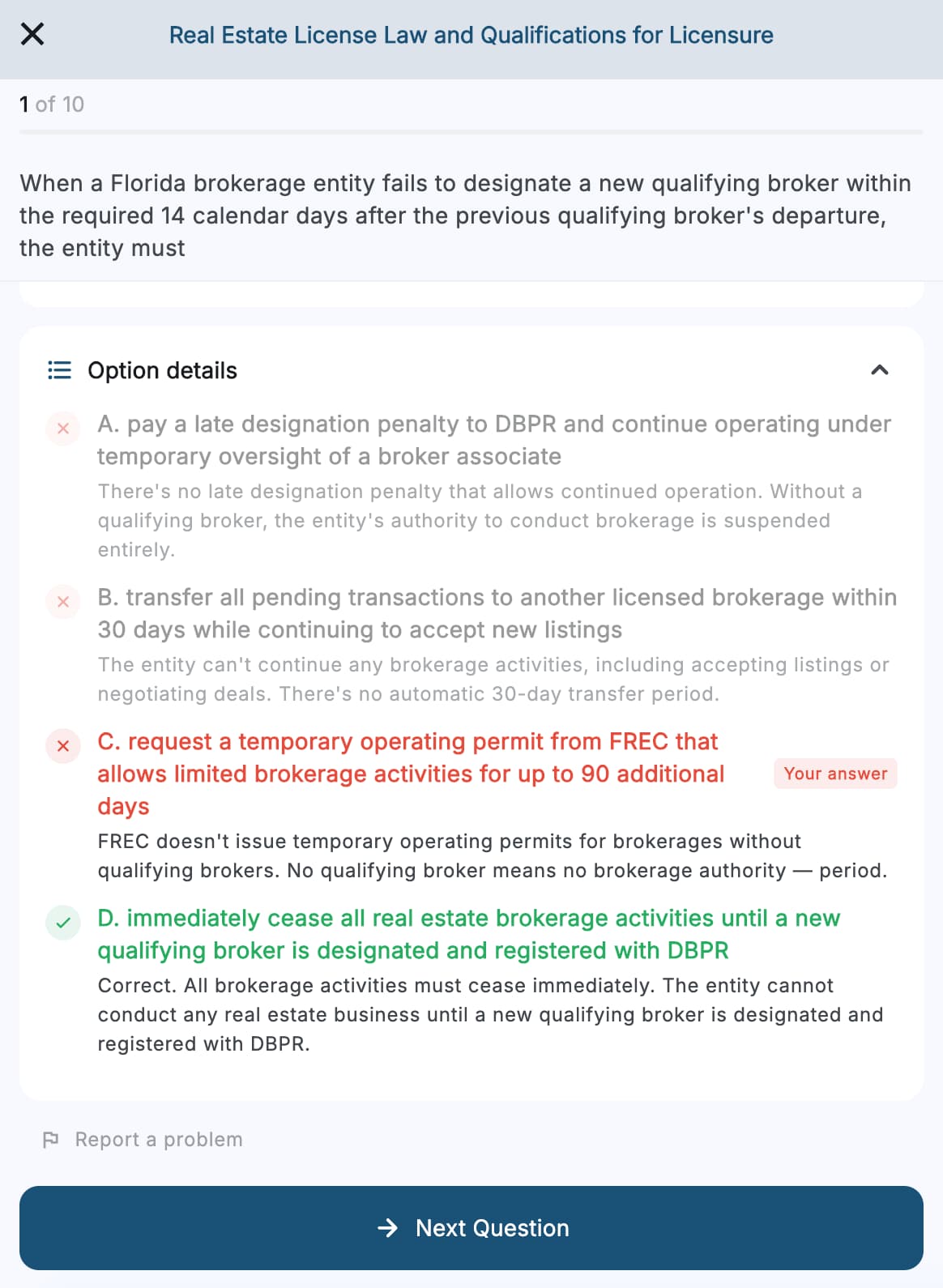
Try a free Florida question | Run the readiness calculator | Download Pass Florida
Methodology
This guide separates official Florida licensing requirements from local Pinellas County career strategy. Local market guidance is practical editorial strategy based on stable regional patterns, not volatile price claims. Verify fees, appointment availability, broker costs, association or MLS costs, local ordinances, community documents, condo documents, insurance, flood, rental, older-home, HOA, and property-management documents before spending money, scheduling, or advising a client.
Product note. Pass Florida is our Florida-specific exam prep app. This page references our own product, so the relationship is direct and disclosed. We do not claim to use copied exam questions, guarantee passage, or replace official DBPR, Florida Real Estate Commission (FREC), Pearson VUE, course provider, broker, Suncoast Tampa Association of REALTORS, Stellar MLS, legal, tax, insurance, lending, property-management, condo, HOA, flood, or professional guidance. Pass Florida is independent exam prep and is not a DBPR-approved 63-hour pre-license course or continuing education.
This post is educational content about Florida real estate licensing and Clearwater career strategy. It is not legal, tax, brokerage, licensing, insurance, inspection, lending, HOA, condo, flood, rental, property-management, older-home, or professional advice. DBPR application fees, Pearson VUE exam fees, course tuition, fingerprint vendor pricing, Clearwater-area association and MLS dues, broker startup costs, and local market conditions can change. Always verify your specific path with DBPR, Pearson VUE, your course provider, your broker, your local association, and qualified counsel before paying fees, scheduling an exam, or making a career decision based on this article.
Sources
- DBPR Sales Associate Initial Application checklist
- DBPR Real Estate Associate Requirements for licensure
- DBPR RE 1 Sales Associate Application
- DBPR Real Estate Sales Associate Candidate Information Booklet
- Pearson VUE Florida Real Estate testing page
- Pearson VUE Florida Real Estate and Appraiser Fact Sheet
- DBPR mutual recognition information
- Suncoast Tampa Association of REALTORS
- Stellar MLS