VERIFY BEFORE RELYING
Florida sales associate eligibility rules, the 63-hour pre-license course requirement, and the limited exemptions (four-year real estate degree from an accredited institution, active Florida Bar membership) are controlled by F.S. 475 and Department of Business and Professional Regulation (DBPR) rules, which can change between exam windows. Application fees, fingerprint vendors, Pearson VUE scheduling, and DBPR Candidate Information Booklet content can also change. Before paying for a course, claiming an exemption, or submitting an application, verify against the current DBPR Sales Associate Application, the current DBPR Candidate Information Booklet, and current F.S. 475.17.
QUICK ANSWER
A college student can start the Florida real estate sales associate path if they are at least 18, have a high school diploma or GED, have a U.S. Social Security number (SSN), complete the required 63-hour pre-license course unless a specific DBPR exemption applies, submit the DBPR application and fingerprints, pass the Pearson VUE state exam with a grade of 75 points or higher, and activate under a broker. Being in college does not automatically replace the 63-hour course. A four-year degree in real estate or active Florida Bar membership can create a course exemption, but ordinary college classes, a business major, or pre-law coursework usually do not.
WHO THIS GUIDE IS FOR
Florida college students considering a sales associate license while still in school, plus students who have already started the licensing path and need a student-specific study schedule. Useful whether you are a freshman exploring a real estate career, a junior planning around graduation, or a senior who wants to be license-ready by commencement. Pair with the full licensing path guide for the complete step-by-step, the license cost breakdown for budget planning, and the working full-time study plan if you are also working part-time. Not legal, tax, financial, or academic advising. Your school's career center and DBPR's official application materials remain the authoritative sources.
What this guide covers
- Florida real estate exam college student plan
- What college changes and what it does not
- Degree and Florida Bar misconceptions
- Best timing by student type
- Out-of-state and international student notes
- Semester study schedule
- Four-week college student exam plan
- Active vs inactive license boundaries
- What to study first
- How to use campus life without letting it distract you
- First broker choice for college students
- Mistakes college students make
- Related exam concepts
- FAQ
If you are searching "Florida real estate exam college student," you are probably not asking only about the test. You are asking whether it is too early, whether your degree helps, how to study around classes, whether the license can become a part-time income path, and whether a broker will take you seriously before graduation.
The short answer: college can be a smart time to get licensed, but only if you treat the license like a professional track, not a side quest you squeeze in the week after finals. Florida's licensing process is reachable for students. The state exam still needs focused preparation.
This page gives you a student-specific path: when to start, what college does and does not change, how to schedule the 63-hour course, how to study during a semester, and what to ask before choosing your first broker.
Start now
You are 18, have a high school diploma or GED, and can protect 30 to 45 minutes most study days.
Wait a term
You are in finals, moving housing, overloaded with labs, or cannot finish the course without rushing.
Check exemption
You have a four-year real estate degree or active Florida Bar status. Verify the DBPR path before paying for the course.
STUDENT SCHEDULE, SHORT REPS
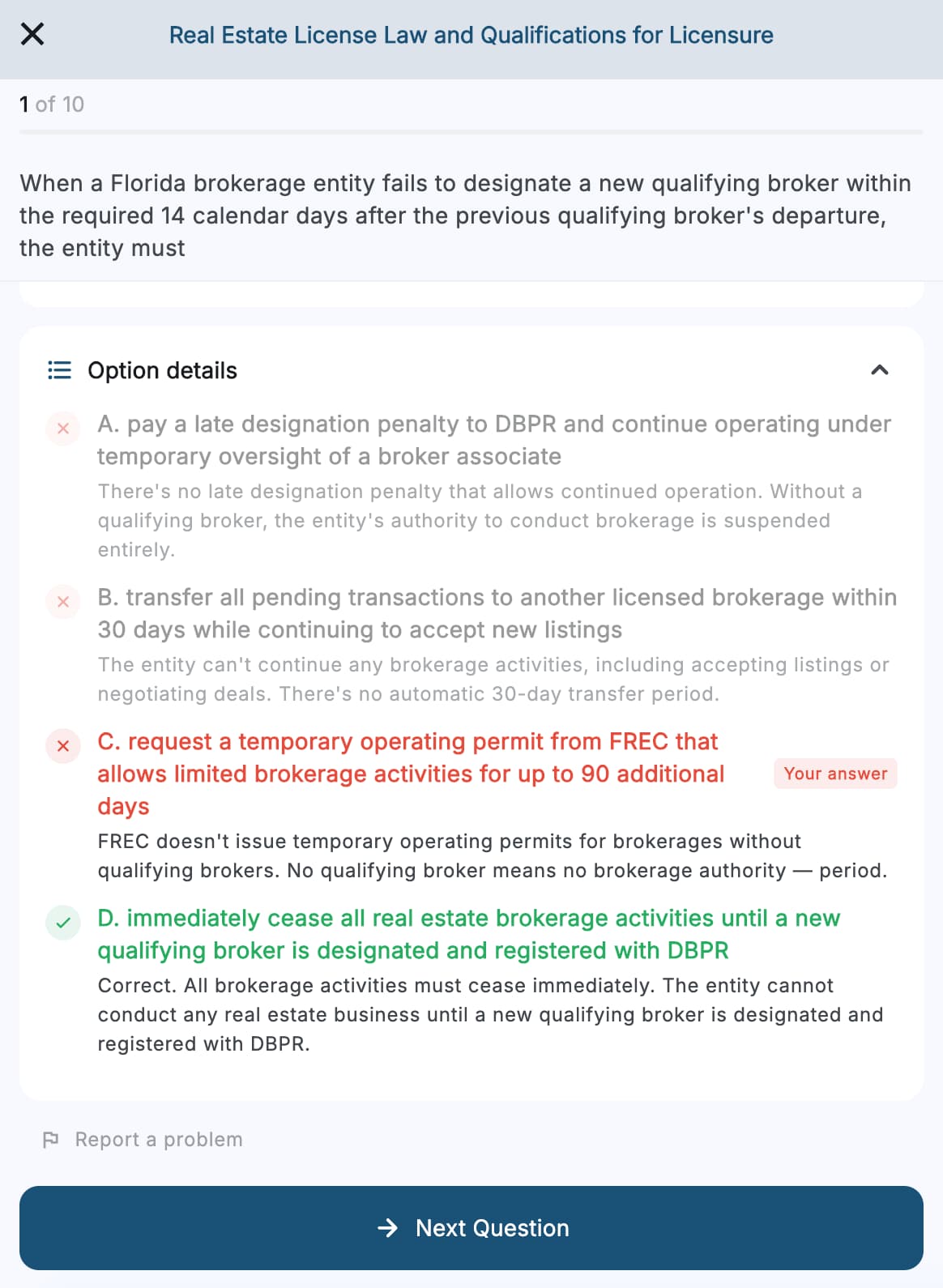
Try 5 Florida questions between classes.
Verify the official licensing requirement first, then use Florida-specific practice only for the sales associate knowledge exam.
Florida Real Estate Exam College Student Plan
Use this plan if you want to get licensed while still in school.
| Decision | Student-friendly answer | Why it matters |
|---|---|---|
| Can I apply while in college? | Yes, if you meet DBPR eligibility. | College enrollment itself is not the issue. Age, education, SSN, background review, course completion, and exam readiness are. |
| Do I need a real estate degree? | No. | Florida requires a high school diploma or equivalent for the standard sales associate path. |
| Does my major waive the 63-hour course? | Usually no. | DBPR's course exemption is specific. A four-year degree in real estate is different from a business, finance, marketing, or pre-law major. |
| Should I finish the course during a semester? | Only if your weekly calendar can handle it. | The course gets you eligible. The state exam still needs separate prep. |
| Should I look for a broker before passing? | Yes, but do not activate until you know the fit. | Broker choice affects training, supervision, schedule expectations, and early career habits. |
The cleanest student sequence is:
- Confirm eligibility.
- Choose the 63-hour course format.
- Start the DBPR application and fingerprints early when appropriate.
- Finish the course without rushing the final.
- Study for the state exam with Florida-specific practice.
- Interview brokers before exam day.
- Activate only when the broker fit makes sense.
For the full licensing path, use how to get a Florida real estate license. For course selection, use the Florida pre-license course comparison. For budget planning, use the Florida real estate license cost breakdown.
What College Changes and What It Does Not
College changes your schedule, your cash flow, your network, and your first broker questions.
It does not automatically change DBPR's sales associate requirements.
| Topic | What college may change | What it does not change |
|---|---|---|
| Eligibility | You may already meet age and high school requirements. | You still need to meet DBPR's license requirements. |
| Course timing | You can choose online, livestream, or classroom around your semester. | A standard applicant still needs a FREC-approved 63-hour course. |
| Exam prep | You may already know how to study for tests. | The state exam tests Florida law, wording traps, and applied scenarios differently from college exams. |
| Career start | Campus, alumni, rentals, and internships can help you network. | You cannot practice real estate until the license is active under a broker. |
| Broker fit | You may need flexible training and part-time expectations. | Florida sales associates still work under broker supervision. |
The best college-student plan uses school habits to your advantage without pretending the state exam is just another class final.
Out-of-State and International Student Notes
College students often ask this because their school, home address, and future market may be in different places.
| Situation | What to check first | Practical move |
|---|---|---|
| You attend college in Florida but are from another state | Whether you meet Florida DBPR eligibility and have the required SSN | Use Florida-specific course and exam prep if you want a Florida license. |
| You attend college outside Florida but want a Florida license | Whether you can complete the Florida course, application, fingerprints, and Pearson VUE process | Do not study from a generic national course and assume it maps to Florida. |
| You are an international student | SSN, visa/work authorization, campus rules, and broker expectations | Verify with DBPR and your school's international student office before spending money. |
| You plan to move after graduation | Whether Florida is actually the state where you want to practice first | A license is state-specific. Build the plan around the market where you expect to work. |
| You want a broker internship before licensure | What tasks are unlicensed vs licensed activity | Ask the broker exactly what you may do before activation. |
The big point is simple: college location does not decide licensure by itself. The license path is governed by Florida eligibility, education, application, exam, and activation rules.
Degree and Florida Bar Misconceptions
This is where many students get bad advice.
DBPR's sales associate application materials identify two specific education-exemption situations that students often misunderstand.
| Belief | Accurate version |
|---|---|
| "I am in college, so I can skip the 63-hour course." | No. Being enrolled in college does not automatically waive the sales associate pre-license course. |
| "I am a business major, so my degree should count." | Usually no. DBPR references a four-year degree in real estate from an accredited institution. |
| "I took real estate finance, so I am exempt." | A single class is not the same as a four-year real estate degree exemption. |
| "Pre-law or law school means I can skip the course." | Not by itself. DBPR references active members in good standing with the Florida Bar. |
| "If I am exempt from the course, I do not need the exam." | Do not assume that. Course exemption and exam requirements are different questions. |
If you think an exemption applies, verify it before you pay for a course or skip a step. A normal undergraduate student should usually plan on the standard 63-hour course.
Best Timing by Student Type
The right timing depends on your semester.
| Student situation | Best timing | Why |
|---|---|---|
| Freshman or sophomore with stable schedule | Start with light research and maybe the course during a lighter term. | You have time, but you may not need to rush activation. |
| Junior or senior exploring real estate career | Start the course 3 to 5 months before you want to interview brokers seriously. | You can line up licensing with internships, graduation, or summer availability. |
| Student athlete, lab-heavy major, nursing, pre-med, architecture | Use breaks or a lighter term. | Rigid weekly demands make self-paced drift more likely. |
| Business, finance, marketing, hospitality, urban planning student | Course during semester may fit if you protect weekly blocks. | Related classes can help context, but they do not replace Florida exam prep. |
| Student working part time | Use the working full-time study plan and stretch it. | Smaller daily reps beat one exhausted weekly session. |
| Graduating soon | Apply and fingerprint early when appropriate, then schedule prep around finals. | You do not want DBPR processing to become dead time after graduation. |
If your semester is already overloaded, wait. A rushed 63-hour course followed by no exam prep is how students turn an affordable license path into retake fees and delay.
Active vs Inactive: The Student Boundary
Passing the exam is not the same as being able to practice real estate.
DBPR's associate requirements say the license must be activated, otherwise it is issued in inactive status. For a college student, that distinction matters because it separates "I passed" from "I can work with clients under a broker."
| Stage | What it means | Student caution |
|---|---|---|
| Taking the course | You are completing eligibility education. | You are not licensed yet. |
| Approved to test | DBPR has authorized the exam path. | You still need to pass the state exam. |
| Passed the exam | You cleared the testing step. | Do not perform licensed services until properly active. |
| Inactive license | License exists but is not active under a broker. | Good if you need time to choose a broker; not permission to practice. |
| Active under a broker | Broker activation is complete. | Now client deadlines, supervision, and broker policies matter. |
If you are in finals, an internship, or a heavy lab semester, there is nothing wrong with interviewing brokers and delaying activation until the schedule is realistic.
Semester Study Schedule
Most college students do best with a 4 to 6 week exam-prep window after finishing the 63-hour course.
Here is the student version.
| Day type | Session | What to do |
|---|---|---|
| Class day | 20 to 30 minutes | 10 to 15 practice questions from one topic, then review explanations. |
| Light class day | 45 minutes | Topic set plus 2 math problems. |
| Gap between classes | 10 minutes | Flashcards, vocabulary pairs, or one Trap Library pattern. |
| Weekend morning | 60 to 90 minutes | Mixed practice, weak-topic review, or a timed section. |
| Weekend before exam | 100-question simulation | Practice pacing and review every miss. |
Do not build the plan around midnight studying. It works once. It does not work for four weeks.
Use your campus schedule intelligently. A 70-minute gap between classes can be better than a late-night session after work, dinner, and homework. If you commute by bus or ride as a passenger, use that time for review. If you drive, use audio-style review only for rules you already know, never for solving math.
Four-Week College Student Exam Plan
This plan assumes you already completed the 63-hour course or are in the final stretch of it.
| Week | Focus | Student version |
|---|---|---|
| Week 1 | Baseline and high-value topics | Take a diagnostic, then drill brokerage activities, contracts, mortgages, appraisal, property rights, and brokerage relationships. |
| Week 2 | Math and Florida law | Use daily math reps, then rotate license law, FREC rules, escrow, fair housing, and landlord-tenant basics. |
| Week 3 | Mixed practice and wording | Switch from topic sets to mixed sets. Drill EXCEPT, NOT, first action, and best answer wording. |
| Week 4 | Timed readiness | Take one full timed exam, repair weak areas, then do light review before test day. |
If finals or midterms hit during Week 3 or Week 4, pause the exam date instead of pretending you can cram both. You can study real estate during a busy academic week, but you should not take the state exam when you are sleep-deprived and underprepared.
For a more detailed version, use the 30-day Florida real estate exam study plan.
What to Study First
The DBPR sales associate outline lists 19 content areas. College students often make the mistake of studying the material in course order instead of score-impact order.
Start here:
| Priority | Topics | Why |
|---|---|---|
| First | Real estate contracts, brokerage activities, residential mortgages | High-value topics with scenario wording. |
| Second | Appraisal, property rights, brokerage relationships | These topics reward comparison charts and pattern recognition. |
| Third | Math, license law, FREC rules, escrow | Florida-specific details can create fast points if drilled. |
| Fourth | Lower-weight topics | Do not ignore them, but do not let them crowd out the heavier areas. |
Math deserves small daily reps. You do not need advanced math. You need fast setup. Use Math Drill for commission, prorations, property tax, documentary stamps, LTV, GRM, cap rate, and other Florida exam patterns.
For topic weights, use the Florida real estate exam 19 topics guide. For formulas, use the math formulas guide.
How to Use Campus Life Without Letting It Distract You
College can help if you use it correctly.
| Campus resource | Good use | Bad use |
|---|---|---|
| Business club | Meet agents, lenders, property managers, and alumni. | Treat networking as a substitute for licensure. |
| Real estate club | Learn market language and career paths. | Assume club events prepare you for DBPR exam wording. |
| Career center | Practice broker interviews and compare internship-style roles. | Let a generic resume template hide your schedule limits. |
| Alumni network | Ask how agents started and which broker training helped. | Ask for leads before you understand broker supervision. |
| Study spaces | Protect focused question-review blocks. | Re-read notes for hours because it feels academic. |
Real estate rewards initiative, but the license path still has order. You can network before passing. You cannot perform licensed services before your license is active under a broker.
First Broker Choice for College Students
Your first broker should fit your stage of life.
Ask these questions before activating:
| Broker question | Why it matters |
|---|---|
| Do you train brand-new agents who are still in school? | Some offices are built for full-time agents only. |
| What weekly availability do you expect? | "Flexible" means different things in different brokerages. |
| Who reviews contracts before submission? | New agents need supervision, not just a desk and a split. |
| Can I shadow open houses or showings before taking clients? | Observation can be valuable if your schedule is limited. |
| What are the monthly fees before my first closing? | A low split can still be expensive if fixed fees are high. |
| What happens during finals week? | You need a realistic coverage plan for deadlines and clients. |
Do not choose the broker with the loudest recruiting pitch. Choose the broker that will train you, supervise you, and be honest about whether your student schedule works.
Mistakes College Students Make
Assuming college replaces the 63-hour course. It usually does not. Check DBPR's specific exemption language before assuming anything.
Treating the state exam like a course final. College finals often reward recall. The Florida exam rewards applied rules, scenario reading, math setup, and trap wording.
Waiting until summer, then overloading summer. Summer can work, but only if you leave time for the course, DBPR application, fingerprints, exam prep, and broker interviews.
Trying to activate before understanding broker costs. MLS, association, lockbox, desk fees, E&O, and marketing costs can matter more than the license fee.
Saying yes to clients before finals. Once you are active, real deadlines apply. Plan coverage before you take on work.
Skipping exam prep because you are a good student. Being good at school helps discipline. It does not automatically teach Florida contract wording, escrow rules, or FREC discipline questions.
Ignoring the SSN requirement until late. The DBPR application says an applicant must possess a Social Security number to apply. This is especially important for international students and anyone whose campus paperwork is separate from licensing eligibility.
Related Exam Concepts
| If you are deciding | Read this next | Why it helps |
|---|---|---|
| Whether to start the license process | How to get a Florida real estate license | Shows the full standard path from eligibility to broker activation. |
| Which course to choose | Best Florida pre-license real estate course | Compares online, classroom, and budget options. |
| What it will cost | Florida real estate license cost | Separates license costs from first-year agent costs. |
| How to study with a packed schedule | Study while working full time | Gives a short-session framework that also works for students. |
| How to plan the final month | 30-day study plan | Gives a structured exam-prep calendar. |
| What the app does | Florida exam app with no subscription | Explains one-time pricing and study features. |
FAQ
Can a college student take the Florida real estate exam?
Yes, if the student meets DBPR eligibility, completes the required pre-license education unless a specific exemption applies, submits the application and fingerprints, and is authorized to test.
Do I need a college degree to get a Florida real estate license?
No. The standard education requirement is a high school diploma or equivalent. A college degree is not required.
Does a business degree waive the 63-hour Florida pre-license course?
Usually no. DBPR's sales associate materials reference a four-year degree in real estate from an accredited institution, not a general business, marketing, finance, economics, or hospitality degree.
Does being in law school waive the pre-license course?
No. DBPR references active members in good standing with the Florida Bar. Being a pre-law student or law student is not the same thing as active Florida Bar membership.
Should I get licensed before graduation?
It can make sense if you have the time, money, and maturity to treat the license professionally. It may be smarter to wait if your schedule is overloaded or you cannot afford first-year agent costs.
Can I work part time as a real estate agent in college?
Possibly, but broker fit matters. Ask about training, coverage, fees, contract supervision, and what happens during finals or heavy academic weeks.
Can an out-of-state student get a Florida real estate license?
Possibly, if the student meets Florida's eligibility and application requirements. The key questions are not where you attend college, but whether you can satisfy DBPR requirements, complete the Florida process, pass the exam, and activate appropriately if you intend to practice in Florida.
Can an international student get a Florida real estate license?
Do not assume. DBPR requires a Social Security number to apply, and work authorization is a separate issue from exam eligibility. International students should verify with DBPR and their school's international student office before paying for a course or planning broker activation.
Is Pass Florida a pre-license course?
No. Pass Florida is Florida-specific exam prep only. It does not replace the 63-hour course, does not submit your DBPR application, and does not provide continuing education.
Ready to start your student license path?
If you are a college student, your advantage is consistency, not cramming.
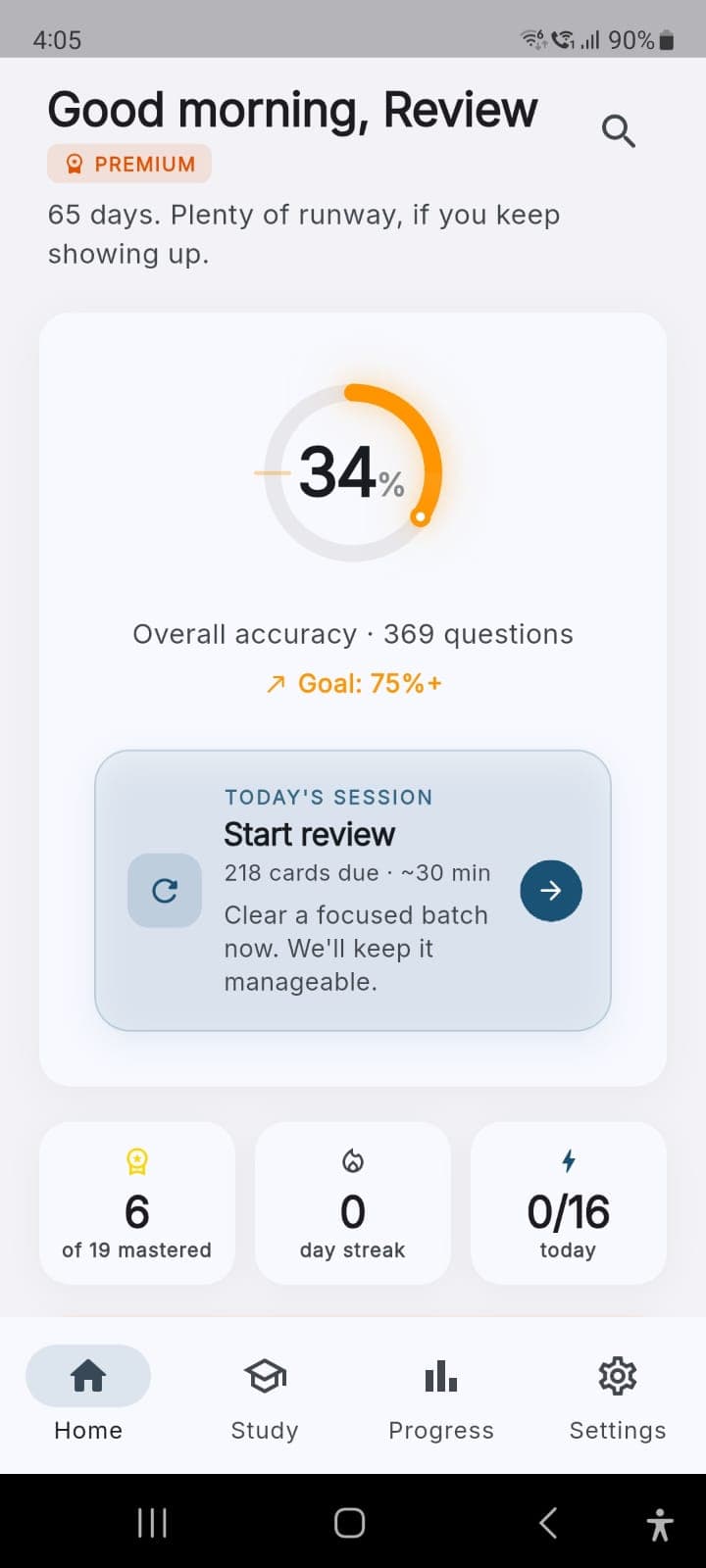
Use the 63-hour course to become eligible. Use Florida-specific practice to become exam-ready. Pass Florida helps with the second part with student-friendly short reps you can fit between classes.
Start small today: try 5 Florida questions, drill one math pattern in Math Drill, or download Pass Florida when you are ready for the full question bank.
Methodology
This article was written for Florida sales associate candidates who are currently in college or planning around a college schedule. Study schedules, broker questions, campus-networking advice, and readiness advice are Pass Florida coaching guidance, not DBPR rules.
Product Note
Pass Florida publishes this guide and offers the exam-prep app linked on this page. Pass Florida is independent exam prep and is not a DBPR-approved 63-hour pre-license course, post-license course, continuing education course, broker, school, law firm, or academic advisor. It does not guarantee passage.
This post is exam preparation and licensing-path content for Florida real estate sales associate candidates currently in college. It is not legal, tax, financial, lending, brokerage, licensing, or academic advice. Eligibility rules, exemptions, application requirements, and fees can change between exam windows. For an exemption claim, application question, or career decision, verify against the current DBPR materials, the current F.S. 475, and a qualified licensed Florida professional or your school's career center. Studying with Pass Florida or any other exam-prep tool does not guarantee passage of the state exam.
Sources
- DBPR Sales Associate Application
- DBPR Real Estate Associate Requirements
- DBPR Real Estate Commission Licensure Information
- DBPR Real Estate Sales Associate Candidate Information Booklet
- F.S. 475.17, Qualifications for practice
- F.A.C. 61J2-3.008, Pre-licensing Education for Broker and Sales Associate Applicants
- F.A.C. 61J2-3.015, Notices of Satisfactory Course Completion
- Pearson VUE Florida Real Estate and Appraisers Licensing Exams