QUICK ANSWER
The Florida real estate business entities exam rule is this: F.S. 475.15 lets partnerships, limited liability partnerships, limited liability companies, and corporations register as Florida brokerage entities if at least one active broker member is in force. Corporation sole, joint venture, business trust, cooperative association, and unincorporated association are not in that list. F.S. 475.161 is separate: it lets a sales associate or broker associate hold a personal license through a professional corporation, LLC, or professional LLC, but that personal wrapper does not become a brokerage.
Start with the right practice route
Business entity questions are really brokerage-registration questions, so the best next step is brokerage activities practice, then license-law and violations practice for the surrounding traps.
| If the question sounds like this | Practice next | Why it helps |
|---|---|---|
| "Which business entity can register as a brokerage?" | Practice brokerage activities | Tests broker supervision, office, compensation, advertising, and brokerage procedure |
| "Can a sales associate form an LLC?" | Drill license-law qualifications | Keeps license category, broker authority, and employment registration separate |
| "What happens if someone operates without the right broker registration?" | Practice violations and penalties | Connects unlicensed activity, discipline, and Chapter 475 penalties |
| "I want the full mixed-exam feel" | Take the free timed practice exam | Forces entity traps to show up beside contracts, math, and brokerage rules |
BROKERAGE ENTITY PRACTICE
Drill the entity traps inside brokerage scenarios.
Business entity questions rarely feel like vocabulary. They put an LLC, trade name, branch office, sales associate, or missing broker into a scenario and ask which registration rule controls.
What this guide covers
- Start with the right practice route
- The central framework
- Which entities may register as a Florida brokerage
- Which entities cannot register as Florida brokerages
- Sole proprietorship
- The qualifying broker requirement
- The individual licensee's professional entity
- Trade names
- Office requirements
- Branch offices
- Registration comparison matrix
- Four exam patterns
- Worked scenario
- Common candidate mistakes
- Frequently Asked Questions
The central framework: entity + qualifying broker + trade name + office
Florida business entities on the real estate exam appear as a four-part framework: entity registration, qualifying broker, trade name, and office or branch office.
| Part | What it controls | Statutory anchor |
|---|---|---|
| Brokerage entity registration | Which entity type (corporation, LLC, LLP, partnership) may operate as a Florida real estate brokerage; registration with FREC required before transacting business | F.S. 475.15 |
| Qualifying broker | At least one active broker member of the entity must be licensed at all times; if none, the entity's registration is canceled automatically | F.S. 475.15 |
| Trade name | A broker may not operate under a trade name without causing it to be noted in FREC records and placed on the license | F.S. 475.42(1)(j) + F.S. 865.09 (Florida Fictitious Name Act) |
| Office and branch offices | Each active broker must maintain at least one enclosed-room office of stationary construction with required signage; additional business locations are registered separately as branch offices | F.S. 475.22 + F.S. 475.24 |
Most exam questions can be resolved by identifying which part the stem tests. A "which entity may register" question is an F.S. 475.15 question. A "what happens if the broker leaves" question is a qualifying broker question. A "broker operating as ABC Realty" question is a trade name question. A "broker office has only a virtual address" question is an F.S. 475.22 office question. Mixing the four is the most common candidate trap. For broader context, use Florida Statute 475 explained, Florida real estate trade names, and FREC rules and violations.
F.S. 475.15: which entities may register as a Florida brokerage
F.S. 475.15 allows partnerships, limited liability partnerships, limited liability companies, and corporations to register as Florida brokerage entities, but each registered entity needs at least one active broker member.
For exam purposes, remember four statutory buckets. Course materials often split "partnership" into general partnership and limited partnership, which creates five exam rows:
| # | Exam row | Notes |
|---|---|---|
| 1 | General partnership | All general partners must be licensed brokers |
| 2 | Limited partnership (LP) | Still part of the partnership bucket; only the general partners must be licensed brokers, and limited partners do not need to be licensed brokers |
| 3 | Limited liability partnership (LLP) | Modern partnership form with liability shield |
| 4 | Limited liability company (LLC) | Most common modern brokerage entity form |
| 5 | Corporation | Includes for-profit corporations (Inc., Corp.); a professional corporation (PC) is a special form of corporation also permitted |
Each registered entity must designate at least one active broker member. The active broker member is the entity's "qualifying broker" for exam-shorthand purposes (the statute does not always use that exact term, but it is the universal name in Florida real estate practice and course materials).
Practical exam pattern. A stem describes a sales associate who wants to form "XYZ Realty LLC" with herself as the only member. The question asks whether the LLC can register with FREC as a brokerage. The answer is no: an LLC may register, but only if at least one active broker member exists. A sales associate is not a broker; the LLC has no active broker member; it cannot be registered as a Florida brokerage.
Which entities cannot register as Florida brokerages
Corporation sole, joint venture, business trust, cooperative association, and unincorporated association cannot register as Florida real estate brokerages because they are not in the F.S. 475.15 list.
Florida real estate course materials traditionally list five entity forms that cannot register because they are not in the F.S. 475.15 list:
| Entity that cannot register | Why not |
|---|---|
| Corporation sole | A corporation sole is a one-person ecclesiastical or office-based corporate form. Not in F.S. 475.15. |
| Joint venture | A joint venture is a temporary cooperative arrangement between parties for a single project. Not an entity in F.S. 475.15. |
| Business trust | A business trust holds assets through a trustee for beneficiaries. Not in F.S. 475.15. |
| Cooperative association | A cooperative association is owned by its members for their mutual benefit. Not in F.S. 475.15. |
| Unincorporated association | A group of people associated without forming a corporate or LLC entity. Not in F.S. 475.15. |
The exam trap. Candidates often see "joint venture" or "business trust" in an answer choice and think "that sounds like a real business form, so it must be allowed." On the Florida exam, the question is not whether the form is recognized somewhere; the question is whether it appears in the F.S. 475.15 list. If it does not, it cannot register as a Florida real estate brokerage.
The five-entity "cannot register" list is one of the most common direct exam questions in this topic. Memorize it: corporation sole, joint venture, business trust, cooperative association, unincorporated association.
Sole proprietorship: not a registrable entity, but a recognized brokerage form
A sole proprietorship is not a separate F.S. 475.15 brokerage entity, but an individual active broker can operate as a sole proprietor through the broker's own license.
F.S. 475.15 lists partnerships, LLPs, LLCs, and corporations as registrable entity types. A sole proprietorship is not in that list. That can mislead candidates into thinking a sole proprietorship cannot operate as a Florida brokerage. It can, but through a different mechanism.
| Form | How it works | Registration |
|---|---|---|
| Sole proprietorship | An individual broker holding the broker license operates the brokerage in their own name | The broker is licensed as an individual; no separate entity registration under F.S. 475.15 because there is no separate entity |
| Sole proprietorship operating under a trade name | An individual broker operates under a trade name like "Smith Realty" | The broker is licensed as an individual + the trade name must be noted in FREC records and placed on the license under F.S. 475.42(1)(j); separate fictitious name registration with the Florida Division of Corporations under F.S. 865.09 may also be required |
| Single-member LLC | The broker forms an LLC and the LLC operates as the brokerage | The LLC must register with FREC under F.S. 475.15 + the broker is the active broker member |
The exam distinction. A sole proprietorship has no separate F.S. 475.15 registration because there is no separate entity to register. The broker's individual license is the brokerage. If the broker forms an LLC and operates through it, the LLC must register separately under F.S. 475.15.
The most common candidate mistake. A candidate sees an exam question like "which of the following is NOT a registrable entity under F.S. 475.15: (A) corporation, (B) LLC, (C) sole proprietorship, (D) limited partnership" and picks (C) sole proprietorship. The technical answer is yes; sole proprietorship is not in the F.S. 475.15 list. But the exam may also score that as the correct answer for a "cannot register as a brokerage entity" question because the underlying point is the same: a sole proprietorship operates through the individual broker license, not through a separate entity registration. Read the exact stem to determine which framing the question uses.
The qualifying broker requirement and automatic cancellation
Every registered Florida brokerage entity must have at least one active broker member at all times, or the entity registration is canceled automatically during the period without that active broker member.
This is the most operationally important rule in the entity framework. Three points matter for the exam:
| Point | Detail |
|---|---|
| Qualifying broker | At least one active, licensed broker must be a member, officer, director, partner, or qualifying party of the entity |
| Who cannot serve as the qualifying broker | Sales associate cannot; broker associate cannot; an inactive broker cannot. Only an active licensed broker satisfies the requirement. |
| Automatic cancellation | If the active broker member's license lapses, becomes inactive, or the broker dies or leaves, the entity's registration is at risk of automatic cancellation. F.S. 475.15 gives the automatic-cancellation rule; F.A.C. 61J2-5.018 supplies the vacancy process for certain sole-broker situations. |
F.S. 475.15 also authorizes a limited emergency rule for unexpected loss of the sole broker. The current FREC vacancy rule is F.A.C. 61J2-5.018:
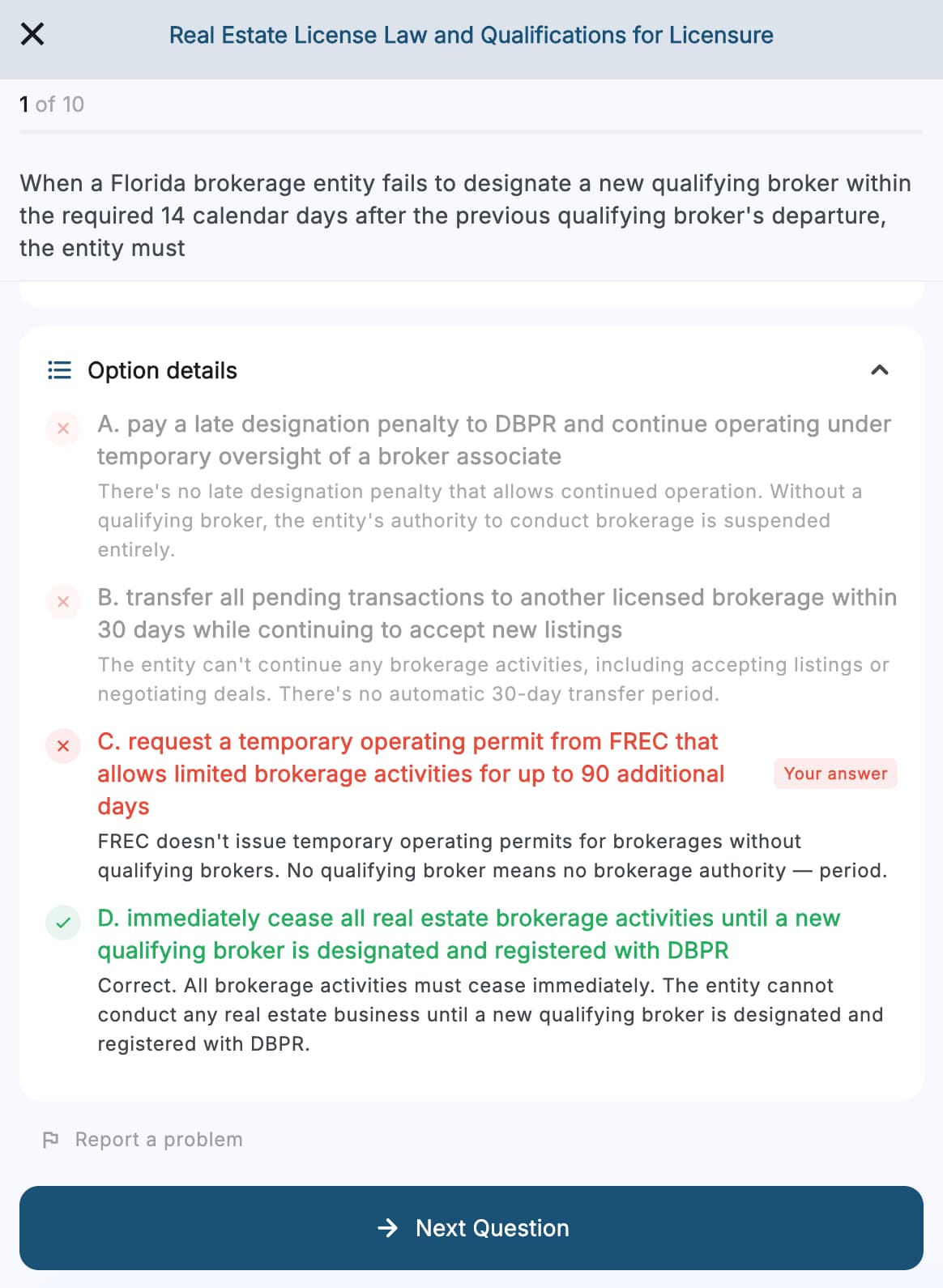
- If a brokerage has only one active broker and that broker dies, resigns, or is unexpectedly unable to remain active, the vacancy must be filled within 14 calendar days.
- During that vacancy period, no new brokerage business may be performed until a new active or temporary broker is appointed and registered.
- If another active or temporary broker is not appointed within 14 calendar days, the brokerage registration is canceled automatically and related broker associate / sales associate licenses become inactive.
- A temporary broker may be registered for up to 60 days while the brokerage completes the permanent-broker registration process.
- If the brokerage has more than one active broker and one leaves, the brokerage registration is not affected by that vacancy.
The exam trap. A common stem reads: "ABC Realty LLC's only broker dies on a Tuesday. The LLC can keep taking new listings during the vacancy while it finds a replacement." That is wrong. The rule is not an ordinary operating grace period. The brokerage has a short vacancy process, but no new brokerage business may be performed until a new active or temporary broker is appointed and registered.
F.S. 475.161: the individual licensee's professional entity (different concept)
F.S. 475.161 lets a sales associate or broker associate hold a personal license through an authorized professional entity, but it does not let that licensee register the entity as a brokerage firm.
This is the most-confused point in the topic. F.S. 475.15 governs brokerage entity registration. F.S. 475.161 is a different statute that governs how an individual licensee (broker associate or sales associate) may hold their personal license.
F.S. 475.161 permits a broker associate or sales associate to be licensed individually or, with Department of State authorization, through a professional corporation, LLC, or professional limited liability company. This means a sales associate named Maria can hold her individual real estate license through one of four forms:
| Form | When used |
|---|---|
| Individual (personal name) | Default; no Department of State filing needed |
| Professional Corporation (PC, P.C.) | For tax / liability purposes; requires Department of State authorization |
| Limited Liability Company (LLC) | For tax / liability purposes; requires Department of State authorization |
| Professional Limited Liability Company (PLLC) | For tax / liability purposes; requires Department of State authorization |
This is not a brokerage entity. Maria's personal-license PC, PA, LLC, or PLLC does not transact real estate business as a brokerage. It is only the legal vehicle through which Maria holds her personal license for tax and liability purposes. Maria still works for a registered brokerage; her personal-license entity is a wrapper around her individual license, not an independent brokerage. Course materials may use PA or PC language for the professional-corporation path; the statutory concept is the same for exam purposes.
F.S. 475.161 also makes the boundary explicit: using a personal professional entity does not allow a broker associate or sales associate to register or be licensed as a general partner, member, manager, officer, or director of a brokerage firm under F.S. 475.15.
The exam distinction. F.S. 475.15 = brokerage entity registration. F.S. 475.161 = individual licensee's personal entity wrapper. The two often appear in the same exam topic but answer different questions.
| Question | Statute |
|---|---|
| "Which entity types may register as a Florida brokerage?" | F.S. 475.15 |
| "May a sales associate hold her personal license through a PA?" | F.S. 475.161 (yes, with Department of State authorization) |
| "May a sales associate's PA register as a brokerage?" | Combined: no. F.S. 475.15 requires at least one active broker member, and a sales associate's PA still has only the sales associate, not a broker |
Trade names under F.S. 475.42(1)(j) and the Florida Fictitious Name Act
A Florida broker using a trade name needs FREC notation under F.S. 475.42(1)(j), and a separate Sunbiz fictitious-name registration may also be required under F.S. 865.09.
A trade name, also called a fictitious name or DBA name, is the business name a broker uses publicly that differs from the broker's personal or entity legal name.
F.S. 475.42(1)(j) prohibits a broker from operating under a trade name unless the trade name is noted in FREC records and placed on the broker's license. This creates a two-step registration requirement for any Florida broker operating under a trade name:
| Step | What it requires |
|---|---|
| 1 | FREC notation under F.S. 475.42(1)(j). The trade name must be noted in FREC records and placed on the broker's license. |
| 2 | Florida Fictitious Name Act registration under F.S. 865.09. Most trade names also require separate fictitious name registration with the Florida Division of Corporations (Sunbiz). |
The two registrations are independent. A broker who registers a fictitious name with Sunbiz but does not notify FREC has not complied with F.S. 475.42(1)(j). A broker who notifies FREC but does not register the fictitious name with Sunbiz has not complied with F.S. 865.09.
Exam pattern. A stem describes a broker who registers "Smith Premier Realty" as a fictitious name with the Florida Division of Corporations and starts advertising. The exam asks whether the broker has fully complied with Florida brokerage rules. The answer is no: the broker must also cause the trade name to be noted in FREC records and placed on the license under F.S. 475.42(1)(j). Sunbiz registration alone is not enough.
Office requirements under F.S. 475.22
F.S. 475.22 requires each active Florida broker to maintain at least one enclosed room in a building of stationary construction, with the required broker sign.
The office must display the required sign at the principal office and any branch location:
| Sign requirement | Details |
|---|---|
| Easily observed and read | Must be observable by any person about to enter the office |
| Broker's name | Required on the sign |
| Trade name | If any trade name is used, it must appear on the sign |
| Partnership / corporation name | Firm name or trade name plus at least one broker's name |
| License designation | The phrase "licensed real estate broker" or "lic. real estate broker" must appear |
Out-of-state office requirement. If the broker's registered office is outside Florida, the broker must "agree in writing to cooperate" with departmental investigations. Failure to substantially comply with notices or requests by certified mail violates F.S. 475.25.
Exam pattern. A stem describes a broker who operates entirely from a coffee shop or a virtual address. The question asks whether the broker complies with F.S. 475.22. The answer is no: the statute requires "at least one enclosed room in a building of stationary construction." A coffee shop is not a building of stationary construction occupied for the broker's use, and a virtual address with no physical space does not satisfy the requirement.
Branch offices under F.S. 475.24
F.S. 475.24 requires branch-office registration when a licensee conducts brokerage business at another qualifying place of business.
Each branch office also needs the same sign required at the principal office: broker's name, trade name if used, and license designation.
Exam pattern. A stem describes a brokerage with three offices in three counties. The question asks how many office registrations are required. The answer is three: one principal office plus two branch offices. Each branch must be separately registered with FREC and display the required sign.
Entity registration vs trade name vs office vs employment (comparison matrix)
Entity registration, trade-name notation, fictitious-name registration, office registration, branch registration, employment registration, and personal license entities are separate concepts.
The registration concepts often appear together in a stem and are easily confused. This matrix distinguishes them.
| Concept | What it registers | Statutory anchor | Required for |
|---|---|---|---|
| Brokerage entity registration | A specific entity (corporation / LLC / LLP / partnership) as a real estate brokerage with FREC | F.S. 475.15 | Any entity-form brokerage; sole proprietorships skip this |
| Trade name registration (FREC notation) | The trade name noted in FREC records and placed on the license | F.S. 475.42(1)(j) | Any broker operating under a name different from the legal entity / personal name |
| Fictitious name registration (Sunbiz) | The fictitious name registered with the Florida Division of Corporations | F.S. 865.09 (Florida Fictitious Name Act) | Most trade names; separate from FREC notation |
| Office registration | The physical principal office location with FREC | F.S. 475.22 | Every active broker |
| Branch office registration | Each additional place of business that must be registered as a branch office | F.S. 475.24 | Additional brokerage business locations when the statutory branch-office test is met |
| Employment registration | A sales associate's or broker associate's employer (broker or brokerage entity) | F.S. 475.01(1) and FREC rules | Every sales associate and broker associate |
| Individual licensee's PC / PA / LLC / PLLC | The personal entity wrapper around an individual broker associate or sales associate license | F.S. 475.161 | Optional; only if the licensee wants to hold their personal license through an authorized professional entity |
The trap pattern. A stem says "the broker registered XYZ Realty LLC with the Florida Division of Corporations and listed the office address on the LLC formation." The candidate assumes that satisfies all Florida registration requirements. It does not. The LLC also needs F.S. 475.15 registration with FREC; the trade name (if XYZ Realty differs from the LLC's legal name) needs F.S. 475.42(1)(j) notation; the office needs F.S. 475.22 sign compliance. Four separate registration paths.
PRACTICE THE RULE IN CONTEXT
Train the four-part entity + qualifying broker + trade name + office framework.
Turn the Florida rule into a scenario: identify the actor, required action, deadline, and disciplinary consequence before selecting the answer.
Four ways the exam can ask this (with tempting wrong-answer patterns)
The exam usually asks this topic through four patterns: cannot-register entities, a sales associate's LLC, the missing qualifying broker, or the trade-name registration trap.
Pattern 1: The "cannot register" five-entity question
Stem shape. A multiple-choice question lists five entity forms and asks which one cannot register as a Florida real estate brokerage. The correct answer is one of: corporation sole, joint venture, business trust, cooperative association, or unincorporated association.
Tempting wrong-answer pattern. "Sole proprietorship" sometimes appears as a distractor. Sole proprietorship is technically not a registrable entity (because there is no separate entity to register), but the exam usually scores the "cannot register" answer as one of the five not-in-F.S.-475.15 entity forms above, not sole proprietorship. Read the exact stem to confirm the framing.
Pattern 2: The sales associate's LLC
Stem shape. A sales associate forms an LLC with herself as the only member and wants to register the LLC with FREC as a brokerage.
Correct answer. The LLC cannot be registered as a Florida brokerage because there is no active broker member. F.S. 475.15 requires at least one active broker member. A sales associate is not a broker.
Tempting wrong-answer pattern. "Yes, the LLC can register because F.S. 475.15 allows LLCs." Correct that LLCs are permitted entity types under F.S. 475.15; incorrect that this specific LLC qualifies, because the active broker member requirement is not met.
Pattern 3: The qualifying broker who leaves
Stem shape. ABC Realty LLC has one active broker who dies, retires, or has their license revoked. What happens to the LLC's brokerage registration?
Correct answer. The entity is in a sole-broker vacancy posture. F.S. 475.15 contains the automatic-cancellation rule, and F.A.C. 61J2-5.018 gives the current vacancy process: fill the vacancy within 14 calendar days, perform no new brokerage business during the vacancy, and use a temporary broker for up to 60 days if properly registered.
Tempting wrong-answer pattern. Any answer that treats the vacancy window as a free operating grace period. The safer exam answer is: no active broker means immediate operational risk, no new brokerage business, and urgent compliance with the FREC vacancy / temporary-broker rule.
Pattern 4: The trade name dual registration
Stem shape. A broker registers a fictitious name with the Florida Division of Corporations (Sunbiz) and starts advertising. Has the broker fully complied with Florida brokerage trade name rules?
Correct answer. No. F.S. 475.42(1)(j) separately requires the trade name to be noted in FREC records and placed on the broker's license. Sunbiz fictitious name registration under F.S. 865.09 does not satisfy F.S. 475.42(1)(j).
Tempting wrong-answer pattern. "Yes, Florida Fictitious Name Act registration is sufficient." Incorrect. The broker has two separate registration obligations: FREC notation under F.S. 475.42(1)(j) and Sunbiz fictitious name registration under F.S. 865.09.
Worked-scenario walkthrough: the Sally sales associate forms XYZ Realty LLC
Sally's LLC cannot register as a Florida brokerage while Sally is only a sales associate because F.S. 475.15 requires at least one active broker member.
The stem. Sally is a Florida sales associate currently working under Broker Tom at Tom's brokerage. Sally wants to start her own real estate business. She forms "XYZ Realty LLC" with the Florida Division of Corporations, with herself as the only member. She files for a federal EIN and opens a business bank account. She wants to register XYZ Realty LLC with FREC as a brokerage and start taking listings. What is the legal framework?
Step 1: Identify the central framework. This is a brokerage entity registration question. F.S. 475.15 controls.
Step 2: Apply the F.S. 475.15 registrable-entities test. Is LLC a registrable entity? Yes. LLC is one of the four registrable entity types under F.S. 475.15. So far so good.
Step 3: Apply the active broker member requirement. Does XYZ Realty LLC have at least one active broker member? No. Sally is a sales associate, not a broker. The LLC has no broker member. F.S. 475.15 requires that "at least one active broker member" be licensed; without that, the registration would be canceled automatically. Therefore, XYZ Realty LLC cannot be registered with FREC as a brokerage.
Step 4: What Sally actually needs to do.
| Step | What | Why |
|---|---|---|
| 1 | Get her broker license first | A sales associate cannot register a brokerage. Sally needs to complete sales associate post-licensing if applicable, meet the broker experience requirement (typically 24 months active sales associate experience during the preceding 5 years), complete the broker pre-license course, and pass the broker state exam before she can be the qualifying broker of any entity. |
| 2 | Then register XYZ Realty LLC with FREC | Once Sally is a broker, the LLC can register under F.S. 475.15 with Sally as the active broker member. |
| 3 | Register a trade name if "XYZ Realty" differs from the LLC's legal name | Trade name must be noted in FREC records under F.S. 475.42(1)(j) and registered with Sunbiz under F.S. 865.09 if it qualifies as a fictitious name. |
| 4 | Set up the office | F.S. 475.22 requires at least one enclosed room in a building of stationary construction, with the required sign. |
| 5 | Until then, work for Tom or another broker | Sally remains a sales associate under Broker Tom's brokerage until her own broker license issues. She cannot list properties through XYZ Realty LLC before then. |
Step 5: What if Sally tries to operate XYZ Realty LLC before getting her broker license? This is unlicensed activity under F.S. 475.42 and exposes Sally to discipline under F.S. 475.25 and potential criminal liability under F.S. 475.42 (operating a brokerage without proper licensure). Forming an LLC at Sunbiz does not grant Florida brokerage authority; FREC registration of the LLC is a separate process that requires an active broker member.
The realistic decision tree for Sally.
| Option | Practical reality |
|---|---|
| Register XYZ Realty LLC with FREC now | Cannot. No active broker member; the LLC fails F.S. 475.15. |
| Operate "XYZ Realty LLC" as a real estate business now | Unlicensed brokerage activity. Discipline and criminal exposure. |
| Have Broker Tom be the qualifying broker of XYZ Realty LLC | Possible if Tom agrees to be the qualifying broker and is added as an active broker member. Sally would still be a sales associate working under the entity, not its owner-broker. |
| Get her broker license, then register XYZ Realty LLC | The clean path. Takes time (post-license + experience + broker exam) but creates a valid brokerage entity that Sally herself controls. |
The expensive mistake. Sally's most expensive mistake would be assuming that forming an LLC at Sunbiz creates Florida brokerage authority. It does not. Sunbiz is the entity formation step; FREC registration under F.S. 475.15 is a separate licensing step that requires an active broker member. Confusing the two is the most common source of unintentional unlicensed activity.
What the worked scenario shows. Brokerage entity registration requires three things in sequence: (1) the entity exists at Sunbiz, (2) an active broker is a member, (3) the entity is registered with FREC under F.S. 475.15. Missing any of the three is fatal to the registration. The "qualifying broker" piece is the most common candidate trap because Sunbiz lets anyone form an LLC, but Florida real estate law requires the broker to be inside it.
Common candidate mistakes
The most common mistakes are mixing F.S. 475.15 with F.S. 475.161, treating Sunbiz formation as FREC registration, and forgetting that a brokerage entity needs an active broker member.
| Mistake | Why it happens | What to study instead |
|---|---|---|
| Treating sole proprietorship as "cannot register" in the F.S. 475.15 list | Sole proprietorship is not in the list, but for a different reason than the "five not allowed" entities | Sole proprietorship operates through the individual broker license, not through a separate entity registration |
| Confusing F.S. 475.15 (brokerage entity) with F.S. 475.161 (individual licensee's PC / PA / LLC / PLLC) | Both sections mention LLCs and corporations | F.S. 475.15 = brokerage entity registration; F.S. 475.161 = individual licensee's personal entity wrapper |
| Saying a sales associate can register an LLC as a brokerage | Sunbiz lets a sales associate form an LLC | F.S. 475.15 requires at least one active broker member; sales associate does not satisfy this |
| Assuming Sunbiz fictitious name registration is enough for a trade name | Sunbiz is the universal Florida fictitious-name venue | F.S. 475.42(1)(j) also requires FREC notation and placement on the license (two registrations, not one) |
| Saying a virtual office or coffee shop satisfies F.S. 475.22 | Modern remote work feels reasonable | F.S. 475.22 requires "at least one enclosed room in a building of stationary construction" (a virtual address does not qualify) |
| Treating the sole-broker vacancy process as a free grace period | The 14-day rule sounds like permission to keep operating normally | F.A.C. 61J2-5.018 requires no new brokerage business during the vacancy until a new active or temporary broker is registered |
| Counting "joint venture" or "business trust" as registrable because they sound business-like | They are real business forms in other contexts | They are not in the F.S. 475.15 list; not registrable as Florida brokerages |
| Forgetting that each branch office may require separate registration | The principal office feels like "the brokerage" | F.S. 475.24 controls branch-office registration; F.S. 475.22 controls office and sign requirements |
Frequently Asked Questions
What entity types can register as a Florida real estate brokerage?
Under F.S. 475.15, partnerships, limited liability partnerships, limited liability companies, and corporations can register as Florida brokerage entities. For limited partnerships, only the general partners must be licensed brokers.
What entity types cannot register as a Florida real estate brokerage?
Corporation sole, joint venture, business trust, cooperative association, and unincorporated association cannot register as Florida real estate brokerages because they are not listed in F.S. 475.15.
Can a sole proprietorship operate as a Florida real estate brokerage?
Yes. A sole proprietorship is the individual active broker operating through the broker's own license, not a separate entity registration under F.S. 475.15. A trade name may still trigger FREC notation and Sunbiz fictitious-name requirements.
Can a sales associate register an LLC as a real estate brokerage?
No. A sales associate can form an LLC at Sunbiz, but F.S. 475.15 requires at least one active broker member before an LLC can register with FREC as a brokerage.
Who can serve as the qualifying broker of a Florida brokerage entity?
Only an active Florida broker can satisfy the active-broker-member requirement. A sales associate, broker associate, or inactive broker does not satisfy it.
What happens if the qualifying broker of a Florida brokerage entity dies, retires, or has their license revoked?
The entity enters a sole-broker vacancy posture. F.A.C. 61J2-5.018 gives a 14-calendar-day vacancy process, but no new brokerage business should be performed until a new active or temporary broker is appointed and registered.
What is the difference between F.S. 475.15 and F.S. 475.161?
F.S. 475.15 governs brokerage entity registration. F.S. 475.161 governs a sales associate's or broker associate's personal license wrapper, such as a professional corporation, LLC, or professional LLC.
What is the trade name registration requirement for Florida brokers?
F.S. 475.42(1)(j) requires a broker's trade name to be noted in FREC records and placed on the broker's license. F.S. 865.09 may also require separate fictitious-name registration with Sunbiz.
Does a broker need a physical office under Florida law?
Yes. F.S. 475.22 requires at least one enclosed room in a building of stationary construction, plus the required broker sign. A virtual address or coffee-shop setup is the wrong exam answer.
Does each branch office require separate registration?
Yes, when the F.S. 475.24 branch-office test is met. A brokerage with one principal office and two qualifying additional offices generally needs two branch registrations.
Can an out-of-state entity register as a Florida real estate brokerage?
Yes, subject to Florida brokerage registration and office rules. If the registered office is outside Florida, F.S. 475.22 adds a written cooperation requirement for department investigations.
What is the relationship between brokerage entity registration, trade name registration, office registration, and employment registration?
They are separate registrations. Entity registration covers the brokerage form, trade-name registration covers the public business name, office and branch registration cover locations, and employment registration ties a sales associate or broker associate to the brokerage.
Ready to drill business entities in scenario form?
Florida business entities appear on the exam as a four-part framework: entity registration + qualifying broker + trade name + office / branch office. The candidates who consistently answer correctly identify which part the stem tests, apply the right statute (F.S. 475.15 vs F.S. 475.161 vs F.S. 475.42(1)(j) vs F.S. 475.22 vs F.S. 475.24), and avoid the most common traps (sales associate registering an LLC, Sunbiz registration as the only step, virtual office, treating a sole-broker vacancy window as permission to keep operating normally). Drill the full content area with the free real estate business practice questions.
Before you leave, test the rule in a fresh Florida scenario and explain why the distractors fail.
Practice brokerage activities | Drill license-law qualifications | Practice violations and penalties | Take the free timed practice exam | Download Pass Florida
Methodology
This guide uses F.S. 475.15 (registration of partnerships, LLPs, LLCs, and corporations as brokerages + automatic cancellation when no active broker member is in force + emergency temporary registration authority for unexpected sole-broker loss), F.S. 475.17 (broker qualification, education, and experience framework), F.S. 475.161 (individual licensee's PC / LLC / PLLC option with Department of State authorization), F.S. 475.22 (office requirements: at least one enclosed room in a building of stationary construction + sign requirements + out-of-state office cooperation requirement), F.S. 475.24 (branch office registration), F.S. 475.42(1)(j) (trade name notation in FREC records and on the broker's license), F.S. 865.09 (Florida Fictitious Name Act framework), F.A.C. 61J2-5.018 (sole-broker vacancy / temporary-broker process), the DBPR Real Estate Sales Associate Candidate Information Booklet structure, the F.A.C. Chapter 61J2 FREC rules, and the Florida Division of Corporations (Sunbiz) entity formation process.
The four-part central framework (entity + qualifying broker + trade name + office), the registrable-vs-not entity tables, the F.S. 475.15-vs-475.161 distinction, the four exam patterns, the worked-scenario walkthrough, and the comparison matrix vs trade name vs office vs employment registration are practical study patterns derived from common candidate mistakes, not DBPR, FREC, Florida Department of State, or Sunbiz rules.
This article does not promise a passing result on the Florida sales associate examination, does not provide entity-formation advice, and does not replace official statutory text, qualified Florida business or real estate counsel, a CPA, the Florida Division of Corporations, DBPR, FREC, or any other professional guidance. Outcomes depend on candidate preparation, current statutory and rule updates, and entity-specific facts.
Product note. Pass Florida publishes this guide and offers the exam-prep app linked on this page. We do not claim to use copied exam questions, promise passage, or replace official DBPR, Florida Real Estate Commission (FREC), Pearson VUE, Florida Division of Corporations, pre-license provider, broker, qualified business or real estate counsel, CPA, or other professional guidance.
Sources
- F.S. 475.15, registration and renewal of partnerships, LLPs, LLCs, and corporations
- F.S. 475.17, qualifications for practice
- F.S. 475.161, licensing of broker associates and sales associates through professional entities
- F.S. 475.22, broker office requirements
- F.S. 475.24, branch office registration
- F.S. 475.42, violations and penalties (including trade name notation requirement at (1)(j))
- F.S. 475.25, discipline
- F.S. 865.09, Florida Fictitious Name Act
- F.A.C. 61J2-5.018, Vacancies of Office
- Florida Statutes Chapter 475, Part I (Real Estate Brokers and Sales Associates)
- DBPR Real Estate Sales Associate Candidate Information Booklet
This post is exam preparation content for Florida real estate sales associate candidates. It summarizes the F.S. 475.15 brokerage entity registration framework, the F.S. 475.161 individual licensee professional entity option, the F.S. 475.42(1)(j) trade name requirement, the F.S. 475.22 office requirement, the F.S. 475.24 branch-office rule, and the F.A.C. 61J2-5.018 sole-broker vacancy process. It is not a guarantee of passing the exam, not legal advice, not tax advice, not entity-formation advice, and not a substitute for the Florida Statutes, qualified Florida business or real estate counsel, a CPA, the Florida Division of Corporations (Sunbiz), DBPR, FREC, or any other professional guidance. Verify any statute, registration requirement, qualifying broker rule, trade name registration, office requirement, branch-office requirement, or vacancy rule against the primary source and the current FREC rules before forming or registering a brokerage entity. Pass Florida is an educational study tool sold for one $39.99 purchase with no subscription.