QUICK ANSWER
Florida has no state income tax, so there is no Florida state capital gains tax for individual sellers. When you sell Florida real estate as an individual, the capital gains tax you owe is federal only. Property held by a corporation or an entity taxed as a corporation can face Florida's separate corporate income tax. If you held the property more than one year, the gain is long-term and taxed at 0, 15, or 20 percent depending on your taxable income. If you held it one year or less, the gain is short-term and taxed at ordinary income rates. Sellers of a primary residence can exclude up to $250,000 of gain ($500,000 if married filing jointly) under Section 121 if they owned and lived in the home two of the last five years. Investors face depreciation recapture taxed up to 25 percent and can defer gain with a 1031 exchange. High earners may owe an extra 3.8 percent net investment income tax. This is educational information, not tax advice; confirm your numbers with a CPA.
"Capital gains tax on Florida real estate" sounds like it should have a Florida-specific answer. It mostly does not, and that is the good news. Florida is one of the states with no personal income tax, which means there is no separate state-level capital gains tax on the sale of your property. The tax you plan for is federal.
That does not make it free. Federal capital gains rules still apply, and for an appreciated Florida property the federal bill can be substantial. This guide walks the federal rates for 2026, the exclusion that wipes out the tax for many homeowners, and the rules that matter for rentals and investment property.
This is general educational content, not tax or legal advice. Real estate tax outcomes turn on specific facts, and the rules change. Run your actual numbers with a CPA or tax attorney before you sell.
What this guide covers
- Florida has no state capital gains tax
- Federal capital gains: short-term vs long-term
- The 2026 long-term rates
- The primary-residence exclusion
- How the gain is calculated
- Investment and rental property
- Inherited property and foreign sellers
- A worked example
- FAQ
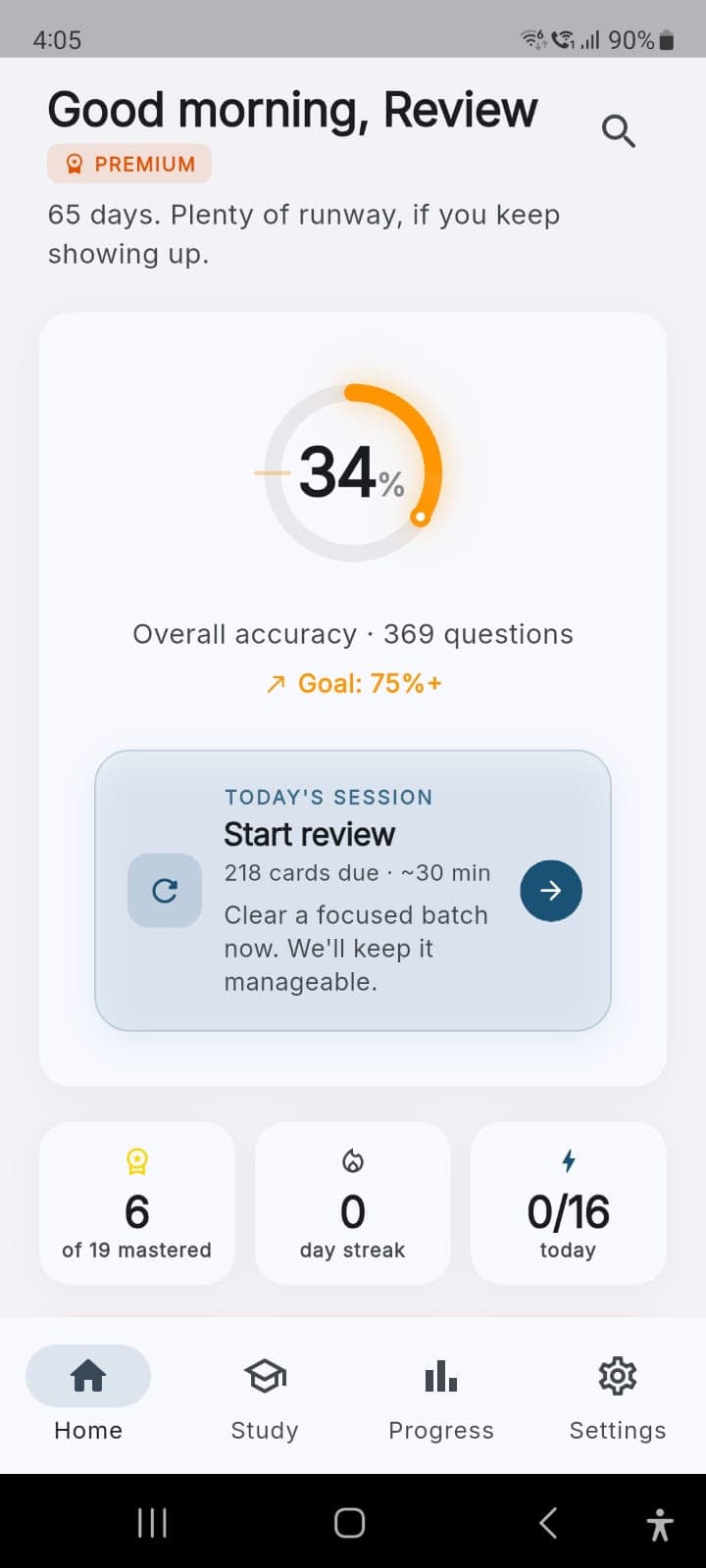
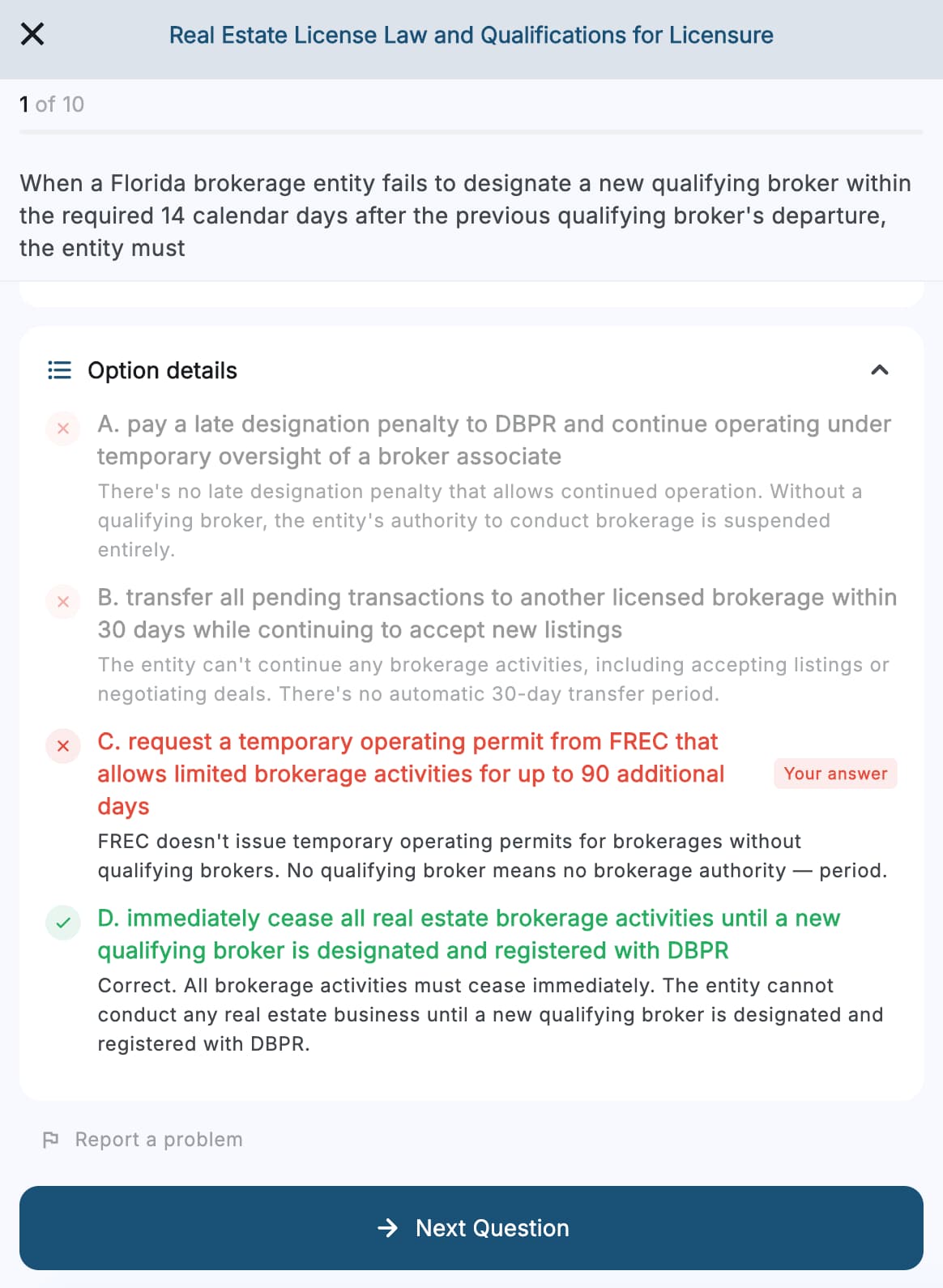
What Florida exam candidates need to know
For the Florida sales associate exam, study capital gains as a recognition and math topic, not as personal tax planning. You need to know basis, gain, depreciation, 1031 deferral, FIRPTA basics, and the difference between Florida taxes and federal income-tax rules.
This page can attract seller and investor traffic, but the exam-prep use case is narrower. Focus on these testable ideas:
| Exam idea | What to remember | Where to practice next |
|---|---|---|
| Basis and gain | Gain is net sale price minus adjusted basis | profit, loss, and basis math |
| Appreciation and depreciation | Depreciation affects adjusted basis and tax treatment | appreciation and depreciation math |
| 1031 exchange | Investment-property gain can be deferred, not erased | Florida-specific exam content |
| Florida transfer taxes | Doc stamps are separate from capital gains tax | documentary stamps and closing costs |
| Tax vocabulary | Federal rules, Florida taxes, and closing costs are different buckets | Florida exam laws to memorize |
What changed for 2026
The federal long-term capital-gains thresholds increased for inflation. The core structure did not change: qualifying long-term gains still use 0, 15, or 20 percent rates, while short-term gains are taxed as ordinary income. Florida still does not impose a personal income tax on natural persons, and the federal Section 121 home-sale exclusion remains $250,000 for a qualifying single filer or $500,000 for qualifying married taxpayers filing jointly.
For exam preparation, the useful distinction is stable: separate federal capital-gains rules from Florida property taxes and documentary stamp taxes. For an actual sale, use the current IRS thresholds and obtain advice based on the seller's full tax situation.
Florida has no state capital gains tax
Florida has no personal income tax on natural persons, so an individual seller does not owe a separate Florida state capital gains tax on real estate profit.
Florida does not levy a personal income tax. The Florida Constitution prohibits a state income tax on natural persons, and capital gains are a form of income. So when you sell a house, condo, or investment property in Florida as an individual, no Florida state capital gains tax applies to the profit.
This is one of the reasons Florida is attractive to sellers and investors compared with high-income-tax states. A seller in California or New York can owe state capital gains tax on top of the federal bill. A Florida seller owes the federal portion only.
One scope note for the investor sections below: this guide is written for individual sellers. Florida does impose a state corporate income and franchise tax, so a property held by a corporation, or by an entity taxed as a corporation, can have Florida corporate income-tax consequences on a sale that an individual owner would not. If you hold Florida real estate inside a corporate structure, work the entity-level tax through with a CPA.
What Florida does tax is property while you own it (property tax) and certain transfers (documentary stamp taxes on the deed). Those are separate from capital gains. The capital gains question itself is answered at the federal level.
Federal capital gains: short-term vs long-term
Federal capital gains are short-term if you held the property one year or less and long-term if you held it more than one year.
Federal capital gains tax depends on how long you owned the property before selling.
| Holding period | Classification | How it is taxed |
|---|---|---|
| One year or less | Short-term | As ordinary income, at your regular federal income tax rate |
| More than one year | Long-term | At preferential rates of 0, 15, or 20 percent |
The one-year line is the single most important planning fact. Selling just before you cross one year of ownership can push the entire gain from preferential long-term rates into ordinary income rates, which are higher. Holding past the one-year mark before closing can change the tax meaningfully.
The 2026 long-term rates
For 2026, the IRS long-term capital gains thresholds put single filers in the 0 percent bracket up to $49,450 and married joint filers up to $98,900, with higher taxable income moving into 15 percent or 20 percent treatment.
Long-term capital gains use their own brackets, separate from ordinary income brackets. For 2026, the taxable-income thresholds are:
| Filing status | 0% rate | 15% rate | 20% rate |
|---|---|---|---|
| Single | Taxable income up to $49,450 | $49,451 to $545,500 | Above $545,500 |
| Married filing jointly | Taxable income up to $98,900 | $98,901 to $613,700 | Above $613,700 |
These thresholds are based on your total taxable income, including the gain, so a large real estate gain can push part of your income into a higher capital gains bracket in the year of sale. The figures adjust for inflation each year, so confirm the current-year numbers with the IRS or your CPA.
On top of these rates, a 3.8 percent net investment income tax can apply to capital gains when your modified adjusted gross income exceeds $200,000 (single) or $250,000 (married filing jointly). Those net investment income tax thresholds are not indexed for inflation, so more sellers cross them over time.
The primary-residence exclusion
Section 121 can exclude up to $250,000 of gain for a single filer or $500,000 for married filing jointly when the ownership and use tests are met.
The rule that eliminates capital gains tax for most homeowners is the Section 121 exclusion. If the property you sold was your primary residence, you can exclude up to:
- $250,000 of gain if you file single
- $500,000 of gain if you are married filing jointly
To qualify, you generally must have owned the home and used it as your main residence for at least two of the five years before the sale (the ownership and use tests, often called the two-out-of-five-year rule). The two years do not have to be continuous.
The full $500,000 joint exclusion has stricter conditions than many sellers assume. To claim it, generally one spouse must meet the two-year ownership test, both spouses must meet the two-year residence and use test, and neither spouse can have used the Section 121 exclusion on another home sale within the two years before this sale. If only one spouse meets the use test, the couple is typically limited to the $250,000 amount.
Only gain above the exclusion is taxed. A married couple with a $400,000 gain on a primary residence they qualified on typically owes no federal capital gains tax, because the gain is under the $500,000 exclusion. A partial exclusion can apply if you sell early because of a work move, health reasons, or certain unforeseen circumstances. The exclusion generally does not apply to investment or rental property that was never your primary residence.
How the gain is calculated
Capital gain is net sale price minus adjusted basis, not sale price by itself.
Capital gain is not your sale price. It is your profit over your adjusted basis.
The basic structure:
- Start with your cost basis: what you paid for the property, plus buying costs and capital improvements (a new roof, an addition, a renovation, not routine repairs).
- Subtract depreciation you claimed or could have claimed if it was a rental or had a home office.
- The result is your adjusted basis.
- Gain equals the net sale price (sale price minus selling costs such as the real estate commission) minus adjusted basis.
This is the same gain-over-basis logic tested on the real estate exam. Keeping records of improvements raises your basis and lowers your taxable gain, which is why receipts matter. The profit, loss, and basis math guide walks the calculation in exam form, and the exam math formulas guide covers the related computations. If the question moves into investment analysis, pair this with income approach practice.
Investment and rental property
Rental and investment property can add depreciation recapture, Section 1031 deferral, and net investment income tax issues on top of the basic gain calculation.
Rental and investment property follows the same long-term and short-term framework, with two extra layers.
- Depreciation recapture. While you owned a rental, you deducted depreciation. When you sell, the portion of the gain attributable to that depreciation (unrecaptured Section 1250 gain) is taxed at a maximum rate of 25 percent, separate from the 0, 15, 20 percent rates on the rest of the gain.
- The 1031 exchange. A like-kind exchange under Section 1031 lets you defer capital gains tax by reinvesting the proceeds into another qualifying investment property within strict timelines (generally 45 days to identify and 180 days to close). It defers the tax, it does not erase it, and it applies to investment or business property, not your primary residence.
The 3.8 percent net investment income tax also commonly applies to gains on investment property for higher-income sellers. These rules are technical and the timelines on a 1031 are unforgiving, so an investor selling appreciated Florida property should plan with a CPA and a qualified intermediary before listing.
Inherited property and foreign sellers
Inherited property often starts with a stepped-up basis, while foreign sellers can trigger FIRPTA withholding at closing.
- Inherited property gets a stepped-up basis. When you inherit real estate, your basis is generally the fair market value at the date of death, not what the original owner paid. That step-up can erase most or all of the gain that built up during the prior owner's lifetime, so an heir who sells soon after inheriting often owes little capital gains tax.
- Foreign sellers face FIRPTA withholding. Under the Foreign Investment in Real Property Tax Act, the buyer generally must withhold a percentage of the sale price (commonly 15 percent) when the seller is a foreign person. This is withholding against the eventual tax, not the tax itself, and the seller reconciles it on a U.S. return. Florida's large share of foreign owners makes this a frequent closing issue.
A worked example
The exam-style calculation starts with net sale price, subtracts adjusted basis, then applies any rule that changes what is taxable.
A married couple sells their Florida primary residence.
- Sale price: $750,000
- Selling costs (commission and closing): $50,000
- Net sale price: $700,000
- Original purchase price: $300,000
- Capital improvements over the years: $80,000
- Adjusted basis: $380,000
- Gain: $700,000 minus $380,000 equals $320,000
Because they owned and lived in the home two of the last five years and file jointly, they apply the $500,000 exclusion. Their $320,000 gain is fully under $500,000, so their federal capital gains tax on the sale is $0. Florida adds no state capital gains tax either way.
Change one fact: make it a rental they never lived in, with $90,000 of depreciation claimed. Now there is no Section 121 exclusion, the $90,000 of depreciation is taxed as recapture up to 25 percent, and the rest of the gain is taxed at their long-term rate, possibly plus the 3.8 percent net investment income tax. Same property, very different bill. This is why the primary-residence question drives the whole outcome.
THESE CONCEPTS ARE ON THE EXAM
Basis, capital gains, depreciation, and 1031 exchanges all show up on the Florida real estate exam.
Keep federal capital-gains rules separate from Florida licensing and exam-prep questions, and verify personal tax decisions with a qualified tax professional.
Frequently Asked Questions
Does Florida have a state capital gains tax?
No, not for individual sellers. Florida has no personal income tax, and capital gains are income, so there is no Florida state capital gains tax on an individual's sale. Selling Florida real estate as an individual, you plan only for the federal capital gains tax. Property held by a corporation or an entity taxed as a corporation can face Florida's corporate income tax.
What is the capital gains tax rate on Florida real estate?
There is no state rate. Federally, a property held more than one year is taxed at 0, 15, or 20 percent depending on your taxable income, plus a possible 3.8 percent net investment income tax for higher earners. Held one year or less, the gain is taxed at ordinary income rates.
How much can I exclude when I sell my Florida home?
If it was your primary residence and you owned and lived in it two of the last five years, you can exclude up to $250,000 of gain if single, or $500,000 if married filing jointly. Gain above that is taxed federally.
Do I pay capital gains tax if I sell a rental property in Florida?
Assuming individual ownership, there is still no Florida state tax. Federally, you owe long-term or short-term capital gains tax on the gain, plus depreciation recapture taxed up to 25 percent on the depreciation you took, and possibly the 3.8 percent net investment income tax. A 1031 exchange can defer the tax if you reinvest in qualifying property within the deadlines. If the rental is held in a corporation or an entity taxed as a corporation, Florida corporate income tax can apply.
How is the gain calculated?
Gain is your net sale price (sale price minus selling costs) minus your adjusted basis. Adjusted basis is your purchase price plus capital improvements minus depreciation claimed. Selling price alone is not the gain.
Do I owe capital gains tax on inherited Florida property?
Often little or none, because inherited property generally gets a stepped-up basis to its fair market value at the date of death. If you sell soon after inheriting, there may be little gain above that stepped-up basis.
What is FIRPTA?
The Foreign Investment in Real Property Tax Act requires a buyer to withhold a percentage of the sale price (commonly 15 percent) when the seller is a foreign person. It is withholding toward the eventual tax, reconciled on a U.S. tax return, not an extra tax.
This post is exam preparation content for the Florida Real Estate Sales Associate exam. It is not legal, tax, financial, lending, appraisal, brokerage, insurance, title, closing, or professional advice. Federal capital gains rules, IRS treatment, primary-residence exclusions, 1031 provisions, and Florida tax law can change, and individual tax outcomes depend on personal circumstances. For real-world decisions, verify against the current primary source and consult a qualified licensed Florida professional. Studying with Pass Florida or any other exam-prep tool does not guarantee passage of the state exam.
Methodology
Florida's lack of a personal income tax (and therefore a state capital gains tax) reflects the Florida Constitution's prohibition on a state income tax on individuals. The 2026 federal long-term capital gains brackets (0 percent maximum amount of $49,450 single and $98,900 married filing jointly, 15 percent through $545,500 single and $613,700 married filing jointly, and 20 percent above those amounts) are from IRS Rev. Proc. 2025-32, Section 3.03. The Section 121 primary-residence exclusion ($250,000 single, $500,000 married filing jointly, with the two-of-five-year ownership and use tests), the unrecaptured Section 1250 depreciation recapture rate (up to 25 percent), the Section 1031 like-kind exchange deferral, the 3.8 percent net investment income tax thresholds ($200,000 single, $250,000 married filing jointly), and FIRPTA withholding come from the Internal Revenue Code and IRS guidance. Federal thresholds adjust for inflation and tax law changes, so verify current-year figures with the IRS and a tax professional.
Product note. Pass Florida is our Florida-specific exam prep app for the sales associate exam. The exam tests related concepts (basis, capital gains, depreciation, and 1031 exchanges), which is why this topic overlaps with our content. The app prepares you for the exam. It is not a tax tool, does not provide tax advice, and does not compute your tax liability. We do not claim to use copied exam questions or guarantee passage.
This post is educational content about how capital gains tax applies to Florida real estate. It is not tax, legal, or accounting advice. Tax outcomes depend on your specific facts, and federal rates, thresholds, exclusions, and rules change. Confirm your situation with a CPA or tax attorney before selling. Pass Florida is an exam-prep app, not a tax advisor.
Sources
- Florida Constitution, Article VII, Section 5, the prohibition on a personal income tax on natural persons and the authorization of the corporate income tax
- Florida Department of Revenue, Corporate Income Tax, Florida's corporate income and franchise tax
- IRS Rev. Proc. 2025-32, Section 3.03, the 2026 long-term capital gains maximum zero-rate and 15-percent-rate amounts
- IRS Topic No. 409, Capital Gains and Losses
- IRS Topic No. 701, Sale of Your Home (Section 121 exclusion)
- IRS Publication 523, Selling Your Home
- IRS, Like-Kind Exchanges under Section 1031
- IRS, Net Investment Income Tax
- IRS, FIRPTA Withholding