VERIFY BEFORE RELYING
This guide explains how seller net proceeds and closing math are tested on the Florida sales associate real estate exam. It is exam-math coaching only, not closing-statement preparation, ALTA settlement-statement preparation, Closing Disclosure preparation, title-insurance advice, brokerage trust-accounting advice, lending, tax, or licensing advice and not a Department of Business and Professional Regulation (DBPR), Florida Real Estate Commission (FREC), Florida Department of Revenue (DOR), Consumer Financial Protection Bureau (CFPB), or Pearson VUE determination. The Florida Administrative Code at F.A.C. Rule 61J2-2.029 allocates 10 points to mathematics on the sales associate examination, and the current DBPR Sales Associate Candidate Information Booklet (CIB) lists Real Estate Related Computations and Closing of Transactions as Topic 9 at 6% of the 100-question exam. The Florida documentary stamp tax on deeds at F.S. Section 201.02 sets the load-bearing $0.70 per $100 or fractional part thereof rate outside Miami-Dade County. Miami-Dade County uses a separate rate (a $0.60 per $100 base rate, with most non-single-family deeds also carrying a $0.45 per $100 surtax); the exam does not typically test the Miami-Dade rate unless the stem names it. Real-world Florida closing statements involve specific statutory, regulatory, lender-document, title-commitment, ALTA settlement-statement, and TRID/CFPB Closing Disclosure requirements that licensed closing agents, title agents, attorneys, and lenders handle; this guide does not produce a closing statement, Closing Disclosure, or settlement statement. Real-world brokerage trust-account handling of seller proceeds, escrow deposits, and commission disbursement is governed by F.S. Chapter 475 and F.A.C. Chapter 61J2 escrow rules; this guide does not produce escrow guidance. The seller-side cost allocations referenced in exam-style stems (commission as seller-paid, deed stamps as seller-paid, note stamps and intangible tax as buyer-paid) reflect typical Florida exam-question conventions and not negotiable real-world cost allocations. Specific question counts, content weights, exam fees, the documentary stamp rate, Miami-Dade surtax rules, and calculator allowances can change between exam windows and rulemaking cycles; verify current allocations against the DBPR Sales Associate CIB, the F.A.C. Rule 61J2-2.029 text, the current F.S. Section 201.02 text, the current Florida DOR documentary stamp page, and current CFPB Regulation Z materials. The Seller Net Stack, Side Selector, Deed-Stamp Rounding rule, Seller Debits vs Seller Credits sign check, Step 1-5 procedure, What-Does-Not-Belong distractor list, Net-vs-Equity-vs-Profit lane table, 8-row wrong-answer trap diagnostic, 5-question fast practice loop, and embedded exam-style question are Pass Florida observational coaching pedagogy, not DBPR, FREC, DOR, CFPB, or Pearson VUE process documents.
QUICK ANSWER
Seller net proceeds equal sale price minus the seller's payoff, commission, deed stamps, seller-paid closing costs, and seller debit prorations, plus any seller credits. On the Florida exam, stack the seller-side deductions in order before calculating, because wrong answers often stop at equity or skip one closing cost. The exam-day shortcut: equity is sale price minus debt; seller net proceeds is sale price minus debt minus every seller-side selling cost (plus any seller credits). Equity is the floor; seller net proceeds sits below it.
WHO THIS GUIDE IS FOR
Florida sales associate exam candidates whose closing-math misses concentrate in seller-net-proceeds errors: stopping at equity (sale price minus payoff), skipping commission or deed stamps from the stack, importing buyer-side numbers (buyer's loan amount, buyer's down payment, buyer note stamps, buyer intangible tax) into the seller-side answer, reversing proration direction, or confusing a "credit to seller" with a "seller credit to buyer." Useful whether you are first-time studying closing math, drilling EXCEPT/NOT questions about which side of closing pays which cost, recovering from a Computations or Closing-of-Transactions miss on a practice exam, or a retake candidate whose score report flagged math. Pair with the seller net closing math guide for the broader equity-vs-net framing, the buyer funds needed at closing guide for the buyer-side counterpart, the commission math guide for the multi-party split-base sibling, the documentary stamps and closing costs guide for the F.S. 201.02 deep dive (including the Miami-Dade exception), the proration guide for the timing-direction sibling, the profit, loss, and equity math guide for the equity-vs-profit cross-reference, and the Florida real estate exam math formulas guide for the full archetype map, and the T-bar method guide for when a vertical stack beats a T-bar on closing math. Not closing-statement preparation, ALTA settlement preparation, title-insurance advice, brokerage trust-accounting advice, lending, tax, or licensing advice.
EXAM PREP ONLY
The Florida sales associate exam is a closed-book, computer-based licensing exam. DBPR's current Sales Associate CIB states 100 multiple-choice questions, three and a half hours, 19 content areas, and a passing grade of at least 75. The exam covers Florida real estate principles and practices, real estate law, real estate mathematics, F.S. Chapter 475 Part I, and F.A.C. Chapter 61J2. F.A.C. Rule 61J2-2.029 separately allocates 10 points to mathematics. This guide does not replace the required 63-hour FREC-approved pre-license course, DBPR application steps, Pearson VUE scheduling rules, fingerprinting, post-licensing, continuing education, legal advice, or official sources. Real-world Florida closing statements, settlement statements, brokerage trust-account handling, escrow deposits, and commission disbursement are limited to licensed closing agents, title agents, attorneys, lenders, and brokers operating within F.S. Chapter 475 and the F.A.C. Chapter 61J2 escrow rules; this guide does not substitute for any of that.
Sale price minus payoff minus commission minus deed stamps minus seller costs minus seller debit prorations plus seller credits.
Sale price minus payoff. Do not subtract commission or seller costs unless the final sentence asks for net.
Profit compares sale result to the seller's original cost or basis, not to the remaining loan balance.
Seller net proceeds questions look like a paragraph, not a formula. The stem may give sale price, mortgage payoff, commission, documentary stamps, prorations, seller costs, buyer costs, and maybe a buyer loan amount.
The exam skill is deciding which numbers belong to the seller's proceeds calculation, then walking every seller-side deduction in order before answering.
DBPR and Pearson VUE candidate materials organize the sales associate exam as 100 multiple-choice questions across 19 weighted content areas. Topic 9, Real Estate Related Computations and Closing of Transactions, is weighted at 6%. Seller net proceeds belongs in that closing-math bucket, but the same sorting habit also helps with proration, documentary stamps, buyer funds, and seller required sale price.
What this guide covers
- Official source map
- Exam concept vs real closing statement
- Side Selector: net proceeds, equity, or profit?
- The Seller Net Stack
- Step 1: start with sale price
- Step 2: subtract the payoff
- Step 3: subtract commission
- Step 4: subtract Florida deed stamps
- Deed-stamp rounding: each $100 or portion thereof
- Step 5: subtract seller costs and apply prorations
- Seller debits vs seller credits
- Seller net proceeds vs equity vs profit
- What usually does not belong in seller net
- Read the wrong answers
- Fast practice loop
- Exam-style question
- Frequently asked questions
Official Source Map
Use F.A.C. Rule 61J2-2.029 and the DBPR Sales Associate CIB for the exam structure and math weighting. Use F.S. Section 201.02 and the Florida Department of Revenue for the deed-stamp rate and the Miami-Dade exception. Use the Seller Net Stack, Side Selector, Deed-Stamp Rounding rule, Seller Debits vs Seller Credits sign check, and Net-vs-Equity-vs-Profit lane table in this guide as study coaching.
| Claim in this guide | Primary source | Why it matters |
|---|---|---|
| F.A.C. Rule 61J2-2.029 allocates 10 points to mathematics on the Florida sales associate examination | F.A.C. Rule 61J2-2.029, Examination Areas of Competency | The rule-level math weighting that anchors seller-net-proceeds questions inside the broader Florida math allocation |
| The DBPR Sales Associate CIB lists Topic 9 (Real Estate Related Computations and Closing of Transactions) at 6% of the 100-question exam, with seller-net-proceeds questions placed inside this topic | DBPR Sales Associate Candidate Information Booklet | The CIB topic-weighting that places seller-net-proceeds inside the Closing of Transactions content area |
| The Florida sales associate exam is closed book, 100 multiple-choice questions, three and a half hours, 19 content areas, with a passing grade of at least 75 | DBPR Sales Associate CIB and DBPR Real Estate Sales Associate Requirements | Sets the test-day structure within which math execution happens |
| The Florida documentary stamp tax on deeds is $0.70 per $100 (or fractional part thereof) of consideration outside Miami-Dade County; Miami-Dade County uses a separate $0.60 per $100 base rate, with most non-single-family deeds also carrying a $0.45 per $100 surtax | F.S. Section 201.02, Tax on deeds and other instruments relating to real property and Florida Department of Revenue, Documentary Stamp Tax | The load-bearing Florida-specific rate that drives the deed-stamp line in the Seller Net Stack |
| Real estate brokerage law that frames the exam content is in F.S. Chapter 475, Part I, and brokerage escrow handling is governed by F.A.C. Chapter 61J2 | F.S. Chapter 475, Florida Senate and F.A.C. Chapter 61J2, Florida Real Estate Commission | The statutory and rule backbone for the exam content and the real-world trust-account rules this guide hedges against |
| Pearson VUE administers scheduling, physical test-center delivery, calculator allowances, cancellation/rescheduling, and exam fee collection | Pearson VUE Florida Real Estate and Appraisers licensing exams | Calculator allowances and test-day procedure are governed by Pearson VUE |
| The Seller Net Stack, Side Selector, Deed-Stamp Rounding rule, Seller Debits vs Seller Credits sign check, Step 1-5 procedure, What-Does-Not-Belong distractor list, Net-vs-Equity-vs-Profit lane table, 8-row wrong-answer trap diagnostic, 5-question fast practice loop, and embedded exam-style question are exam-math study heuristics | Pass Florida coaching methodology | These are not DBPR, FREC, DOR, or Pearson VUE rules |
Exam Concept vs Real Closing Statement
Before stacking numbers, separate exam math from real closing work.
| Situation | What to rely on | Why it matters |
|---|---|---|
| Florida exam-style seller-net-proceeds question | The stem, the Seller Net Stack, seller-side deductions, and seller credits | The exam tests side selection and arithmetic, not live settlement-document preparation |
| Real Closing Disclosure or ALTA settlement statement | Lender, title company, closing agent, attorney, CFPB / TRID rules, title commitment, contract, and current tax rules | Real closing documents have prescribed disclosures, negotiated allocations, payoff letters, title charges, lender charges, and prorations |
| Real brokerage trust-account handling | Broker supervision, F.S. Chapter 475, F.A.C. Chapter 61J2, escrow instructions, and closing agent instructions | Seller proceeds and commission disbursement are not scratch-paper math in practice |
| Florida documentary stamp calculation (Miami-Dade vs outside) | F.S. Section 201.02 and Florida DOR documentary stamp guidance | The exam usually gives the outside-Miami-Dade $0.70/$100 convention; the Miami-Dade rate is different |
For the exam, the stem controls the universe. If the stem says deed stamps are seller-paid, subtract them. If the stem gives buyer loan taxes, ignore them for seller-net-proceeds unless the stem assigns them to the seller. In real closings, follow the contract, title and closing instructions, lender documents, and current law.
Side Selector: Net Proceeds, Equity, or Profit?
The first job is not calculation. The first job is identifying which lane the final sentence asks for.
| If the final sentence asks for... | Start with | Use | Ignore unless assigned |
|---|---|---|---|
| Seller net proceeds / net to seller | Sale price | Payoff, commission, deed stamps, seller closing costs, seller-debit prorations, seller credits | Buyer's loan amount, buyer's down payment, buyer note stamps, buyer intangible tax |
| Seller equity | Sale price or value | Debt / payoff only | Commission, deed stamps, closing costs (unless the final sentence asks for net) |
| Seller profit or loss | Cost or basis from the stem | Sale result compared with cost or basis, plus any stated improvements and selling costs | Loan payoff (unless the stem asks for cash after sale) |
| Buyer funds needed / cash to close | Buyer side of the closing | Purchase price, loan amount, deposit, buyer costs, buyer prorations | Seller payoff and seller commission |
If you choose the wrong lane, perfect arithmetic still produces a wrong answer. Circle the ask: net proceeds, equity, profit, or buyer funds.
The Seller Net Stack: Start With Sale Price
The Seller Net Stack starts with the sale price because seller net proceeds is the cash left from this sale after seller-side deductions.
Use this scratch-paper setup:
Sale price: ____
- Loan payoff: ____
- Commission: ____
- Deed stamps: ____
- Seller costs: ____
- Seller debit prorations: ____
+ Seller credits: ____
= Seller net proceeds: ____
Do not start with original purchase price. Do not start with the buyer's loan amount. Do not start with equity unless the question asks only for equity.
Step 1: Start With Sale Price
The seller-net-proceeds question always starts with the sale price the stem gives you. Write it at the top of the stack. Do not use original purchase price (that is profit math). Do not use the buyer's loan amount (that is buyer-side financing).
Step 2: Subtract The Payoff
The payoff is the seller's remaining mortgage debt. In a proceeds question, it comes out of the sale price.
Example:
Sale price: $410,000
- Payoff: $276,000
= $134,000
That $134,000 is equity before selling costs. It is not final seller net proceeds if the stem also gives commission, deed stamps, or seller costs.
The 1-line trap is simple: equity is not net proceeds.
Step 3: Subtract Commission
Commission usually uses the sale price as the base unless the stem gives a different agreement.
Example:
$410,000 x 0.06 = $24,600 commission
Now keep stacking:
$410,000 sale price
- $276,000 payoff
- $24,600 commission
= $109,400 before stamps and other costs
If the final sentence asks for net after payoff and commission only, stop there. If it gives more seller-side costs, keep going.
Step 4: Subtract Florida Deed Stamps If The Seller Pays Them
Florida deed documentary stamps are tied to the deed and sale price. F.S. Section 201.02 sets the standard rate at 70 cents per $100, or fractional part of $100, of consideration outside Miami-Dade County.
In many Florida exam-style seller-net questions, deed stamps are a seller-side deduction unless the stem allocates them differently.
For a $410,000 sale outside Miami-Dade:
$410,000 / $100 = 4,100 units
4,100 x $0.70 = $2,870 deed stamps
Add the deduction:
$410,000 sale price
- $276,000 payoff
- $24,600 commission
- $2,870 deed stamps
= $106,530 before other seller costs
If the stem says Miami-Dade, note stamps, mortgage stamps, or intangible tax, slow down. Deed stamps use sale price. Mortgage-related taxes use loan amount. Miami-Dade deed stamps use a different setup: the base rate is $0.60 per $100, and most non-single-family deeds also include a $0.45 per $100 surtax. Use the documentary stamps guide when that distinction is shaky.
Deed-Stamp Rounding: Each $100 or Portion Thereof
F.S. Section 201.02 and Florida DOR guidance use the phrase "each $100 or portion thereof" for deeds outside Miami-Dade. That means the taxable units round UP when the consideration is not an exact multiple of $100.
| Sale price / consideration | Taxable $100 units | Standard deed stamps outside Miami-Dade |
|---|---|---|
| $410,000 | 4,100 | 4,100 x $0.70 = $2,870.00 |
| $410,001 | 4,101 | 4,101 x $0.70 = $2,870.70 |
| $390,000 | 3,900 | 3,900 x $0.70 = $2,730.00 |
| $40,675 | 407 | 407 x $0.70 = $284.90 |
The exam often uses round numbers, but the phrase "or fractional part" matters. If the sale price is not cleanly divisible by $100, round the number of $100 units up before multiplying by $0.70. A $1 increase in sale price can shift the deed stamps by $0.70 if it crosses a $100 boundary.
Step 5: Subtract Seller Costs And Apply Prorations
Seller costs are only the costs the stem assigns to the seller. Seller debit prorations reduce seller net proceeds. Seller credit prorations increase them.
Continue the same example:
$410,000 sale price
- $276,000 payoff
- $24,600 commission
- $2,870 deed stamps
- $3,400 seller costs
= $103,130 seller net proceeds
Answer: $103,130
If the stem also says the seller owes the buyer a $1,200 property tax proration, subtract it:
$103,130 - $1,200 = $101,930
If the stem says the buyer owes the seller a $1,200 proration, add it instead. Direction matters as much as arithmetic.
Seller Debits vs Seller Credits
Seller net proceeds rises or falls based on whether the line is a debit to the seller or a credit to the seller.
| Line item | Seller net effect | Exam logic |
|---|---|---|
| Mortgage payoff | Subtract | Seller debt is paid from sale proceeds |
| Commission | Subtract | Usually seller-paid in exam-style stems unless allocated otherwise |
| Deed stamps on deed | Subtract when seller-paid | Often a seller-side deduction in Florida seller-net questions |
| Seller closing cost | Subtract | The stem assigns the cost to the seller |
| Seller debit proration | Subtract | Seller owes buyer for the seller's share of an unpaid item |
| Seller credit proration | Add | Buyer owes seller for the buyer's share of a prepaid item |
| Seller credit to buyer | Subtract | Seller gives money or value to the buyer at closing |
| Buyer credit to seller | Add | Buyer gives money or value to the seller at closing |
The language matters. A "credit to seller" increases seller net proceeds. A "seller credit to buyer" reduces seller net proceeds. The words are similar; the direction is opposite. Write the direction on scratch paper before the arithmetic.
Seller Net Proceeds vs Equity vs Profit
These three answers can come from the same paragraph. They are not interchangeable.
| Ask | Formula | In the $410,000 example |
|---|---|---|
| Equity | Sale price - payoff | $134,000 |
| Net after commission | Sale price - payoff - commission | $109,400 |
| Net after deed stamps | Sale price - payoff - commission - deed stamps | $106,530 |
| Seller net proceeds | Sale price - payoff - all seller-side deductions + seller credits | $103,130 |
| Profit | Sale result compared with cost or basis | Not enough facts in this stem |
If the answer choices include both equity and seller net, the equity answer is usually the trap that appears too early in the stack.
SELLER-SIDE NUMBERS ONLY
Train the stack until buyer-side noise stops pulling your eyes.
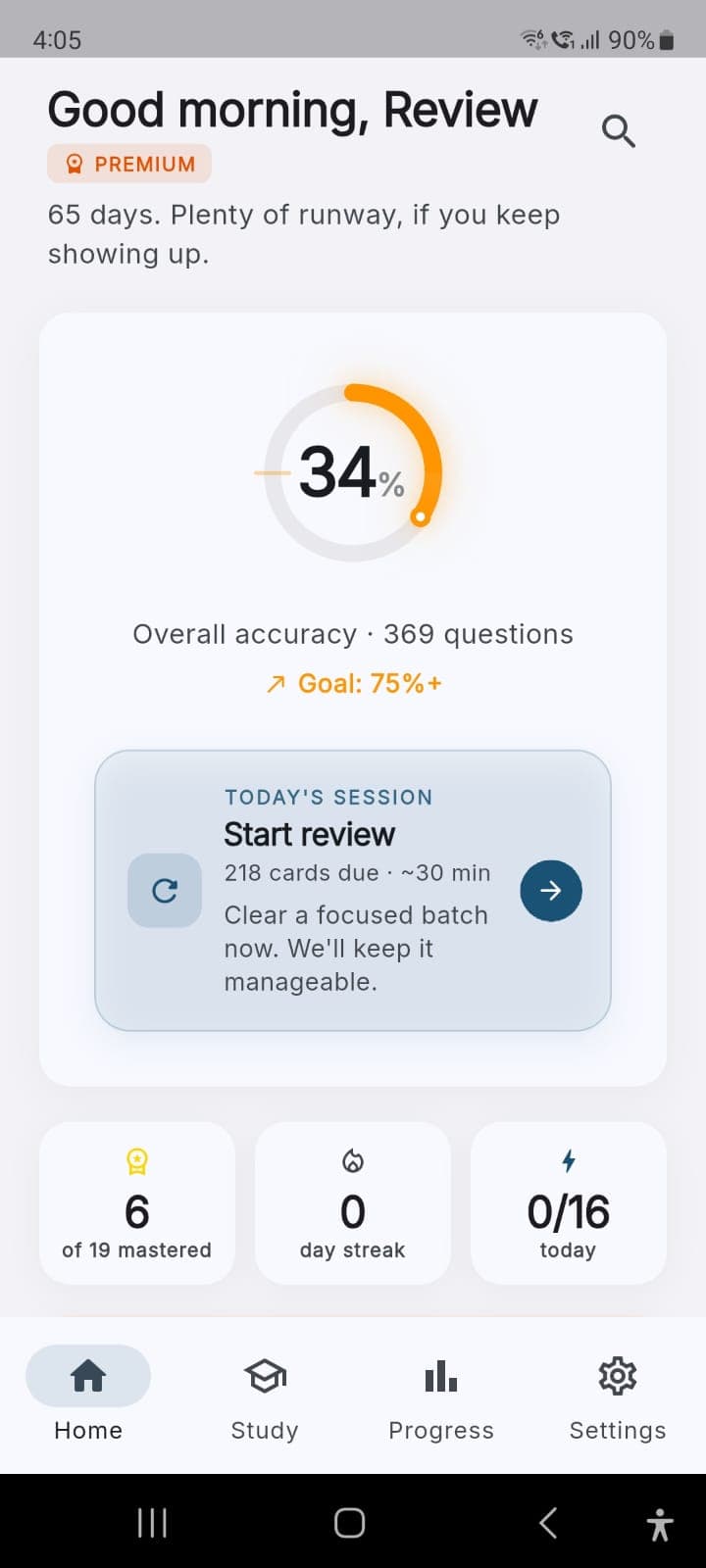
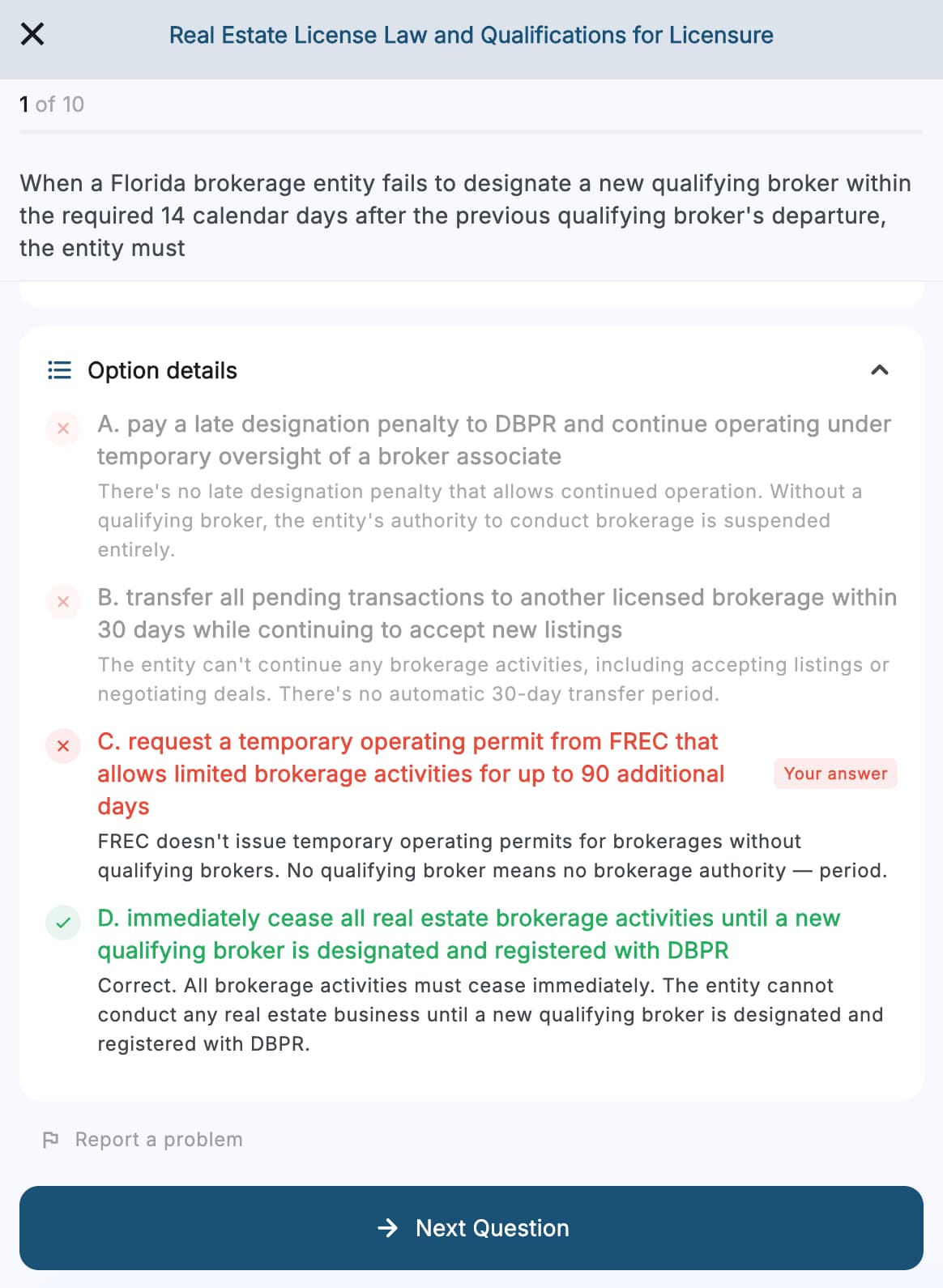
Pass Florida is exam prep only. Math Coach drills seller net, buyer funds, proration, deed stamps, commission, and mixed closing math across the 14 Florida math calculation types. Trap Library helps you name whether the miss came from equity confusion, a skipped deduction, buyer-side noise, sign reversal, or Miami-Dade-rate confusion. The app includes 1,142 Florida-specific practice questions and costs $39.99 once, with no subscription and no copied exam questions.
What Usually Does Not Belong In Seller Net
Seller net proceeds is seller-side math. Buyer-side financing facts usually do not reduce the seller's net.
| Fact in the stem | Usually use in seller net? | Why |
|---|---|---|
| Buyer's loan amount | No | It belongs to buyer financing |
| Buyer's down payment | No | It is not a seller deduction |
| Buyer note stamps | No | Usually buyer-side loan tax |
| Buyer intangible tax | No | Usually buyer-side loan tax |
| Appraised value | Usually no | Sale price controls the closing proceeds question |
| Earnest money deposit | Usually no | It affects buyer funds unless the stem asks otherwise |
| Seller credit to buyer | Yes | It reduces seller net if assigned to seller |
Follow the stem if it explicitly shifts a cost. The exam tests sorting, not real-world custom.
Read The Wrong Answers
Wrong answers in seller-net-proceeds questions are often earlier stops in the stack.
| Wrong answer pattern | What probably happened | Repair |
|---|---|---|
| Sale price minus payoff | Chose equity instead of seller net | Keep subtracting seller-side costs |
| Net after commission only | Stopped before deed stamps and other costs | Read the full final sentence |
| Included buyer loan taxes | Used buyer-side numbers as seller deductions | Label buyer vs seller |
| Forgot deed stamps | Skipped Florida closing-cost math | Check whether the stem assigns deed stamps |
| Added seller debit proration | Reversed proration direction | Debit reduces net, credit increases net |
| Used purchase price | Solved profit instead of proceeds | Seller net starts with sale price |
| Used loan amount for commission | Chose the wrong base | Commission usually uses sale price |
| Sign flipped on a "credit to" line | Confused "credit to seller" with "seller credit to buyer" | Words are similar, direction is opposite |
The wrong answer is often a correct calculation attached to the wrong label. That is the same diagnostic habit used in profit and equity math.
Fast Practice Loop
Answer these like exam questions. Then open the explanations.
Question 1: Payoff And Commission
A property sells for $360,000. The seller's payoff is $245,000, and commission is 6%. What is the seller net after payoff and commission?
A. $93,400
B. $115,000
C. $21,600
D. $338,400
Show answer
Correct answer: A. Commission is $360,000 x 0.06 = $21,600. Seller net after payoff and commission is $360,000 - $245,000 - $21,600 = $93,400.
Option B is equity before commission. Option C is commission only. Option D subtracts commission but forgets the payoff.
Question 2: Add Deed Stamps
A property sells for $390,000 outside Miami-Dade. The payoff is $260,000, commission is 5%, and standard deed stamps are charged at $0.70 per $100. What is the seller net before other costs?
A. $107,770
B. $130,000
C. $110,500
D. $115,570
Show answer
Correct answer: A. Commission is $390,000 x 0.05 = $19,500. Deed stamps are $390,000 / 100 x $0.70 = $2,730. Seller net is $390,000 - $260,000 - $19,500 - $2,730 = $107,770.
Option B is equity before selling costs. Option C skips deed stamps. Option D uses a 3% commission mistake instead of the 5% stated commission: $390,000 - $260,000 - $11,700 - $2,730 = $115,570.
Question 3: Seller Debit Proration
A seller's net before prorations is $108,600. The seller owes the buyer a tax proration of $1,450. What is the seller net after the proration?
A. $107,150
B. $110,050
C. $108,600
D. $1,450
Show answer
Correct answer: A. A seller debit reduces seller net: $108,600 - $1,450 = $107,150.
Option B adds a debit as if it were a credit. Option C ignores the proration. Option D gives only the proration amount.
Question 4: Buyer-Side Noise
A property sells for $450,000. The seller's payoff is $315,000, commission is 6%, seller costs are $3,800, and the buyer's loan amount is $360,000. What is the seller net?
A. $104,200
B. $135,000
C. $108,000
D. $59,200
Show answer
Correct answer: A. Commission is $450,000 x 0.06 = $27,000. Seller net is $450,000 - $315,000 - $27,000 - $3,800 = $104,200.
Option B is equity before commission and costs. Option C skips seller costs. Option D uses the buyer's loan amount as if it were the seller payoff: $450,000 - $360,000 - $27,000 - $3,800 = $59,200.
Question 5: Seller Credit
A seller's net before credits is $96,800. The stem says the buyer credits the seller $900 for unused prepaid HOA dues. What is the seller's net after the credit?
A. $97,700
B. $95,900
C. $96,800
D. $900
Show answer
Correct answer: A. A seller credit increases seller net: $96,800 + $900 = $97,700.
Option B treats a credit as a debit. Option C ignores the credit. Option D gives only the proration amount.
If you miss Questions 2 or 4, drill mixed closing math. If you miss Questions 3 or 5, review proration direction before doing more seller-net problems.
Exam-Style Question
A property sells for $460,000. The seller's payoff is $312,000. Commission is 5.5%. Standard deed stamps are $0.70 per $100. Seller closing costs are $2,900, and the seller owes the buyer a tax proration of $1,180. What are the seller's net proceeds?
A. $115,400
B. $148,000
C. $122,700
D. $116,580
Show answer
Correct answer: A.
Sale price: $460,000
- Payoff: $312,000
- Commission: $25,300
- Deed stamps: $3,220
- Seller costs: $2,900
- Seller debit proration: $1,180
= $115,400
Commission is $460,000 x 0.055 = $25,300. Deed stamps are $460,000 / 100 x $0.70 = $3,220.
Option B is equity before seller costs. Option C stops after payoff and commission. Option D skips the seller debit proration.
Key Takeaway
Seller net proceeds is a stack, not a single subtraction. Start with sale price, subtract the payoff, then subtract every seller-side deduction the stem gives you. If the answer choice appears before the bottom of the stack, it is probably a trap.
FAQ
What is the seller net proceeds formula on the Florida real estate exam?
Use sale price - payoff - seller deductions + seller credits = seller net proceeds. Seller deductions can include commission, deed stamps, seller closing costs, and seller debit prorations if the stem gives them.
Are seller net proceeds the same as equity?
No. Equity is sale price or value minus payoff. Seller net proceeds come after equity is reduced by commission, deed stamps, seller costs, prorations, and any other seller-side deductions in the stem.
Do I subtract commission from seller net proceeds?
Yes, if the question gives a commission or asks for net after commission. Commission usually uses sale price as the base unless the stem gives a different agreement.
Do I subtract Florida deed stamps from seller net?
Usually yes in a seller-net exam setup if the stem places deed stamps on the seller. Florida Statutes Section 201.02 gives the standard deed stamp rate as $0.70 per $100 or fractional part of $100 of consideration outside Miami-Dade. Miami-Dade County uses a separate $0.60 per $100 base rate with a $0.45 per $100 surtax on most non-single-family deeds. Follow the stem if it allocates the cost differently.
Do buyer note stamps and intangible tax reduce seller net?
Usually no. Buyer note stamps and intangible tax are buyer loan-cost facts in a typical exam setup. Do not subtract them from seller net unless the question explicitly assigns them to the seller.
How do prorations affect seller net proceeds?
Seller debit prorations reduce seller net. Seller credit prorations increase seller net. Write the direction in the stack before doing the arithmetic.
What is the difference between a "credit to seller" and a "seller credit to buyer"?
A "credit to seller" (also called a "buyer credit to seller") increases seller net proceeds because the buyer gives money or value to the seller at closing. A "seller credit to buyer" reduces seller net proceeds because the seller gives money or value to the buyer at closing. The words are similar; the sign is opposite.
What if the question asks for required sale price instead?
That is the backward version of seller net. If commission is the only deduction, divide the desired net by the percentage the seller keeps. If the stem adds payoff, deed stamps, fixed costs, or prorations, use a full required-sale-price setup or practice with the seller net and required sale price calculator.
Does Pass Florida replace my 63-hour course?
No. Pass Florida is exam preparation content, not a substitute for the FREC-approved 63-hour pre-license course, DBPR processes, Pearson VUE scheduling, or licensed professional advice. The app gives you 1,142 Florida-specific practice questions to help you prepare after and alongside your required coursework.
Ready to drill seller-net-proceeds discipline?
The Seller Net Stack is the single discipline that prevents most closing-math misses. The next score jump usually comes from drilling the sister-pair sibling that covers the broader seller-net framing, the buyer-side counterpart that uses the opposite stack, and adjacent math archetypes (commission split, proration direction, deed-stamp base) under the same start-with-sale-price / subtract-every-seller-deduction / ignore-buyer-side-noise pattern.
- Pair with the sister seller-net guide: Seller net closing math guide
- Pair with the buyer-side counterpart: Buyer funds needed at closing
- Pair with the deed-stamp deep dive: Documentary stamps and closing costs guide
- Try Florida-specific Math Coach drills: Try 5 questions
Methodology
This guide was written for Florida sales associate exam candidates. It focuses on how seller net proceeds appear in exam-style questions, including payoff, commission, deed stamps, seller costs, prorations, credits, sign discipline, and buyer-side distractors. The guide anchors the topic to F.A.C. Rule 61J2-2.029 (10 points to mathematics), the DBPR Sales Associate Candidate Information Booklet (CIB) Topic 9 framing (Real Estate Related Computations and Closing of Transactions at 6%), F.S. Section 201.02 (Florida documentary stamp tax at $0.70 per $100 outside Miami-Dade), and the Florida Department of Revenue documentary stamp guidance (including the Miami-Dade $0.60 per $100 base rate plus $0.45 per $100 surtax on most non-single-family deeds).
The Seller Net Stack, Side Selector, Deed-Stamp Rounding rule, Seller Debits vs Seller Credits sign check, Step 1-5 procedure, What-Does-Not-Belong distractor list, Net-vs-Equity-vs-Profit lane table, 8-row wrong-answer trap diagnostic, 5-question fast practice loop, and embedded exam-style question are Pass Florida observational coaching pedagogy and are not DBPR, FREC, DOR, CFPB, or Pearson VUE process documents.
Pass Florida is not affiliated with DBPR, FREC, the Florida Department of Revenue, the Consumer Financial Protection Bureau, Pearson VUE, or any pre-license course provider, and Pass Florida does not guarantee passage of any state exam. Pass Florida does not replace the FREC-approved 63-hour pre-license course, DBPR application steps, Pearson VUE scheduling rules, fingerprinting, post-licensing, continuing education, or consultation with a qualified licensed professional. Its role is targeted practice with Florida-specific exam-style questions, not closing-statement preparation, ALTA settlement-statement preparation, Closing Disclosure preparation, brokerage trust-accounting, escrow handling, lending, tax, title, or licensing guidance.
Real-world Florida closing statements, Closing Disclosures, settlement statements, escrow deposit handling, commission disbursement, and trust-account reconciliation involve specific statutory, regulatory, lender-document, title-commitment, TRID/CFPB Closing Disclosure, F.S. Chapter 475 brokerage, and F.A.C. Chapter 61J2 escrow rules that licensed closing agents, title agents, attorneys, lenders, and brokers handle. This guide does not produce a closing statement, Closing Disclosure, settlement statement, or escrow-accounting record. The seller-side cost allocations referenced in exam-style stems (commission as seller-paid, deed stamps as seller-paid, note stamps and intangible tax as buyer-paid) reflect typical Florida exam-question conventions and not negotiable real-world cost allocations.
Official sources are listed below. Requirements, policies, exam outlines, deed-stamp rates, Miami-Dade surtax rules, calculator allowances, and laws can change, so verify current details with the official source before making a real-world decision.
Product Note
Pass Florida publishes this guide and offers the exam-prep app linked on this page. Pass Florida is not affiliated with DBPR, FREC, the Florida Department of Revenue, the Consumer Financial Protection Bureau, Pearson VUE, or any pre-license course provider, and Pass Florida does not guarantee passage of any state exam.
Sources
- F.A.C. Rule 61J2-2.029, Examination Areas of Competency
- F.A.C. Chapter 61J2, Florida Real Estate Commission
- DBPR Sales Associate Candidate Information Booklet PDF
- DBPR Candidate Information Booklets index
- DBPR Real Estate Sales Associate Requirements PDF
- F.S. Chapter 475, Real Estate Brokers, Sales Associates, Schools, and Appraisers, Florida Senate
- F.S. Section 201.02, Tax on deeds and other instruments relating to real property
- Florida Department of Revenue, Documentary Stamp Tax
- Pearson VUE Florida Real Estate and Appraisers Licensing Exams
- Pearson VUE Florida real estate candidate fact sheet PDF
This post is exam preparation content for the Florida Real Estate Sales Associate exam. It is not legal, tax, financial, lending, appraisal, brokerage, insurance, title, closing, valuation, pricing, closing-statement preparation, Closing Disclosure preparation, ALTA settlement preparation, brokerage trust-accounting, or professional advice. Pass Florida is not affiliated with the Department of Business and Professional Regulation (DBPR), the Florida Real Estate Commission (FREC), the Florida Department of Revenue (DOR), the Consumer Financial Protection Bureau (CFPB), Pearson VUE, or any pre-license course provider, and Pass Florida does not guarantee passage of any state exam. Real-world Florida closing statements, Closing Disclosures, settlement statements, escrow handling, and trust-account reconciliation are limited to licensed closing agents, title agents, attorneys, lenders, and brokers operating within F.S. Chapter 475 and the F.A.C. Chapter 61J2 escrow rules. For real-world decisions, verify current requirements with the official source or consult a qualified licensed Florida professional.