QUICK ANSWER
A criminal record does not automatically and permanently disqualify every applicant from a Florida real estate sales associate license. The Florida Real Estate Commission (FREC) applies the good-character standard in F.S. 475.17(1)(a) and may refuse to certify an applicant who is subject to discipline under F.S. 475.25. Chapter 475 sets no general age cutoff after which criminal history must be disregarded, and real estate is not expressly named among the professions covered by the 5-year provision in F.S. 455.213(3). Two additional general statutes, F.S. 112.011 and F.S. 775.16, can affect eligibility; the latter can temporarily make a person ineligible to apply after specified felony drug convictions unless a statutory condition is met. Answer the RE 1 background question exactly as written. The form warns that an inaccurate answer may result in denial or revocation.
If you have an arrest, a plea, or a conviction in your past, the internet will tell you two contradictory things. One camp says felons cannot get licensed in Florida. The other says anything older than five years is wiped clean. Neither is a reliable statement of Florida law, and relying on either can lead to a costly application mistake.
This guide walks through the statutes, application language, and official procedures that matter when a Florida real estate applicant has a criminal record. The primary sources are linked so you can check the current language before filing.
What this guide covers
- Can you get a Florida real estate license with a criminal record?
- The core Chapter 475 provisions FREC applies
- Why real estate applicants should not rely on the 5-year rule
- Two additional general statutes that can affect eligibility
- "Regardless of adjudication" is the phrase that catches people
- How FREC applies the rehabilitation standard
- How the statute categorizes criminal conduct
- Answer the background question exactly as the form writes it
- What happens if your application is denied
- FAQ
WHILE YOUR APPLICATION IS PENDING
Review takes time. Use it to get exam ready.
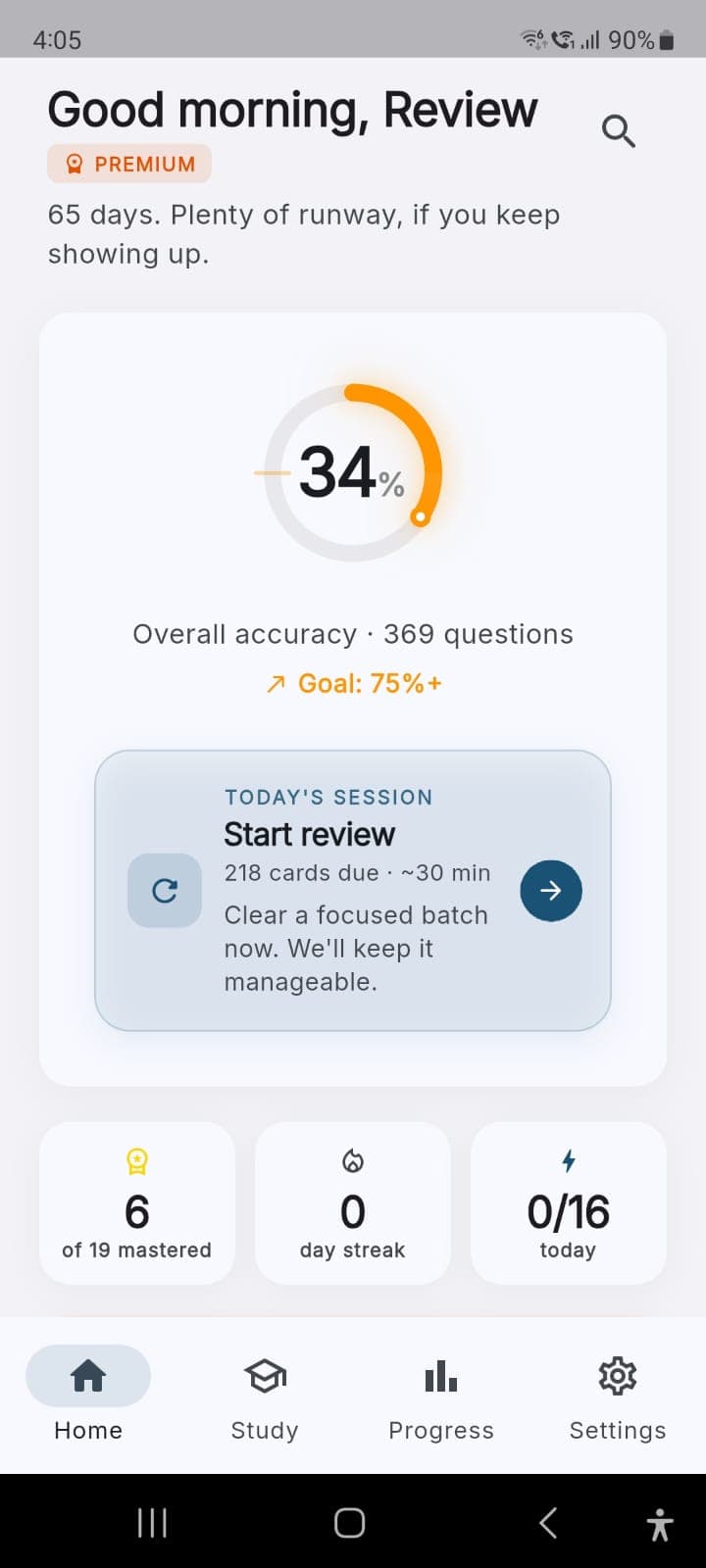
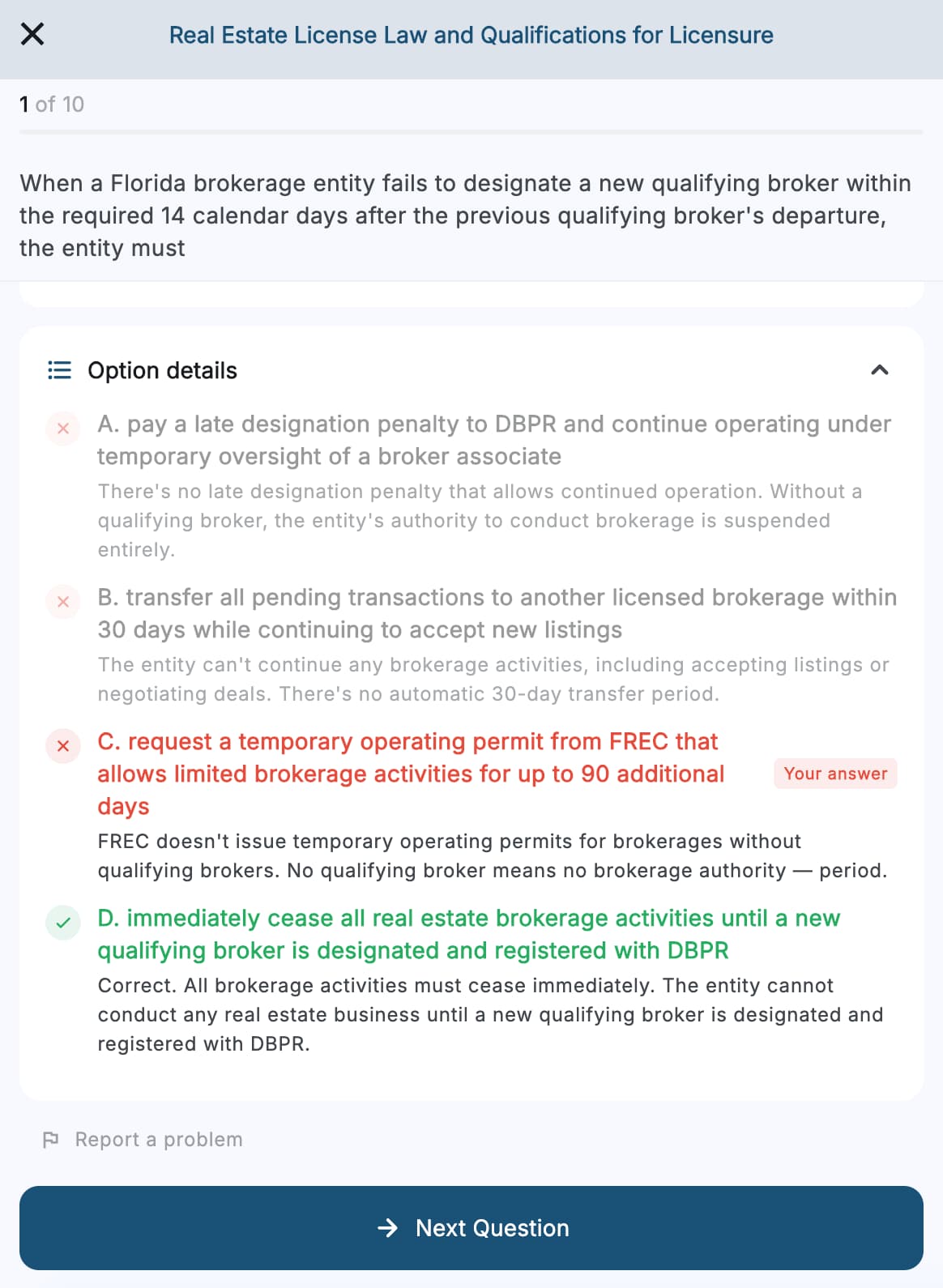
A character review can make the application timeline less predictable. You can still use that time well: start with the free 19-topic diagnostic, identify your weak areas, and work through 1,142 Florida-specific questions for one $39.99 purchase.
Try a free Florida question · Take the free timed practice exam
Can you get a Florida real estate license with a criminal record?
Yes, it may be possible. Chapter 475 does not impose a permanent categorical bar solely because an applicant has a felony record. FREC evaluates the application under the good-character and disciplinary standards below. Separate statutes can affect eligibility in particular cases.
The central qualification appears in F.S. 475.17(1)(a). It requires an applicant to be "honest, truthful, trustworthy, and of good character" and to "have a good reputation for fair dealing."
That is not the same as a no-record requirement. Criminal conduct can matter, but the legal analysis does not end at the word "felony."
The same subsection identifies the route by which an applicant may overcome otherwise disqualifying conduct: lapse of time, subsequent good conduct and reputation, or another reason FREC considers sufficient, when the public and investors are not likely to be endangered. Those are statutory considerations, not a promise of approval.
The core Chapter 475 provisions FREC applies
Three sections of Chapter 475 do the central work. Reading them in order tells you how a file moves.
| Statute | What it does | Why it matters to you |
|---|---|---|
| F.S. 475.17(1)(a) | Sets the good-character and fair-dealing qualifications and states the lapse-of-time and subsequent-conduct standard | It supplies the central qualification and rehabilitation analysis |
| F.S. 475.181(2) | Directs FREC to certify applicants who satisfy the listed requirements and permits refusal to certify an applicant subject to discipline under F.S. 475.25 | It connects the application decision to the discipline statute |
| F.S. 475.25(1)(f) | Identifies criminal conduct that can support discipline: a crime related to licensed activity or involving moral turpitude or fraudulent or dishonest dealing | It identifies the criminal-conduct categories FREC may apply |
Read together, the chain works like this. F.S. 475.181(2) says FREC "may refuse to certify any applicant who has violated any of the provisions of s. 475.42 or who is subject to discipline under s. 475.25." Conduct that could subject a licensee to discipline can therefore affect an applicant's certification.
F.S. 475.25(1)(f) then identifies the relevant criminal ground. It covers anyone who "has been convicted or found guilty of, or entered a plea of nolo contendere to, regardless of adjudication, a crime in any jurisdiction which directly relates to the activities of a licensed broker or sales associate, or involves moral turpitude or fraudulent or dishonest dealing."
Two phrases matter immediately. "In any jurisdiction" reaches matters outside Florida, including qualifying federal and out-of-state matters. "Regardless of adjudication" means a qualifying plea or finding is not automatically excluded merely because adjudication was withheld.
Why real estate applicants should not rely on the 5-year rule
Search this topic and you will quickly find the claim that Florida cannot consider a conviction older than five years. That is an incomplete description of F.S. 455.213(3). Subparagraph (3)(b)1 says a conviction or other adjudication more than five years before the application is received may not be grounds for denial of a license covered by paragraph (3)(a).
The critical limitation is that paragraph (3)(a) does not cover every profession DBPR regulates. It names barbers, cosmetologists and cosmetology specialists, specified construction professions, and a catchall for another DBPR-licensed profession offered to inmates as vocational training or through an industry-certification program.
Real estate sales associate is not expressly named. Because the catchall turns on whether a profession is offered to inmates in a correctional institution or facility as vocational training or through an industry-certification program, the safest practical conclusion is narrower than saying the five-year provision can never apply: a real estate applicant should not assume an older conviction is outside FREC's review.
Even within the listed professions, five years is not an absolute shield. The statute permits consideration at any time of criminal history involving a crime listed in F.S. 775.21(4)(a)1 or F.S. 776.08 when that history relates to the profession. It also separately permits consideration of criminal history related to good moral character for applicants in the construction professions listed in subparagraph (3)(a)3.
This matters because an older conviction that may fall outside review for a listed profession can remain reviewable for a real estate applicant. Do not assume age alone removes a conviction from consideration. If the current RE 1 question requires disclosure, answer it accurately; the age of the conduct may instead be relevant to the separate "lapse of time" analysis in F.S. 475.17(1)(a).
Two additional general statutes that can affect eligibility
Chapter 475 supplies the core real-estate standards, while Chapter 455 supplies other general licensing rules discussed elsewhere in this guide. Two additional statutes deserve separate attention because they can affect criminal-record eligibility.
F.S. 112.011(1)(b) permits denial on conviction grounds in defined circumstances. It says a person "may be denied a license, permit, or certification to pursue, practice, or engage in an occupation, trade, vocation, profession, or business by reason of the prior conviction for a crime if the crime was a felony or first-degree misdemeanor that is directly related to the standards determined by the regulatory authority to be necessary and reasonably related to the protection of the public health, safety, and welfare for the specific occupation, trade, vocation, profession, or business for which the license, permit, or certificate is sought."
Read that as a relatedness test rather than a blanket rule. The conviction has to be a felony or first-degree misdemeanor, and it has to connect to standards the regulator has tied to public protection for this specific occupation.
F.S. 775.16 applies to specified felony convictions involving the sale of, trafficking in, or conspiracy to sell or traffic in a controlled substance under Chapter 893. It also reaches an out-of-state or foreign conviction that would constitute one of those felonies if committed in Florida.
For those convictions, the statute disqualifies a person from applying for a state occupational license unless one of its conditions is met: the person has completed all imprisonment and supervisory sanctions; while under supervision, the person complies with the statute's monitored treatment and periodic drug-testing conditions, including maintaining enrollment until completion unless the program finds no substance-abuse problem; or the person has successfully completed an appropriate Correctional Education Program.
The practical consequence is worth stating plainly: if F.S. 775.16 applies, first determine whether you currently satisfy an exception to its application disqualification. Confirm your status against the current statute before paying the application fee, and seek legal advice if you are unsure how it applies to your sentence or supervision.
"Regardless of adjudication" is the phrase that catches people
Florida courts can withhold adjudication, but that does not make the RE 1 question disappear when the case involved one of the form's stated triggers.
F.S. 475.25(1)(f) reaches convictions, findings of guilt, and pleas of nolo contendere "regardless of adjudication." The RE 1 wording separately and expressly asks about guilty pleas and current criminal investigations. When adjudication was withheld after a finding of guilt or a guilty or nolo contendere plea, the withhold does not turn the required answer into "No."
The same applies to a plea of no contest. People often treat nolo contendere as a way of resolving a charge without admitting anything. For this statute, the plea itself is the trigger.
The RE 1 application says the question applies "without regard to whether you were placed on probation, had adjudication withheld, were paroled, or pardoned."
Sealed and expunged records get specific treatment on the form rather than silence. The RE 1 states that if you intend to answer "NO" because you believe records were expunged or sealed by court order under F.S. 943.0585 or F.S. 943.059, or the equivalent law of another state, "you are responsible for verifying the expungement or sealing prior to answering 'NO.'"
Read that as an instruction to confirm, not to assume. The form also tells you what to do when the answer is unclear: consult an attorney or contact the department.
How FREC applies the rehabilitation standard
F.S. 475.17(1)(a) also states when otherwise disqualifying conduct may be overcome. An applicant may still be approved if, "because of lapse of time and subsequent good conduct and reputation, or other reason deemed sufficient, it appears to the commission that the interest of the public and investors will not likely be endangered by the granting of registration."
That sentence tells you what to build your file around. The statute names three things it cares about.
- Lapse of time. How long ago the conduct occurred. A longer period since the conduct may help demonstrate this factor, although the statute sets no required number of years.
- Subsequent good conduct and reputation. What you have done since. Evidence here may support the application, and FREC determines its relevance and weight case by case.
- Public and investor protection. Whether licensing you creates risk. This is the question the other two factors are being measured against.
The statute also gives FREC discretion through the phrase "or other reason deemed sufficient." The RE 1 instructions separately require documentation showing that sanctions have been served and satisfied. Those records establish the status of the case; FREC decides what weight the full record receives.
One more line in the same section is easy to miss. F.S. 475.17(1)(b) allows an application to be disapproved if the applicant acted as a broker or sales associate in violation of the chapter during the year before filing. Unlicensed practice is its own problem, separate from any criminal history.
How the statute categorizes criminal conduct
F.S. 475.25(1)(f) gives categories, not a ranked list of crimes or a prediction formula.
| Statutory category | What the language focuses on |
|---|---|
| Directly relates to broker or sales-associate activities | Whether the crime is connected to activities performed by a licensed real-estate professional |
| Involves fraudulent or dishonest dealing | Whether the underlying conduct involved fraud or dishonesty |
| Involves moral turpitude | A fact-specific legal classification that may require review of applicable decisions and the circumstances of the offense |
Determining whether conduct falls within one of these categories helps identify which statutory ground FREC may apply. It does not, by itself, predict whether an application will be approved or denied.
The application also remains subject to the good-character standard in F.S. 475.17(1)(a). That is why an offense name alone cannot answer the licensing question and why unsupported "easy" and "hard" crime rankings are misleading.
Answer the background question exactly as the form writes it
The RE 1 application does not say to disclose every arrest or every charge. It asks a carefully drafted question. Answer that exact question accurately rather than broadening or narrowing it from memory.
Background question 1 asks whether you have "ever been convicted or found guilty of, or entered a plea of nolo contendere or guilty to, regardless of adjudication, a crime in any jurisdiction, or are you currently under criminal investigation."
The form then defines its own scope. The question "applies to any criminal violation of the laws of any municipality, county, state or nation, including felony, misdemeanor and traffic offenses (but not parking, speeding, inspection, or traffic signal violations)."
The exclusions listed by the form are parking, speeding, inspection, and traffic-signal violations. For other felonies, misdemeanors, and traffic offenses, disclosure is required when the matter falls within the form's stated triggers: a conviction, finding of guilt, guilty or nolo contendere plea, or current criminal investigation.
The form is equally direct about the consequence of getting it wrong. It warns that the answer "MAY BE CHECKED AGAINST LOCAL, STATE AND FEDERAL RECORDS" and that "FAILURE TO ANSWER THIS QUESTION ACCURATELY MAY RESULT IN THE DENIAL OR REVOCATION OF YOUR LICENSE."
Those warnings are the practical reason to slow down and check. Electronic fingerprints are processed through the Florida Department of Law Enforcement (FDLE) and Federal Bureau of Investigation (FBI). An inaccurate answer can therefore create a separate issue in an application already subject to an honesty standard.
What to send when you answer yes
The RE 1 instructions set out the supporting documents rather than leaving it to you. For each disclosed matter, provide a copy of the arrest report, copies of the disposition or final orders, and documentation proving all sanctions have been served and satisfied.
Two situational rules sit alongside that list. If you cannot supply those records, the form calls for a certified statement from the clerk of court. If you are still on probation, you must supply a letter from your probation officer on official letterhead stating the status of your probation.
The 30-day duty after you are licensed
The reporting obligation continues after licensure, and the general provision is not limited to felonies.
F.S. 455.227(1)(t) makes it a discipline ground to fail "to report in writing to the board or, if there is no board, to the department within 30 days after the licensee is convicted or found guilty of, or entered a plea of nolo contendere or guilty to, regardless of adjudication, a crime in any jurisdiction." The text says a crime, not only a felony.
This reaches real estate licensees through F.S. 475.25(1)(a), which makes it a violation to have "violated any provision of s. 455.227(1) or s. 475.42" and exempts real estate licensees only from s. 455.227(1)(i).
Separately, F.S. 475.25(1)(p) imposes a felony-specific duty, making it a ground to fail "to inform the commission in writing within 30 days after pleading guilty or nolo contendere to, or being convicted or found guilty of, any felony."
The safe reading is the broader one. Treat any conviction, finding of guilt, or guilty or nolo contendere plea as reportable within 30 days, and follow the department's current self-reporting instructions.
If your application is marked pending, our guide to a DBPR application marked pending explains what that status means and what to check next. Fingerprint issues are a separate possible source of delay, covered in Florida real estate fingerprints delay.
What happens if your application is denied
A denial notice is not simply a dead end. Florida's Administrative Procedure Act requires it to explain the decision and identify any available review process.
Under F.S. 120.60(3), a licensing notice must state the basis for the agency decision, identify any available administrative hearing under F.S. 120.569 and F.S. 120.57 or judicial review under F.S. 120.68, explain the procedure, and state the applicable time limits.
In practice that means the notice you receive is also your instruction sheet. It has to tell you what to do next and by when, so read it immediately rather than filing it away. The deadline stated on the notice governs, and a hearing request under F.S. 120.569 has to be timely to preserve the option.
When an applicant timely requests a hearing and material facts are genuinely disputed, the matter may be referred to the Division of Administrative Hearings (DOAH), where an administrative law judge hears it and issues a recommended order back to the commission. Our glossary entry on DOAH explains where it fits in Florida's licensing structure.
Frequently Asked Questions
Can a felon get a real estate license in Florida?
Potentially, yes. Chapter 475 does not impose a permanent categorical prohibition solely because an applicant has a felony record. FREC evaluates whether the conduct falls within the disciplinary grounds in F.S. 475.25 and applies the qualification and rehabilitation standard in F.S. 475.17(1)(a), including lapse of time, subsequent good conduct and reputation, and whether licensing the applicant would endanger the public or investors. Other generally applicable statutes may affect eligibility or timing in particular cases.
Does Florida have a 5-year rule for real estate criminal history?
Real estate is not expressly listed among the professions in F.S. 455.213(3), so do not assume a conviction older than five years is excluded from FREC's review. The listed professions are barbers, cosmetologists, and specified construction trades, plus a catchall for professions offered to inmates through qualifying vocational or industry-certification programs. Even for covered professions, the subsection contains exceptions that permit consideration of certain older criminal history. Chapter 475 itself sets no general age cutoff.
Do I have to disclose a case in which adjudication was withheld?
Yes, when the withheld adjudication followed a finding of guilt or a guilty or nolo contendere plea. The RE 1 question expressly applies regardless of whether adjudication was withheld. A mere arrest or a dismissed charge without one of the form's stated triggers should be evaluated against the exact wording of the current application rather than assumed to be covered. If you do not fully understand the question, the form instructs you to consult an attorney or contact DBPR.
How long after a conviction should I wait to apply?
Chapter 475 does not set a fixed waiting period based solely on the age of a conviction. A longer period may help demonstrate the statutory "lapse of time" factor, and evidence of subsequent good conduct and reputation may also support the application. FREC determines the relevance and weight of that evidence case by case. F.S. 775.16 can separately make a person temporarily ineligible to apply after specified felony drug convictions unless a statutory condition is met.
What documents should I send with my application?
The RE 1 instructions call for a copy of the arrest report, copies of the disposition or final orders, and documentation proving all sanctions have been served and satisfied. If you cannot supply those records, the form calls for a certified statement from the clerk of court. If you are still on probation, include a letter from your probation officer on official letterhead stating its status.
Does a criminal record affect when I can schedule the Florida real estate exam?
A criminal record does not change the examination's content, 100-question format, or 75-point passing standard. It can affect timing because DBPR's Division of Real Estate must approve the application and authorize the candidate for testing before a Pearson VUE appointment can be reserved. Once you know your candidate identification number, the DBPR candidate booklet says you do not need to wait for a confirmation or authorization letter to reserve. The Pearson VUE fact sheet currently linked from its Florida real-estate page lists the Real Estate Salesperson examination at $36.75, but the PDF is dated January 2017, so verify the amount when you schedule. Our Florida exam cost guide covers the other costs.
Be exam ready when DBPR authorizes you
If DBPR requests additional records or conducts a character review, use the waiting period as study time.
Use the waiting period to identify weak areas before you are eligible to reserve your test. Start with the free diagnostic, then drill by DBPR exam weight.
Try a free Florida question | Run the readiness calculator | Download Pass Florida
This post is exam preparation content for the Florida Real Estate Sales Associate exam. It is not legal, tax, financial, lending, appraisal, brokerage, insurance, title, closing, or professional advice. Licensing outcomes for applicants with criminal records are decided case by case. For real-world decisions, verify current requirements with the official source or consult a qualified licensed Florida professional.
Methodology
This guide covers how the Florida Real Estate Commission treats criminal history on a sales associate application. It is written for candidates deciding whether to apply, what to disclose, and how to prepare supporting documents.
The legal rules stated here were checked against the controlling sources on August 4, 2026. The statutory chain came from the official Florida Senate text of F.S. 475.17, F.S. 475.181, F.S. 475.25, F.S. 455.213, F.S. 455.227, F.S. 112.011, F.S. 775.16, and F.S. 120.60. The RE 1 question, supporting-document instructions, $62.75 application fee, and exam-authorization sequence were checked against the current DBPR form. Exam format and scoring were checked against DBPR's sales associate candidate booklet.
The $36.75 examination amount comes from the Pearson VUE fact sheet currently linked on Pearson's Florida real-estate page. Because that fact sheet is dated January 2017, the article identifies the source and tells readers to verify the amount when reserving rather than presenting it as independently confirmed current pricing.
Three limits are worth stating plainly. First, FREC decisions in this area are discretionary and fact-specific, so no article can predict an individual outcome. Second, this guide does not rank offenses by likelihood of denial, because that would require an analysis of FREC final orders rather than statutory text. Third, sealed and expunged records depend on the specific court order in your case, and the RE 1 places the burden of verifying a sealing or expungement on you before answering "NO."
Reviewed August 4, 2026. Statutory citations reflect the 2025 Florida Statutes, the latest annual compilation published by the Florida Senate at the time of review. Fees, forms, and procedures change, so reverify the current RE 1 application and Pearson VUE information before filing or scheduling.
Product note. Pass Florida is our Florida-specific exam prep app. This page references our own product, so the relationship is direct and disclosed. We do not claim to use copied exam questions, guarantee passage, or rely on invented review claims.
Sources
- F.S. 475.17, Qualifications for practice
- F.S. 475.181, Licensure
- F.S. 475.25, Discipline
- F.S. 455.213, General licensing provisions
- F.S. 120.60, Licensing under the Administrative Procedure Act
- F.S. 455.227, grounds for discipline and the 30-day crime reporting duty
- F.S. 112.011, disqualification from licensing and public employment
- F.S. 775.16, drug offenses and disqualification from state occupational licensure
- Florida House staff analysis, 2022 House Bill 87, criminal history in professional licensing
- DBPR RE 1 sales associate application
- DBPR real estate sales associate candidate information booklet
- Pearson VUE Florida DBPR real estate and appraiser fact sheet