VERIFY BEFORE RELYING
This guide explains how Real Estate Markets Analysis (Market Characteristics) is tested on the Florida sales associate real estate exam. It is exam-prep coaching only, not market-analysis advice, comparative market analysis (CMA) preparation, appraisal, valuation, investment, insurance, brokerage, lending, or licensing advice and not a Department of Business and Professional Regulation (DBPR), Florida Real Estate Commission (FREC), or Pearson VUE determination. The exam-tested framework for real estate market characteristics is grounded in F.S. Chapter 475, Part I (Real Estate Brokers, Sales Associates), F.A.C. Chapter 61J2 (FREC rules), and the broader real estate principles taught in the FREC-approved 63-hour pre-license course. Full appraisal services are separately regulated under F.S. Chapter 475, Part II and are limited to Florida-licensed appraisers. The exam-tested vocabulary (the four economic characteristics: scarcity, improvements, permanence of investment, area preference / situs; the physical characteristics: immobility, indestructibility / durability, non-homogeneity / uniqueness; supply, demand, equilibrium, disequilibrium, buyer's market, seller's market, market analysis, comparative market analysis, appraisal) and the DBPR placement of these concepts inside the Markets Analysis content area can change between exam windows. Florida-specific market overlays referenced in this guide (coastal/waterfront markets, hurricane insurance impact, snowbird seasonality, tourism markets, condo-conversion patterns, 55+ housing markets under the Housing for Older Persons Act / HOPA) are context for exam-style questions, not market-data or insurance-pricing claims. Verify the current exam topic outline against the DBPR Sales Associate Candidate Information Booklet, the current Real Estate Brokers chapter text at F.S. Chapter 475, and the current FREC rules at F.A.C. Chapter 61J2. The Four-Economic / Physical-Characteristics decision table, supply-and-demand driver framework, Market-Analysis vs CMA vs Appraisal disambiguation table, Florida-specific market-overlay decoder, 4-step Stem Decoder, 7-row Florida-specific traps table, and embedded exam-style question are Pass Florida observational coaching pedagogy, not DBPR, FREC, or Pearson VUE process documents.
QUICK ANSWER
Real Estate Markets Analysis is a small-weight but commonly tested content area on the Florida sales associate exam. The exam-tested vocabulary covers the four economic characteristics of real estate (scarcity, improvements, permanence of investment, area preference also called situs), the physical characteristics (immobility, indestructibility / durability, non-homogeneity / uniqueness), the supply-and-demand drivers that shift market equilibrium, the difference between a buyer's market and a seller's market (and the price-signal direction in each), and the distinction between market analysis, comparative market analysis (CMA), and appraisal. The single most-tested distinction is market analysis or CMA (within the lawful scope of a Florida sales associate under F.S. Chapter 475, Part I) versus appraisal (full valuation services that require Florida appraiser licensure under F.S. Chapter 475, Part II). The Florida-specific traps are confusing the four economic with the physical characteristics, treating a CMA as an appraisal, and ignoring the Florida-specific market overlays (coastal markets, hurricane insurance, snowbird seasonality, tourism, condo-conversion, 55+ housing).
WHO THIS GUIDE IS FOR
Florida sales associate exam candidates studying the Real Estate Markets Analysis (Market Characteristics) content area, particularly the four economic characteristics, the physical characteristics, the supply-and-demand driver framework, and the market-analysis vs CMA vs appraisal distinction. Useful whether you are first-time studying Markets Analysis and need the economic-vs-physical-characteristics framework, drilling EXCEPT/NOT questions about which factor would increase demand or shift supply, recovering from a Markets-Analysis miss on a practice exam (typically the CMA-vs-appraisal trap or the economic-vs-physical mix-up), or a retake candidate whose score report flagged Markets Analysis. Pair with the sales comparison approach guide for the dedicated valuation-method deep dive, the Florida real estate exam appraisal guide for the broader appraisal context, the GRM guide and IRV formula guide for income-approach valuation, the planning and zoning guide for the public-land-use overlay on market behavior, the condominiums and cooperatives guide for the condo-conversion market overlay, the HOPA guide for the 55+ housing market overlay, the laws to memorize guide for the broader memorization strategy, and the 19 exam topics guide for the broader exam map. Not market-analysis advice, CMA preparation, appraisal, valuation, investment, insurance, brokerage, lending, or licensing advice.
EXAM PREP ONLY
The Florida sales associate exam is a closed-book, computer-based licensing exam built around Florida real estate principles, practices, law, math, F.S. Chapter 475, Part I, and F.A.C. Chapter 61J2. DBPR's current Sales Associate Candidate Information Booklet (CIB) states 100 multiple-choice questions, three and a half hours, and 19 content areas with a passing grade of at least 75. The Markets Analysis content area covers market characteristics, supply and demand, market equilibrium and disequilibrium, and the distinction between market analysis, CMA, and appraisal within the lawful scope of a Florida sales associate. This article explains how those concepts are tested. It does not replace the required 63-hour FREC-approved course, DBPR application steps, Pearson VUE scheduling rules, fingerprinting, broker activation, post-licensing, continuing education, legal advice, or official sources. Full appraisal services and USPAP-compliant value opinions are limited to Florida-licensed appraisers under F.S. Chapter 475, Part II.
Scarcity, improvements, permanence, and area preference are economic. Immobility, indestructibility, and non-homogeneity are physical.
Identify whether the stem is shifting supply (construction, inventory) or demand (population, jobs, rates) before predicting the price direction.
Sales associates can perform market analysis and CMAs. Full appraisal requires Florida appraiser licensure under F.S. Chapter 475, Part II.
Real Estate Markets Analysis questions feel familiar because the vocabulary is everyday vocabulary. That is the danger. On the Florida sales associate exam, "scarcity," "improvements," "immobility," "uniqueness," "supply," "demand," "market analysis," "CMA," and "appraisal" can all appear in the same stem, and the right answer depends on which exact category the question is asking about.
DBPR's Sales Associate Candidate Information Booklet identifies Real Estate Markets Analysis (sometimes called Real Estate Market Characteristics) as one of the 19 content areas. The exam tests the vocabulary distinctions and the lane discipline: knowing which characteristic is economic vs physical, which driver shifts supply vs demand, and which service a Florida sales associate can lawfully perform. Practice the area with the free markets and analysis practice questions.
This post is exam prep. It is not market-analysis advice, CMA preparation, appraisal, valuation, investment guidance, insurance advice, or a real-world transaction tool.
What this guide covers
- Official source map
- Exam concept vs real market work
- The 1% strategy
- Market Analysis vs CMA vs Appraisal
- The four economic characteristics
- The physical characteristics
- Supply and demand drivers
- Market equilibrium and disequilibrium
- Florida-specific market overlays
- The Stem Decoder for Markets Analysis
- Common Florida-specific traps
- Exam-style question
- Related exam concepts
- Frequently asked questions
Official Source Map
Use Florida statutes and the DBPR exam outline for the legal text. Use the decision frameworks in this guide as exam-prep coaching.
| Claim in this guide | Primary source | Why it matters |
|---|---|---|
| Real Estate Markets and Analysis is one of the 19 DBPR content areas on the Florida sales associate exam, listed at 1%, with "Characteristics of the Real Estate Market" as its listed subtopic | DBPR Sales Associate Candidate Information Booklet | Anchors the Markets Analysis vocabulary to the DBPR exam outline without overstating the topic weight |
| Real estate broker and sales associate scope, including the lawful performance of market analysis and comparative market analysis (CMA), is governed by F.S. Chapter 475, Part I | F.S. Chapter 475, Part I, Real Estate Brokers, Sales Associates, Schools | Establishes what a Florida sales associate can lawfully do in market analysis without crossing into appraisal services |
| Full appraisal services and USPAP-compliant value opinions are separately regulated under F.S. Chapter 475, Part II and are limited to Florida-licensed appraisers | F.S. Chapter 475, Part II, Real Estate Appraisers and Florida Real Estate Appraisal Board | The CMA-vs-appraisal distinction is a Florida licensure scope distinction, not a study preference |
| FREC rules at F.A.C. Chapter 61J2 govern the conduct of licensed sales associates and brokers, including standards around market-analysis representations | F.A.C. Chapter 61J2, Florida Real Estate Commission | The administrative-rule backbone for sales associate practice |
| The Uniform Standards of Professional Appraisal Practice (USPAP) defines the professional standards that distinguish a formal appraisal from a CMA | The Appraisal Foundation, USPAP | The cross-state professional-standards framework that anchors the appraisal-vs-CMA distinction beyond Florida-specific statutes |
| The Florida Office of Insurance Regulation regulates hurricane and property insurance in Florida, which affects coastal-market demand and pricing | Florida Office of Insurance Regulation | Hurricane insurance pricing is a Florida-specific demand-side factor referenced in the Florida-overlay section |
| The Housing for Older Persons Act (HOPA) governs the 55+ housing market overlay referenced in this guide | HUD Fair Housing: Housing for Older Persons Act | The 55+ market segment is a Florida-prominent market category with a separate federal-law overlay |
| The Four-Economic / Physical-Characteristics decision table, supply-and-demand driver framework, Market-Analysis vs CMA vs Appraisal disambiguation table, Florida-specific market-overlay decoder, 4-step Stem Decoder, and 7-row Florida-specific traps table are study heuristics | Pass Florida coaching methodology | These are not DBPR, FREC, FREAB, or Pearson VUE rules |
Exam Concept vs Real Market Work
Before studying this topic, separate exam vocabulary from real professional work.
| Situation | What to rely on | Why it matters |
|---|---|---|
| Florida exam-style Markets Analysis question | DBPR outline vocabulary: economic characteristics, physical characteristics, supply, demand, equilibrium, CMA vs appraisal | The exam tests lane recognition and vocabulary, not current market forecasting |
| Listing presentation or buyer offer support | Broker supervision, current comparable sales, MLS data, local market evidence, and brokerage policy | Real-world CMA work must be based on actual current data, not exam-memory shortcuts |
| Appraisal for lending, litigation, estate, tax, or government purpose | Florida-licensed appraiser and USPAP-compliant appraisal process | A CMA is not an appraisal even if both discuss value |
| Market trend or insurance discussion | Current local data, Florida Office of Insurance Regulation context, Citizens / private-market context, and licensed professional guidance | Florida coastal and insurance conditions change faster than exam-prep content |
For the exam, do not forecast a market. Identify the concept. If the stem says "no two parcels are alike," the answer is non-homogeneity. If the stem says "buyers prefer this location," the answer is area preference / situs. If the stem says a sales associate prepared a pricing report for a listing, the answer is CMA or market analysis, not appraisal.
Real market work requires current evidence. Exam work requires correct labels.
The 1% Strategy
Real Estate Markets and Analysis is listed at 1% in the current DBPR Sales Associate CIB. That means this topic may be only about one question on a 100-question exam, but it is still worth learning because the same vocabulary leaks into appraisal, planning and zoning, property rights, fair housing, and investment analysis.
Do not spend a week memorizing market theory. Spend one focused block learning the tested lanes:
| What to memorize | Why it earns the point |
|---|---|
| 4 economic characteristics | The exam may ask which factor explains value: scarcity, improvements, permanence, or situs |
| 3 physical characteristics | The exam may ask which factor describes land itself: immobility, indestructibility, or non-homogeneity |
| Supply vs demand drivers | The exam may ask whether a scenario changes inventory or buyer desire |
| Equilibrium states | The exam may ask buyer's market vs seller's market based on inventory and price direction |
| Market analysis / CMA / appraisal lanes | The exam may ask what a sales associate may prepare vs what requires an appraiser |
| Florida overlays | The exam may add coastal, insurance, tourism, condo, snowbird, or 55+ context as scenario flavor |
The efficient study target is simple: get this 1% question right without stealing time from 8% appraisal, 12% contracts, 12% brokerage, or 9% mortgages. Treat Markets Analysis as a vocabulary-lane topic that supports larger topics, not as a full market-economics course.
Market Analysis vs CMA vs Appraisal
The single most-tested distinction in this content area is service-scope. Three terms that sound similar are governed by different parts of Florida law.
| Service | Who can perform | Purpose | Standards |
|---|---|---|---|
| Market analysis | Florida sales associate or broker | Broad overview of a local market (supply, demand, price trends, inventory, days on market) for a seller or buyer | Sales-associate practice standards under F.S. Chapter 475, Part I and F.A.C. Chapter 61J2 |
| Comparative market analysis (CMA) | Florida sales associate or broker | Comparable-sales-based pricing tool for a specific property, typically prepared for a listing presentation or buyer offer | Same as above; explicitly not an appraisal |
| Appraisal | Florida-licensed appraiser only | USPAP-compliant value opinion (often required for lending, estates, tax appeals, condemnation, divorce, litigation) | F.S. Chapter 475, Part II; USPAP |
The exam-day shortcut: a sales associate's CMA estimates a likely sale price for marketing purposes. An appraiser's appraisal produces a USPAP-compliant value opinion that can support a loan, tax, legal, or estate decision. A CMA is not legally an appraisal, even if a CMA and an appraisal happen to land on similar numbers. Confusing the two is the most common single-line miss on this content area.
Florida-specific scope reminder: a sales associate who performs full appraisal services for a fee without an appraiser license is practicing outside Chapter 475, Part I. The CMA exception exists precisely so a sales associate can price a listing without crossing into appraisal practice.
The Four Economic Characteristics
The four economic characteristics describe why land has value as an economic asset. Memorize the four, then memorize one Florida example of each.
| Economic characteristic | Definition | Florida-specific example |
|---|---|---|
| Scarcity | Land in a desirable location is limited in supply | Oceanfront Miami Beach parcels are scarce; inland Polk County parcels are not |
| Improvements | Improvements (buildings, roads, utilities) on or near a property affect its value | A new I-4 interchange or a Brightline rail station can change land values for miles |
| Permanence of investment | Real estate investments are long-term and tied to permanent capital improvements | A condo tower or seawall represents capital that cannot be easily moved or recouped |
| Area preference (situs) | Buyer preference for a specific location drives market price beyond bare land economics | Snowbird preference for South Florida vs Central Florida creates location-based demand |
The exam often tests these by giving a scenario and asking which economic characteristic it illustrates. The trap is recognizing the example without naming the characteristic. "Buyers will pay more for waterfront" is area preference (situs). "There is no more oceanfront left to build on" is scarcity. "A new highway interchange raised nearby land values" is improvements. "Real estate investments do not move and tie up long-term capital" is permanence of investment.
The Physical Characteristics
The physical characteristics describe how land behaves as a physical asset. The three standard physical characteristics tested on the Florida exam are immobility, indestructibility (also called durability), and non-homogeneity (also called uniqueness or heterogeneity). Some textbook sources count four; the three above are the safest exam-day baseline.
| Physical characteristic | Definition | Why it matters on the exam |
|---|---|---|
| Immobility | Land cannot be physically moved | Drives the "location, location, location" premium and explains why market values are local |
| Indestructibility (durability) | Land itself is permanent (improvements are not) | Explains why land is treated differently from buildings in depreciation, insurance, and lender underwriting |
| Non-homogeneity (uniqueness, heterogeneity) | No two parcels are identical | Justifies parcel-by-parcel valuation rather than commodity pricing |
The four-economic-vs-three-physical split is the single most common mix-up. Scarcity is economic (it explains value). Immobility is physical (it explains behavior). The exam trap is using economic and physical interchangeably.
Supply and Demand Drivers
Once vocabulary is set, the exam tests how a change in a real-world factor shifts supply or demand and which direction prices move.
| Factor | Side it shifts | Effect on price (if all else equal) |
|---|---|---|
| Population growth | Demand up | Prices rise |
| Net employment growth | Demand up | Prices rise |
| Real wage / income growth | Demand up | Prices rise |
| Falling mortgage interest rates | Demand up | Prices rise |
| Consumer confidence rising | Demand up | Prices rise (with lag) |
| New construction starts up | Supply up | Prices fall (or rise slower) |
| Tightened land-use regulation or zoning | Supply down | Prices rise |
| Higher construction or materials costs | Supply down | Prices rise |
| Rising vacancy / inventory | Supply up (effective) | Prices fall |
| Rising hurricane / property insurance premiums | Demand down (for affected areas) | Prices fall in high-premium areas |
Two operating rules: supply-side shifts move slowly (construction takes 18-36 months from permit to certificate of occupancy in most Florida jurisdictions; zoning changes take longer). Demand-side shifts can move quickly (mortgage rates can change in weeks; insurance premiums can spike after a hurricane season).
That asymmetry is why Florida's coastal markets often experience demand-side shocks (insurance, hurricane risk, snowbird seasonality) before supply has time to respond, which produces the volatility candidates may see referenced on the exam.
LANE DISCIPLINE BEFORE VOCABULARY
Markets Analysis traps come from mixing lanes, not from forgetting definitions.
Practice identifying the loan, market, or clause from the facts in the stem, then eliminate answers that describe a different financing relationship.
Market Equilibrium and Disequilibrium
Equilibrium is the price point at which supply equals demand. Disequilibrium is everything else.
| Market state | Supply vs demand | Common name | Price signal | What buyers / sellers see |
|---|---|---|---|---|
| Equilibrium | Supply = demand | Balanced market | Stable | Reasonable days on market, fewer concessions |
| Oversupply | Supply > demand | Buyer's market | Prices fall (or grow more slowly) | More inventory, longer days on market, more concessions |
| Undersupply | Demand > supply | Seller's market | Prices rise | Less inventory, shorter days on market, multiple offers, fewer concessions |
The exam shortcut: excess supply favors buyers, excess demand favors sellers, and the price direction follows the side that is short. When the stem describes inventory rising and homes sitting longer, it is a buyer's market. When the stem describes multiple offers and homes selling above asking, it is a seller's market.
Florida-specific reminder: Florida's market often runs differently across regions in the same calendar quarter. South Florida (Miami-Dade, Broward, Palm Beach) can be in a seller's market while the Panhandle is in a buyer's market. National housing-market headlines are not always Florida-applicable.
Florida-Specific Market Overlays
Florida markets have features the national exam-prep textbooks rarely emphasize but the Florida exam can reference.
| Florida-specific overlay | What it affects | Exam-style reference |
|---|---|---|
| Coastal / waterfront premium | Demand (positive) | Higher area preference / situs value; constrained scarcity |
| Hurricane and property insurance pricing | Demand (negative for high-premium areas) | Florida Office of Insurance Regulation oversees property insurance; pricing pressure affects affordability and demand |
| Snowbird seasonality | Demand (cyclical) | Q1 and Q4 demand peaks in South and Southwest Florida; summer demand peaks in seasonal-rental markets |
| Tourism markets and short-term rentals | Demand (use-specific) | Vacation-home demand can disconnect from local-employment-driven demand |
| Condo-conversion patterns | Supply mix shift | Conversion from rental to condo (or back) reshapes effective supply, especially in South Florida high-rise inventory |
| 55+ housing under HOPA | Demand (segmented) | The Housing for Older Persons Act creates an age-restricted housing market segment with its own demand drivers (retirement, downsizing) |
| Citizens Property Insurance | Demand (residual-market influence) | Florida's state-backed insurer of last resort affects market behavior in areas where the private market has retreated |
| Florida Building Code and post-Andrew construction | Supply (cost-side) | Stronger codes since Hurricane Andrew (1992) and successive updates raise construction cost and influence inventory mix |
These overlays appear in exam stems as scenario flavor (e.g., "A South Florida condo market with rising hurricane insurance premiums...") and the answer hinges on knowing which side of supply or demand the overlay shifts.
The Stem Decoder for Markets Analysis
When the stem describes a market situation, walk these four steps before choosing an answer:
- What is the question asking about? Vocabulary (which characteristic / which lane), driver (which side does X shift), state (buyer's vs seller's market), or service-scope (CMA vs appraisal vs market analysis).
- Which framework applies? Four economic or three physical characteristics; supply-side or demand-side driver; equilibrium / oversupply / undersupply; service-scope under F.S. 475 Part I vs Part II.
- Are there Florida-specific overlays? Coastal, insurance, snowbird, tourism, condo-conversion, 55+, Citizens, or building-code references in the stem.
- What is the controlling answer? Pick the choice that names the framework correctly (not the choice that simply restates a phrase from the stem).
This sequence is a label-discipline check, not a calculation. Markets Analysis questions are almost entirely vocabulary and framework questions; the trap is matching the wrong framework to a real-world-sounding scenario.
Common Florida-Specific Traps
| Trap | What it looks like | Repair |
|---|---|---|
| Mixing economic and physical characteristics | Stem describes "no more land to build on" and the answer choices include both "scarcity" (economic) and "immobility" (physical) | Memorize the 4 economic / 3 physical split as two distinct lists |
| Calling a CMA an appraisal | Stem describes a sales associate preparing a "pricing report" for a listing and an answer choice calls it an "appraisal" | A CMA is not legally an appraisal; full appraisal requires Florida appraiser licensure under F.S. Chapter 475, Part II |
| Treating national market headlines as Florida-applicable | Stem describes "a national housing slowdown" and asks about a specific Florida regional market | Florida regional markets run on different cycles; do not assume the national signal applies to South Florida or the Panhandle uniformly |
| Ignoring the Florida-specific overlay | Stem mentions "hurricane insurance premium increases" and the candidate picks a generic demand answer without connecting to the coastal-market context | Always check whether the stem includes a Florida-specific overlay (coastal, insurance, snowbird, tourism, condo-conversion, 55+) before picking the answer |
| Mixing supply-side and demand-side drivers | Stem describes "new construction" and the candidate calls it a demand shift | New construction adds to supply, not demand; population growth adds to demand, not supply |
| Reversing the price-direction signal | Stem describes "rising inventory and homes sitting longer" and the candidate picks "seller's market" | Rising inventory and longer days on market = buyer's market = prices flat or falling |
| Calling situs a physical characteristic | "Area preference" or "situs" listed alongside immobility / indestructibility / non-homogeneity in an EXCEPT question | Situs is economic (it captures buyer preference for a location), not physical (which is about how land itself behaves) |
Exam-Style Question
Stem: A Florida sales associate is preparing a pricing report for a seller who wants to list a single-family home in a South Florida coastal market. The seller is considering whether to use the sales associate's pricing report to support a loan modification request with the seller's lender. Which of the following statements is MOST correct?
A. The sales associate's pricing report is a comparative market analysis (CMA) and is appropriate for the seller's listing decision, but it is not an appraisal and is not designed to support a loan modification.
B. The sales associate's pricing report is an appraisal because it provides a value opinion for the property.
C. The sales associate's pricing report is a market analysis but the sales associate must be licensed under F.S. Chapter 475, Part II to prepare any pricing document for any purpose.
D. The sales associate's pricing report is a CMA and may be used in place of an appraisal for any lending purpose if the lender accepts it.
Show answer
Correct answer: A. A CMA prepared by a Florida sales associate is appropriate for marketing-side decisions (listing price, buyer offer guidance) but is not a USPAP-compliant appraisal. Loan modifications and other lending-side valuation decisions typically require a formal appraisal from a Florida-licensed appraiser under F.S. Chapter 475, Part II. The CMA is lawful; using it as a substitute for an appraisal is not.
Option B is the most common wrong answer: it conflates CMA and appraisal. A CMA produces a likely-sale-price estimate for marketing purposes; an appraisal produces a USPAP-compliant value opinion that can support a lending, tax, legal, or estate decision. Same dollar number, different legal product.
Option C is wrong on the licensure side. A Florida sales associate licensed under F.S. Chapter 475, Part I can lawfully prepare a CMA. Part II licensure is required for appraisal services, not for CMA preparation.
Option D is wrong because a CMA cannot be substituted for an appraisal in lending decisions that require a USPAP-compliant value opinion. Lender acceptance is not the same as legal equivalence.
The Florida-specific overlay (coastal market) is scenario flavor; it does not change the lane-discipline answer. The question is testing whether you can distinguish CMA from appraisal, not whether you can value a coastal property.
Related exam concepts
| If this is your weak spot | Read this next | Why |
|---|---|---|
| Valuation method specifics | Sales comparison approach guide | Dedicated walk-through of the sales-comp valuation method that underlies a CMA |
| Broader appraisal context | Florida real estate exam appraisal guide | The full appraisal content area, including the three approaches to value |
| Income-approach math | GRM guide and IRV formula guide | Income-approach valuation that complements market and sales-comp approaches |
| Public land-use overlay on market behavior | Planning and zoning guide | How zoning and comprehensive plans constrain supply and affect markets |
| Florida growth management context | Florida Growth Management Act guide | The F.S. Chapter 163 framework that drives Florida-specific supply constraints |
| Condo-conversion market overlay | Condominiums, cooperatives, and timeshares guide | The Florida condo-market segment most exposed to conversion patterns |
| 55+ housing market overlay | HOPA guide | The Housing for Older Persons Act framework for age-restricted housing |
| Broader exam map | Florida real estate exam 19 topics guide | DBPR topic-weight overview |
Frequently Asked Questions
Is Real Estate Markets Analysis the same as appraisal?
No. Market analysis and CMA are within the lawful scope of a Florida sales associate under F.S. Chapter 475, Part I. Full appraisal services are limited to Florida-licensed appraisers under F.S. Chapter 475, Part II, and appraisals follow USPAP standards.
How many economic vs physical characteristics should I memorize?
Four economic (scarcity, improvements, permanence of investment, area preference / situs) and three physical (immobility, indestructibility / durability, non-homogeneity / uniqueness). Some textbook sources count physical characteristics differently; four economic and three physical is the safest exam-day baseline. The exam often tests whether you can distinguish the two lists, not how many are in each.
What is the difference between scarcity and immobility?
Scarcity is an economic characteristic (limited supply of desirable land drives value). Immobility is a physical characteristic (land cannot be moved). They sound similar in casual conversation, but the exam treats them as separate lanes.
What is the difference between a CMA and an appraisal?
A CMA (comparative market analysis) is a marketing tool prepared by a Florida sales associate or broker to support a listing or offer decision. An appraisal is a USPAP-compliant value opinion prepared by a Florida-licensed appraiser, typically required for lending, tax appeals, estates, condemnation, or litigation. A CMA is not legally an appraisal even if both produce similar numbers.
Why are Florida coastal markets treated differently from inland markets on the exam?
Florida coastal markets face Florida-specific demand-side factors (hurricane insurance pricing, hurricane risk, snowbird seasonality, tourism) and supply-side factors (Florida Building Code post-Andrew updates, coastal zoning, environmental regulation) that inland markets face less acutely. Exam stems may include coastal context as a Florida-specific overlay on the standard supply-and-demand framework.
How is the 55+ housing market different from general housing?
The Housing for Older Persons Act (HOPA) creates an age-restricted housing market segment with separate demand drivers (retirement, downsizing, healthcare proximity) and a separate federal-law exemption from the Fair Housing Act's familial-status protected class. Florida has significant 55+ inventory, which makes this overlay common on Florida exam stems.
Is a sales associate allowed to give a value opinion?
A sales associate can prepare a CMA or market analysis that estimates a likely sale price for marketing purposes. A sales associate cannot lawfully prepare a USPAP-compliant appraisal for compensation without an appraiser license under F.S. Chapter 475, Part II. The lawful CMA-vs-unlawful-unlicensed-appraisal line is a Florida licensure issue, not a study preference.
Should I use national market data for Florida exam stems?
Only when the stem explicitly references national data. Florida regional markets often diverge from national trends (and from each other). A national-headline reference in a stem may be a distractor; check whether the stem is asking about a specific Florida region.
Does Pass Florida replace my 63-hour course?
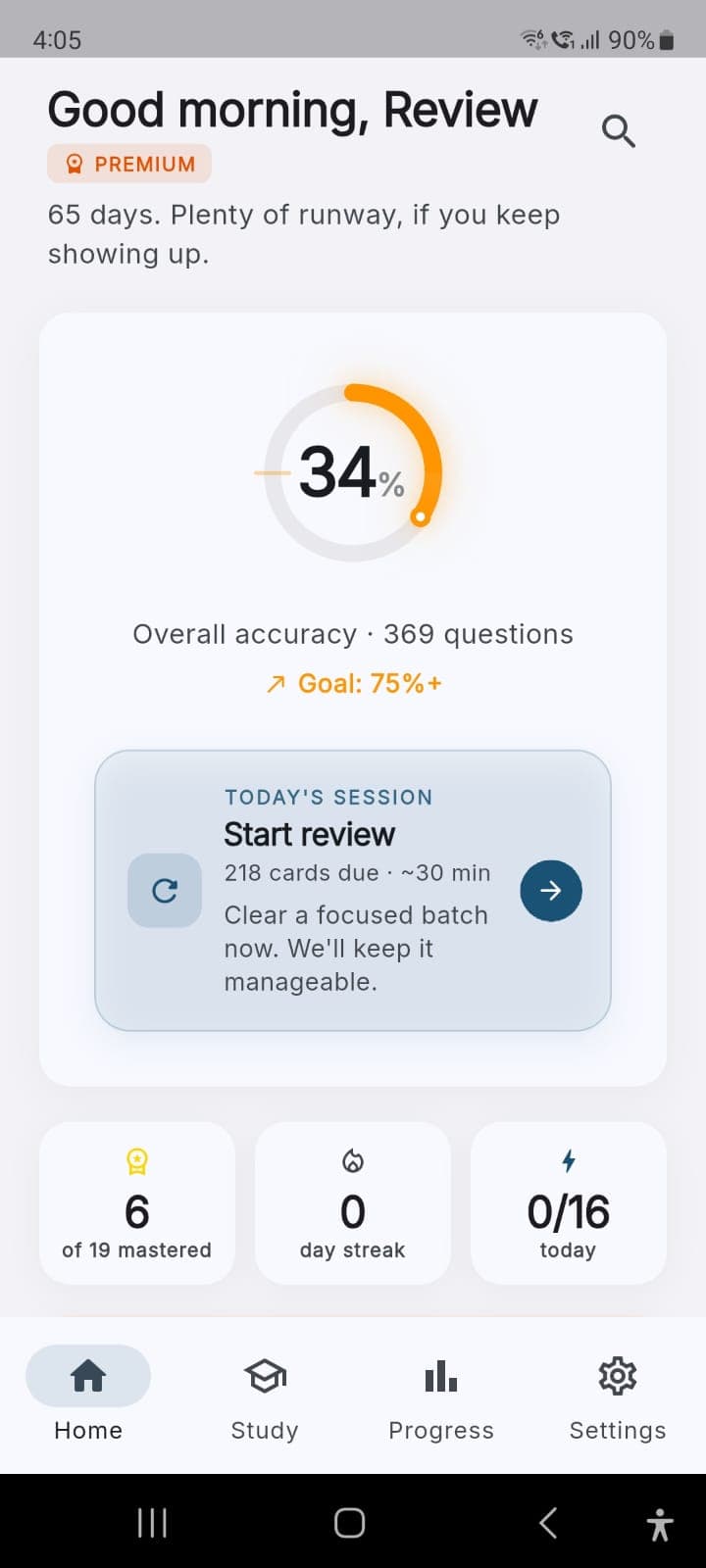
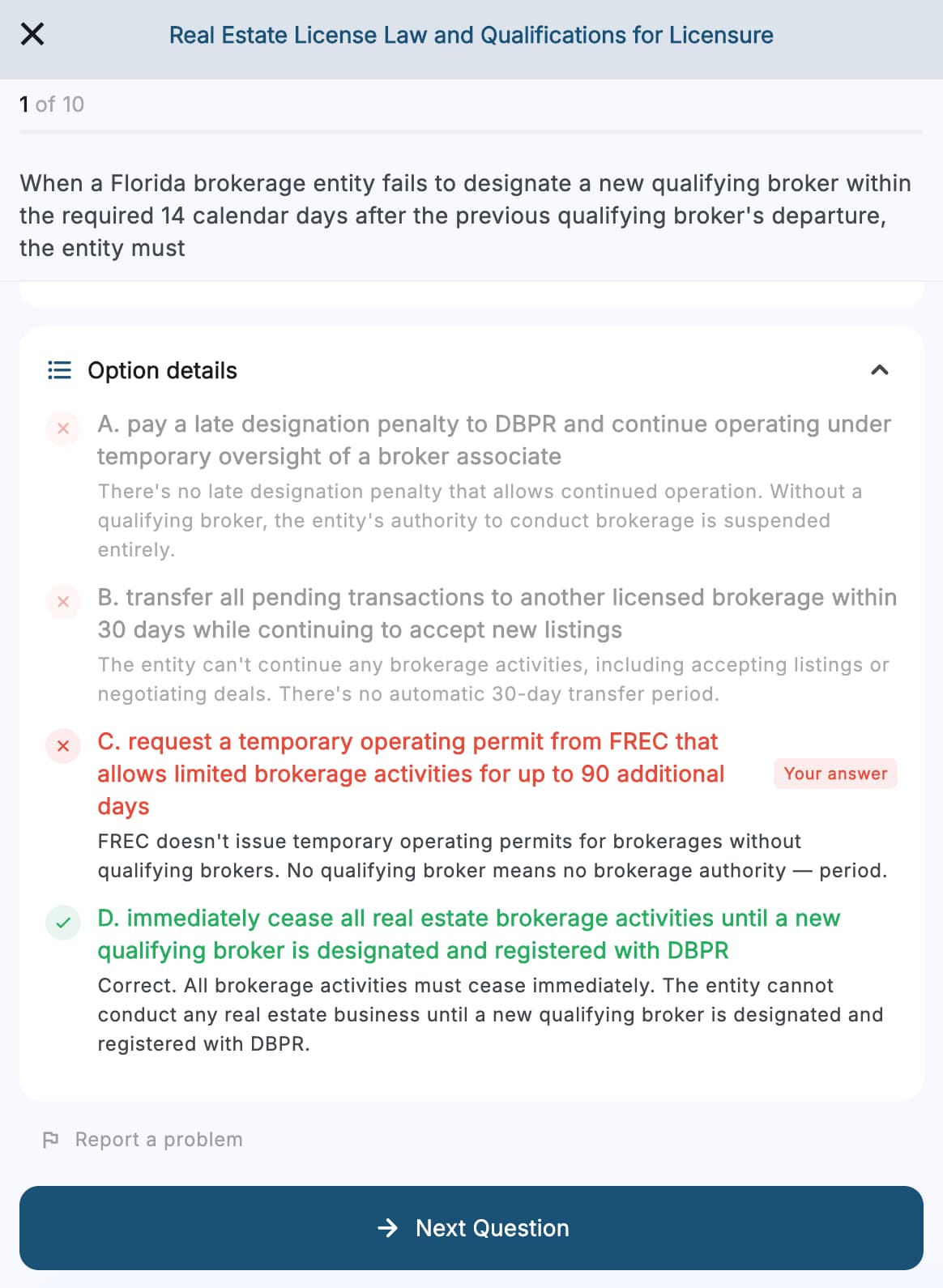
No. Pass Florida is exam preparation content, not a substitute for the FREC-approved 63-hour pre-license course, DBPR processes, Pearson VUE scheduling, or licensed professional advice. The app gives you 1,142 Florida-specific practice questions to help you prepare after and alongside your required coursework.
Ready to drill Markets Analysis discipline?
The single discipline that prevents most Markets-Analysis misses is lane identification: economic vs physical, supply vs demand, market analysis vs CMA vs appraisal. The next score jump usually comes from drilling sister-topic content areas that share the same vocabulary lanes (appraisal, valuation methods, land use, condo overlay).
- Drill the sales-comparison valuation method: Sales comparison approach guide
- Pair with the broader appraisal content area: Florida real estate exam appraisal guide
- Map your weak topics to DBPR weights: Florida real estate exam 19 topics guide
- Try Florida-specific practice questions: Try 5 questions
Methodology
This guide was written for Florida sales associate exam candidates studying the Real Estate Markets Analysis content area. It anchors the four-economic / three-physical characteristics framework, the supply-and-demand driver lanes, the market-equilibrium states, and the market-analysis vs CMA vs appraisal distinction to F.S. Chapter 475 (Parts I and II), F.A.C. Chapter 61J2, the DBPR Sales Associate Candidate Information Booklet (CIB), and the broader real estate principles taught in the FREC-approved 63-hour pre-license course. Florida-specific market overlays referenced in this guide draw on the Florida Office of Insurance Regulation (hurricane insurance), the Florida Building Code (post-Andrew construction standards), the Housing for Older Persons Act (55+ housing), and standard Florida real estate principles textbooks.
The Four-Economic / Physical-Characteristics decision table, supply-and-demand driver framework, Market-Analysis vs CMA vs Appraisal disambiguation table, Florida-specific market-overlay decoder, 4-step Stem Decoder, 7-row Florida-specific traps table, and embedded exam-style question are Pass Florida observational coaching pedagogy and are not DBPR, FREC, FREAB, or Pearson VUE process documents.
Pass Florida is not affiliated with DBPR, FREC, FREAB, Pearson VUE, the Florida Office of Insurance Regulation, HUD, or any pre-license course provider, and Pass Florida does not guarantee passage of any state exam. Pass Florida does not replace the FREC-approved 63-hour pre-license course, DBPR application steps, Pearson VUE scheduling rules, fingerprinting, post-licensing, continuing education, or consultation with a qualified licensed professional. Its role is targeted practice with Florida-specific exam-style questions, not market-analysis advice, CMA preparation, appraisal services, investment guidance, insurance advice, or real-world transaction tools.
Real-world market analysis, CMA preparation, appraisal, insurance pricing, and investment decisions require licensed Florida professionals working within the scope of their licensure (sales associate / broker under Chapter 475 Part I; appraiser under Chapter 475 Part II; insurance agent under separate Florida insurance law; investment adviser under separate federal and state securities law).
Official sources are listed below. Requirements, policies, exam outlines, and laws can change, so verify current details with the official source before making a real-world decision.
Product Note
Pass Florida publishes this guide and offers the exam-prep app linked on this page. Pass Florida is not affiliated with DBPR, FREC, FREAB, Pearson VUE, or any pre-license course provider, and Pass Florida does not guarantee passage of any state exam.
Sources
- DBPR Sales Associate Candidate Information Booklet PDF
- DBPR Real Estate Sales Associate Requirements PDF
- F.S. Chapter 475, Real Estate Brokers, Sales Associates, Schools, and Appraisers, Florida Senate
- F.A.C. Chapter 61J2, Florida Real Estate Commission
- Florida Real Estate Appraisal Board (FREAB)
- The Appraisal Foundation, USPAP
- Florida Office of Insurance Regulation
- Citizens Property Insurance Corporation
- Florida Building Commission
- HUD Fair Housing: Housing for Older Persons Act (HOPA)
- Pearson VUE Florida Real Estate and Appraisers licensing exams
This post is exam preparation content for the Florida Real Estate Sales Associate exam. It is not legal, tax, financial, lending, appraisal, valuation, brokerage, insurance, title, closing, market-analysis, CMA, investment, or professional advice. Pass Florida is not affiliated with the Department of Business and Professional Regulation (DBPR), the Florida Real Estate Commission (FREC), the Florida Real Estate Appraisal Board (FREAB), Pearson VUE, the Florida Office of Insurance Regulation, HUD, or any pre-license course provider, and Pass Florida does not guarantee passage of any state exam. For real-world decisions, verify current requirements with the official source or consult a qualified licensed Florida professional working within the scope of their Florida licensure.