QUICK ANSWER
Yes, you can be a part-time real estate agent in Florida. The state sets no minimum-hours requirement, so nothing in the license itself forces you to work full-time. Two realities decide whether it is worth it. First, you still must hold an active license under a registered broker. Under F.S. 475.42, a sales associate cannot operate for anyone not registered as the employer, so there is no independent or solo part-time practice. Second, the recurring costs of practicing (which can include board or multiple listing service (MLS) dues, a Realtor association membership, broker technology fees, and errors and omissions (E&O) or risk-management coverage, depending on your broker, MLS, and business model) generally do not shrink with your hours, so a part-timer can carry similar overhead on fewer deals. Part-time works well when you have a warm network, a flexible day job, and savings to cover the fixed costs while you ramp.
Most articles answer "can I do this part-time" with a quick yes and a sales pitch. The honest answer is yes, with conditions that matter. This page covers what the license actually requires, the broker reality for part-timers, the money math, and the time commitment, so you can decide before you spend anything. If you are still deciding whether to get licensed at all, start with the honest "is it worth it" guide.
Can you legally be a part-time agent in Florida?
Yes. Florida licensing law does not set a minimum number of hours you must work, and it does not create a separate "full-time" license. A sales associate license is the same license whether you use it 10 hours a week or 50. So the legal answer is simple: part-time is allowed.
The real constraint is not hours. It is sponsorship. Under F.S. 475.42, a person licensed as a sales associate "may not operate as a sales associate for any person not registered as her or his employer." In plain terms, you must work under a registered Florida broker to practice at all. There is no solo, unsponsored, part-time path. You cannot list, show, or close on your own license without a broker behind you.
That single rule shapes everything below. Being part-time does not change the requirement, but it does change how brokers treat you and how the economics work out.
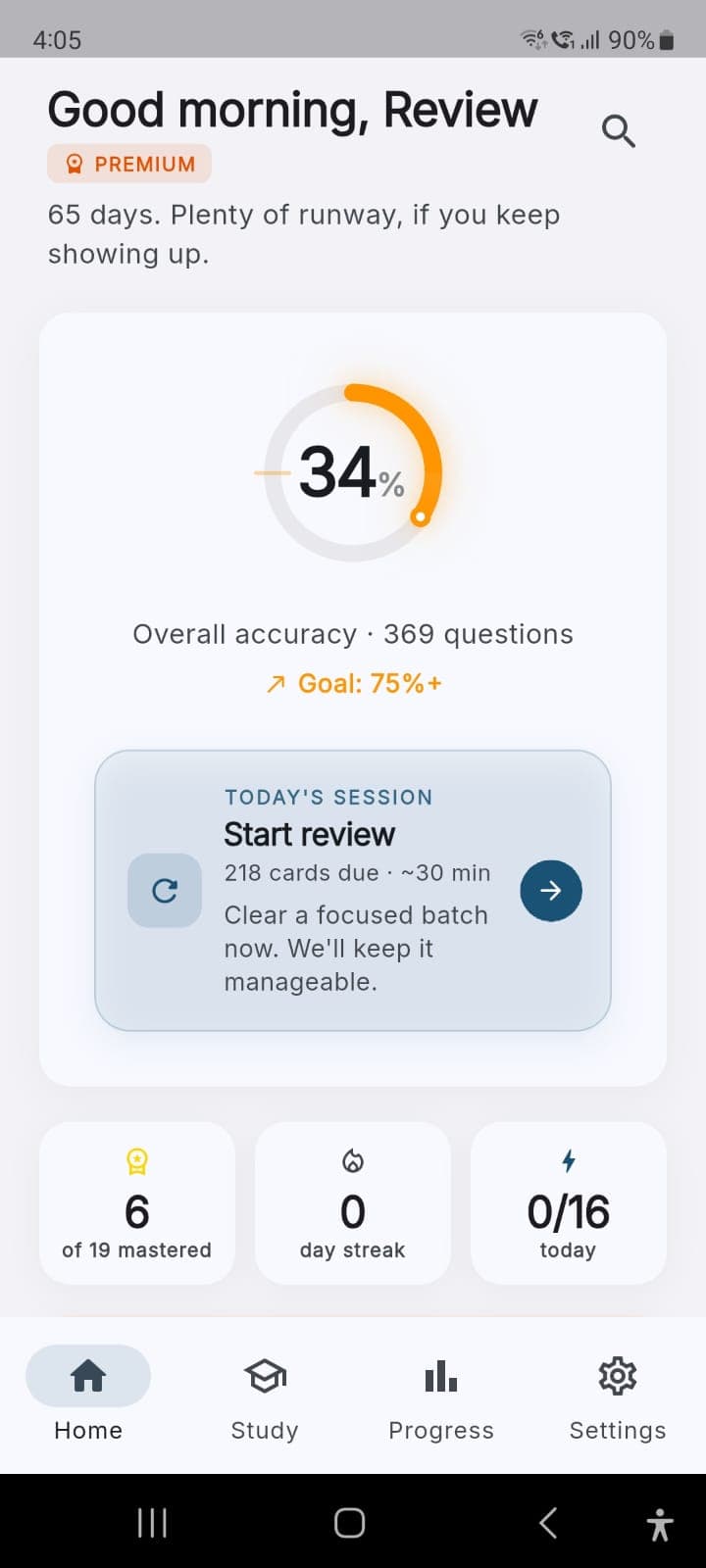
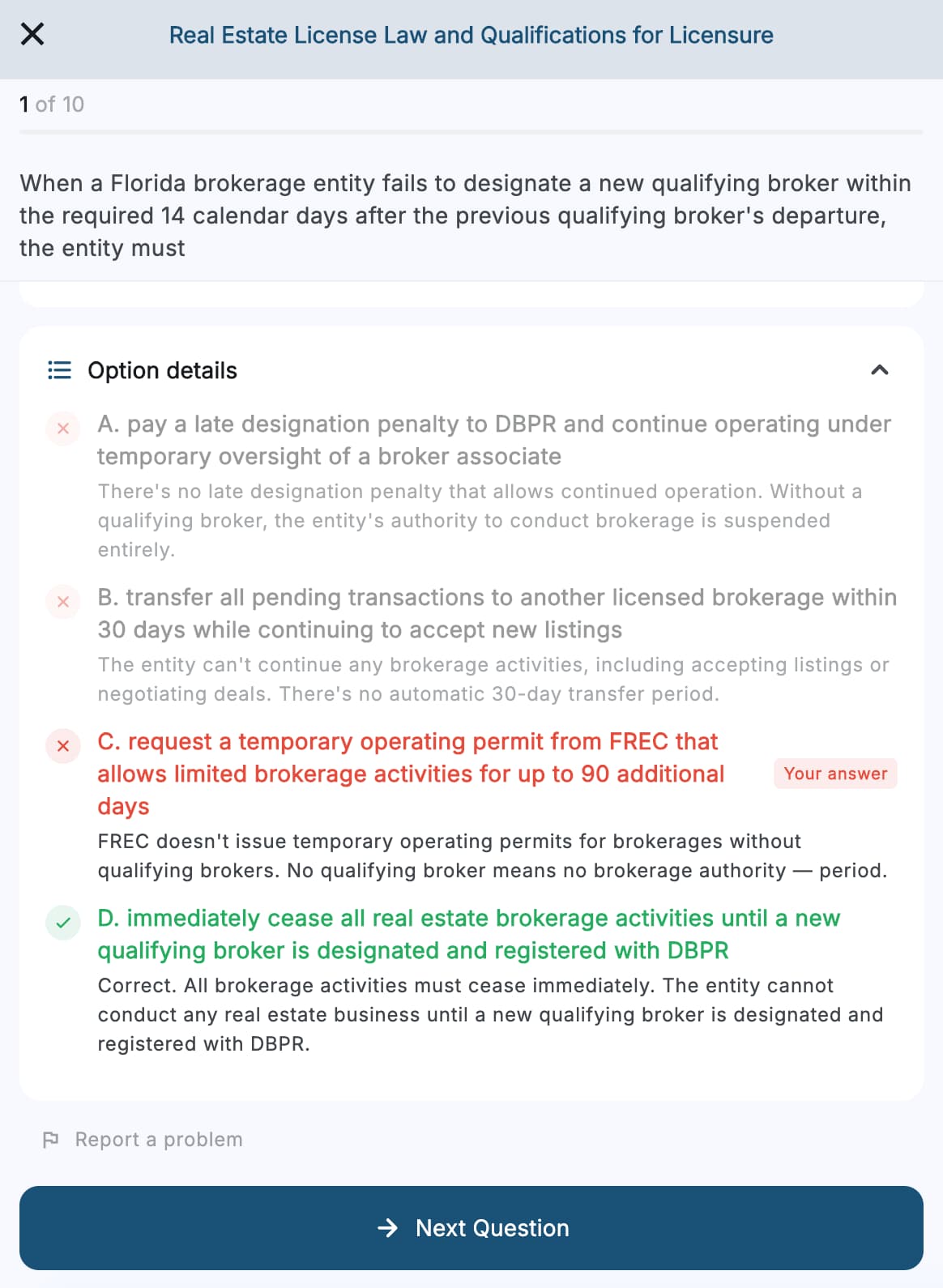
PART-TIME OR FULL-TIME, THE EXAM IS THE SAME
You cannot work part-time on a license you have not earned yet.
Exam preparation helps you reach the licensing gate. Broker supervision, local training, prospecting, and transaction experience determine what happens after it.
The broker reality for part-timers
Because sponsorship is required, your part-time experience depends heavily on the broker you choose. Brokers are not all equal on this, and some are openly built for part-timers while others are not.
Three things to ask any broker before you sign:
- Do they accept part-time agents at all? Some teams and brokerages expect full-time availability, floor time, or lead-response speed that a part-timer cannot meet. Others welcome part-timers. Ask directly.
- How is the cost structure built? A high-split, low-fee model can suit part-timers who close a few deals a year, because you are not paying a large monthly desk fee against thin volume. A desk-fee model can punish low volume. Match the model to the deal count you realistically expect.
- What support do you get at low volume? Training, mentorship, and lead access vary. A part-timer with no sphere of influence needs more support, not less.
The broker decision is the highest-leverage choice a part-timer makes. The guide to finding a sponsoring broker covers how to evaluate splits, fees, and fit. Interview several before committing, and be honest with each one about your availability.
The honest money math part-time
This is where part-time gets misunderstood. People assume part-time means proportionally lower cost. Often it does not. Your income scales with your deals, but many of your costs do not scale with your hours.
Depending on your broker, MLS, Realtor association, and business model, a part-timer can take on much the same recurring costs as a full-timer:
- Board or MLS dues, which are typically billed on a set schedule rather than per deal, if you choose to join.
- E&O or risk-management coverage, which many brokers require before you transact.
- License renewal and continuing education on the standard two-year cycle.
- Any desk or technology fees your broker charges.
So if a full-timer closing 12 deals and a part-timer closing 2 deals carry similar recurring costs, the part-timer's overhead per deal is far higher. Your first part-time deals can largely cover those costs before you net much. That is common, not a red flag, but it means part-time rarely produces meaningful net income in year one. For the full income picture, including first-year ramp and what a Florida deal actually pays, see the agent salary guide.
The practical takeaway: budget these recurring costs as a known expense, and treat early part-time commissions as paying down that overhead rather than as take-home pay.
The time commitment is real
Part-time does not mean low-effort or fully on your schedule. Real estate runs on other people's timelines. Buyers want to see homes on evenings and weekends. Closings, inspections, and lender deadlines happen on business days. Clients expect reasonably quick responses.
For some people, this fits well. If your day job is flexible, or your evenings and weekends are open, the showing schedule can line up. If your day job blocks daytime calls and you cannot respond to a lender or a buyer's agent until 6 p.m., transactions get harder to manage and clients notice.
Be honest about two things before you start. Can you respond to time-sensitive messages during business hours at least some of the time? And can you protect evenings and weekends for showings when a client is ready? If both answers are no, part-time will frustrate you and your clients. If at least one is yes, part-time is workable.
Is being a part-time agent in Florida worth it?
It depends on why you are doing it and what you bring. Part-time is a good fit in some situations and a poor one in others.
Part-time tends to work when you:
- Have a warm network that can produce a few transactions a year without cold prospecting.
- Hold a flexible primary job, or want to test the career before going full-time.
- Have savings to cover the fixed costs during the ramp.
- Pick a broker whose cost structure rewards low, steady volume.
Part-time tends to struggle when you:
- Expect quick income from a standing start with no sphere of influence.
- Cannot respond during business hours at all.
- Underbudget the fixed costs and treat early commissions as profit.
- Sign with a high-fee broker model that needs volume to make sense.
If you are changing careers later in life rather than working alongside a job, the Florida real estate second-career guide speaks more directly to runway and timeline. If you are weighing the license as a whole, the worth-it guide lays out the three factors that decide it.
Frequently Asked Questions
Can you be a part-time real estate agent in Florida?
Yes. Florida sets no minimum-hours requirement and issues one sales associate license regardless of how much you work. The catch is sponsorship: under F.S. 475.42, you must hold an active license under a registered broker, so there is no solo or unsponsored part-time practice. Choose a broker that accepts part-time agents.
Do part-time agents still need a broker in Florida?
Yes, always. A Florida sales associate cannot operate for anyone not registered as the employer. Full-time or part-time, you work under a sponsoring broker, and your license must be active under that broker before you list, show, or close. Practicing without an active license under a broker carries serious consequences.
Is being a part-time real estate agent worth it in Florida?
It can be, with conditions. The recurring costs of practicing (board or MLS dues, E&O or risk-management coverage, license upkeep, and broker fees) depend on your broker, MLS, association, and business model, and they generally do not shrink with your hours, so part-timers can carry similar overhead on fewer deals. Part-time works best when you have a warm network, a flexible primary job, savings to cover those costs, and a broker whose cost model suits low volume.
How much does a part-time real estate agent make in Florida?
Income scales with deals closed, not hours worked, and the recurring costs generally do not shrink. Many part-timers spend their first commissions covering dues, coverage, and broker fees before netting much. For realistic ranges, first-year ramp, and what a single deal pays, see the Florida agent salary guide.
Can I keep my full-time job and sell real estate on the side?
Yes, if you can manage the timing. Showings cluster on evenings and weekends, but closings, inspections, and lender deadlines fall on business days, and clients expect timely responses. If your primary job offers some daytime flexibility, side real estate is workable. If it blocks all daytime communication, transactions become hard to manage.
Ready to earn the license first?
Part-time or full-time is a decision you make after you pass. The exam is identical either way, and it is the one step the career cannot route around. Pass it once, on the first try, and you keep your options open.
Verify the official licensing step first, then use exam practice only for the knowledge test.
Try a free Florida question | Run the readiness calculator | Download Pass Florida
This post is educational content about working as a part-time Florida real estate sales associate. It is not legal, tax, financial, or career advice. Brokerage policies, fees, dues, insurance costs, and income outcomes vary widely by market, broker, and individual. Verify license requirements with DBPR and the specific terms with any broker before you commit.
Methodology
This page answers a decision-stage question for prospective Florida sales associates: whether part-time practice is realistic. F.S. 475.42 supplies the core legal point. A sales associate must hold an active license under a registered broker and cannot operate for an unregistered employer. Florida licensing law does not set a minimum-hours requirement, so part-time practice is permitted as a matter of law. Board or MLS dues, E&O or risk-management coverage, broker fees, and renewal education are recurring costs that generally do not shrink with your hours. The exact amount depends on your broker, MLS, association, and business model. Income depends on market, network, broker model, and effort, so this page describes tradeoffs rather than promising a result.
What changes by brokerage. Broker policies, fees, and income conditions vary. Confirm the licensing rules with DBPR and the business terms with any broker you are considering.
Product note. Pass Florida is our Florida-specific exam prep app. This page references our own product, so the relationship is direct and disclosed. We do not claim to use copied exam questions, guarantee passage, or replace official DBPR, FREC, broker, legal, tax, or career guidance.