TALLAHASSEE LOCAL SOURCE NOTE
Tallahassee is Florida's state capital and the seat of Leon County, with a daily-life economy anchored by state government, Florida State University (FSU), Florida A&M University (FAMU), and a regional healthcare cluster. The local risk profile is different from Florida's coastal cities: Tallahassee is inland, dominated by single-family stock, and largely outside the dense high-rise condo inventory that drives F.S. 553.899 milestone activity elsewhere. The active local risk vectors are inland hurricane wind exposure (Hermine 2016, Michael 2018, Idalia 2023, Helene 2024 all produced significant Leon County tree damage and extended power outages through City of Tallahassee Utilities and Talquin Electric service areas), FSU and FAMU student-rental compliance, state-government relocation framing, and federal Fair Housing law on school, university, and neighborhood discussions.
Treat every local fact in this guide as a starting point. Before advising any client, verify current insurance availability and pricing with a licensed Florida property and casualty agent, tree-condition and roof-age questions with a licensed inspector, septic and well status in Wakulla, Gadsden, Jefferson, and unincorporated Leon parcels with the county health department and licensed contractors, current Leon County School District and FSU / FAMU academic-calendar context with the institutions themselves rather than buyer assumptions, and short-term rental rules with the City of Tallahassee or Leon County depending on the parcel.
Federal fair-housing law prohibits steering buyers because of protected characteristics such as race, color, religion, sex, disability, familial status, or national origin. FSU, FAMU, and Leon County Schools frequently come up in Tallahassee buyer conversations. Current HUD/FHEO guidance does not categorically forbid truthful, nonracial discussion of school quality or neighborhood data, but a new agent should still keep the posture disciplined: provide the same objective sources to every buyer, avoid protected-class implications, and route uncertain phrasing to the broker or qualified counsel.
This guide is educational. It is not legal, tax, insurance, lending, condo, HOA, inspection, broker, property-management, school-guidance, or fair-housing-compliance advice.
QUICK ANSWER
To get a real estate license in Tallahassee, you follow the Florida sales associate path: be at least 18, have a high school diploma or equivalent, have a Social Security number, complete a Florida-approved 63-hour pre-license course unless exempt, submit the Department of Business and Professional Regulation (DBPR) RE 1 application, complete Livescan fingerprints, pass the Pearson VUE sales associate exam, then activate the license with a Florida broker.
Tallahassee does not have its own city license. The license is statewide. What changes locally is the market you enter: state-government employee relocation, FSU and FAMU faculty and staff buyers, Killearn Estates, SouthWood, Midtown, Betton Hills, Myers Park, College Town, Frenchtown, Indian Head Acres, and the surrounding Leon / Wakulla / Gadsden / Jefferson Metropolitan Statistical Area; healthcare anchors (Tallahassee Memorial HealthCare, HCA Florida Capital Hospital); and a North Florida hurricane wind, tree, and outage profile that is qualitatively different from the coastal surge story.
What this guide covers
- The six-step Florida license path applied to Tallahassee
- Current Florida fees, exam, and timing snapshot
- First-renewal warning for new Tallahassee licensees
- Eligibility and your Tallahassee path
- Tallahassee submarket map: Killearn, SouthWood, Midtown, College Town, Betton Hills, Frenchtown, Crawfordville
- State government, FSU, FAMU, and the relocation buyer pipeline
- Healthcare and employer anchors
- Tallahassee Board of Realtors (TBR), TBRMLS, and the local association landscape
- Inland hurricane wind exposure: Hermine, Michael, Idalia, Helene, insurance, and HVHZ-not-applicable
- Fair Housing, FSU / FAMU rentals, and the boundaries new agents miss
- 63-hour course, DBPR RE 1, fingerprints, Pearson VUE
- Sponsoring broker, first 90 days, and local association
Current Florida fees, exam, and timing
DBPR application and Pearson VUE exam pricing reflect amounts published in the DBPR Sales Associate Initial Application checklist and the DBPR Real Estate Sales Associate Candidate Information Booklet. Course tuition is set by your Florida-approved provider and is separate from these fees. Verify the current dollar amounts directly with DBPR and Pearson VUE before quoting them to a friend, family member, or client.
TALLAHASSEE DECISION MAP
| Your situation | Best next move | Watch out for |
|---|---|---|
| You know state employees | Build a relocation and first-time buyer follow-up system | Do not assume proximity to government creates a licensing shortcut |
| You want university-adjacent clients | Learn fair housing, leasing boundaries, property-management limits, and investor math | Student housing and school questions need objective sources and broker supervision |
| You are part time | Choose a narrow lane and schedule follow-up blocks | Relationship markets still require speed when a client is active |
| You are choosing a broker | Ask who reviews rental, investor, and first-time buyer files | A friendly office is not automatically a training system |
First-renewal warning for new Tallahassee licensees
Your first Florida real estate license renewal is different from every renewal that follows. A new sales associate must complete a Florida-approved 45-hour post-licensing course before the first license-expiration date, not the standard 14-hour continuing education cycle. Missing the 45-hour post-license deadline means the license becomes null and void by operation of law, and you would need to repeat the 63-hour pre-license course and the Pearson VUE state exam to relicense. Calendar the post-license deadline the day you activate, and confirm the exact expiration date in your DBPR online account because course completion is not a substitute for licensee responsibility to renew on time.
If you searched "how to get a real estate license in Tallahassee," the state checklist is only the first layer. You also need to know when to apply, when to fingerprint, how to prepare for Pearson VUE, which broker model gives a beginner real supervision, and what local market lane is realistic in year one.
The official license is the same Florida sales associate license you would get anywhere in the state. The local career is not the same. Tallahassee rewards practical trust: state-government relocation, university timing, first-time buyers, investor rentals, North Florida neighborhoods, and steady relationship follow-up.
This guide separates official Florida licensing requirements from Leon County and North Florida career strategy so you can avoid stale fee claims, overconfident local advice, and the common mistake of passing the exam without a first-year plan.
How to get a real estate license in Tallahassee: the six-step path
Tallahassee does not issue a separate real estate license. To work as a sales associate in Tallahassee, complete Florida's 63-hour course, apply through DBPR, submit fingerprints, pass Pearson VUE, then activate under a Florida broker.
THE SIX STEPS
Florida sales associate applicants must be at least 18, have a high school diploma or equivalent, have a Social Security number, and answer DBPR background questions accurately.
Use a Florida-approved pre-license provider. This is pre-license education, not exam prep and not continuing education.
DBPR lets you apply before the course is complete. Valid course completion proof is required before you sit for the state exam.
Use an FDLE-registered Livescan provider immediately after submitting the application. Keep the receipt and transaction information.
The Florida sales associate exam is computer based, closed book, 100 multiple-choice questions, and 3.5 hours. You need 75 points or higher to pass. Pearson VUE locations and seat availability can change, so confirm your exact Tallahassee-area appointment in your Pearson VUE account.
A sales associate works under a Florida broker. Passing the exam is not the same as being activated to perform licensed services for compensation.
Step 1: Confirm eligibility and your Tallahassee path
Confirm the statewide Florida eligibility rules first, then choose a realistic Tallahassee first-year lane based on broker support, local demand, and the type of clients you can serve repeatedly.
Then Tallahassee adds local decisions that do not appear on the state checklist.
| Local decision | Why it matters in Leon County and North Florida |
|---|---|
| First niche | Florida State University, Florida A&M University, state government offices, Midtown, SouthWood, Killearn, Crawfordville, and surrounding North Florida communities do not all reward the same beginner strategy. |
| Broker model | Team, boutique, franchise, luxury, relocation, investor, and new-construction offices train new agents differently. |
| Local risk questions | Insurance, HOA, condo, rental, land, inspection, or community-rule issues can appear before your first contract. |
| Test timing | Pearson VUE availability changes, so confirm open seats inside your Pearson VUE account after DBPR approval. |
Local market intelligence: Tallahassee ecosystem map
Tallahassee rewards focused local competence more than a generic license. Pick one repeatable starter lane, learn its documents and client questions, and work under broker supervision until the pattern is familiar.
| Local lane | What to learn early | Where new agents often start |
|---|---|---|
| State-government relocation | Agency timing, professional referrals, commute patterns, first-time buyer needs | Sphere and relocation follow-up |
| University-adjacent buyers | Parent questions, student timing, rental boundaries, investor math | Broker-supervised investor support |
| First-time buyers | Financing, inspections, seller credits, appraisal gaps, homestead | Open houses and buyer consults |
| Killearn and northeast suburbs | Family buyers, commute, inspections, older-home condition | Open houses and sphere |
| SouthWood and planned communities | HOA, amenities, commute, newer-home questions | Buyer tours and listing support |
| Crawfordville and rural edges | Septic, well, land, insurance, commute trade-offs | Referral or mentor-supported work |
Local ecosystem visuals: where new agents can start
| Starting path | How it works in Tallahassee |
|---|---|
| Fastest practical start | Open houses and first-time buyer consultations with broker review |
| Best relationship lane | State employee, university, and local professional sphere follow-up |
| Best investor lane | Rental basics only under supervision until you know boundaries |
| Best part-time fit | Sphere and open-house support, if urgent weekday work is covered |
Tallahassee submarkets: Killearn, SouthWood, Midtown, College Town, Betton Hills, Frenchtown, and Crawfordville
"Tallahassee real estate" is shorthand for a set of submarkets that share TBRMLS but ask very different questions. A new agent who treats them as interchangeable will miss the buyer concerns that decide whether a transaction closes.
| Submarket | What it actually is | What buyers ask first |
|---|---|---|
| Killearn Estates and northeast Tallahassee | Large 1960s-1970s planned community north of I-10; mature trees, golf-course frontage in places, established HOAs | HOA dues and rules, mature-tree condition after hurricane events, roof age, school zoning, commute |
| SouthWood (southeast Tallahassee) | Master-planned community with mixed housing types, schools, amenities, and proximity to state government offices on Capital Circle SE | HOA / CDD or special-assessment line items, school zoning, amenity access, commute to downtown |
| Midtown (City of Tallahassee, near downtown) | Walkable urban corridor between downtown and the universities; small-lot single-family, infill condos, dining and retail | Walk score, infill density, parking, older-home condition, FSU / FAMU game-day traffic |
| College Town (FSU-adjacent) | Mixed-use district near FSU with student-oriented housing and retail; high student turnover | Student-rental compliance (covered separately), parking, noise rules, lease-cycle timing |
| Betton Hills, Lafayette Park, Myers Park (central Tallahassee) | Established historic-character neighborhoods with mature canopy, single-family, near downtown and TMH | Older-home renovation, mature-tree condition, flood-zone status near creeks, school zoning |
| Frenchtown (historic district) | Historic African-American neighborhood adjacent to downtown; long history within the city; community-led revitalization efforts have shaped the modern character. Handle as factual neighborhood and community context, not as promotional or political framing. | Local context handled respectfully, infill development sensitivity, community engagement, accurate-not-promotional history |
| Indian Head Acres (south-central) | Mid-century neighborhood near Cascades Park and the FAMU corridor | Mature-tree condition, older-home renovation, walkability, downtown access |
| Centerville Road / Buck Lake corridor | Suburban northeast corridor extending toward Lake Jackson and the Georgia line | Commute, septic vs. sewer in outlying parcels, school zoning, family-size housing |
| Crawfordville (Wakulla County, south of Tallahassee) | Wakulla County seat with single-family inventory south of Leon County; rural-edge and waterway access to the Gulf | Septic and well, rural-county building department processes, longer commute, lower density |
| Quincy (Gadsden County, west of Tallahassee) | Gadsden County seat west of Tallahassee | Septic and well, county building department processes, downtown Quincy historic district |
| Monticello (Jefferson County, east of Tallahassee) | Jefferson County seat east of Tallahassee | Septic and well, rural-county building processes, longer commute to Tallahassee employers |
| Forgotten Coast (Franklin County: St. George Island, Apalachicola, Carrabelle) | ~1.5 hours south of Tallahassee on the Gulf; distinct second-home and short-term-rental market | Coastal flood and insurance (different regime from inland Tallahassee), STR rules, condo milestone where applicable; route to Franklin County and a coastal-specialist broker |
A new Tallahassee agent should pick one or two submarkets in year one rather than trying to cover the entire Tallahassee MSA plus the Forgotten Coast. The Forgotten Coast in particular is a separate coastal market with its own insurance, STR, and condo-diligence framework; if a buyer is targeting it, partner with a Franklin County-active broker rather than improvising.
State government, FSU, FAMU, and the relocation buyer pipeline
Tallahassee's relocation-buyer pipeline is unusually concentrated. State government, FSU, FAMU, and the regional healthcare system are responsible for a large share of net inbound moves. A new agent who understands the dynamics of each pipeline will create more repeatable buyer reps than one who chases generic leads.
| Pipeline | What it actually drives | Practical agent posture |
|---|---|---|
| State of Florida agency hiring and reorganization | Net inbound moves by state employees and contractors when agencies expand, reorganize, or relocate functions; the State of Florida is the single largest employer concentration in Leon County | Maintain relationships with relocation HR contacts; understand commute patterns from agency office clusters; do not represent or imply any inside information about agency moves |
| Legislative session cycle (annual 60-day regular session, typically January-March; committee weeks before) | Short-term housing demand from legislators, staff, lobbyists, and contractors during session; secondary effect on furnished-rental and corporate-housing inventory | Refer short-term-rental questions to qualified counsel and the City of Tallahassee STR ordinance; do not improvise compliance |
| FSU faculty, staff, and graduate-student moves | Recurring inbound moves tied to academic-year cycles; FSU's R1 research footprint adds science-and-medicine faculty pipeline | Provide objective location, commute, school-district, and market information consistently; avoid protected-class implications |
| FAMU faculty, staff, and graduate-student moves | Recurring inbound moves tied to academic-year cycles; FAMU's HBCU mission attracts a national faculty and student pipeline | Same posture as FSU; describe location and commute objectively without demographic steering |
| TMH and HCA Capital clinical staff moves | Recurring inbound moves by nurses, physicians, and clinical staff tied to hiring cycles | Build relationships with hospital recruiting and HR contacts where appropriate |
| Retiree relocation to Killearn, SouthWood, and the Lake Jackson corridor | Often driven by family ties (children attending FSU, grandchildren in Leon schools) or capital-region lifestyle | Provide objective information; respect Fair Housing rules on familial framing |
For a new agent, the practical implication is to choose one pipeline and build a year-one practice around it. Trying to serve "anyone moving to Tallahassee" is rarely a winning strategy in year one because the pipelines ask different questions, run on different calendars, and respond to different broker positioning.
Healthcare and employer anchors
Tallahassee's daily-life economy runs on state government, the two universities, healthcare, regional retail, and a small but growing tech and research footprint.
| Anchor | Why it matters for local real estate |
|---|---|
| State of Florida government (Legislature, executive agencies, Cabinet, Supreme Court of Florida) | Single largest employer concentration in Leon County; agency hiring, reorganization, and relocation cycles drive recurring inbound moves; do not represent or imply inside information about agency decisions |
| Florida State University (FSU) | R1 research university with approximately 46,000 students; FSU College of Medicine and FSU College of Law add graduate and faculty pipelines; affects rental and resale demand citywide |
| Florida A&M University (FAMU) | Historically Black college and university with approximately 9,000 students; FAMU College of Law and FAMU College of Pharmacy add graduate and faculty pipelines; significant cultural and educational anchor |
| Tallahassee Community College (TCC) | Two-year college serving workforce, dual-enrollment, and transfer programs |
| Tallahassee Memorial HealthCare (TMH) | Large regional public hospital and academic partner of the FSU College of Medicine; major employer and physician/nurse relocation driver |
| HCA Florida Capital Hospital (formerly Capital Regional Medical Center) | Acute-care hospital serving the southwest Tallahassee corridor; rebranded under HCA Florida system |
| Tallahassee International Airport (TLH) | Small regional airport; supports legislative-session and university travel |
| City of Tallahassee Utilities | Municipal electric, water, gas, and sewer provider for the City of Tallahassee; after major storms, restoration timelines through City Utilities are a common buyer question |
| Talquin Electric Cooperative | Electric cooperative serving outlying Leon County and parts of Wakulla, Gadsden, and Jefferson; relevant for parcels outside the City of Tallahassee service area |
| Florida Department of Transportation, Department of Health, Department of Children and Families, Department of Revenue, and other state agency headquarters | Each is a sizable employer with distinct office locations across Capital Circle and the downtown core |
The relocation-buyer conversation in Tallahassee usually starts with one of these anchors. A nurse moving to TMH, an FSU faculty member, a FAMU graduate student, a state agency relocation, or a retiree returning to be near family in Killearn will ask very different questions about commute, schools, and housing stock than a second-home buyer targeting the Forgotten Coast.
Tallahassee Board of Realtors (TBR), TBRMLS, and the local association landscape
The local Realtor association serving Tallahassee is the Tallahassee Board of Realtors (TBR), and the MLS most commonly used by Tallahassee-area brokerages is TBRMLS, operated through Capital Area Technology & Realtor Services (CATRS). TBR publishes market statistics for the Tallahassee Metropolitan Statistical Area (Leon, Gadsden, Jefferson, and Wakulla counties), which gives the local market a single defined statistical footprint that maps closely to the practical service area for most Tallahassee brokerages.
For a new agent, this matters in three concrete ways. First, your sponsoring broker chooses the association and MLS that you join; ask before you sign because dues, lockbox access, forms libraries, and CE access vary. Second, comparable-sale searches across the four-county MSA stay inside a single MLS, which simplifies neighborhood-level market work for buyers and sellers. Third, TBR's monthly market statistics are typically a more reliable local source than national portal summaries; ask your broker which TBR or third-party report the office uses for client conversations. Confirm your specific association, MLS, lockbox, forms, and dues structure with your broker before signing.
Inland hurricane wind exposure: Hermine, Michael, Idalia, Helene, insurance, and HVHZ-not-applicable
Tallahassee is inland and not subject to the coastal storm-surge profile that drives insurance posture in St. Petersburg or Sarasota. The local hurricane story is wind, tree damage, and prolonged power outages.
- Hurricane Hermine (September 2, 2016): made landfall on the Florida Big Bend coast as a Category 1 storm; the first hurricane to make landfall in Florida in eleven years. Hermine produced widespread tree damage and a prolonged power restoration story in Tallahassee that shaped local utility planning for several years.
- Hurricane Michael (October 10, 2018): made landfall at Mexico Beach in the Florida Panhandle as a Category 5 storm; devastated Bay, Calhoun, Liberty, and Gadsden counties. Tallahassee took significant tree damage and outages even though direct landfall was to the west.
- Hurricane Idalia (August 30, 2023): made landfall in the Big Bend region as a Category 3 storm; produced inland wind damage in the Tallahassee area.
- Hurricane Helene (September 26, 2024): made landfall in the Big Bend region as a Category 4 storm; produced significant inland wind, tree, and outage damage in the Tallahassee area.
For storm-by-storm context, the National Hurricane Center publishes Tropical Cyclone Reports for each named storm.
The combined effect on the Florida property-insurance market in North Florida has been a tighter underwriting posture, with renewed attention to roof age, opening protection, wind-mitigation features, and tree-condition risk on mature-canopy parcels.
| Insurance topic | What it means in practice for a Tallahassee buyer |
|---|---|
| Wind mitigation report | A licensed inspector documents roof shape, attachment, opening protection, and other features; carriers apply premium credits based on findings |
| Four-point inspection | Snapshot of roof, electrical, plumbing, HVAC condition; older Killearn, Midtown, and Betton Hills homes often need careful underwriting on roof age and electrical |
| Citizens Property Insurance | State-created insurer of last resort; eligibility, depopulation, and renewal rules change frequently |
| Florida SB 4-D and SB 2-D legislative changes (2022) | Reshaped reinsurance, attorney-fee rules, and roof-claim handling; verify current law before quoting |
| Tree-condition risk | Mature-canopy parcels in Killearn, Betton Hills, Lafayette Park, and Midtown can carry meaningful wind risk during major events; carriers may ask about tree health and proximity to the structure |
| Flood insurance | Limited compared to coastal cities, but creek-corridor and floodway parcels (Lake Jackson watershed, Lake Munson, drainage corridors) need a FEMA Flood Insurance Rate Map check; flood is separate from homeowners coverage |
| HVHZ (High Velocity Hurricane Zone) | Defined in the Florida Building Code as Miami-Dade and Broward counties only; Leon County is NOT in the HVHZ, but North Florida wind design still applies under the Florida Building Code |
Insurance is a moving topic statewide. Premiums, eligibility, surplus-lines availability, and Citizens depopulation status can change quarter to quarter. Always route specific premium questions to a licensed Florida property and casualty agent and never quote a number from a comparable home as a stand-in for an actual quote on the subject property.
Fair Housing, FSU / FAMU rentals, and the boundaries new agents miss
Tallahassee's two universities and the Leon County School District create more fair-housing exposure for new agents than in most Florida markets. The federal Fair Housing Act prohibits steering or making housing unavailable because of protected characteristics. In 2026, HUD/FHEO also clarified that the Act does not categorically prohibit real estate professionals from sharing truthful, nonracial information about school quality or neighborhood data when it is provided equally and consistently.
That nuance matters. The risk is not answering a factual question. The risk is using school, university, safety, neighborhood, or family language as a proxy for protected-class steering, or giving different information to different buyers because of who they are. Tallahassee agents should treat FSU, FAMU, Leon County Schools, and student-rental conversations as a discipline problem: use objective sources, apply the same process to every buyer, and ask the broker before using subjective labels.
| Buyer question | Safer agent posture |
|---|---|
| "Is this a good school zone?" | Provide the district attendance-zone source, school-board source, and neutral third-party data the brokerage allows; avoid personal rating language unless your broker has approved the exact practice |
| "Is this a family neighborhood?" | Avoid family-composition labels. Ask about the buyer's objective needs: bedrooms, yard, commute, parks, price, HOA, and school assignment |
| "Is this near FSU or FAMU?" | Answer objective distance, commute, route, parking, and transit questions. Do not imply who lives there or who "belongs" there |
| "Is this a student rental area?" | Discuss zoning, lease cycle, parking, occupancy, noise rules, and property-management requirements. Avoid demographic shortcuts |
| "Is this neighborhood safe?" | Follow broker policy. If allowed, provide consistent public data sources and avoid personal assurances, coded language, or different treatment between buyers |
What this typically means in practice (verify each with qualified counsel and your sponsoring broker):
- Describe properties and neighborhoods using objective criteria: square footage, lot, HOA, school district source, commute distance, walkability, parking, zoning, and lease rules.
- Never characterize a neighborhood by the racial, religious, ethnic, familial, disability, sex, or national-origin composition of the people who live there.
- Be especially careful around FSU and FAMU descriptions. "FAMU is a historically Black university in Tallahassee" is factual context; using that fact to imply who should live nearby is not.
- Student rentals introduce additional complexity: occupancy limits, parking, noise, lease cycles tied to academic calendar, city ordinance compliance, and property-management licensing boundaries. Refer detailed rental, occupancy, and city-ordinance questions to qualified counsel, a property-management specialist, and the City of Tallahassee.
- Current HUD guidance should not be read as permission to freelance. Fair Housing, NAR ethics, brokerage policy, and local risk management all still matter.
For a new agent in Tallahassee, the practical rule is simple: objective data, equal treatment, no demographic implications, and broker review when the wording feels even slightly loaded.
Steps 2 to 4: course, application, fingerprints, and exam
These steps are statewide. Tallahassee does not have a separate course, application, fingerprint rule, or licensing exam. Use the complete Florida licensing guide for the current requirements, sequence, forms, and official sources.
For planning, keep the workflow simple:
- Complete a Florida-approved 63-hour pre-license course unless DBPR confirms that an exemption applies to you.
- Submit DBPR Form RE 1. DBPR allows you to apply while the course is still in progress, but you need valid proof of completion before the state exam.
- Complete electronic fingerprints using the real estate ORI listed by DBPR. Keep the receipt and make sure your name and identifying details match your application.
- After authorization, schedule the statewide sales associate exam through Pearson VUE. Confirm the available test center and appointment in your account because locations and seats can change.
Use the waiting time to prepare across the full DBPR outline. The 19-topic exam map, Florida math formulas guide, and fingerprint delay checklist cover the details without repeating the same statewide material in every city guide.
TALLAHASSEE EXAM PREP
Prepare for the statewide exam, then apply the license locally.
Use Florida-specific practice and a timed readiness check before booking your attempt.
What Tallahassee actually rewards after licensing
After licensing, Tallahassee rewards supervised repetition, local document discipline, safe routing of legal and risk questions, consistent follow-up, and a first-year lane that fits the local market.
| What the market rewards | What that means in practice |
|---|---|
| Steady follow-up | Trust compounds faster than broad advertising |
| University timing | Academic calendars and family involvement shape many conversations |
| First-time buyer clarity | Financing and inspection explanations matter more than flash |
| North Florida practicality | Clients appreciate plain language on property condition and commute trade-offs |
First-year reality in Tallahassee
New agents often ask whether they can make money quickly, work part time, or start in a premium niche. The honest answer is: sometimes, but only with a realistic system.
| Reality | What to expect |
|---|---|
| Income reality | Tallahassee can be slower but relationship-driven. Expect uneven closings unless you have a warm sphere or team support |
| Lead generation | Open houses, state employee sphere, university referrals, first-time buyer education, and investor support are realistic starts |
| Broker support | Ask for supervision on rentals, investor math, and first contracts |
| Part-time viability | Possible with a local sphere, but contract deadlines and showings still require backup |
Step 5: Find a sponsoring broker
Tallahassee candidates should choose a sponsoring broker based on beginner training, contract review, first-transaction supervision, local market support, lead systems, and startup costs, not only commission split.
A Florida sales associate works under a broker. For a new agent, this choice affects training, file review, fees, lead access, transaction supervision, and how quickly you learn the local market.
Ask these before you sign.
| Broker interview question | Why it matters |
|---|---|
| Who reviews my first contracts before they go out? | New agents need supervision before client-facing mistakes happen |
| How many brand-new agents did you train last year? | Recruiting beginners is not the same as training them |
| What costs are due before my first closing? | Association, MLS, E&O, signs, lockbox, desk fees, tech, and marketing can add up |
| How do new agents start here? | You need a clear lane, not just office access |
| Who reviews rental and investor questions? | University-adjacent work can create compliance risk |
| Do you train first-time buyer consultations? | That is a practical Tallahassee starting point |
| How do part-time agents handle live deadlines? | Coverage matters even in relationship markets |
Use how to find a sponsoring broker in Florida before signing.
Step 6: Activate and start your first 90 days
After passing, activate under a Florida broker before performing licensed services. Use the first 90 days to learn systems, pick one Tallahassee lane, build supervised reps, and turn follow-up into appointments.
After you pass, activate with your sponsoring broker before performing licensed services for compensation. Then treat the first 90 days as a practical training sprint.
FIRST 90 DAYS
MLS, forms, file review, showing rules, E&O, compliance, lead process, and who answers live transaction questions.
Choose one local lane from the ecosystem map. One repeatable lane beats vague ambition.
Host open houses, shadow inspections, practice buyer consultations, review sample contracts, and ask your broker to review hard questions.
Track every lead, schedule next steps, ask for appointments, and keep your broker involved before live questions become client problems.
If you already passed, use what to do after passing the Florida real estate exam.
Mistakes Tallahassee applicants make
AVOID THESE
- Waiting until the course is finished to submit the DBPR application.
- Doing fingerprints before understanding DBPR's sequence and provider requirements.
- Treating the course final as proof that Pearson VUE will feel easy.
- Scheduling the exam without checking ID match, course certificate validity, and current Pearson VUE availability.
- Choosing a broker by commission split before asking who reviews first contracts.
- Trying to cover every nearby city before learning one local lane deeply.
- Implying inside knowledge about state agency moves, hiring, relocation, or political decisions.
- Answering FSU, FAMU, school, safety, or student-rental questions with subjective labels instead of objective sources and broker-approved language.
- Treating TBR, CATRS, TBRMLS, forms, lockbox, or dues as automatic before your sponsoring broker confirms the exact membership stack.
- Giving legal, insurance, inspection, tax, rental, HOA, or property-management advice outside your role.
- Forgetting that Pass Florida is exam prep, not a 63-hour pre-license course and not continuing education.
Related exam and licensing concepts
| If you need help with | Read this next |
|---|---|
| Full statewide path | How to get a Florida real estate license |
| Timeline and delays | How long it takes to get licensed in Florida |
| Costs | Florida real estate license cost |
| Test-center planning | Florida Pearson VUE real estate testing centers |
| Fingerprint delays | Florida real estate fingerprints delay |
| Course certificate expiration | Florida real estate course certificate expired |
| Exam topics | Florida real estate exam 19 topics |
| Math formulas | Florida real estate exam math formulas |
| Broker choice | Find a sponsoring broker in Florida |
FAQ
How long does it take to get a real estate license in Tallahassee?
Most first-time candidates should plan around 10 to 16 weeks. The timeline depends on course pace, DBPR application review, fingerprints, exam readiness, Pearson VUE availability, and broker activation.
Is there a separate Tallahassee real estate license?
No. You receive a Florida real estate sales associate license. Tallahassee affects your local career strategy, broker fit, and first niche, but not the license itself.
Can I apply to DBPR before finishing the 63-hour course?
Yes. DBPR says the course is not required at application submission. You still need valid proof of course completion before sitting for the state exam.
Where do Tallahassee candidates take the Florida real estate exam?
Pearson VUE administers the Florida real estate exam. After DBPR approval, check current Pearson VUE seat availability in your account. Test-center details and available appointments can change.
Can I discuss FSU, FAMU, schools, or safety with Tallahassee buyers?
Yes, but use discipline. Current HUD/FHEO guidance says the Fair Housing Act does not categorically prohibit truthful, nonracial discussion of school quality or neighborhood data when provided equally and consistently. Do not use schools, universities, safety, or neighborhood descriptions as a proxy for protected-class steering. Follow your broker's policy, use objective sources, and avoid subjective labels.
What should I study after the 63-hour course?
Study Florida-specific scenarios, math, DBPR topic areas, and test wording. Course completion gets you eligible. Exam prep makes the test feel familiar.
Can I start part time in Tallahassee?
Sometimes. Part-time works best when you have a narrow lead lane, fast follow-up habits, and broker or team coverage for weekday urgency. It works poorly when clients need immediate showings, offers, inspections, or contract answers and you have no backup.
Which broker should a new Tallahassee agent choose?
Choose the broker that can supervise your first files, explain local risks, provide a realistic first lead lane, and tell you clearly what costs are due before your first closing. Brand name and split matter, but training matters first.
Ready to start the Tallahassee license path?
The Florida license is statewide, but your first year is local. Get the license first, then choose the local broker, lane, and follow-up rhythm that lets you build supervised reps.
The exam is statewide, so Tallahassee candidates should verify local logistics and prepare against the same Florida outline used across the state.
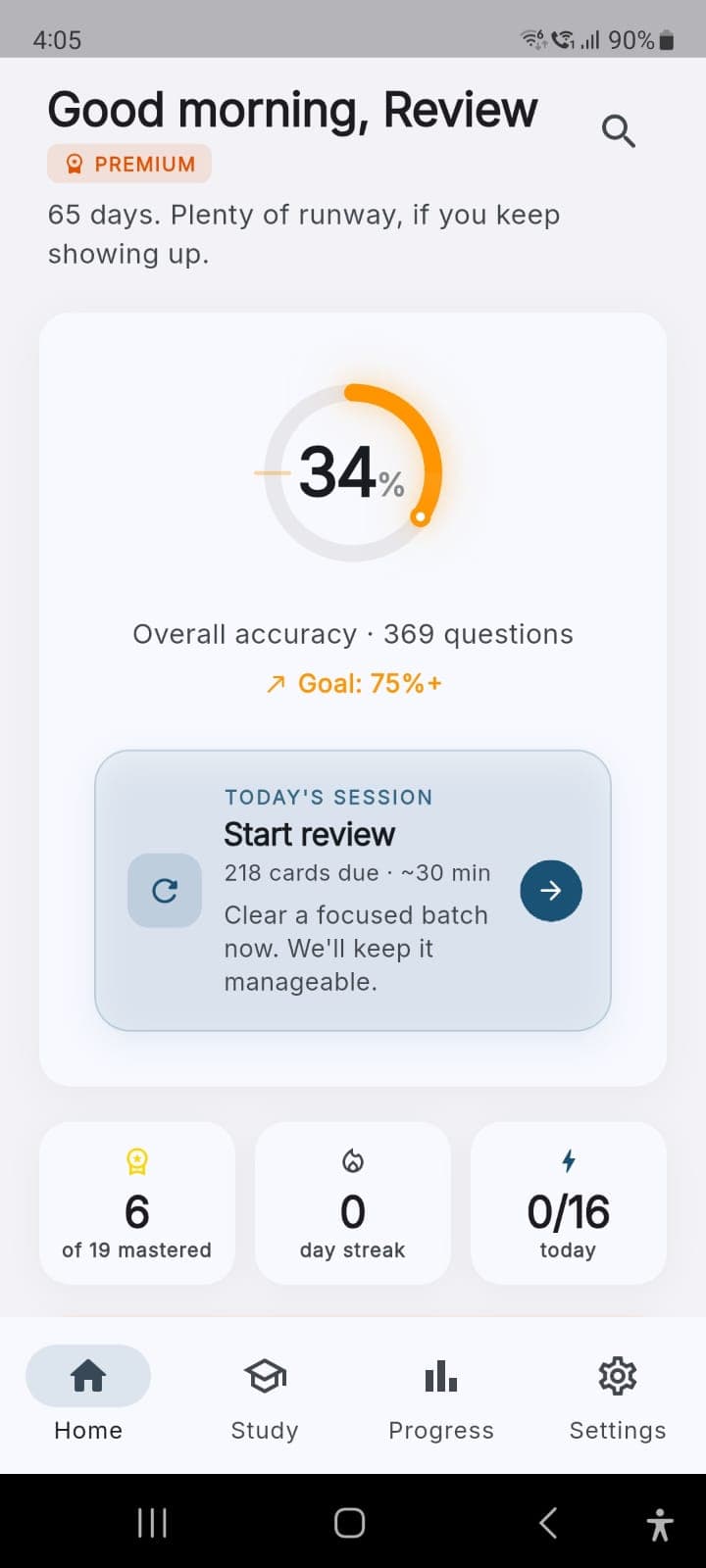
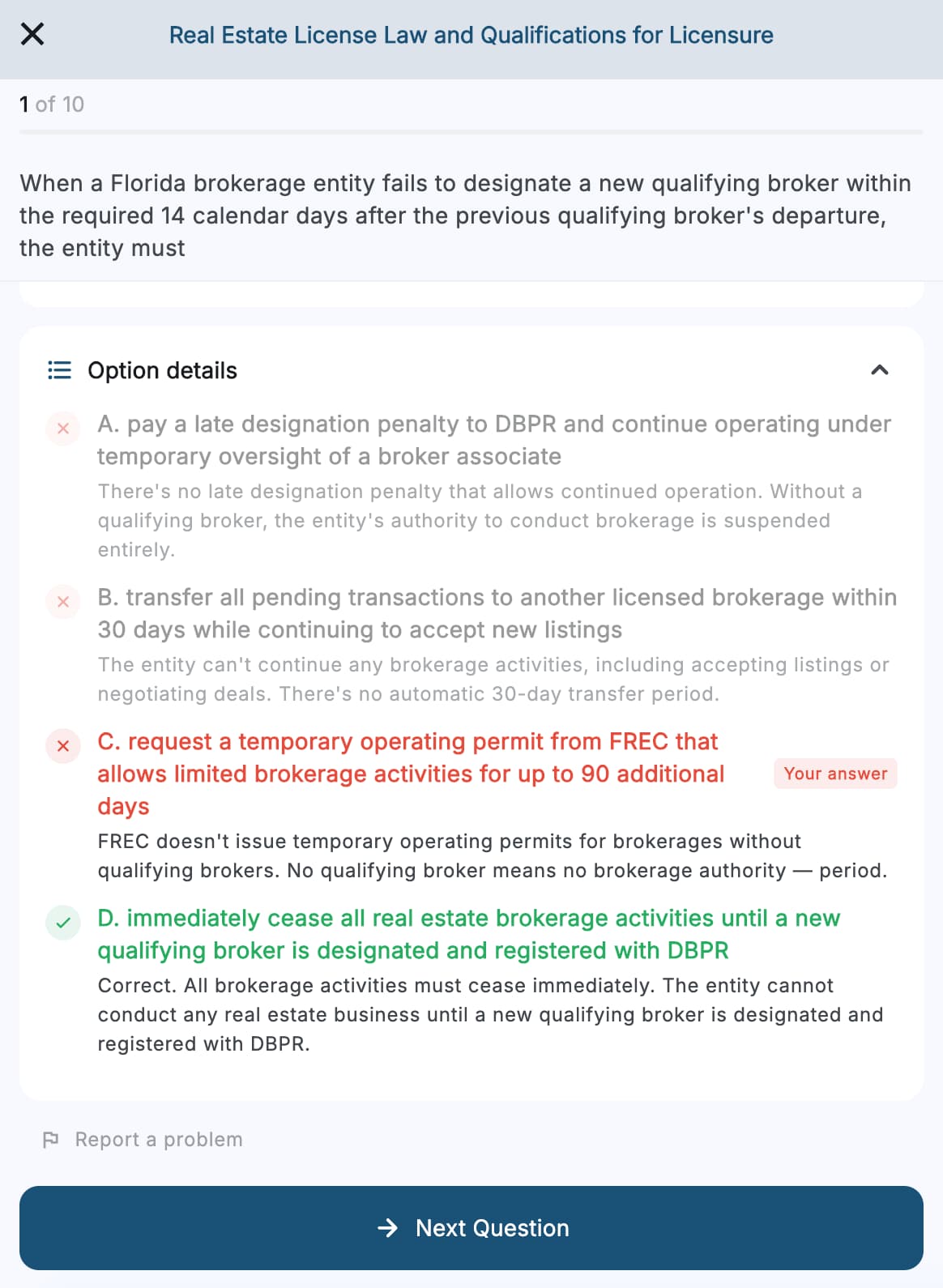
Try a free Florida question | Run the readiness calculator | Download Pass Florida
Methodology
This guide separates official Florida licensing requirements from local Leon County and North Florida career strategy. Official licensing and exam logistics are based on DBPR and Pearson VUE materials current.
Verification cadence for this guide is semi-annual for regulatory items, quarterly for fee, Pearson VUE logistics, TBR / CATRS membership-language, and insurance items, and post-event for any newly named storm with Leon County impact. Local market guidance is practical editorial strategy based on stable regional patterns, not price claims, appraisal opinions, fair-housing legal advice, school guidance, insurance advice, or property-management advice. Verify fees, appointment availability, broker costs, local ordinances, school-zone data, rental rules, association dues, MLS access, and community documents before spending money, scheduling, or advising a client.
Product note. Pass Florida is our Florida-specific exam prep app. This page references our own product, so the relationship is direct and disclosed. We do not claim to use copied exam questions, guarantee passage, or replace official DBPR, Florida Real Estate Commission (FREC), Pearson VUE, course provider, broker, local Realtor association, MLS, legal, tax, insurance, lending, rental, property-management, school-guidance, or fair-housing-compliance guidance. Pass Florida is independent exam prep and is not a DBPR-approved 63-hour pre-license course or continuing education.
This post is educational content about Florida real estate licensing and Tallahassee career strategy. It is not legal, tax, brokerage, licensing, insurance, inspection, lending, HOA, condo, rental, property-management, school-guidance, or fair-housing-compliance advice. DBPR application fees, Pearson VUE exam fees, course tuition, fingerprint vendor pricing, Tallahassee-area association and MLS dues, broker startup costs, local market conditions, academic calendars, rental rules, and brokerage compliance policies can change. Always verify your specific path with DBPR, Pearson VUE, your course provider, your broker, your local association, official school and university sources, local government, and qualified counsel before paying fees, scheduling an exam, advising a client, or making a career decision based on this article.
Sources
State licensing
- DBPR Sales Associate Initial Application checklist
- DBPR RE 1 Sales Associate Application
- DBPR Real Estate Sales Associate Candidate Information Booklet
- DBPR Real Estate Sales Associate Requirements
- Pearson VUE Florida Real Estate and Appraisers testing page
- Pearson VUE Florida Real Estate and Appraisers Candidate Fact Sheet
- DBPR mutual recognition information
Florida statutes and federal law referenced
- F.S. 475.17: qualifications for practice
- F.S. 553.899: mandatory structural inspections for condominium and cooperative buildings
- F.S. 509.032: public lodging and vacation rental preemption
- F.S. 760.29: housing for older persons (HOPA) exemption
- 42 U.S.C. 3604: federal Fair Housing Act prohibited practices
- 24 C.F.R. 100.70: unlawful steering examples
- HUD/FHEO Dear Colleague letter on neighborhood crime data and school quality
Tallahassee market anchors
- Tallahassee Board of Realtors (TBR)
- Capital Area Technology and Realtor Services (CATRS)
- CATRS MLS Rules and Regulations
- City of Tallahassee
- Leon County government
- Florida State University (FSU)
- Florida A&M University (FAMU)
- Tallahassee Memorial HealthCare (TMH)
- HCA Florida Capital Hospital
Hurricane and weather context
- National Hurricane Center Tropical Cyclone Reports archive
- NHC Tropical Cyclone Report: Hurricane Hermine
- NHC Tropical Cyclone Report: Hurricane Michael
- NHC Tropical Cyclone Report: Hurricane Idalia
- NHC Tropical Cyclone Report: Hurricane Helene
- FEMA Flood Insurance Rate Map (Map Service Center)
- Florida Office of Insurance Regulation