PORT ST. LUCIE LOCAL SOURCE NOTE
Port St. Lucie sits in St. Lucie County on Florida's Treasure Coast and combines a fast-growing master-planned interior (Tradition, St. Lucie West, PGA Village, Tesoro) with a 2004 dual-hurricane history (Frances and Jeanne both made landfall on nearby Hutchinson Island within three weeks), a volatile Florida property-insurance market, multi-jurisdictional short-term-rental rules along the St. Lucie / Martin / Indian River coastal corridor, community development district (CDD) and other special-assessment questions in parts of the western growth area, and the post-Surfside milestone-inspection regime in F.S. 553.899 for condo or co-op buildings three habitable stories or more.
Treat every local fact in this guide as a starting point. Before advising any client, verify current insurance availability and pricing with a licensed Florida property and casualty agent, condo and HOA documents with the association and qualified counsel, milestone-inspection status with the St. Lucie County Building Department or the City of Port St. Lucie Building Department, CDD or special-assessment items with the current tax bill, St. Lucie County Tax Collector, City of Port St. Lucie special-assessment records, the district website, the closing agent, and the association where applicable, flood-zone status with the most current FEMA Flood Insurance Rate Map, and short-term rental rules with the City of Port St. Lucie, St. Lucie County, Town of Sewall's Point, City of Stuart, or Martin County depending on the parcel.
This guide is educational. It is not legal, tax, insurance, lending, condo, HOA, CDD, inspection, broker, or property-management advice.
QUICK ANSWER
To get a real estate license in Port St. Lucie, you follow the Florida sales associate path: be at least 18, have a high school diploma or equivalent, have a Social Security number, complete a Florida-approved 63-hour pre-license course unless exempt, submit the Department of Business and Professional Regulation (DBPR) RE 1 application, complete Livescan fingerprints, pass the Pearson VUE sales associate exam, then activate the license with a Florida broker.
Port St. Lucie does not have its own city license. The license is statewide. What changes locally is the market you enter: Tradition and Southern Grove growth, St. Lucie West and PGA Village resale, original PSL single-family inventory, South Florida commuter and remote-work buyers, Cleveland Clinic Tradition Hospital, the Southern Grove research and employment corridor, Clover Park and the New York Mets spring-training pattern, Treasure Coast insurance and flood diligence, and Hutchinson Island condo questions just outside the city.
What this guide covers
- The six-step Florida license path applied to Port St. Lucie
- Current Florida fees, exam, and timing snapshot
- First-renewal warning for new Port St. Lucie licensees
- Eligibility and your Port St. Lucie path
- Port St. Lucie submarket map: Tradition, St. Lucie West, PGA Village, original PSL
- Healthcare, education, and employer anchors
- Clover Park, the New York Mets, and the spring-rental seasonal pattern
- Treasure Coast positioning: Fort Pierce to the north, Stuart and Jensen Beach to the south
- Hurricane Frances and Jeanne (2004), insurance, and HVHZ-not-applicable note
- F.S. 553.899 milestone inspections for older condo and coop buildings
- 63-hour course, DBPR RE 1, fingerprints, Pearson VUE
- Sponsoring broker, first 90 days, and the local Realtor association
Current Florida fees, exam, and timing
DBPR application and Pearson VUE exam pricing reflect amounts published in the DBPR Sales Associate Initial Application checklist and the DBPR Real Estate Sales Associate Candidate Information Booklet. Course tuition is set by your Florida-approved provider and is separate from these fees. Verify the current dollar amounts directly with DBPR and Pearson VUE before quoting them to a friend, family member, or client.
PORT ST. LUCIE DECISION MAP
| Your situation | Best next move | Watch out for |
|---|---|---|
| You want Tradition or new construction | Study builder timelines, incentives, HOA, inspections, CDD or special-assessment line items, and community amenities | Builder communities still need buyer representation |
| You want first-time buyers | Learn financing, seller credits, inspection, insurance, and appraisal gaps | Affordability does not remove complexity |
| You want coastal or Fort Pierce / Hutchinson Island spillover | Learn flood, insurance, condo, milestone, SIRS, and investor questions with broker support | Do not give expert insurance or condo-engineering advice |
| You are part time | Pick a repeatable lead lane such as open houses or sphere | Active buyers may need weekday attention |
First-renewal warning for new Port St. Lucie licensees
Your first Florida real estate license renewal is different from every renewal that follows. A new sales associate must complete a Florida-approved 45-hour post-licensing course before the first license-expiration date, not the standard 14-hour continuing education cycle. Missing the 45-hour post-license deadline means the license becomes null and void by operation of law, and you would need to repeat the 63-hour pre-license course and the Pearson VUE state exam to relicense. Calendar the post-license deadline the day you activate, and confirm the exact expiration date in your DBPR online account because course completion is not a substitute for licensee responsibility to renew on time.
If you searched "how to get a real estate license in Port St. Lucie," the state checklist is only the first layer. You also need to know when to apply, when to fingerprint, how to prepare for Pearson VUE, which broker model gives a beginner real supervision, and what local market lane is realistic in year one.
The official license is the same Florida sales associate license you would get anywhere in the state. The local career is not the same. Port St. Lucie rewards new agents who understand master-planned growth, affordability compared with South Florida, commuter and remote-work buyers, retiree relocation, new construction, and Treasure Coast coastal spillover.
This guide separates official Florida licensing requirements from St. Lucie County and the Treasure Coast career strategy so you can avoid stale fee claims, overconfident local advice, and the common mistake of passing the exam without a first-year plan.
How to get a real estate license in Port St. Lucie: the six-step path
Port St. Lucie does not issue a separate real estate license. To work as a sales associate in Port St. Lucie, complete Florida's 63-hour course, apply through DBPR, submit fingerprints, pass Pearson VUE, then activate under a Florida broker.
THE SIX STEPS
Florida sales associate applicants must be at least 18, have a high school diploma or equivalent, have a Social Security number, and answer DBPR background questions accurately.
Use a Florida-approved pre-license provider. This is pre-license education, not exam prep and not continuing education.
DBPR lets you apply before the course is complete. Valid course completion proof is required before you sit for the state exam.
Use an FDLE-registered Livescan provider immediately after submitting the application. Keep the receipt and transaction information.
The Florida sales associate exam is computer based, closed book, 100 multiple-choice questions, and 3.5 hours. You need 75 points or higher to pass.
A sales associate works under a Florida broker. Passing the exam is not the same as being activated to perform licensed services for compensation.
Step 1: Confirm eligibility and your Port St. Lucie path
Confirm the statewide Florida eligibility rules first, then choose a realistic Port St. Lucie first-year lane based on broker support, local demand, and the type of clients you can serve repeatedly.
Then Port St. Lucie adds local decisions that do not appear on the state checklist.
| Local decision | Why it matters in St. Lucie County and the Treasure Coast |
|---|---|
| First niche | Tradition, St. Lucie West, Fort Pierce, Jensen Beach, Stuart, Vero Beach, and Palm Beach commuter corridors do not all reward the same beginner strategy. |
| Broker model | Team, boutique, franchise, luxury, relocation, investor, and new-construction offices train new agents differently. |
| Local risk questions | Tradition CDD or special-assessment line items, insurance, HOA, condo, rental, land, inspection, milestone / SIRS, or community-rule issues can appear before your first contract. |
| Test timing | Pearson VUE's Florida real estate fact sheet does not list Port St. Lucie as a named test-center location. Check nearby listed centers and the live Pearson VUE appointment list after DBPR approval. |
Local market intelligence: Port St. Lucie ecosystem map
Port St. Lucie rewards focused local competence more than a generic license. Pick one repeatable starter lane, learn its documents and client questions, and work under broker supervision until the pattern is familiar.
| Local lane | What to learn early | Where new agents often start |
|---|---|---|
| Tradition | Master-planned amenities, new construction, HOA, CDD or special-assessment line items, commute, family buyers | Open houses and builder tours |
| St. Lucie West | Established neighborhoods, golf, retirees, first-time buyers, townhomes | Open houses and sphere |
| Port St. Lucie single-family | Affordability, inspections, insurance, financing, family moves | Buyer leads and first-time buyer consults |
| Fort Pierce and coastal edge | Coastal condition, flood, investor questions, downtown redevelopment | Mentor-supported buyer support |
| Palm Beach commuter buyers | Commute trade-offs, value comparison, remote work, relocation timing | Relocation follow-up |
| Investor rentals | Rent assumptions, insurance, HOA restrictions, cap rate basics | Math and broker review |
Local ecosystem visuals: where new agents can start
| Starting path | How it works in Port St. Lucie |
|---|---|
| Fastest practical start | Open houses in Tradition, St. Lucie West, and active subdivision corridors |
| Best builder lane | Tour communities weekly and learn builder processes |
| Best first-time buyer lane | Create simple financing and inspection checklists under broker review |
| Best part-time fit | Weekend open houses plus disciplined weekday follow-up |
Port St. Lucie submarkets: Tradition, St. Lucie West, PGA Village, and original PSL
Port St. Lucie is one of Florida's fastest-growing cities by population, and the local conversation about "Port St. Lucie real estate" actually covers four very different submarkets. A new agent who treats them as interchangeable will miss the buyer questions that decide whether a transaction closes.
| Submarket | What it actually is | What buyers ask first |
|---|---|---|
| Tradition | Master-planned community on the western side of I-95 (Tradition Parkway corridor), built around Tradition Square, Southern Grove / Tradition employment areas, and the Cleveland Clinic Tradition Hospital campus | New-construction timelines, CDD or special-assessment line items, HOA dues, school zoning, builder incentives, hospital and employer proximity |
| St. Lucie West | Established planned community north of Crosstown Parkway, anchored by the St. Lucie Mets minor-league corridor, golf, retail, and PGA-area amenities | Resale value, golf-community dues, age-restricted vs. all-ages neighborhoods, walkability to dining and retail |
| PGA Village and PGA Village Verano | Country-club neighborhoods around the 54-hole PGA Golf Club (Wanamaker, Ryder, Pete Dye courses), with Kolter's PGA Village Verano marketed as an active-adult community | Golf-membership structure, country-club dues separate from HOA, 55+ verification under HOPA (F.S. 760.29(4)) where applicable, amenity access |
| Original Port St. Lucie | Older single-family lots from the city's mid-century General Development Corporation (GDC) era, mostly east of I-95 toward the North Fork of the St. Lucie River | Lot size, septic vs. sewer, roof and 4-point insurance issues, flood-zone status, renovation scope |
Tradition is the section that newer agents most often oversimplify. Tradition is a master-planned area that has changed master developers over time and contains multiple sub-neighborhoods, each with its own HOA, amenities, and cost structure. Some properties are subject to CDD or other special-assessment line items in addition to HOA dues and ordinary ad valorem property taxes. CDD websites for Tradition districts describe annual assessments as including operation and maintenance plus debt service for capital-improvement bonds, collected through the St. Lucie County Tax Collector and shown in the non-ad valorem section of the tax bill. Do not summarize this as simply "high taxes" or "the HOA fee." Verify the actual current tax bill, non-ad valorem line items, remaining debt-service term if any, payoff information if available, and association dues with the Tax Collector, the CDD or district records, the City of Port St. Lucie special-assessment records, the closing agent, and the association before discussing total monthly cost with a buyer.
PGA Village is a country-club community where the PGA Golf Club operates three championship courses designed by Tom Fazio and Pete Dye. PGA Village Verano, developed by Kolter Homes, markets itself as an active-adult lifestyle community with a large pickleball complex, fitness, and indoor and outdoor pools. If a community is marketed as 55+, the HOPA verification described in F.S. 760.29(4) and the federal regulations at 24 C.F.R. part 100 governs how the association establishes and documents age-occupancy compliance. Do not represent 55+ status from marketing materials alone; verify it from the governing documents.
Original-PSL single-family lots are the most affordable entry point in the city, but they are also where insurance underwriting, septic-system condition, and roof age can collapse a deal late. The four-point insurance inspection (roof, electrical, plumbing, HVAC), a wind-mitigation report, and an in-depth review of the FEMA Flood Insurance Rate Map for the specific parcel matter more than any general statement about "Port St. Lucie affordability."
Healthcare, education, and employer anchors
Port St. Lucie's daily-life economy runs on healthcare, regional government and services, and the growing Southern Grove / Tradition employment corridor.
| Anchor | Why it matters for local real estate |
|---|---|
| Cleveland Clinic Tradition Hospital (Cleveland Clinic Martin Health) | Major Tradition-area employer and a relocation driver for clinical staff, nurses, and physicians; campus is integrated into Tradition's western corridor |
| HCA Florida St. Lucie Hospital | Long-established acute-care hospital on US-1 corridor; supports older-PSL and St. Lucie West relocations |
| Indian River State College (IRSC) Pruitt Campus | Higher-education anchor for residents commuting to a local degree, dual-enrollment, and workforce programs; one of several IRSC campuses across the Treasure Coast |
| Keiser University Port St. Lucie | Private four-year institution with a Port St. Lucie campus serving healthcare, business, and education programs |
| Southern Grove / Tradition employment corridor | City-led economic-development area near Tradition that includes healthcare, research, logistics, office, and future employment uses; Cleveland Clinic's Florida Research and Innovation Center is one current research anchor, and Florida Cancer Specialists has announced a Tradition cancer center expected to open in 2026 |
| City of Port St. Lucie government | Major civilian employer; civic, police, fire, utilities, and parks workforce |
| St. Lucie County government | County seat is in Fort Pierce, but St. Lucie County is a significant Treasure Coast employer with a workforce that lives across both cities |
The relocation-buyer conversation in Port St. Lucie usually starts with one of these anchors. A nurse moving to Cleveland Clinic Tradition Hospital, a faculty member at IRSC, a healthcare or research employee in the Southern Grove / Tradition corridor, or a city or county employee will ask very different questions about commute, schools, and housing stock than a snowbird buying a second home or an investor evaluating a small multifamily.
Clover Park, the New York Mets, and the spring-rental seasonal pattern
Clover Park in Port St. Lucie has been the New York Mets' spring training home since 1988 and is also home to the St. Lucie Mets minor-league affiliate during the regular season. The Mets returned to the renovated ballpark in 2020 after a multimillion-dollar capital project, and the team plays roughly two and a half weeks of Grapefruit League home games each February and March before the regular season begins.
Spring training matters to a local agent for three reasons. First, it creates a measurable February-through-March bump in short-term and mid-term rental demand across St. Lucie West, Tradition, and the broader Tradition Parkway corridor. Second, it generates a steady stream of out-of-state visitors who form a relocation pipeline over a five-to-ten-year horizon, particularly buyers comparing Port St. Lucie to other Florida markets. Third, short-term-rental rules vary by jurisdiction and HOA across St. Lucie and Martin counties, so an investor counting on nightly or weekly spring revenue needs to verify both city or county registration requirements and HOA bylaws before committing to a STR business model. Route all STR questions to the City of Port St. Lucie Planning and Zoning Department, the relevant HOA, and qualified counsel.
Treasure Coast positioning: Fort Pierce to the north, Stuart and Jensen Beach to the south
Port St. Lucie sits between Fort Pierce (St. Lucie County seat, to the north) and Stuart and Jensen Beach (Martin County, to the south). All three cities show up in the same MLS search radius, and a Port St. Lucie agent will routinely advise on at least the edges of each.
| Neighbor | What makes it different from Port St. Lucie |
|---|---|
| Fort Pierce (St. Lucie County, north) | Older downtown waterfront, deep-water inlet, historic neighborhoods, A.E. Backus Museum and Highwaymen art legacy, Hutchinson Island North condos, IRSC main campus, Indian River Lagoon working waterfront (see Fort Pierce city guide) |
| Stuart (Martin County, south) | Martin County's stricter growth-management and short-term-rental posture, historic Stuart downtown, deep-water access via the St. Lucie Inlet, higher median pricing tier than Port St. Lucie interior |
| Jensen Beach (Martin County, south) | Hutchinson Island South beachfront condos and single-family, mainland walkable village, Indian River Lagoon, distinct CRA district |
| Sewall's Point (Martin County, south) | Small affluent peninsula with its own town government and STR rules; properties carry premium pricing and condo and HOA documents matter more than marketing |
The MLS most commonly associated with Port St. Lucie brokerages is BeachesMLS, and the regional association source is Broward, Palm Beaches & St. Lucie Realtors. The association describes itself as serving Broward, Palm Beaches, and St. Lucie Counties, while BeachesMLS materials describe MLS access across Broward, Palm Beaches, and St. Lucie Counties. Verify your specific association, MLS, lockbox, forms, and dues structure with your sponsoring broker before signing.
Across all four neighbors, jurisdictional rules vary on short-term rentals, density, building height, and waterfront protection. State preemption under F.S. 509.032(7) limits how aggressively local governments can prohibit vacation rentals outright, but local registration, inspection, and licensing requirements can still matter. Route every short-term-rental question to qualified counsel and the specific jurisdiction.
Hurricane Frances and Jeanne (2004), insurance, and HVHZ-not-applicable note
In 2004, two major hurricanes made landfall on Hutchinson Island in St. Lucie and Martin counties within three weeks of each other. Hurricane Frances came ashore on September 5, 2004 as a Category 2 storm near Sewall's Point. Hurricane Jeanne struck on September 26, 2004 as a Category 3 storm in nearly the same location. The combined wind, surge, and rainfall damage from the two storms reshaped insurance underwriting, roof requirements, and building practice across the Treasure Coast for the next two decades. Hurricane Matthew (2016), Hurricane Irma (2017), and Hurricane Nicole (2022) added additional impact events with varying severity along the same coastline. For storm-by-storm context, the National Hurricane Center publishes Tropical Cyclone Reports for each named storm.
A Port St. Lucie agent should be able to explain the practical insurance posture without giving insurance advice.
| Insurance topic | What it means in practice for a Port St. Lucie buyer |
|---|---|
| Wind mitigation report | A licensed inspector documents roof shape, attachment, opening protection, and other features; carriers apply premium credits based on findings |
| Four-point inspection | Snapshot of roof, electrical, plumbing, HVAC condition; older PSL homes can fail underwriting on roof age alone |
| Citizens Property Insurance | State-created insurer of last resort; eligibility, depopulation, and renewal rules change frequently |
| Florida SB 4-D and SB 2-D legislative changes (2022) | Reshaped reinsurance, attorney-fee rules, and roof-claim handling; verify current law before quoting |
| Flood insurance | Treasure Coast parcels need a FEMA Flood Insurance Rate Map check; flood is separate from homeowners coverage and may be required by the lender |
| HVHZ (High Velocity Hurricane Zone) | Defined in the Florida Building Code as Miami-Dade and Broward counties only; St. Lucie County is NOT in the HVHZ, but Treasure Coast wind design still applies under the Florida Building Code |
Insurance is the most volatile single topic in a Port St. Lucie transaction. Premiums, eligibility, surplus-lines availability, and Citizens depopulation status can change quarter to quarter. Always route specific premium questions to a licensed Florida property and casualty agent and never quote a number from a comparable home as a stand-in for an actual quote on the subject property.
F.S. 553.899 milestone inspections for older condo and coop buildings
Florida's response to the 2021 Champlain Towers South collapse in Surfside (Miami-Dade County) was a statewide milestone-inspection regime codified at F.S. 553.899. The statute applies to condominium and cooperative buildings three habitable stories or more and establishes a phase-one visual inspection followed, where warranted, by a phase-two testing inspection. Buildings within three miles of the coastline have a 25-year initial milestone trigger; other buildings have a 30-year trigger. Subsequent milestone inspections recur on a 10-year cycle.
Port St. Lucie's housing stock is heavily single-family and townhome rather than high-rise condo, but the city and the adjacent Hutchinson Island corridor in St. Lucie and Martin counties do contain older mid-rise oceanfront condo and coop buildings that fall squarely within the milestone regime. A buyer pursuing an older Hutchinson Island condo should ask the association for the most recent milestone-inspection status report, the structural integrity reserve study (SIRS) results, the current reserve funding posture, and any pending special assessments before signing a contract. SIRS funding has been a moving compliance target as the legislature has revisited timing and scope provisions, so verify the current statutory deadline and the building's actual posture with qualified counsel before relying on any age- or stage-based assumption.
A new Port St. Lucie agent does not need to be a milestone-inspection expert. The agent needs to know that the question exists, who to send the buyer to (qualified counsel and a structural engineer where appropriate), and how to read the association's response (or non-response) honestly.
Steps 2 to 4: course, application, fingerprints, and exam
These steps are statewide. Port St. Lucie does not have a separate course, application, fingerprint rule, or licensing exam. Use the complete Florida licensing guide for the current requirements, sequence, forms, and official sources.
For planning, keep the workflow simple:
- Complete a Florida-approved 63-hour pre-license course unless DBPR confirms that an exemption applies to you.
- Submit DBPR Form RE 1. DBPR allows you to apply while the course is still in progress, but you need valid proof of completion before the state exam.
- Complete electronic fingerprints using the real estate ORI listed by DBPR. Keep the receipt and make sure your name and identifying details match your application.
- After authorization, schedule the statewide sales associate exam through Pearson VUE. Confirm the available test center and appointment in your account because locations and seats can change.
Use the waiting time to prepare across the full DBPR outline. The 19-topic exam map, Florida math formulas guide, and fingerprint delay checklist cover the details without repeating the same statewide material in every city guide.
PORT ST. LUCIE EXAM PREP
Prepare for the statewide exam, then apply the license locally.
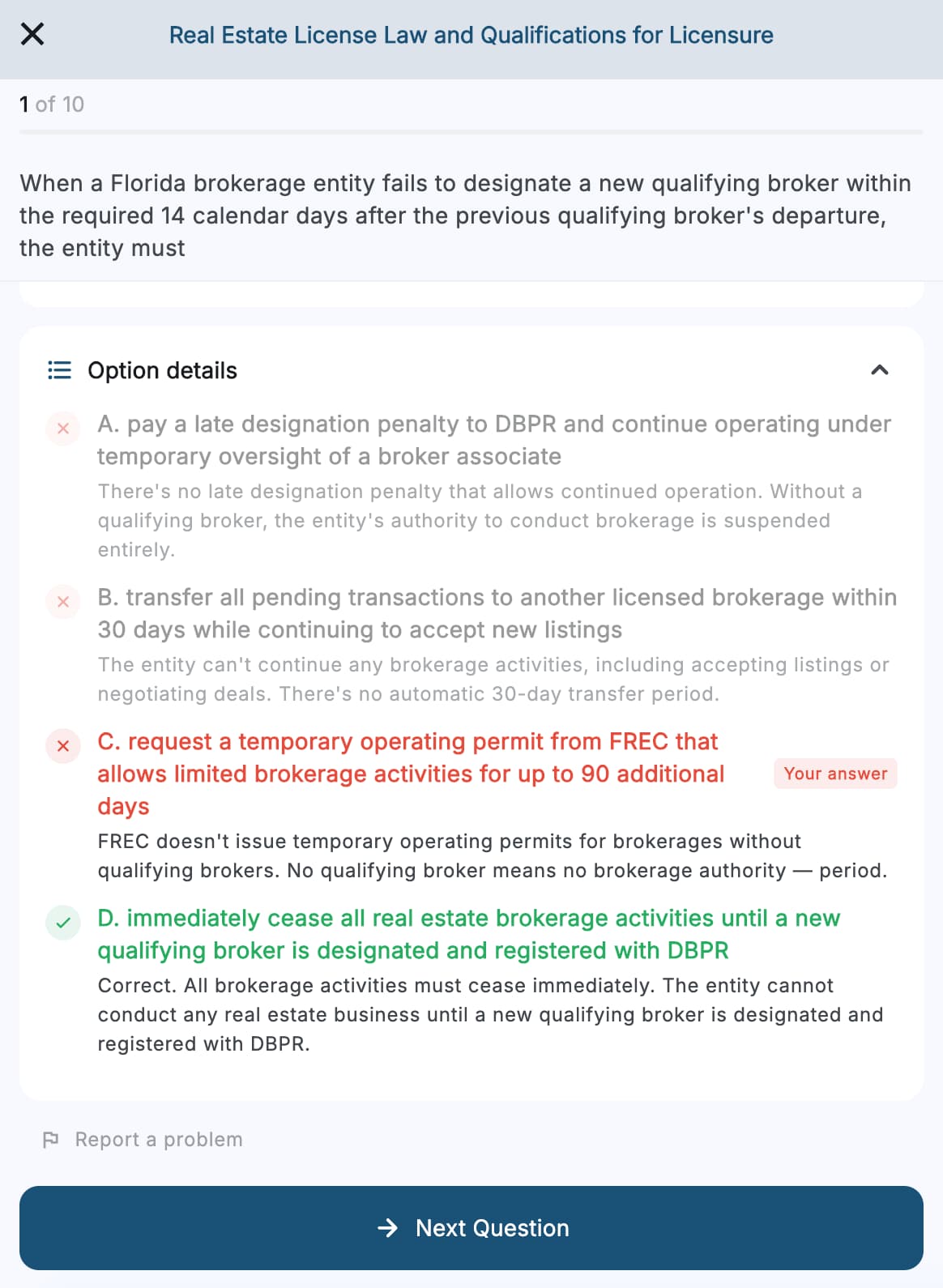
Use Florida-specific practice and a timed readiness check before booking your attempt.
What Port St. Lucie actually rewards after licensing
After licensing, Port St. Lucie rewards supervised repetition, local document discipline, safe routing of legal and risk questions, consistent follow-up, and a first-year lane that fits the local market.
| What the market rewards | What that means in practice |
|---|---|
| Growth literacy | Buyers need help comparing new communities and commute patterns |
| Affordability clarity | Value buyers still need careful financing and inspection guidance |
| South Florida comparison | Many clients are comparing Port St. Lucie to Palm Beach or Broward costs |
| New-construction follow-through | Timelines, incentives, and walkthroughs create repeat questions |
| CDD and assessment discipline | Tradition-area buyers need the tax bill, non-ad valorem line items, HOA dues, and builder incentives explained clearly |
| Condo-document humility | Hutchinson Island and coastal spillover buyers need milestone, SIRS, reserve, insurance, and assessment questions routed correctly |
First-year reality in Port St. Lucie
New agents often ask whether they can make money quickly, work part time, or start in a premium niche. The honest answer is: sometimes, but only with a realistic system.
| Reality | What to expect |
|---|---|
| Income reality | A first year can build through volume and buyer reps, but closings may still lag several months |
| Lead generation | Open houses, builder tours, first-time buyer education, and commuter relocation are practical starts |
| Broker support | Ask who reviews builder, HOA, and inspection questions |
| Part-time viability | Better than some luxury markets if you can respond quickly and get contract support |
Step 5: Find a sponsoring broker
Port St. Lucie candidates should choose a sponsoring broker based on beginner training, contract review, first-transaction supervision, local market support, lead systems, and startup costs, not only commission split.
A Florida sales associate works under a broker. For a new agent, this choice affects training, file review, fees, lead access, transaction supervision, and how quickly you learn the local market.
Ask these before you sign.
| Broker interview question | Why it matters |
|---|---|
| Who reviews my first contracts before they go out? | New agents need supervision before client-facing mistakes happen. |
| How many brand-new agents did you train last year? | Recruiting beginners is not the same as training them. |
| What costs are due before my first closing? | Association, MLS, E&O, signs, lockbox, desk fees, tech, and marketing can add up. |
| Do new agents get open houses in active communities? | Repeated buyer traffic helps beginners learn. |
| How do you train on builders and new construction? | Port St. Lucie has many builder conversations. |
| Who reviews Tradition CDD, special-assessment, tax-bill, and HOA questions? | Buyers can misunderstand total monthly cost if these are treated casually. |
| Who reviews first-time buyer financing questions? | These appear immediately. |
| Who reviews Hutchinson Island condo, milestone, SIRS, reserve, and insurance questions? | Coastal spillover work needs more than generic condo language. |
| Do you support commuter and relocation leads? | Value migration is a local opportunity. |
Use how to find a sponsoring broker in Florida before signing.
Step 6: Activate and start your first 90 days
After passing, activate under a Florida broker before performing licensed services. Use the first 90 days to learn systems, pick one Port St. Lucie lane, build supervised reps, and turn follow-up into appointments.
After you pass, activate with your sponsoring broker before performing licensed services for compensation. Then treat the first 90 days as a practical training sprint.
FIRST 90 DAYS
MLS, forms, file review, showing rules, E&O, compliance, lead process, and who answers live transaction questions.
Choose one local lane from the ecosystem map. One repeatable lane beats vague ambition.
Host open houses, shadow inspections, practice buyer consultations, review sample contracts, and ask your broker to review hard questions.
Track every lead, schedule next steps, ask for appointments, and keep your broker involved before live questions become client problems.
If you already passed, use what to do after passing the Florida real estate exam.
Mistakes Port St. Lucie applicants make
AVOID THESE
- Waiting until the course is finished to submit the DBPR application.
- Doing fingerprints before understanding DBPR's sequence and provider requirements.
- Treating the course final as proof that Pearson VUE will feel easy.
- Scheduling the exam without checking ID match, course certificate validity, and current Pearson VUE availability.
- Choosing a broker by commission split before asking who reviews first contracts.
- Trying to cover every nearby city before learning one local lane deeply.
- Treating Tradition CDD or special-assessment line items as if they were the same thing as HOA dues.
- Saying Port St. Lucie has a Pearson VUE test center without checking the current Pearson VUE location list.
- Describing the Southern Grove / Tradition employment corridor from old Torrey Pines-era materials without verifying current tenants.
- Treating Hutchinson Island condo milestone, SIRS, reserve, and special-assessment questions as routine paperwork.
- Giving legal, insurance, inspection, tax, rental, HOA, or property-management advice outside your role.
- Forgetting that Pass Florida is exam prep, not a 63-hour pre-license course and not continuing education.
Related exam and licensing concepts
| If you need help with | Read this next |
|---|---|
| Full statewide path | How to get a Florida real estate license |
| Timeline and delays | How long it takes to get licensed in Florida |
| Costs | Florida real estate license cost |
| Test-center planning | Florida Pearson VUE real estate testing centers |
| Fingerprint delays | Florida real estate fingerprints delay |
| Course certificate expiration | Florida real estate course certificate expired |
| Exam topics | Florida real estate exam 19 topics |
| Math formulas | Florida real estate exam math formulas |
| Broker choice | Find a sponsoring broker in Florida |
FAQ
How long does it take to get a real estate license in Port St. Lucie?
Most first-time candidates should plan around 10 to 16 weeks. The timeline depends on course pace, DBPR application review, fingerprints, exam readiness, Pearson VUE availability, and broker activation.
Is there a separate Port St. Lucie real estate license?
No. You receive a Florida real estate sales associate license. Port St. Lucie affects your local career strategy, broker fit, and first niche, but not the license itself.
Can I apply to DBPR before finishing the 63-hour course?
Yes. DBPR says the course is not required at application submission. You still need valid proof of course completion before sitting for the state exam.
Where do Port St. Lucie candidates take the Florida real estate exam?
Pearson VUE administers the Florida real estate exam. Pearson VUE's Florida real estate fact sheet does not list Port St. Lucie as a named test-center location. Nearby listed options often include Boynton Beach and Melbourne, but available locations and seats can change. After DBPR approval, check current Pearson VUE seat availability in your account before making travel plans.
What are CDD fees in Tradition?
Some Tradition-area properties may have CDD or other special-assessment line items in addition to ordinary ad valorem property taxes and HOA dues. Tradition CDD materials describe assessments as including operation and maintenance plus debt service for capital-improvement bonds, collected through the St. Lucie County Tax Collector and shown in the non-ad valorem section of the property tax bill. Verify the actual current tax bill, district records, payoff information if available, and HOA dues before discussing total monthly cost with a buyer.
Is the Torrey Pines Institute still the main research anchor in Tradition?
Do not describe Tradition from old Torrey Pines-era materials without checking current tenants. The safer 2026 framing is Southern Grove / Tradition employment corridor, with Cleveland Clinic's Florida Research and Innovation Center as a current research anchor and other healthcare, research, logistics, office, and future employment projects changing over time. Verify current occupancy, tenant mix, and project timing with the City of Port St. Lucie and the employer before using the cluster in a client conversation.
Which association and MLS serve Port St. Lucie agents?
Port St. Lucie agents commonly work through Broward, Palm Beaches & St. Lucie Realtors and BeachesMLS, but your actual association, MLS, lockbox, forms, and dues setup depends on your broker. Confirm the exact structure before signing with a brokerage.
What should I study after the 63-hour course?
Study Florida-specific scenarios, math, DBPR topic areas, and test wording. Course completion gets you eligible. Exam prep makes the test feel familiar.
Can I start part time in Port St. Lucie?
Sometimes. Part-time works best when you have a narrow lead lane, fast follow-up habits, and broker or team coverage for weekday urgency. It works poorly when clients need immediate showings, offers, inspections, or contract answers and you have no backup.
Which broker should a new Port St. Lucie agent choose?
Choose the broker that can supervise your first files, explain local risks, provide a realistic first lead lane, and tell you clearly what costs are due before your first closing. Brand name and split matter, but training matters first.
Ready to start the Port St. Lucie license path?
The Florida license is statewide, but your first year is local. Get the license first, then choose the local broker, lane, and follow-up rhythm that lets you build supervised reps.
The exam is statewide, so Port St. Lucie candidates should verify local logistics and prepare against the same Florida outline used across the state.
Try a free Florida question | Run the readiness calculator | Download Pass Florida
Methodology
This guide separates official Florida licensing requirements from local St. Lucie County and the Treasure Coast career strategy. Lucie not listed as a named test-center location), the Florida Department of Business and Professional Regulation (DBPR) Real Estate Sales Associate Candidate Information Booklet (100 multiple-choice questions), and DBPR real estate associate requirements (45-hour post-licensing before the initial sales associate license expires). CDD and special-assessment references were framed against City of Port St. Lucie special-assessment materials, St. Lucie County Tax Collector materials, and Tradition CDD public descriptions of operation and maintenance plus debt-service assessments collected on the non-ad valorem portion of the tax bill. Southern Grove / Tradition employment references were framed against City of Port St. Lucie Southern Grove materials, Cleveland Clinic's Florida Research and Innovation Center listing, Cleveland Clinic Tradition Hospital materials, and public healthcare-development announcements; current tenants, job counts, project timing, and occupancy must be verified before client use. Association and MLS references were framed against Broward, Palm Beaches & St. Lucie Realtors, BeachesMLS / Only A Realtor materials, and Florida Realtors association listings; broker-specific dues and access still control. Statutory anchors include F.S. 553.899 (mandatory structural milestone inspections for condominium and cooperative buildings three habitable stories or more), Florida Statutes ch. 718 / ch. 719 (condominium / cooperative law and SIRS context), F.S. 760.29(4) (housing for older persons), and F.S. 509.032(7) (vacation-rental preemption context). Hurricane references include National Hurricane Center materials for Frances and Jeanne. Local market guidance is practical editorial strategy based on stable regional patterns, not volatile price claims. Verify fees, appointment availability, broker costs, association or MLS costs, Tradition CDD or special-assessment line items, HOA documents, condo milestone and SIRS status, Citizens or private-market insurance options for any specific listing, FEMA flood-zone status, municipal jurisdiction, and local short-term-rental rules before spending money, scheduling, or advising a client.
Product note. Pass Florida is our Florida-specific exam prep app. This page references our own product, so the relationship is direct and disclosed. We do not claim to use copied exam questions, guarantee passage, or replace official DBPR, Florida Real Estate Commission (FREC), Pearson VUE, course provider, broker, local Realtor association, MLS, legal, tax, insurance, CDD, HOA, condo, inspection, lending, or professional guidance. Pass Florida is independent exam prep and is not a DBPR-approved 63-hour pre-license course or continuing education.
This post is educational content about Florida real estate licensing and Port St. Lucie career strategy. It is not legal, tax, brokerage, licensing, insurance, inspection, lending, HOA, condo, CDD, rental, or professional advice. DBPR application fees, Pearson VUE exam fees, course tuition, fingerprint vendor pricing, Port St. Lucie-area association and MLS dues, broker startup costs, and local market conditions can change. Always verify your specific path with DBPR, Pearson VUE, your course provider, your broker, your local association, the current tax bill and district records for CDD or special-assessment questions, the relevant condo association for milestone and SIRS questions, a licensed Florida property and casualty agent for insurance, and qualified counsel before paying fees, scheduling an exam, or making a career decision based on this article.
Sources
State licensing
- DBPR Sales Associate Initial Application checklist
- DBPR RE 1 Sales Associate Application
- DBPR Real Estate Sales Associate Candidate Information Booklet
- DBPR Real Estate Sales Associate Requirements
- Pearson VUE Florida Real Estate testing page
- Pearson VUE Florida Real Estate and Appraiser Fact Sheet
- DBPR mutual recognition information
Florida statutes referenced
- F.S. 553.899: mandatory structural inspections for condominium and cooperative buildings
- Florida Statutes, Chapter 718 condominium law
- Florida Statutes, Chapter 719 cooperative law
- F.S. 760.29: housing for older persons (HOPA) exemption
- F.S. 509.032: public lodging and vacation rental preemption
Port St. Lucie market anchors
- Cleveland Clinic Tradition Hospital
- Cleveland Clinic Florida Research and Innovation Center
- Cleveland Clinic Florida Research and Innovation Center opening announcement
- HCA Florida St. Lucie Hospital
- Keiser University Port St. Lucie Campus
- Florida Cancer Specialists Tradition cancer center announcement
- City of Port St. Lucie: Southern Grove
- City of Port St. Lucie: Special Assessment & Property Tax
- Tradition Community Development District 5
- St. Lucie County Tax Collector: Taxing Assessments
- Broward, Palm Beaches & St. Lucie Realtors
- BeachesMLS information from Only A Realtor
- Florida Realtors: Broward, Palm Beaches & St. Lucie Realtors
- Clover Park, New York Mets spring training
- PGA Golf Club at PGA Village
- PGA Village Verano
- Indian River State College
- City of Port St. Lucie
Hurricane and coastal context