QUICK ANSWER

To get a Florida real estate license in Daytona Beach: meet F.S. 475.17 eligibility, complete 63 hours of approved pre-license education, file the DBPR RE-1 application with the $83.75 fee, complete Livescan fingerprinting, pass the Pearson VUE state exam (100 questions, 75% to pass) at the Ormond Beach testing center, and activate with a sponsoring broker. Standard path runs 3 to 5 months at $400 to $700 in fees before exam prep.

$400–700
Total cost before exam prep
3–5 mo
Standard timeline (6–10 wk for mutual recognition)
~50%
First-time pass rate

DAYTONA BEACH LICENSE CHECKLIST

STEP 1
Confirm eligibility

F.S. 475.17: 18+, high-school diploma or equivalent, Social Security number, and DBPR good-character review.

STEP 2
63-hour pre-license course

In-person, livestream, or self-paced online. Daytona State College's CCP program and Watson School of Real Estate are the dominant local options.

STEP 3
DBPR RE-1 application

$83.75 fee. File in parallel with the course to save 3–5 weeks of total timeline.

STEP 4
Livescan fingerprints

$50–75 at any Florida-approved vendor. 90-day validity window with DBPR.

STEP 5
Pearson VUE state exam

100 questions, 3.5 hours, 75% to pass, $36.75 sitting fee. Ormond Beach (5 miles north) is the closest testing center.

STEP 6
Activate with a sponsoring broker

$83.75 activation. The moment this processes, you can list, show, write offers, and earn commission.

The Florida real estate license is the same exam, the same 63 hours of pre-license education, the same $83.75 DBPR application fee whether you sit it in Daytona Beach or in Miami. The career on the other side of it is not.

Three things separate Daytona Beach from every other Florida market for a new sales associate. Daytona Beach is the only Florida metro where a recurring annual motorsports and event calendar drives a meaningful share of the real estate market: Daytona International Speedway (the "World Center of Racing") hosts the DAYTONA 500 each February (NASCAR's season-opening event with the largest audience in motorsports), the Rolex 24 At DAYTONA in January, Bike Week in late February through early March (which drew approximately 520,000 attendees in 2026 across 10 days), the Coke Zero Sugar 400 NASCAR night race in August, and Biketoberfest in October, producing recurring premium event-week short-term-rental cycles no other Florida metro replicates. Daytona Beach is the "World's Most Famous Beach," with a 23-mile hard-packed-sand barrier-island corridor running from Ormond-by-the-Sea south through Daytona Beach Shores to Ponce Inlet, one of the few US beaches where driving on the sand is legally permitted in designated areas, and the beach corridor anchors a mid-market coastal vacation-rental and condo market distinct from peninsular Florida's luxury beach segments. And Daytona Beach is home to Embry-Riddle Aeronautical University (approximately 7,000 students at the Daytona campus, the top-ranked aerospace university in the United States), with Kennedy Space Center 75 miles south, creating an aerospace and aviation buyer pool that no other Florida metro outside Brevard County carries at this density.

None of those appear in the standard state guide.

This post walks the six-step path from "considering this" to "active license held by a sponsoring broker": eligibility under F.S. 475.17, the 63-hour pre-license course, the DBPR application, fingerprinting, the 100-question state exam at the Ormond Beach Pearson VUE center, and activation with a brokerage. By the end you'll have a realistic timeline (3 to 5 months for the standard path, 6 to 10 weeks for the mutual recognition path), an honest fee range ($400 to $700 before exam prep), and a clear view of why Daytona Beach's motorsports event economy, drive-on-beach coastal market, and Embry-Riddle aerospace corridor reward agents here differently than they reward agents in Orlando, Jacksonville, or anywhere else in Florida.

What Daytona Beach actually rewards

THE MOTORSPORTS + RECURRING EVENT ECONOMY

The Daytona International Speedway event calendar is the single most distinctive feature of the Daytona Beach real estate market and the one most absent from generic state licensing guides. Daytona Beach is the only Florida metro where a recurring annual motorsports and event calendar drives a meaningful share of housing demand on a predictable cycle.

The annual cycle is concrete and high-volume. The Rolex 24 At DAYTONA in late January draws international sports-car-endurance racing crowds. Speedweeks Presented by AdventHealth runs through February, culminating in the DAYTONA 500, which produces the largest audience in motorsports and one of the highest-attendance sporting events in the United States. Bike Week at DAYTONA runs from late February through early March; the 2026 edition (the 85th anniversary) drew approximately 520,000 attendees across 10 days and saw hotels and short-term rentals booked solid from Ormond Beach south to New Smyrna Beach, with Main Street and the broader corridor packed across the entire stretch. The Coke Zero Sugar 400 NASCAR Cup Series night race in late August draws additional crowds. Biketoberfest in mid-October is the smaller fall companion to Bike Week, running 4 days and drawing roughly 100,000 attendees.

The downstream implications for the real estate market are concrete. Daytona Beach has approximately 200 hotel and motel properties carrying roughly 12,000 rooms, plus a substantial vacation-rental and short-term-rental inventory across the beach corridor and the speedway-adjacent neighborhoods. Event-week premiums on STR rates run 3 to 6x normal weekly rates depending on the event and proximity to the speedway or to Main Street. The DAYTONA 500 weekend, Bike Week's two opening weekends, and the Coke Zero Sugar 400 weekend produce the highest per-week revenue for owners who manage the inventory correctly. Properties within 5 to 10 miles of the speedway command meaningful event-week premiums; beachside inventory commands premium for the longer-duration multi-day events (Bike Week particularly, given attendees often stay 5 to 10 days).

The agent specialization here is concrete. STR investor pro-forma underwriting that correctly models event-week premium revenue, year-round occupancy patterns, management fees, and the specific permitting and condo association rules around short-term rentals; speedway-adjacent zoning literacy (the Daytona International Speedway sits across International Speedway Boulevard from the downtown area, surrounded by hotel, retail, and residential inventory with distinct value drivers); and event-traffic logistics for showings (the metro essentially shuts down for traffic during the Daytona 500 and Bike Week, which agents have to account for when scheduling) are all real technical skills that working Daytona Beach agents build over 24 to 36 months.

THE "WORLD'S MOST FAMOUS BEACH" + DRIVE-ON-BEACH MARKET

The beach specialization is the second underpriced differentiator and the most concretely Daytona. The Daytona Beach corridor is one of the few US beaches where driving on the hard-packed quartz-and-shell sand is legally permitted in designated areas, a feature unique to the Volusia County beaches (the practice is also permitted on stretches of New Smyrna Beach south of Daytona). The 23-mile beach corridor runs from Ormond-by-the-Sea in the north through Ormond Beach, Daytona Beach, Daytona Beach Shores, Wilbur-by-the-Sea, and Ponce Inlet in the south.

The market structure on the beach corridor runs heavily toward mid-market vacation rental and condo inventory rather than ultra-luxury single-family. Daytona Beach Shores in particular is the beachfront condo concentration, with high-rise and mid-rise oceanfront towers in the $250,000 to $700,000 range depending on size, floor, and view, plus a smaller share of beachfront single-family in the $700,000 to $1.5 million range. Daytona Beach itself (the city) is mixed with both beachfront condo and inland single-family inventory. Ormond Beach (north) and Port Orange (south) are the larger inland-and-beachside hybrid communities. Ponce Inlet is the southern barrier-island anchor with a distinct lighthouse-and-residential character.

The market is mid-market rather than luxury, which matters for the agent income math. Beachfront condos at $300,000 to $500,000 produce 3% commissions of $9,000 to $15,000 per side; beachside single-family at $400,000 to $700,000 produces $12,000 to $21,000. These are meaningfully lower than Naples Gulf-front, Palm Beach Island, or even Fort Lauderdale waterfront commission dollars, but the transaction volume is higher because the price point is more accessible to a broader buyer pool. Daytona Beach also has a national in-migration story: Daytona Beach ranked #9 nationally on the U-Haul 2025 Growth Index for net-inbound one-way rental traffic, meaning the in-migration pipeline is real and sustained.

EMBRY-RIDDLE AERONAUTICAL UNIVERSITY + AEROSPACE CORRIDOR + KENNEDY SPACE CENTER ADJACENCY

The third differentiator is aerospace and university-specific. Embry-Riddle Aeronautical University (ERAU) operates its flagship Daytona Beach campus with approximately 7,000 students across undergraduate, graduate, and doctoral programs in aerospace engineering, aviation, applied science, and business. ERAU is consistently ranked among the top aerospace and aviation universities globally and carries an unusually high proportion of international students (roughly 15 to 20% of enrollment in recent years). Bethune-Cookman University (a historically Black university with approximately 2,500 students) and Daytona State College (approximately 12,000 students) add to the higher-education footprint in the metro.

The aerospace corridor extends beyond the campus. Daytona Beach International Airport (DAB) hosts ERAU's flight operations plus general aviation activity. Kennedy Space Center is 75 miles south on I-95 in Brevard County, with Cape Canaveral Space Force Station, SpaceX operations, and a growing private spaceflight industry that's drawing workforce relocation across the broader Central Florida East Coast. Patrick Space Force Base anchors the southern end of the aerospace corridor. Aerospace contractors with Brevard County operations sometimes house staff in Daytona Beach given the lower price point and the 75-minute commute to KSC.

The downstream implications for the real estate market are specific. ERAU faculty (tenured and tenure-track) and staff are a stable buyer segment that operates similarly to the Florida Retirement System pattern documented in the Gainesville and Tallahassee posts (ERAU is private rather than state, but the institutional buyer-segment economics are comparable in their stability and predictability). ERAU students cluster in specific rental districts (the Beachside, Holly Hill, and South Daytona corridors) but the rental investor segment is smaller in absolute volume than the Tallahassee or Gainesville student-rental markets given ERAU's smaller enrollment. International ERAU students bring specific financing patterns (cash purchases, cosigner arrangements, US-credit-history gaps) that working agents serving this segment learn to handle correctly. Aerospace contractor employees and KSC-commuting staff are a smaller but predictable buyer segment with relocation cycles that key off launch schedules and contract awards rather than the academic calendar.

The honest counterweight in the income math: Daytona Beach has the lowest income ceiling of any major Florida coastal metro for new real estate agents after Pensacola. Median home prices run $260,000 to $315,000 across sources in Q1-Q2 2026, meaningfully below the Florida state median. Days on market are running 93 to 104 days, slower than peninsular coastal Florida and slower than the 2024 cohort experienced. The market correction has been substantial: some sources show Daytona Beach home values down 8 to 27% year-over-year on certain metrics, depending on measurement window. Atlantic-facing coastal inventory carries the same insurance-and-elevation scrutiny as other Florida coastal markets, particularly after the 2022-2024 storm cycle (Hurricane Ian and Hurricane Nicole in 2022, Hurricane Helene and Hurricane Milton in 2024, with Nicole making direct landfall just south of Daytona Beach Shores and severely damaging the beachfront seawalls).

Step 1: Eligibility

F.S. 475.17 sets the bar lower than most applicants assume. You must be 18, hold a high-school diploma or equivalent, have a Social Security number, and meet a "honesty, trustworthiness, and good character" standard that DBPR evaluates case-by-case.

The "good character" item is the one that worries second-career applicants more than it should. DBPR is materially more permissive than most state real estate commissions on prior records. Old misdemeanors, a single dated felony, and minor financial-history items rarely block a Florida license outright. The board weighs nature of offense, time since, evidence of rehabilitation, and relevance to the practice of real estate. What stops applications is not usually the conviction itself. It is incomplete disclosure on the application form.

Two practical notes for Volusia County applicants.

If your record has anything you're uncertain about, file the application honestly and let DBPR rule. The board says yes more often than applicants expect. Withholding something the background check will surface anyway is what creates problems, not the underlying record.

If you hold a non-US educational credential (common among Daytona Beach second-career applicants given Embry-Riddle's international academic community), you need a U.S. high-school equivalency on file. Either a GED or an accredited foreign credential evaluation. Handle it before you submit the DBPR application, not after.

Nothing in this section is legal advice. If your situation is non-standard, a Florida-licensed attorney will give you a clearer read than any blog post can.

Step 2: The 63-hour pre-license course

Florida requires 63 hours of approved pre-license education before you can sit the sales associate exam. The hour count is the same statewide. The providers and the formats are not.

Three formats exist:

  • In-person classroom. Fixed schedule, 2 to 4 weeks of evenings or a compressed weekday track. Best for candidates who don't trust themselves to finish self-paced material.
  • Livestream. Same instructor and same schedule as in-person, no commute.
  • Self-paced online. Finish in as little as 9 days or stretch over 6 months. Cheapest, highest dropout rate.

Cost runs from about $150 on the cheapest national online providers to $500 for in-person classroom programs. Daytona Beach has a moderate local provider bench. Daytona State College offers a formal Career Certificate Program (CCP) for the Real Estate Sales Associate license through its workforce development division, which is the academic-track option for candidates who want a college credential alongside the license. Watson School of Real Estate (the educational arm of Watson Realty Corp, which has a substantial Volusia County presence) runs livestream and online programs serving the Daytona Beach market. Larson Educational Services (with regional online presence) is the third major option. National online providers (The CE Shop, Aceable, Colibri, Kaplan Real Estate Education) round out the field. We compared the seven major providers in the best Florida pre-license course post.

KEY INSIGHT · MUTUAL RECOGNITION PATH

If you already hold an active real estate license in one of the ten Florida mutual recognition states (Alabama, Arkansas, Connecticut, Georgia, Illinois, Kentucky, Mississippi, Nebraska, Rhode Island, West Virginia), the path described in this post is not your path. You skip the 63-hour course entirely, sit a shorter 40-question Florida-law-only exam, and can be active in 6 to 10 weeks. We cover that sequence in the Florida license transfer guide. Daytona Beach's #9-nationally in-migration ranking on the U-Haul 2025 Growth Index means a meaningful share of new Volusia County agents come through the mutual recognition pipeline rather than the 63-hour course.

Full cost breakdown across the whole licensure path lives in the Florida real estate license cost post. Short version: $400 to $700 in fees and course costs before exam prep.

Step 3: The DBPR application and fingerprinting

You submit the RE-1 application through the DBPR portal. Fee is $83.75. Processing runs 2 to 6 weeks in normal periods and longer during DBPR backlog windows. Fingerprinting is done separately through a Florida-approved Livescan vendor and runs $50 to $75. Daytona Beach has Livescan vendors across the metro including locations in downtown Daytona, the International Speedway Boulevard corridor, Port Orange, Ormond Beach, and the Halifax Health hospital corridor. Most are walk-in.

One tactical point that matters more than the order of any other step in this guide: file the DBPR application before you finish the 63-hour course, not after. The application and the course can process in parallel. DBPR's review does not require proof of course completion at submission. It requires it before they release you to schedule the exam. Filing early can shave 3 to 5 weeks off your total timeline.

The application asks about prior convictions, prior license discipline in any state, and financial history. Answer all of it honestly. The two most common reasons applications get flagged or delayed are nondisclosure of items DBPR finds on the background check anyway, and applicant slowness in responding to follow-up document requests. Neither of those is hard to avoid.

Fingerprints have a 90-day validity window for DBPR's purposes. Schedule the Livescan once you know your application is in. If you fingerprint too early and your application stalls for any reason, you may end up paying to re-print.

HALFWAY THERE · STEP 4 IS WHERE 50% FAIL

The exam is the only step where the failure rate is a coin flip.

1,002 Florida-specific questions weighted to the 19-topic outline, statute-current through HB 913 and the F.S. 689.302 flood disclosure expansion. Trap Library for the EXCEPT/NOT patterns that catch most first-time candidates. $39.99 once.

Try a sample question →

Step 4: The Florida Real Estate Sales Associate exam

The exam is 100 multiple-choice questions, 3.5 hours, 75% to pass. The split is 45 state-specific questions and 55 national questions, with roughly 8 to 12 math questions woven through. First-time pass rate hovers near 50%, depending on the DBPR quarter you sample. About half the people who sit it walk out without a license. That is not a comment on the test takers. It is a comment on how most candidates prepare.

The 19-topic DBPR content outline (we broke it down in the 19 topics post) is weighted heavily toward four clusters: real estate brokerage activities and procedures, contracts, property rights and ownership (which is where the condo content lives, including HB 913 changes), and mortgage and lending. Those four clusters account for roughly 40% of the exam between them. If your study time is split evenly across all 19 topics, you are spending time on the wrong ones.

Volusia County area Pearson VUE testing centers:

  • Ormond Beach (the primary Volusia County center, 5 miles north of Daytona Beach, the standard option for almost all Daytona Beach, Daytona Beach Shores, Port Orange, and South Daytona candidates)
  • Lake Mary (Seminole County, roughly 50 miles southwest)
  • Melbourne (Brevard County, roughly 90 miles south, useful for candidates closer to the Kennedy Space Center corridor)

The Ormond Beach center is the standard option. Lake Mary and Melbourne are regional alternates. Book early. Slots can run 2 to 4 weeks out in peak periods, particularly Q1 ahead of the snowbird-season listing surge and around Daytona event windows.

KEY INSIGHT · WHAT THE EXAM TESTS THAT DAYTONA BEACH AGENTS NEED LOCALLY

The exam tests Florida law, not Volusia County law. But several Florida-statute test areas map directly to the Daytona Beach market in ways that aren't obvious. HB 913 condo reserve and milestone inspection content (Chapter 718, F.S.) is tested explicitly and applies heavily to Daytona Beach Shores beachfront condo inventory where most buildings are at or past the 25-year coastal milestone threshold. F.S. 689.302 flood disclosure obligations, expanded effective October 2025, apply to all coastal Volusia County inventory after Ian, Nicole, Helene, and Milton. And the 4-point inspection and wind mitigation content shows up in property condition and disclosure questions with particular relevance to the post-SB 2-A insurance market on Atlantic-facing coastal inventory.

Landlord-tenant law (Chapter 83, F.S.) applies with particular relevance to the Daytona Beach short-term-rental segment and the broader event-rental market, where short-term lease structures and seasonal occupancy patterns interact with state landlord-tenant rules in ways generalist agents miss.

HB 913 content is on the exam now. If your prep material was printed before 2025, the condo reserve and milestone-inspection answers are wrong. We track the change set in the 2026 exam changes post. Whatever prep tool you use, confirm it's been updated for HB 913 before you commit your study hours to it.

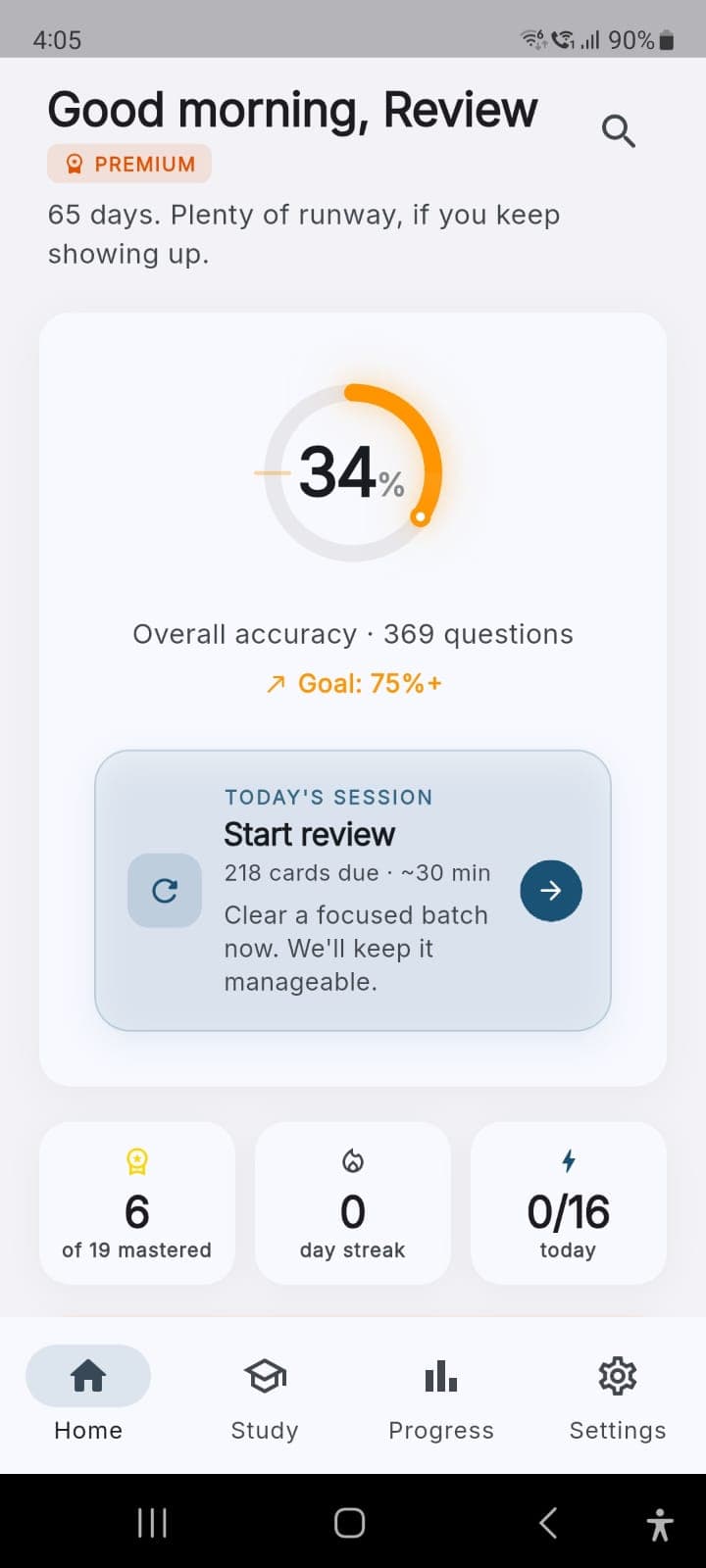
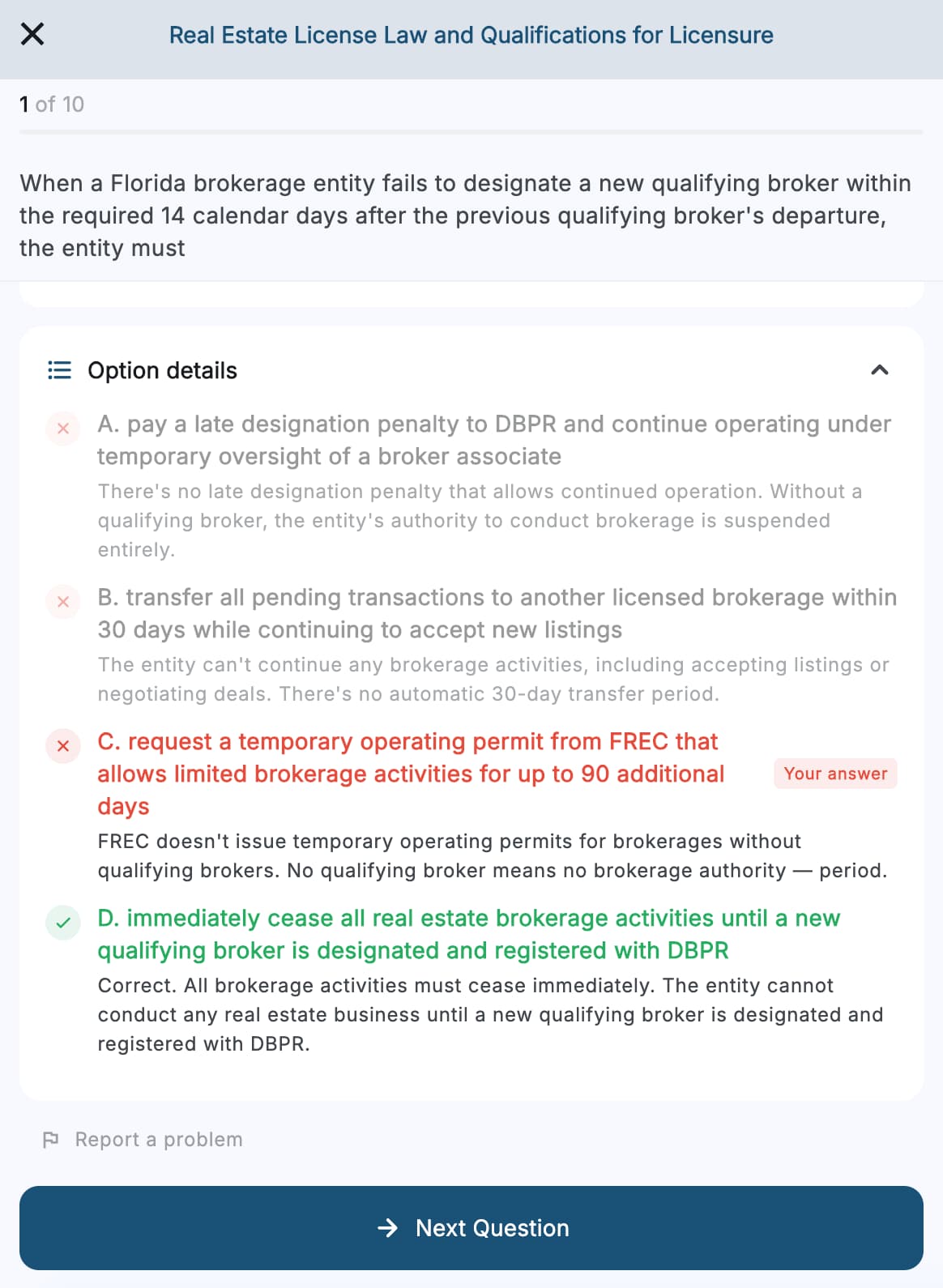
Pass Florida is built for this gap: 1,002 Florida-specific questions weighted to the 19-topic outline, statute-current through HB 913, $39.99 once. Try a sample question before you decide anything.

DRILL THE PATTERNS YOU JUST READ ABOUT

Reading about the exam is not the same as practicing it.

The 50% pass rate isn't a difficulty problem. It's a preparation problem. Drill the 19-topic outline against scenario-based questions weighted to actual exam frequency, including the HB 913 condo content and F.S. 689.302 flood disclosure content the 2024 prep materials don't cover.

Get Pass Florida · $39.99 →

Step 5: Find a sponsoring broker

A Florida sales associate license is inactive until a licensed broker activates it. The brokerage decision is the most consequential career choice a new agent makes in year one and the one most often made on autopilot.

KEY INSIGHT · SPLIT vs. MENTORSHIP

A high-split brokerage (you keep 70 to 100% of the commission) typically pairs the split with low training, no desk infrastructure, and no lead generation. A low-split brokerage (you keep 50 to 60%, sometimes lower in year one) typically pairs the split with structured training, a mentor or team lead, marketing support, and a transaction coordinator. For year-one Daytona Beach agents, the second model usually produces more closed deals even after the worse split. Most new agents close zero to two transactions in their first six months.

The Volusia County brokerage landscape sorts into four tiers:

  • Daytona Beach-anchored local independents: Adams, Cameron & Co. Realtors (founded in Daytona Beach in 1953, one of the longest-running independent brokerages in Volusia County), Realty Pros Assured (Daytona Beach-anchored, with Volusia County coverage), Engel & Völkers Daytona Beach, Geri Westfall Real Estate, Oceans Luxury Realty. For agents who want to work for a founder-led or boutique brokerage with deep Daytona Beach market roots.
  • National full-service brands with strong Volusia County affiliates: Watson Realty Corp (Jacksonville-headquartered with substantial Volusia County presence), Coldwell Banker (multiple Volusia County offices), Berkshire Hathaway HomeServices Florida Network Realty, Keller Williams, Century 21. For new agents who want structure with broad market coverage.
  • Tech-forward growth brands: Compass, eXp Realty (independent contractor model), LPT Realty. For agents who want marketing infrastructure or a high-split structure.
  • STR investor and beach specialist brokerages: Several smaller Volusia County brokerages specialize specifically in beachfront condo investment work, short-term-rental management, or event-week rental coordination. These tend to be team-driven rather than brand-driven.

The brand-name analysis is mostly noise. Here's the analysis that matters in Daytona Beach specifically. Adams, Cameron & Co. is the longstanding Volusia County independent (founded 1953) and carries deep local-market knowledge across both Daytona Beach mainland and beachside inventory. Watson Realty Corp brings the highest North-and-Central Florida regional volume across Volusia County. The STR-and-event-rental specialist brokerages carry concentrated expertise in pro-forma underwriting, condo association rule literacy, and event-week premium modeling that generalist agents take 24 to 36 months to build.

The Daytona Beach-specific multipliers, when they kick in, are STR investor specialization (event-week pro-forma underwriting, condo association short-term rental rule literacy, speedway-adjacent zoning expertise, beachfront elevation certificate timing), event-economy fluency (Daytona 500, Bike Week, Coke Zero Sugar 400, and Biketoberfest cycle management for both buyers and sellers), beachfront condo expertise (Daytona Beach Shores, Ponce Inlet, Ormond-by-the-Sea inventory with HB 913 milestone inspection literacy), and the Embry-Riddle and aerospace-corridor relocation pipeline (faculty, international students, aerospace contractor employees commuting to Kennedy Space Center). A new agent who develops genuine depth in any one of those four areas has differentiation that doesn't exist for new agents in inland Florida metros.

We go deeper on the brokerage-selection criteria, including the specific questions to ask at the interview, in the sponsoring broker guide.

Step 6: Activate and start

Activation runs $83.75 through DBPR and is initiated by your sponsoring broker. From the moment activation processes, you can list, show, write offers, and earn commission. The 24-month post-activation clock starts on a 45-hour post-license education requirement, which must be completed before your first license renewal.

Honest first-90-days expectation: most new Daytona Beach agents do not close a transaction in their first quarter. The standard pattern is 60 to 90 days of pipeline-building (sphere outreach, open houses, listing appointments shadowed with a mentor) before a first offer goes out. First closing typically lands somewhere in months 4 to 8. Income in those first months is zero, which is why most new Florida agents enter the business with 6 to 12 months of savings or part-time work covering the gap.

Daytona Beach has a structural advantage for new agents that South Florida metros don't: cost of living is meaningfully lower than peninsular Florida coastal markets. The Daytona Beach median home price ($260,000 to $315,000 across sources in Q1-Q2 2026) and the broader rental market run substantially cheaper than Miami, Fort Lauderdale, West Palm Beach, or Naples. A new agent's 6-to-12-month savings runway stretches further in Daytona Beach than in the South Florida luxury metros. That said, the lower-price-point math cuts the other direction at closing: a 3% commission on a $300,000 transaction is $9,000 gross; on a $750,000 South Florida transaction it's $22,500. Daytona Beach agents close more transactions per year than coastal-luxury agents to reach the same gross commission income, which means lead generation, pipeline velocity, and recurring-event-cycle prospecting (especially in the STR investor and event-rental segments) matter more relative to high-touch luxury workflows.

The candidates who shorten the ramp materially in Daytona Beach fall into three patterns. They bring an existing book, which is why second-career applicants from local hospitality (Hilton Daytona Beach Oceanfront Resort, The Plaza Resort & Spa, and the broader hotel sector alumni networks), motorsports and event industries (Daytona International Speedway operations, NASCAR-adjacent businesses, the broader event-services economy), or the aerospace sector (Embry-Riddle staff, aerospace contractor employees) often outperform first-career applicants. They have technical depth in one of the four differentiators above. Or they have established Northeast and Midwest snowbird buyer relationships that route into Daytona Beach naturally (Daytona Beach has a substantial snowbird and retiree demographic alongside the event-and-tourism economy).

None of those is reliably built in the first 90 days. All of them can be built deliberately starting in month one if you know to build them.

CALENDAR · STANDARD-PATH TIMELINE

WEEK 1
Enroll and file in parallel

Start the 63-hour pre-license course. File the DBPR RE-1 application the same week. Review and coursework run on separate clocks.

WEEKS 2–4
Finish the course, complete fingerprinting

Walk into any Florida-approved Livescan vendor (Daytona Beach has multiple locations across downtown, the International Speedway Boulevard corridor, Port Orange, and Ormond Beach). DBPR application enters review in parallel.

WEEKS 4–8
Sit the Pearson VUE exam in Ormond Beach

Book early. Ormond Beach has the closest center, 5 miles north; Lake Mary and Melbourne are regional alternates. Slots can run 2–4 weeks out in peak periods, especially around Daytona event windows. 100 questions, 75% to pass.

MONTH 3+
Activate with a broker and start working

Most new agents close their first transaction in months 4–8. Plan 6–12 months of savings to bridge the ramp; Daytona Beach's lower cost of living relative to peninsular Florida stretches that runway meaningfully.

What you'll actually make in Daytona Beach

This is the section most state-guide pages get wrong. They cite an average and move on. Daytona Beach real estate income runs lower than peninsular South Florida averages, and a single number obscures the distribution.

The honest numbers across major sources (Deltona-Daytona Beach-Ormond Beach MSA):

Source Average / Median Range (25th–75th percentile)
Glassdoor (Q1 2026) ~$82K $58K – $112K
AceableAgent career data ~$72K n/a
Indeed ~$78K n/a
ZipRecruiter (Apr 2026) ~$64K $46K – $82K

The reason the Daytona Beach averages run lower than peninsular South Florida is straightforward: lower median home prices produce lower commission dollars per transaction, and the market lacks a deep ultra-luxury tier (Daytona's high end runs into the $1 million to $3 million range for top beachside single-family rather than the multi-million-dollar ranges of South Florida coastal). The distribution does have an event-economy spike unique to the metro: agents who manage substantial STR investor portfolios across the speedway-adjacent and beachside inventory can produce higher annual incomes than the medians suggest because the event-week premiums compound across multiple owned units.

What that means for a new agent: your year-one income will almost certainly be on the low end of those ranges. Most new agents in any Florida metro earn between $10,000 and $30,000 gross in year one. In Daytona Beach, year-one income for generalist new agents often lands in the middle of that band because of the meaningful transaction volume; the multiples in the higher data points come in year two through year five, faster for agents who developed STR investor pipelines, event-economy fluency, beachfront condo expertise, or Embry-Riddle and aerospace-corridor relocation networks during their ramp.

Deeper on the data, the year-by-year ramp, and segmentation in the Florida real estate agent salary post.

Ready to sit the Daytona Beach exam?

The 50% first-time pass rate is the gap between candidates who study by reading and candidates who study by retrieval against the question patterns the exam actually uses. Pass Florida was built for the second kind. 1,002 Florida-specific questions, statute-current through HB 913 and the F.S. 689.302 flood disclosure expansion, weighted to the official 19-topic outline, with a Trap Library for the EXCEPT/NOT pattern questions that catch most first-time candidates. $39.99 once. Lifetime access on iOS and Android. No subscription, no upsells, no fake reviews.

Get Pass Florida. $39.99 →

FAQ

How long does it take to get a real estate license in Daytona Beach?

3 to 5 months on the standard path (eligibility check, 63-hour course, DBPR application, fingerprints, state exam, broker activation). 6 to 10 weeks on the mutual recognition path if you hold an active license in one of the ten reciprocating states (Alabama, Arkansas, Connecticut, Georgia, Illinois, Kentucky, Mississippi, Nebraska, Rhode Island, West Virginia). Daytona Beach's #9 national U-Haul Growth Index ranking for 2025 means a meaningful share of new Volusia County agents come through the mutual recognition pipeline rather than the 63-hour course.

How much does a Florida real estate license cost in Volusia County?

$400 to $700 before exam prep, depending on which 63-hour pre-license course you choose. The mandatory fees are the $83.75 DBPR application, $50 to $75 for Livescan fingerprinting, the $36.75 Pearson VUE exam sitting fee, and $83.75 to activate with a broker. Course costs ($150 to $500) make up the rest. Full breakdown in the Florida real estate license cost post.

Where do I take the Florida real estate exam if I'm based in Daytona Beach?

Ormond Beach has the closest Pearson VUE testing center, 5 miles north of Daytona Beach, and is the standard option for almost all Volusia County candidates. Lake Mary is the next-closest alternate (roughly 50 miles southwest in Seminole County) and Melbourne is the next-closest alternate to the south (roughly 90 miles, useful for candidates closer to Brevard County). Booking 2 to 4 weeks ahead is standard in peak periods, particularly around Daytona event windows when speedway-adjacent inventory is in heaviest demand.

How does the motorsports event economy actually drive the Daytona real estate market?

Daytona International Speedway hosts a recurring annual cycle of major events: the Rolex 24 At DAYTONA in late January, the DAYTONA 500 and Speedweeks Presented by AdventHealth in February, Bike Week (approximately 520,000 attendees in 2026 across 10 days), the Coke Zero Sugar 400 NASCAR Cup Series night race in August, and Biketoberfest in October. Each event drives premium short-term-rental rates for properties within roughly 5 to 10 miles of the speedway, and Bike Week specifically books hotels and STR inventory solid from Ormond Beach south to New Smyrna Beach. Daytona Beach has approximately 200 hotel and motel properties with roughly 12,000 rooms, plus a substantial STR inventory; event-week rates run 3 to 6x normal weekly rates depending on the event and proximity to the speedway. Agents who develop STR investor pipelines and can underwrite event-week premiums accurately operate in a niche unique to Daytona Beach.

Is the "drive on the beach" really a real estate factor?

Yes, in two ways. First, beach access patterns: Volusia County is one of the few US locations where driving on the hard-packed sand is legally permitted in designated areas of the 23-mile beach corridor. This affects the residential market because beachside inventory in Daytona Beach Shores, Ormond Beach, and Ponce Inlet sits adjacent to a beach that operates differently from peninsular Florida beach access. Second, the beach driving identity drives a specific demographic into the metro (motorsports enthusiasts, RV-and-truck owners, broader Americana-tourism segment) that anchors the mid-market beachside condo and single-family inventory. The market is mid-market rather than ultra-luxury, but the beach access and event identity are part of what sustains the buyer pool.

Can I get a Florida real estate license with a criminal record?

It depends on the offense, time since, evidence of rehabilitation, and relevance to the practice of real estate. DBPR is materially more permissive than most state real estate commissions. Old misdemeanors, a single dated felony, and minor financial-history items rarely block a license outright. What stops applications is nondisclosure on the form. The background check surfaces the record either way, so file honestly and let DBPR rule.

How did the 2022-2024 hurricane sequence affect the Daytona Beach market?

Substantially across four named storms. Hurricane Ian in September 2022 produced Atlantic-side storm surge and inland flooding across Volusia County despite making landfall on the west coast. Hurricane Nicole in November 2022 made direct landfall just south of Daytona Beach Shores, producing massive Atlantic-coast erosion and seawall damage on the beachfront inventory. Hurricane Helene in September 2024 and Hurricane Milton in October 2024 both impacted Volusia County with additional storm surge and wind damage. The cumulative effect: insurance carrier behavior on Atlantic-facing coastal inventory has tightened materially, roof-age scrutiny and elevation compliance now matter to most Daytona Beach Shores and Ormond Beach beachfront transactions, and F.S. 689.302's October 2025 expanded flood disclosure obligations apply with particular force to all coastal Volusia County inventory.

What's the difference between Daytona Beach and Orlando for a new real estate agent?

Same license, different careers. Daytona Beach rewards motorsports event-economy fluency (Daytona 500, Bike Week, Coke Zero Sugar 400, Biketoberfest STR cycle management), drive-on-beach mid-market coastal expertise (Daytona Beach Shores, Ormond Beach, Ponce Inlet condo and single-family inventory), and the Embry-Riddle aerospace corridor (university faculty, international students, KSC commuter relocation). Orlando rewards theme park economy specialization (Disney World, Universal, the broader Central Florida tourism corridor), short-term rental investor work (Kissimmee STR market, Disney-adjacent vacation rental), and the I-4 corridor logistics-and-tech economy. Both have substantial STR investor segments but with different drivers. Many Central Florida agents work across both metros via the I-4 corridor; the markets are complementary rather than substitutable.

Methodology

What this post covers. The mechanical and practical path to a Florida real estate sales associate license for candidates based in Daytona Beach and Volusia County (including Daytona Beach, Daytona Beach Shores, Ormond Beach, Port Orange, South Daytona, Holly Hill, and Ponce Inlet), covering eligibility, the 63-hour pre-license course, the DBPR application, fingerprinting, the state exam at the Ormond Beach Pearson VUE center, activation with a sponsoring broker, and realistic year-one income expectations for the Deltona-Daytona Beach-Ormond Beach MSA. Current as of May 2026.

Data sources. Florida Statutes Chapter 475 (license law), Chapter 718 (Condominium Act, as amended by HB 913), Chapter 83 (landlord-tenant), and F.S. 689.302 (flood disclosure, October 2025 expansion), Florida Administrative Code Rule 61J2, DBPR Division of Real Estate fee schedule and application guidance, Pearson VUE Florida Real Estate Sales Associate Candidate Handbook (2025) Ormond Beach testing center, Daytona Beach Area Association of REALTORS market reports (Q1-Q2 2026), Movoto and Houzeo Daytona Beach market data (Q1 2026), Zillow Daytona Beach home value index (March 2026), Bankrate and BrokerOne Daytona Beach market data, U-Haul 2025 Growth Index migration data (Daytona Beach ranked #9 nationally), Daytona International Speedway 2026 event calendar and Bike Week 2026 attendance documentation, Embry-Riddle Aeronautical University Daytona Beach campus enrollment data, Kennedy Space Center launch schedule and Brevard County aerospace contractor data, National Weather Service Hurricane Ian (2022), Hurricane Nicole (2022), Hurricane Helene (2024), and Hurricane Milton (2024) damage assessments for Volusia County, and aggregated salary data from Glassdoor (Q1 2026), Indeed, ZipRecruiter (Apr 2026), and AceableAgent.

Why this post emphasizes motorsports event economy. Daytona Beach is the only Florida metro where a recurring annual motorsports and event calendar drives a meaningful share of housing demand on a predictable cycle. The Daytona International Speedway event calendar (Rolex 24, DAYTONA 500, Bike Week, Coke Zero Sugar 400, Biketoberfest) produces premium STR rate cycles unique to the metro. Generic Florida licensing guides flatten this feature; we treat it as the primary differentiator because it is.

Why this post emphasizes the drive-on-beach feature. Volusia County is one of the few US locations where driving on the hard-packed sand is legally permitted in designated areas, and the beach corridor specifically anchors a mid-market coastal vacation-rental and condo market distinct from peninsular Florida luxury beach segments. The beach driving identity is part of what sustains the buyer pool.

Why this post emphasizes Embry-Riddle and the aerospace corridor. Embry-Riddle Aeronautical University is consistently ranked among the top aerospace universities globally and operates with an unusually high proportion of international students. Combined with Kennedy Space Center adjacency (75 miles south) and the broader Central Florida East Coast aerospace ecosystem, the metro carries an aerospace and aviation buyer pool not replicated outside of Brevard County.

Why this post does not rely on one average income figure. Deltona-Daytona Beach-Ormond Beach real estate income is bimodal because of the event-economy STR investor segment alongside the conventional residential market. A single average obscures the distribution. The post cites the range across four data sources and explains the distribution explicitly.

Mutual recognition note. The ten-state mutual recognition list (AL, AR, CT, GA, IL, KY, MS, NE, RI, WV) reflects DBPR's current agreements at time of writing. Mutual recognition agreements have changed historically and may change again. Confirm against DBPR's current published list before relying on it.

What this post does not cover. The Florida broker license (a different track with different rules), the 45-hour post-license education requirement in detail (covered in a dedicated post), or content review for specific exam topics (the 19-topic and math-formula posts handle those).

Sources

  • Florida Department of Business and Professional Regulation, Division of Real Estate (application, fee schedule, eligibility rules)
  • Florida Statutes Chapter 475 (real estate license law), Chapter 83 (landlord-tenant), Chapter 718 (Condominium Act, as amended by HB 913, 2025), and F.S. 689.302 (flood disclosure, October 2025 expansion)
  • Florida Administrative Code, Rule 61J2 (exam and eligibility rules)
  • Pearson VUE Florida Real Estate Sales Associate Candidate Information Booklet (2025), Ormond Beach testing center
  • Daytona Beach Area Association of REALTORS Q1-Q2 2026 market reports
  • Movoto Daytona Beach market trends (January 2026)
  • Houzeo Daytona Beach housing market analysis (Q1 2026)
  • Zillow Daytona Beach home value index (March 2026)
  • Bankrate Daytona Beach housing market data
  • U-Haul 2025 Growth Index (Daytona Beach ranked #9 nationally for in-migration)
  • Daytona International Speedway 2026 event calendar (Rolex 24, DAYTONA 500, Bike Week, Coke Zero Sugar 400, Biketoberfest)
  • Bike Week 2026 attendance and Main Street/Speedway documentation (85th anniversary, approximately 520,000 attendees across 10 days)
  • Embry-Riddle Aeronautical University Daytona Beach campus enrollment and international-student data
  • National Weather Service Hurricane Ian (2022), Hurricane Nicole (2022), Hurricane Helene (2024), and Hurricane Milton (2024) damage assessments, Volusia County
  • Daytona State College Career Certificate Program catalog, Watson School of Real Estate catalog (May 2026)
  • Glassdoor, Indeed, ZipRecruiter, AceableAgent (Deltona-Daytona Beach-Ormond Beach MSA real estate agent salary data)

All information verified May 2026.