QUICK ANSWER
To get a real estate license in Jacksonville, you follow the Florida sales associate path: be at least 18, have a high school diploma or equivalent, have a Social Security number, complete a Florida-approved 63-hour pre-license course unless exempt, submit the DBPR RE 1 application, complete Livescan fingerprints, pass the Pearson VUE sales associate exam, then activate the license with a Florida broker.
Jacksonville does not have its own city license. The license is statewide. What changes locally is the market you enter: Permanent Change of Station (PCS) clients at Naval Station Mayport and Naval Air Station (NAS) Jacksonville, Veterans Affairs (VA) loan buyers, JAXPORT logistics workers, CSX Transportation corporate relocation, Mayo Clinic and UF Health Jacksonville physician relocation, Beach Cities buyers, urban historic districts, St. Johns County crossover (Ponte Vedra, Nocatee-area searches), Hurricane Matthew and Hurricane Irma flood history, and the unusually large consolidated city-county that turns "Jacksonville" into about 875 square miles of distinct submarkets.
What this guide covers
- How to get a real estate license in Jacksonville: the six-step path
- Jacksonville real estate license cost snapshot
- Step 1: Confirm eligibility and your Jacksonville path
- Local market intelligence: Jacksonville ecosystem map
- Where new agents can start in Jacksonville
- Consolidated government and geography: why "Jacksonville" is 875 square miles
- Military base anchors: NS Mayport and NAS Jacksonville
- Major employer anchors: JAXPORT, CSX, Mayo Clinic, UF Health
- University and college anchors: UNF, JU, Edward Waters, FSCJ
- St. Johns County crossover: Ponte Vedra, Nocatee, TPC Sawgrass
- Historic districts and older neighborhoods: Riverside, Avondale, Ortega, San Marco, Springfield
- Hurricane Matthew, Hurricane Irma, and St. Johns River flood context
- Duval insurance and inspection context
- Steps 2 to 4: course, application, fingerprints, and exam
- What Jacksonville actually rewards after licensing
- First-year reality in Jacksonville
- Step 5: Find a sponsoring broker
- Step 6: Activate and start your first 90 days
- Mistakes Jacksonville applicants make
- FAQ
JACKSONVILLE DECISION MAP
| Your situation | Best next move | Watch out for |
|---|---|---|
| You want military clients | Learn VA loan basics, PCS timing, Mayport surface-fleet and NAS Jax patrol-squadron commute patterns | Do not give VA loan, BAH, or closing details outside your role |
| You want beach-city buyers | Study Atlantic Beach, Neptune Beach, Jacksonville Beach (the "Beach Cities" that stayed independent from consolidation), insurance, flood, condos | Beach buyers need careful process and jurisdiction guidance |
| You want St. Johns crossover | Learn Ponte Vedra, Nocatee-area searches, TPC Sawgrass corridor, new construction, school-boundary conversation limits, commute | Do not steer, rank schools, or quote taxes without parcel-level verification |
| You want urban historic buyers | Learn Riverside, Avondale, Ortega, San Marco, Springfield older-home inventory, post-Irma flood history, inspections, and local vs National Register distinctions | Historic rules vary by designation; older homes need careful underwriting |
| You are choosing a broker | Ask which side of the St. Johns River and which Northeast Florida submarket new agents actually work | An 875-square-mile city demands specific focus |
If you searched "how to get a real estate license in Jacksonville," the state checklist is only the first layer. You also need to know when to apply, when to fingerprint, how to prepare for Pearson VUE, which broker model gives a beginner real supervision, and what local market lane is realistic in year one.
The official license is the same Florida sales associate license you would get anywhere in the state. The local career is not the same. Jacksonville is the largest city by land area in the contiguous United States, with a consolidated city-county government since 1968, multiple major US Navy installations, JAXPORT container and roll-on/roll-off (RoRo) auto-import operations, CSX Transportation corporate headquarters, two major academic medical centers (Mayo Clinic Jacksonville and UF Health Jacksonville), several universities and colleges, independent beach municipalities, older urban neighborhoods with different historic-designation rules, and a St. Johns River system that bisects the city and concentrates flood risk in specific neighborhoods.
This guide separates official Florida licensing requirements from Duval County and Northeast Florida career strategy so you can avoid stale fee claims, overconfident local advice, and the common mistake of passing the exam without a first-year plan.
How to get a real estate license in Jacksonville: the six-step path
Jacksonville does not issue a separate real estate license. To work as a sales associate in Jacksonville, complete Florida's 63-hour course, apply through DBPR, submit fingerprints, pass Pearson VUE, then activate under a Florida broker.
THE SIX STEPS
Florida sales associate applicants must be at least 18, have a high school diploma or equivalent, have a Social Security number, and answer DBPR background questions accurately.
Use a Florida-approved pre-license provider. This is pre-license education, not exam prep and not continuing education.
DBPR lets you apply before the course is complete. Valid course completion proof is required before you sit for the state exam.
Use an FDLE-registered Livescan provider immediately after submitting the application. Keep the receipt and transaction information.
The Florida sales associate exam is computer based, closed book, 100 multiple-choice questions, and 3.5 hours. You need 75 points or higher to pass.
A sales associate works under a Florida broker. Passing the exam is not the same as being activated to perform licensed services for compensation.
Jacksonville real estate license cost snapshot
Jacksonville candidates pay the same statewide Florida licensing costs as other applicants, then add local startup costs such as broker fees, association or MLS access, E&O, lockbox, signs, transportation, and savings for uneven commission timing.
The state license is statewide, but your planning budget should include both official licensing costs and local startup costs. These are the amounts to check before you spend money.
| Cost item | 2026 planning amount | Jacksonville note |
|---|---|---|
| DBPR RE 1 application | $62.75 | Listed on the current DBPR sales associate application. Verify inside DBPR before paying. |
| Electronic fingerprints | Often about $50 to $80 | Vendor pricing varies. Use an FDLE-registered Livescan provider and keep the receipt. |
| Pearson VUE sales associate exam | $36.75 per attempt | Listed on Pearson VUE's Florida real estate fact sheet. Pay again if you retake. |
| 63-hour pre-license course | Provider-dependent | Make sure the provider is Florida-approved before you enroll. |
| Exam prep | Optional | Pass Florida is exam prep only. It does not replace the required 63-hour course. |
| Broker, association, MLS, Supra, E&O, lockbox, and tools | Varies widely | Ask your Jacksonville-area broker what is required before your first closing. |
Jacksonville-area agents most commonly join the Northeast Florida Association of REALTORS (NEFAR) for Duval and surrounding-county coverage, with MLS access (Northeast Florida Multiple Listing Service, NEFMLS) tied to the broker's membership setup. Do not guess on association dues, MLS access, lockbox costs, forms access, or board membership. Ask the broker exactly what is required before you join.
Step 1: Confirm eligibility and your Jacksonville path
Confirm the statewide Florida eligibility rules first, then choose a realistic Jacksonville first-year lane based on broker support, local demand, and the type of clients you can serve repeatedly.
Then Jacksonville adds local decisions that do not appear on the state checklist.
| Local decision | Why it matters in Duval County and Northeast Florida |
|---|---|
| First niche | Military buyers, port and logistics workers, CSX corporate relocation, Mayo/UF Health physician relocation, Beach Cities buyers, older urban neighborhoods, Northside/Westside first-time buyers, and St. Johns crossover searches need different habits. |
| Broker model | Team, franchise, boutique, military-relocation, luxury, historic-neighborhood, new-construction, and Beach Cities offices train new agents differently. |
| Local risk questions | St. Johns River flood history (Matthew 2016, Irma 2017), Citizens Property Insurance eligibility, wind mitigation, HOA, condo, local historic-district rules, septic / well in rural Northwest Duval, and jurisdictional questions across the consolidated city and Beach Cities can appear early. |
| Test timing | Pearson VUE availability changes, so confirm open seats inside your Pearson VUE account after DBPR approval. |
Local market intelligence: Jacksonville ecosystem map
Jacksonville rewards focused local competence more than a generic license. Pick one repeatable starter lane, learn its documents and client questions, and work under broker supervision until the pattern is familiar.
| Local lane | What to learn early | Where new agents often start |
|---|---|---|
| Military and VA buyers (Mayport, NAS Jax) | PCS timing, VA loan basics, BAH planning, remote tours, base-gate commute patterns | Relocation, referral partners, team support |
| Beach Cities (Atlantic, Neptune, Jacksonville Beach) | Coastal insurance, flood, condos, lifestyle buyers, separate municipal jurisdiction | Open houses and mentor support |
| Riverside, Avondale, Ortega historic | National Register vs local designation differences, older-home inspections, post-Irma flood awareness, walkability | Open houses and buyer tours |
| San Marco, Springfield, Brooklyn, Five Points urban | Older-home character, reinvestment dynamics, inspections, riverfront flood | Open houses and historic-neighborhood broker shadowing |
| Mandarin and Southside | Family buyers, condos, townhomes, commute via I-95 and I-295, HOA | Buyer leads and open houses |
| Northside, Oceanway, Dunn Avenue | Port and JAXPORT workers, first-time buyer demand, new construction, commute | First-time buyer consults |
| Westside, Argyle, Oakleaf | Affordability, NAS Jax-adjacent, new construction, Clay County edge | Builder tours and buyer education |
| St. Johns County crossover (Ponte Vedra, Nocatee-area searches, World Golf Village) | TPC Sawgrass / PGA Tour HQ corridor, master-planned communities, parcel-level county boundaries, school-conversation limits | Referral and team support |
| Mayo Clinic and UF Health Jacksonville physician relocation | Residency-match cycle, fellowship rotations, remote tours, neighborhood comparison | Relocation follow-up and sphere |
Where new agents can start in Jacksonville
| Starting path | How it works in Jacksonville |
|---|---|
| Fastest practical start | Open houses in Mandarin, Southside, Westside, or other suburban-buyer corridors where traffic repeats |
| Best military lane | Build a repeatable VA / PCS checklist with lender, inspection, remote showing, and timeline steps for Mayport and NAS Jax clients |
| Best beach-city entry | Support a senior agent on Atlantic Beach / Neptune Beach / Jacksonville Beach condo and coastal buyer work |
| Best historic-district lane | Apprentice with a Riverside / Avondale / San Marco specialist on older-home, local-designation, and flood-history conversations |
| Best St. Johns crossover lane | Build a Ponte Vedra / Nocatee-area buyer system for relocators and referrals, with parcel-level county checks |
| Best medical-relocation lane | Build a Mayo Clinic and UF Health Jacksonville referral and remote-tour system anchored to academic-medical cycles |
| Best part-time fit | Open houses and sphere in one geographic lane, with backup for deadlines |
Consolidated government and geography: why "Jacksonville" is 875 square miles
Jacksonville is unusual. Most cities have separate city and county governments. Jacksonville and Duval County consolidated in October 1968, making the consolidated government cover most of Duval County and giving Jacksonville its unusually large footprint (about 875 square miles, the largest city by land area in the contiguous United States). Four municipalities retained their own governments: Atlantic Beach, Neptune Beach, Jacksonville Beach, and Baldwin. The first three are commonly called the "Beach Cities"; Baldwin is the small western town that also remained a municipality.
Why this matters for a new agent:
- Jurisdiction may not be the City of Jacksonville. A listing inside Atlantic Beach, Neptune Beach, Jacksonville Beach, or Baldwin is in a separate municipality with its own local government, code enforcement, building permits, police, zoning, and municipal rules. Confirm jurisdiction before quoting permits, municipal tax line items, local ordinances, or police / fire contacts.
- The St. Johns River bisects the city. "Northbank" and "Southbank" are common shorthand for the urban core. Bridges, commute, and flood risk all turn on which side of the river a listing sits.
- Submarkets behave like separate cities. Riverside, San Marco, the Beaches, Mandarin, Southside, Northside, Westside, and the St. Johns crossover all have distinct broker networks, buyer pools, and inventory. A "Jacksonville agent" who works Riverside in 2026 may not have set foot in a Westside subdivision.
- Common names are not legal jurisdiction. Beach, river, and neighborhood labels are useful in conversation, but the parcel record controls jurisdiction, taxing authority, permitting, and school assignment.
A new agent who can speak to consolidated-government geography sounds locally credible. A new agent who treats "Jacksonville" as a single market loses listings to specialists who know the submarket.
Military base anchors: NS Mayport and NAS Jacksonville
Jacksonville is one of the largest US Navy concentrations on the Atlantic coast. Two installations drive most of the local PCS volume.
| Installation | What it is | Why it matters to your business |
|---|---|---|
| Naval Station Mayport | Atlantic Fleet surface-combatant base on the south jetty of the St. Johns River; homeport for guided-missile destroyers and amphibious ready groups; historic carrier homeport for USS John F. Kennedy (decommissioned 2007) | Drives PCS volume across Atlantic Beach, Neptune Beach, Jacksonville Beach, Mayport Village, and Arlington commute patterns; surface-fleet deployment cycles affect family moves |
| Naval Air Station Jacksonville (NAS Jax) | Major US Navy aviation installation on the west bank of the St. Johns River; home of P-8A Poseidon maritime-patrol squadrons, helicopter ASW squadrons, and Navy training | Drives PCS volume across Westside, Mandarin, Orange Park (Clay County), and Argyle; aviation deployment cycles differ from surface fleet |
You do not need to be a veteran to serve military clients well. You do need to learn the basics: how PCS orders work, why BAH ZIP codes matter, how VA loans behave at the appraisal stage, and which lenders are routinely fluent in VA loan flow. The right starting move is to apprentice with a brokerage that already serves these clients.
Major employer anchors: JAXPORT, CSX, Mayo Clinic, UF Health
Beyond the military, Jacksonville has a distinctive concentration of major employers that drive relocation, housing demand, and submarket geography.
| Employer | What it is | Why it matters to your business |
|---|---|---|
| Jacksonville Port Authority (JAXPORT) | Major container and roll-on/roll-off (RoRo) vehicle-import port with logistics and military-cargo activity | Drives logistics, longshore, and trucking employment across Northside, Eastside, and Talleyrand; port-adjacent inventory often needs submarket-specific context |
| CSX Transportation | Class I freight railroad headquartered in downtown Jacksonville | Corporate-relocation pipeline for executives, engineers, and operations staff; buyer preferences vary by commute, school-boundary questions, budget, and lifestyle |
| Mayo Clinic Jacksonville | Academic medical center on San Pablo Road (east side, near the Beaches); major Mayo Clinic campus | Drives a physician, fellow, researcher, and nurse relocation pipeline; many buyers compare Beach Cities, Intracoastal West, Southside, and St. Johns County options |
| UF Health Jacksonville | Academic medical center on the Northbank, downtown medical district; major Level I trauma center; UF College of Medicine affiliate | Drives physician, resident, fellow, and biomedical research relocation; UF Health residency match (March match, July start) creates predictable annual demand |
Practical implication for a new agent: the strongest first-year sphere often runs through one of these institutions. Treat those relationships as long-horizon networks, not transactional pipelines.
University and college anchors: UNF, JU, Edward Waters, FSCJ
Jacksonville has multiple higher-education institutions that shape student-rental, workforce, and young-professional buyer demand.
- University of North Florida (UNF). Public university on the Southside (Kernan Boulevard corridor), with significant student-rental demand in St. Johns Town Center and Intracoastal West. Drives starter-condo, townhome, and first-time buyer activity for graduates.
- Jacksonville University (JU). Private university in Arlington on the St. Johns River. Smaller enrollment than UNF; concentrated Arlington-area rental impact.
- Edward Waters University. Florida's first HBCU and private institution, founded in 1866, located on Kings Road in northwest Jacksonville. It is a major educational and cultural anchor. Do not use EWU or historically Black community identity as a steering shortcut.
- Florida State College at Jacksonville (FSCJ). Multi-campus community college with main campus downtown and regional campuses. Drives community-college-to-workforce buyer pipeline.
A new agent who can serve one institutional lane well can build a stable first-year book. The key is respectful relationship-building, not treating universities, hospitals, ports, or historically rooted neighborhoods as lead labels.
St. Johns County crossover: Ponte Vedra, Nocatee, TPC Sawgrass
Many Jacksonville-area buyers compare Duval County with St. Johns County for newer construction, different tax structures, master-planned communities, commute, and amenities. Your Florida license is statewide, but competence is local. A new Duval-focused agent should be ready to identify when a search has crossed into St. Johns County and bring in broker or local-market support.
| Submarket | What it is | Why buyers cross over |
|---|---|---|
| Ponte Vedra Beach | Coastal St. Johns County community just south of Jacksonville Beach | TPC Sawgrass and Players Championship venue; PGA Tour headquarters; coastal inventory; private-club and school-boundary questions |
| Nocatee-area searches | Master-planned community searches that often cross Duval / St. Johns assumptions | New construction, amenities, CDD-financed infrastructure, parcel-level county boundaries, and school-boundary questions |
| World Golf Village (St. Augustine area) | Golf-anchored master-planned community further south | Different entry points than Ponte Vedra; still verify St. Johns County taxes and CDD / HOA structure |
A "Jacksonville" buyer who starts comparing Ponte Vedra, Nocatee-area options, or World Golf Village may leave Duval County. Verify the specific parcel's county, municipality, CDD, HOA, millage, and school assignment before quoting numbers.
Historic districts and older neighborhoods: Riverside, Avondale, Ortega, San Marco, Springfield
Jacksonville has multiple older neighborhoods, National Register districts, and locally designated historic districts. Those categories are not the same. The City of Jacksonville says National Register listing is mostly honorary and does not itself regulate ordinary changes, while locally designated landmarks and local historic districts can require Certificate of Appropriateness (COA) approval for exterior changes before work starts.
| Area | What it is | What's distinctive |
|---|---|---|
| Riverside / Avondale | Large older-neighborhood area with National Register history and local historic-district considerations | Bungalows, craftsman, Tudor revival, Mediterranean revival; flood history along the riverfront edge; check local designation before advising on exterior work |
| Ortega | Older peninsula neighborhood bounded by the St. Johns and Ortega Rivers | Estate-scale older homes; waterfront access; flood and seawall considerations; not every historic label creates the same permitting rule |
| San Marco | Older neighborhood on the south bank of the St. Johns | 1920s and earlier inventory, San Marco Square, St. Johns River flood exposure; verify local designation and flood history by parcel |
| Springfield | Locally regulated historic district north of downtown | Older housing stock, rehabilitation activity, mixed investor and owner-occupant demand; COA review can matter |
| Brooklyn and Five Points | Smaller urban areas near downtown / Riverside | Walkable urban character; commercial and mixed-use revitalization; verify zoning and local designation rather than assuming historic status |
Older and historic-district inventory carries unique considerations: COA review for exterior changes in locally designated districts, older roofs and electrical, asbestos and lead-paint disclosure obligations for pre-1978 homes, flood history, and insurance underwriting that varies sharply by roof age, wind mitigation, and prior claims. Route preservation, permitting, legal, and contractor questions to the right professional.
Hurricane Matthew, Hurricane Irma, and St. Johns River flood context
Jacksonville is hurricane-exposed, but its biggest flood events in the last decade did not come from direct landfall. They came from storm surge pushed up the St. Johns River.
- Hurricane Matthew (October 2016). Brushed the Northeast Florida coast as a strong Category 4 without making Florida landfall. The wind and storm surge caused significant coastal and Beach Cities damage, plus flooding inland.
- Hurricane Irma (September 2017). Made landfall at Cudjoe Key in the Florida Keys as a Category 4, then moved up the Gulf coast. Despite tracking on the opposite side of the state, Irma's persistent onshore winds drove St. Johns River storm surge into downtown Jacksonville, San Marco, Riverside, and nearby riverfront areas. The resulting flooding remains a major underwriting and disclosure memory in the local market.
- Hurricane Idalia (August 2023). Made landfall in the Big Bend (Taylor County) as a Category 3. Northeast Florida saw rain and wind, less catastrophic than Matthew or Irma.
The exam does not test hurricane history. The first-year career does. New agents working anywhere along the St. Johns River corridor (downtown, San Marco, Riverside, Ortega, the Northbank district) need to know:
- Whether a listing flooded in Matthew (2016) or Irma (2017)
- Whether prior flood claims have been disclosed
- Whether the property is in FEMA Zone AE or X
- Whether the current owner carries flood insurance and whether the policy is assumable
- Whether post-flood permits and repairs are documented and closed
Duval insurance and inspection context
Carrier availability can be tight along the Florida Atlantic coast and near flood-exposed river corridors. Citizens Property Insurance may write Northeast Florida risk only under its eligibility rules, and private carriers evaluate each property through their own underwriting standards. A new sales associate should treat this section as issue-spotting only, not as insurance advice.
| Topic | Typical buyer question | How to handle it |
|---|---|---|
| Wind mitigation | "Is there a current wind mitigation report?" | Ask for the OIR-B1-1802 form. Route pricing to a licensed property and casualty (P&C) agent. |
| 4-point inspection | "Will the carrier require a 4-point?" | Routine for older Jacksonville and Beach Cities homes. Refer to a licensed home inspector. |
| Citizens Property Insurance | "Will Citizens write this? Will a private carrier?" | Refer all eligibility and rate questions to a licensed P&C agent. |
| FEMA flood zones and ICC | "What's the flood zone? Is there Increased Cost of Compliance coverage?" | Use the FEMA Flood Map Service Center; route policy questions to a licensed flood-insurance agent. Riverside, San Marco, Ortega, downtown, and the Beach Cities have significant AE / X zone variation. |
| Roof age | "How old is the roof?" | Roof age can still matter in underwriting and inspection conversations. Refer eligibility, coverage, and pricing questions to a licensed P&C agent. |
| Prior flood claims (Matthew / Irma) | "Did this property flood in 2016 or 2017?" | Ask the seller; review the FEMA Increased Cost of Compliance file; route insurance questions to a P&C agent. |
| Open permits | "Are post-storm repairs permitted and closed?" | Check the City of Jacksonville permit portal, Atlantic Beach / Neptune Beach / Jacksonville Beach municipal portals, or Baldwin / unincorporated permits before offer. |
Route every coverage, eligibility, and pricing question to a licensed Florida property and casualty agent. As a sales associate, you recognize the question and refer it. You do not answer it.
Steps 2 to 4: course, application, fingerprints, and exam
These steps are statewide. Jacksonville does not have a separate course, application, fingerprint rule, or licensing exam. Use the complete Florida licensing guide for the current requirements, sequence, forms, and official sources.
For planning, keep the workflow simple:
- Complete a Florida-approved 63-hour pre-license course unless DBPR confirms that an exemption applies to you.
- Submit DBPR Form RE 1. DBPR allows you to apply while the course is still in progress, but you need valid proof of completion before the state exam.
- Complete electronic fingerprints using the real estate ORI listed by DBPR. Keep the receipt and make sure your name and identifying details match your application.
- After authorization, schedule the statewide sales associate exam through Pearson VUE. Confirm the available test center and appointment in your account because locations and seats can change.
Use the waiting time to prepare across the full DBPR outline. The 19-topic exam map, Florida math formulas guide, and fingerprint delay checklist cover the details without repeating the same statewide material in every city guide.
JACKSONVILLE EXAM PREP
Prepare for the statewide exam, then apply the license locally.
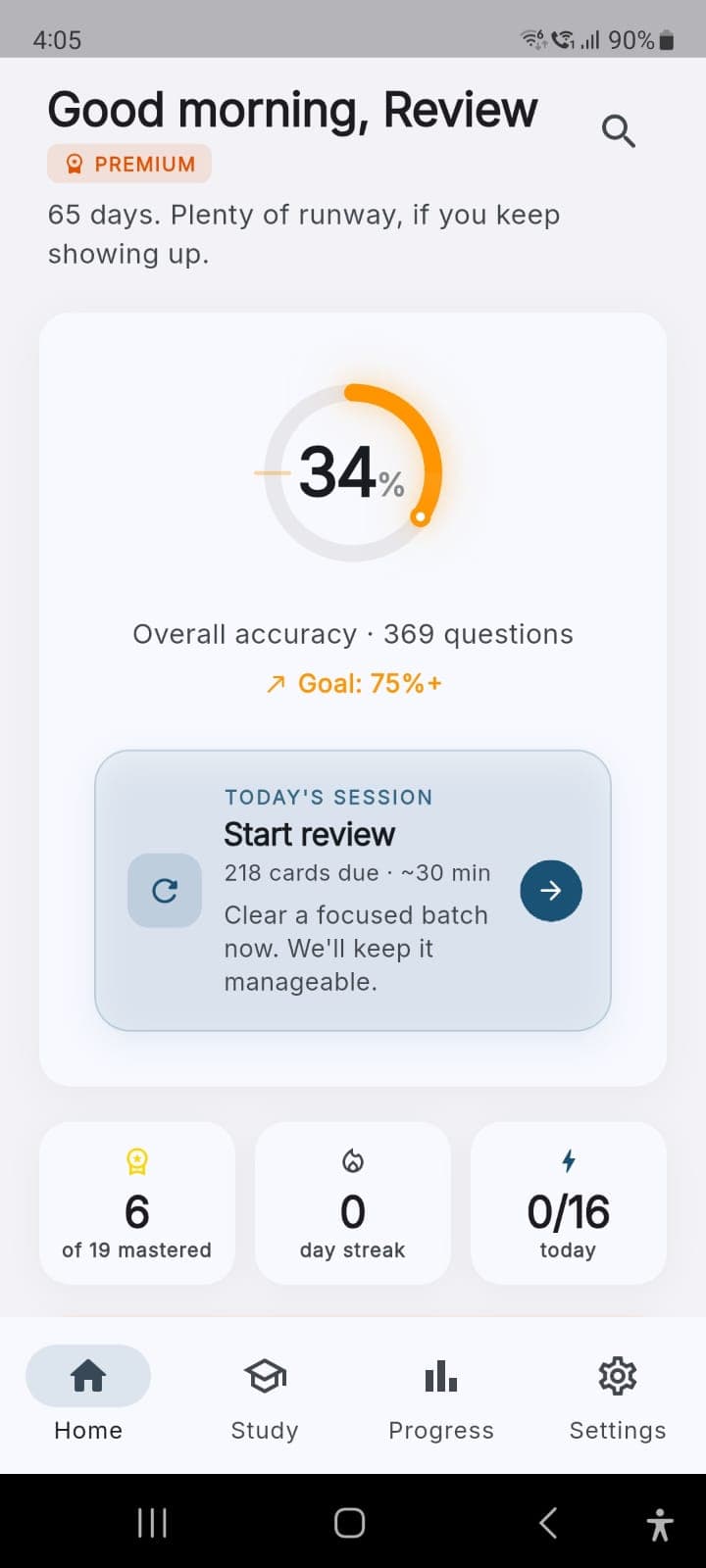
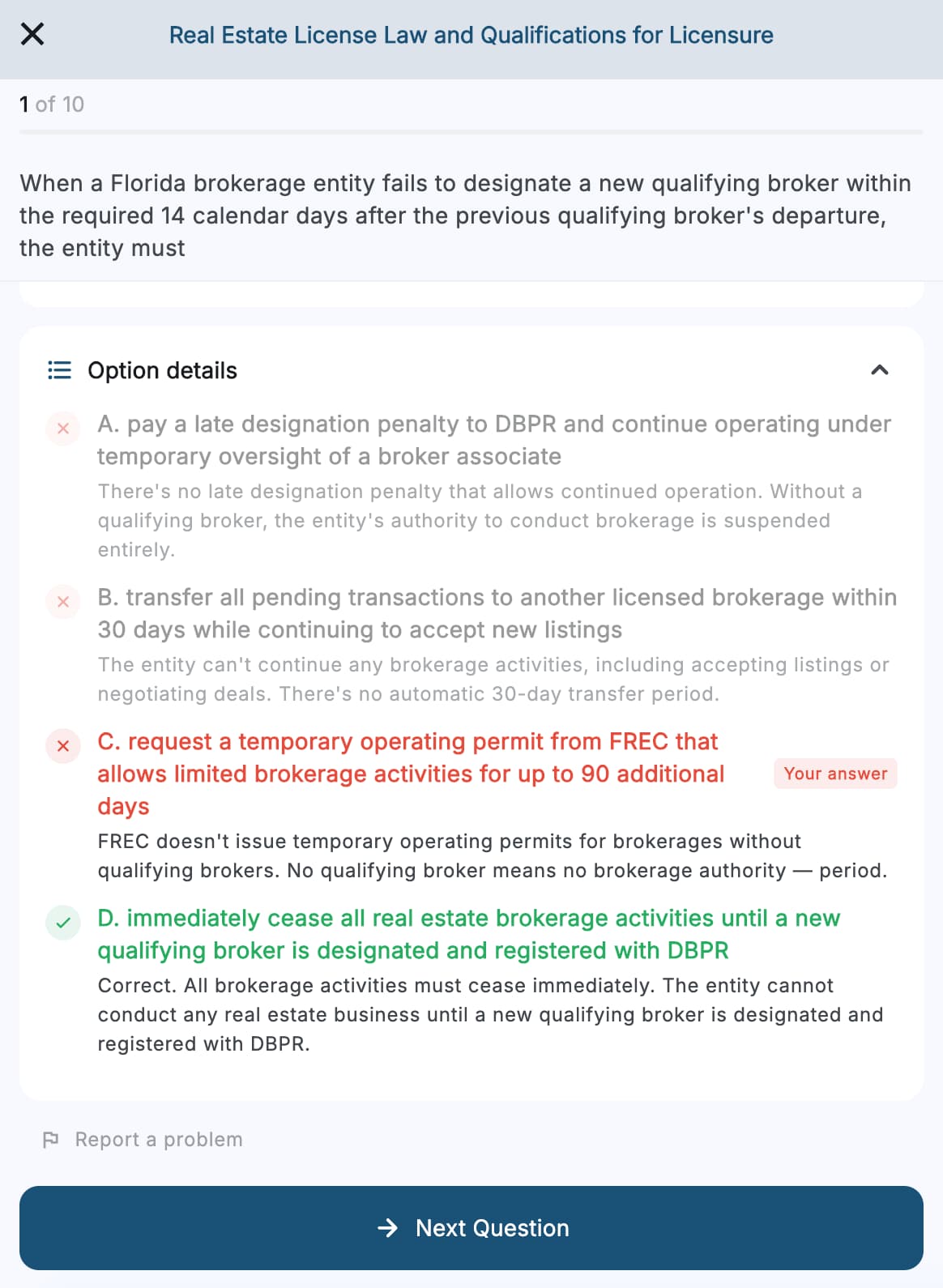
Use Florida-specific practice and a timed readiness check before booking your attempt.
What Jacksonville actually rewards after licensing
After licensing, Jacksonville rewards supervised repetition, local document discipline, safe routing of legal and risk questions, consistent follow-up, and a first-year lane that fits the local market.
| What the market rewards | What that means in practice |
|---|---|
| Geographic focus | Jacksonville is too large to learn all at once; pick a side of the St. Johns River and one submarket |
| Military discipline | PCS buyers at Mayport and NAS Jax need speed, remote clarity, and lender fluency |
| Institutional sphere | Mayo, UF Health, CSX, JAXPORT, higher-education, and military relationships compound over years |
| Beach-city jurisdiction | Atlantic, Neptune, and Jacksonville Beach are separate municipalities; treat them as such |
| Historic-neighborhood care | Riverside / Avondale / Ortega / San Marco / Springfield need older-home, local-designation, and flood-history fluency |
| Flood-history honesty | Matthew (2016) and Irma (2017) shaped St. Johns River corridor underwriting; address it directly |
| Regional comparison | Duval, Clay, Nassau, and St. Johns each have different buyer expectations and tax bases |
First-year reality in Jacksonville
New agents often ask whether they can make money quickly, work part time, or start in a premium niche. The honest answer is: sometimes, but only with a realistic system.
| Reality | What to expect |
|---|---|
| Income reality | Jacksonville can offer volume opportunities, but new agents need a narrow area and repeated lead source |
| Lead generation | Open houses, military sphere, Mayo / UF Health relocation, JAXPORT / CSX sphere, first-time buyer education, and relocation follow-up are practical starts |
| Broker support | Ask who reviews VA, Beach Cities jurisdiction, older-home, historic-district, flood, and new-construction questions |
| Part-time viability | Possible with one lane and team backup, difficult if you try to cover the whole metro |
Step 5: Find a sponsoring broker
Jacksonville candidates should choose a sponsoring broker based on beginner training, contract review, first-transaction supervision, local market support, lead systems, and startup costs, not only commission split.
A Florida sales associate works under a broker. For a new agent, this choice affects training, file review, fees, lead access, transaction supervision, and how quickly you learn the local market.
Ask these before you sign.
| Broker interview question | Why it matters |
|---|---|
| Who reviews my first contracts before they go out? | New agents need supervision before client-facing mistakes happen. |
| How many brand-new agents did you train last year? | Recruiting beginners is not the same as training them. |
| What costs are due before my first closing? | Association, MLS, E&O, signs, lockbox, desk fees, tech, and marketing can add up. |
| Which Jacksonville area do new agents start in? | The market is 875 square miles; specificity matters. |
| Do you train on VA, PCS, Mayport, and NAS Jax clients? | Military is a major lane. |
| Who reviews Beach Cities, condo, flood, and post-Irma inventory questions? | Coastal and historic-flood deals need supervision. |
| Do you have systems for Mayo Clinic, UF Health Jacksonville, CSX, or JAXPORT relocation? | Institutional pipelines compound over time. |
| Can I shadow Riverside / San Marco / Ortega older-home listings? | Older homes, local designations, flood history, and insurance issues have specific risks. |
| Do you have open-house systems by submarket? | Repeated reps beat random driving in an 875-square-mile city. |
Use how to find a sponsoring broker in Florida before signing.
Step 6: Activate and start your first 90 days
After passing, activate under a Florida broker before performing licensed services. Use the first 90 days to learn systems, pick one Jacksonville lane, build supervised reps, and turn follow-up into appointments.
After you pass, activate with your sponsoring broker before performing licensed services for compensation. Then treat the first 90 days as a practical training sprint.
FIRST 90 DAYS
MLS, forms, file review, showing rules, E&O, compliance, lead process, and who answers live transaction questions.
Choose one local lane from the ecosystem map. One repeatable lane beats vague ambition.
Host open houses, shadow inspections, practice buyer consultations, review sample contracts, and ask your broker to review hard questions.
Track every lead, schedule next steps, ask for appointments, and keep your broker involved before live questions become client problems.
FIRST RENEWAL WARNING
After your license is issued, do not confuse activation with renewal compliance. DBPR's real estate associate requirements say sales associates must complete a Florida Real Estate Commission (FREC)-approved 45-hour post-licensing course before the initial sales associate license expires. This is separate from the 63-hour pre-license course and separate from ordinary continuing education.
If you already passed, use what to do after passing the Florida real estate exam.
Mistakes Jacksonville applicants make
AVOID THESE
- Waiting until the course is finished to submit the DBPR application.
- Doing fingerprints before understanding DBPR's sequence and provider requirements.
- Treating the course final as proof that Pearson VUE will feel easy.
- Scheduling the exam without checking ID match, course certificate validity, and current Pearson VUE availability.
- Choosing a broker by commission split before asking who reviews first contracts.
- Treating Jacksonville as a single market instead of an 875-square-mile consolidated city with distinct submarkets, three Beach Cities, and Baldwin.
- Quoting Jacksonville taxes or permits for an Atlantic Beach / Neptune Beach / Jacksonville Beach / Baldwin address without confirming the municipal jurisdiction.
- Quoting BAH rates or VA loan eligibility yourself instead of referring to DoD published rates and a licensed lender.
- Skipping flood-history questions in San Marco, Riverside, Ortega, downtown, and Brooklyn / Five Points after Matthew (2016) and Irma (2017).
- Using Edward Waters University, historically Black community identity, military status, or school preferences as steering shortcuts, even with good intent.
- Giving legal, tax, insurance, inspection, lending, flood, HOA, historic-district, VA loan, fair-housing, or property-management advice outside your role.
- Forgetting that Pass Florida is exam prep, not a 63-hour pre-license course and not continuing education.
Related exam and licensing concepts
| If you need help with | Read this next |
|---|---|
| Full statewide path | How to get a Florida real estate license |
| Timeline and delays | How long it takes to get licensed in Florida |
| Costs | Florida real estate license cost |
| Test-center planning | Florida Pearson VUE real estate testing centers |
| Fingerprint delays | Florida real estate fingerprints delay |
| Course certificate expiration | Florida real estate course certificate expired |
| Exam topics | Florida real estate exam 19 topics |
| Math formulas | Florida real estate exam math formulas |
| Broker choice | Find a sponsoring broker in Florida |
FAQ
How long does it take to get a real estate license in Jacksonville?
Most first-time candidates should plan around 10 to 16 weeks. The timeline depends on course pace, DBPR application review, fingerprints, exam readiness, Pearson VUE availability, and broker activation.
Is there a separate Jacksonville real estate license?
No. You receive a Florida real estate sales associate license. Jacksonville affects your local career strategy, broker fit, and first niche, but not the license itself.
Can I apply to DBPR before finishing the 63-hour course?
Yes. DBPR says the course is not required at application submission. You still need valid proof of course completion before sitting for the state exam.
Where do Jacksonville candidates take the Florida real estate exam?
Pearson VUE administers the Florida real estate exam. Pearson VUE's public Florida real estate fact sheet lists Jacksonville as a test-center location. After DBPR approval, check current Pearson VUE seat availability in your account. Gainesville is the nearest public-fact-sheet alternative. Test-center details and available appointments can change.
Why is Jacksonville 875 square miles?
Jacksonville and Duval County consolidated their governments in 1968. The consolidated government covers most of Duval County, but Atlantic Beach, Neptune Beach, Jacksonville Beach, and Baldwin retained their own municipal governments. The result is the largest city by land area in the contiguous United States.
What military bases drive the Jacksonville real estate market?
Naval Station Mayport (Atlantic Fleet surface combatants and amphibious ready groups, on the south jetty of the St. Johns River) and Naval Air Station Jacksonville (P-8A Poseidon maritime-patrol and ASW helicopter squadrons, on the west bank of the St. Johns River) are the two major installations. Together they drive substantial PCS volume across the Beach Cities, Arlington, Westside, Mandarin, and Orange Park (Clay County).
Why does Hurricane Irma still matter for Jacksonville real estate in 2026?
Irma made landfall in the Florida Keys in September 2017 and tracked up the Gulf coast, but its persistent onshore winds drove St. Johns River storm surge into downtown Jacksonville, San Marco, Riverside, Ortega, and nearby riverfront areas. Pre-Irma flood history, post-Irma repairs and permits, and prior flood claims can affect underwriting on St. Johns River corridor listings. Hurricane Matthew (October 2016) also caused significant coastal and Beach Cities damage.
What is the insurance market like in Northeast Florida in 2026?
Carrier availability can be tight along the Florida Atlantic coast and in flood-exposed river corridors. Citizens Property Insurance may write Northeast Florida risk only under its eligibility rules, and private carriers evaluate each property through their own underwriting standards. Wind mitigation reports and 4-point inspections are common on older homes. Do not quote rates, coverage, or eligibility yourself. Route all insurance conversations to a licensed Florida property and casualty agent.
What are the major employer anchors in Jacksonville?
Beyond Mayport and NAS Jacksonville, the major employer anchors are JAXPORT, CSX Transportation (Class I railroad headquartered downtown), Mayo Clinic Jacksonville (academic medical center on San Pablo Road), and UF Health Jacksonville (academic medical center on the Northbank and Level I trauma center). These institutions drive relocation pipelines that compound over years.
What are the major colleges and universities in Jacksonville?
University of North Florida (UNF, public, Southside), Jacksonville University (JU, private, Arlington), Edward Waters University (Florida's first HBCU and private institution, founded 1866), and Florida State College at Jacksonville (FSCJ, community college with multiple campuses).
What is the difference between Jacksonville and the Beach Cities?
Jacksonville-Duval consolidated in 1968 via voter referendum. The four municipalities that opted out (Atlantic Beach, Neptune Beach, Jacksonville Beach, and Baldwin) kept their own municipal governments, code enforcement, building permits, and police. A listing inside any of those four is in a separate municipality, not in "the City of Jacksonville." Confirm jurisdiction before quoting permits, municipal rules, or specific local ordinances.
Can I start part time in Jacksonville?
Sometimes. Part-time works best when you have a narrow lead lane (often a military, Mayo, or UNF sphere), fast follow-up habits, and broker or team coverage for weekday urgency. It works poorly when clients need immediate showings, offers, inspections, or contract answers and you have no backup.
Which broker should a new Jacksonville agent choose?
Choose the broker that can supervise your first files, explain local risks (Beach Cities jurisdiction, post-Irma flood, military timing, historic-district rules), provide a realistic first lead lane, and tell you clearly what costs are due before your first closing. Brand name and split matter, but training and supervision matter first.
Ready to start the Jacksonville license path?
The Florida license is statewide, but your first year is local. Get the license first, then choose the Northeast Florida broker, lane, and follow-up rhythm that lets you build supervised reps.
The exam is statewide, so Jacksonville candidates should verify local logistics and prepare against the same Florida outline used across the state.
Try a free Florida question | Run the readiness calculator | Download Pass Florida
Methodology
This guide separates official Florida licensing requirements from local Duval County and Northeast Florida career strategy. Consolidated-government references draw on City of Jacksonville materials: Jacksonville and Duval County consolidated in 1968, while Atlantic Beach, Neptune Beach, Jacksonville Beach, and Baldwin retained municipal governments. Historic-district references follow City of Jacksonville guidance distinguishing National Register listing from local historic designation and COA review. Military-installation references (Naval Station Mayport and Naval Air Station Jacksonville) are general public-domain facts and not endorsements or recruiting material. Major-employer references (JAXPORT, CSX Transportation, Mayo Clinic Jacksonville, UF Health Jacksonville) are general public-domain facts. Higher-education references (UNF, JU, Edward Waters University as Florida's first HBCU and private institution founded 1866, FSCJ) are general public-domain facts and should be handled with respectful local context. Hurricane references include Hurricane Matthew (NHC Tropical Cyclone Report, October 2016, brushed Florida Atlantic coast as Category 4 without Florida landfall), Hurricane Irma (NHC Tropical Cyclone Report, September 2017, landfall at Cudjoe Key as Category 4, contributed to St. Johns River corridor flooding), and Hurricane Idalia (NHC Tropical Cyclone Report, August 2023, Category 3 landfall in Taylor County). Insurance references to wind mitigation, 4-point inspections, Citizens Property Insurance eligibility, flood zones, and roof-age conversations are general educational pointers, not coverage, rate, underwriting, or eligibility advice. Local market guidance is practical editorial strategy based on stable regional patterns, not volatile price claims. Verify fees, appointment availability, broker costs, association or MLS costs, local ordinances, municipal jurisdiction for any Beach Cities or Baldwin address, community documents, condo documents, lending, insurance, flood, local historic-district rules, VA loan, military-benefit, fair-housing, and property-management details before spending money, scheduling, or advising a client.
Product note. Pass Florida is our Florida-specific exam prep app. This page references our own product, so the relationship is direct and disclosed. We do not claim to use copied exam questions, guarantee passage, or replace official DBPR, Florida Real Estate Commission (FREC), Pearson VUE, course provider, broker, Northeast Florida Association of REALTORS (NEFAR), Northeast Florida Multiple Listing Service (NEFMLS), legal, tax, insurance, lending, property-management, fair-housing-counsel, local historic-preservation, military-benefit, VA loan, or professional guidance. Pass Florida is independent exam prep and is not a DBPR-approved 63-hour pre-license course or continuing education.
This post is educational content about Florida real estate licensing and Jacksonville career strategy. It is not legal, tax, brokerage, licensing, fair-housing, insurance, inspection, lending, HOA, condo, rental, historic-district, military-benefit, VA loan, or professional advice. DBPR application fees, Pearson VUE exam fees, course tuition, fingerprint vendor pricing, Jacksonville-area association and MLS dues, broker startup costs, and local market conditions can change. Always verify your specific path with DBPR, Pearson VUE, your course provider, your broker, your local association, the relevant municipality for Beach Cities / Baldwin jurisdiction questions, fair-housing counsel for advertising or steering questions, and qualified counsel before paying fees, scheduling an exam, or making a career decision based on this article.
Sources
- DBPR Sales Associate Initial Application checklist
- DBPR Real Estate Associate Requirements
- DBPR RE 1 Sales Associate Application
- DBPR Real Estate Sales Associate Candidate Information Booklet
- Pearson VUE Florida Real Estate testing page
- Pearson VUE Florida Real Estate and Appraiser Fact Sheet
- DBPR mutual recognition information
- Northeast Florida Association of REALTORS (NEFAR)
- City of Jacksonville, About Jacksonville
- City of Jacksonville historic designation definitions
- City of Jacksonville historic preservation FAQ
- City of Jacksonville millage rates
- Naval Station Mayport
- Naval Air Station Jacksonville
- JAXPORT (Jacksonville Port Authority)
- JAXPORT military cargo
- CSX Corporation
- Mayo Clinic Jacksonville
- UF Health Jacksonville
- University of North Florida
- Jacksonville University
- Edward Waters University
- Florida State College at Jacksonville
- National Hurricane Center Tropical Cyclone Report: Hurricane Matthew (2016)
- National Hurricane Center Tropical Cyclone Report: Hurricane Irma (2017)
- Florida Office of Insurance Regulation OIR-B1-1802 Uniform Mitigation Verification Inspection Form
- Citizens Property Insurance Corporation, Get a Policy
- FEMA Flood Map Service Center
- 42 U.S.C. 3604, Fair Housing Act prohibited practices
- Florida Fair Housing Act, F.S. 760.23