VERIFY BEFORE RELYING
This guide explains how to use a peer study group to prepare for the Florida sales associate real estate exam. It is methodology only. The Department of Business and Professional Regulation (DBPR) Sales Associate Candidate Information Booklet controls the official rules around the 19 content areas, topic weights, 75-points passing grade, and the exam-result process. Pearson VUE's current Florida Real Estate page controls scheduling logistics. Study-group cadence, agenda templates, accountability protocols, and failure-mode tables in this guide are Pass Florida coaching pedagogy, not DBPR or Pearson VUE process documents. Verify exam facts against the current DBPR Sales Associate Candidate Information Booklet and the current Pearson VUE Florida Real Estate page.
QUICK ANSWER
A Florida real estate exam study group works only when it has a structure: small group, fixed agenda, individual drill before the meeting, peer teach-back during the meeting, and a written miss log after the meeting. The default that fails is a four-person social meet-up that reviews random chapters. Use 2 to 4 candidates, 60 to 90 minutes per session, two sessions per week, and a clear rule that the group does not replace individual practice. If the group stops producing measurable score movement after three sessions, change the format or leave.
WHO THIS GUIDE IS FOR
Florida sales associate candidates who are studying alongside one or more peers from a pre-license course, a brokerage, or an online cohort, and want to make those sessions actually move scores. Useful whether you are forming a study group, joining one that already exists, or deciding whether a group you are in is still worth your time. Pair with the 19 topics pillar for the official content map the group should drill against, the question wording guide for the wording-trap drill cycle, the wrong-answer review method for the in-meeting teach-back protocol, and the DBPR exam review session guide if a member of the group has already failed an attempt. Not a substitute for individual practice or for the official DBPR Candidate Information Booklet.
Use a group if you have one or two committed peers, a fixed agenda, and a willingness to drill individually between meetings.
A study group cannot help you rank weak areas if you do not know what they are. Do a diagnostic first, then form the group around the gaps.
A social meet-up that reviews random chapters is worse than 60 minutes of focused individual practice. Change the format or step out.
DRILL AS A GROUP, MOVE THE SCORE
Bring the same question bank to every session.
Start with the diagnostic, practice the weakest Florida topics, and use timed mixed sets to prove the improvement before test day.
What this guide covers
- Official source map
- The rules for a safe exam-prep group
- When a study group helps and when it hurts
- Group size and member composition
- The weekly cadence that produces score movement
- The four-block 60 to 90-minute session template
- Drill recipes for a group setting (heavy topic, math, wording, timed mixed)
- The peer teach-back protocol and the 5-row miss classification
- Accountability without groupthink
- The three-session score movement test
- Online versus in-person tradeoffs
- Common study-group failure modes
- When to change the format or leave the group
- Frequently asked questions about study groups for the Florida exam
Official Source Map
Use the official sources for exam facts and licensing requirements. Use the group templates in this guide as study methodology.
DBPR controls the Florida exam facts: 19 content areas, 100 multiple-choice questions, 3.5 hours, 75 points to pass, closed-book testing, and exam-material security. The study-group structure here is coaching methodology, not a DBPR rule.
| Study-group claim | Primary source | Why it matters |
|---|---|---|
| The state exam covers 19 content areas with published weights | DBPR Sales Associate Candidate Information Booklet | A group should drill weak areas by official weight, not random chapters |
| The sales associate exam has 100 multiple-choice questions and 3.5 hours | DBPR CIB | Group timed drills should eventually transfer to full-exam pacing |
| Passing requires 75 points or higher | DBPR CIB | Group confidence is not enough; individual scores still need to clear the pass threshold |
| The exam is closed book and reference materials are not allowed in the test room | DBPR CIB | The group should train recall and application, not dependence on notes |
| Exam materials may not be removed from the examination room | DBPR CIB | Do not trade, recreate, or collect recalled live-exam questions |
| Sales associate pre-licensure is a separate requirement | DBPR Real Estate Education Requirements | A study group does not replace the 63-hour pre-licensure course |
| Scheduling logistics belong to Pearson VUE | Pearson VUE Florida Real Estate page | Group timing should not override legal-name, appointment, or rescheduling rules |
| The exam content is grounded in Chapter 475 and F.A.C. 61J2 | DBPR CIB, F.S. Chapter 475, and F.A.C. Division 61J2 | Source-check rule disagreements against Florida primary sources |
The Rules for a Safe Exam-Prep Group
A good study group is collaborative. It is not a place to trade real exam memories or build a leaked-question file.
A safe Florida real estate exam study group uses official outlines, original practice questions, shared sources, and teach-back. It should never trade or reconstruct live Pearson VUE exam questions.
Use these rules from the first meeting:
| Rule | Why it exists |
|---|---|
| Use original practice questions, official outlines, and approved study materials | Protects exam integrity and keeps the group focused on transferable rules |
| Do not ask members to recall or reconstruct live Pearson VUE questions | DBPR exam materials are controlled; memorized live stems are not a reliable or appropriate study plan |
| Explain concepts, not answer leaks | A different exam form will punish memorized fragments |
| Source-check disagreements against DBPR, Florida statutes, F.A.C. 61J2, or one shared prep resource | Prevents confident wrong rules from spreading through the group |
| Keep score movement individual | A group quiz score is not readiness if members cannot reproduce it alone |
| Keep legal, brokerage, and transaction advice out of the meeting | The group is for exam prep, not professional advice |
If someone joins the group mainly to collect remembered exam questions, do not make that person the center of the room. Bring the group back to rules, scenarios, math setup, and wording discipline.
When a Study Group Helps and When It Hurts
A study group is not automatically useful. It is a multiplier on whatever structure you bring to it.
A study group helps when members drill individually before meetings, bring specific misses, and teach rules out loud. It hurts when it becomes social, chapter-by-chapter, or dependent on one dominant member.
| Condition | A group helps | A group hurts |
|---|---|---|
| Individual practice | Members drill 30 to 60 minutes before each meeting | Members show up cold and treat the meeting as the only study |
| Topic ranking | The group works from each member's diagnostic weak areas | The group reviews chapters in textbook order regardless of need |
| Wrong-answer review | Members bring 5 to 10 specific misses to teach-back | Members say "I missed contracts" without question detail |
| Pace | The group meets 60 to 90 minutes with a clear agenda | The meeting drifts past 2 hours into venting and side topics |
| Accountability | The group enforces individual drill commitments | The group lets members slide because everyone is busy |
| Composition | 2 to 4 members at similar readiness | 6 or more members at wildly different levels |
If three or more rows on the "hurts" column describe your current group, the format needs to change before the next session.
Group Size and Composition
The right size is 2 to 4 Florida sales associate candidates.
The ideal Florida real estate exam study group has 2 to 4 candidates at similar readiness levels. Five or more usually becomes a lecture, a social hour, or a group where quiet members stop practicing.
| Size | What works | What breaks |
|---|---|---|
| 2 | High accountability, fast pace, every member teaches every session | Single absence cancels the meeting |
| 3 | Easiest rotation, room for one weaker and one stronger member | One dominant voice can crowd out a quieter learner |
| 4 | Diverse weak-area coverage, formal turn-taking required | Sessions need a timer or one person runs out of speaking time |
| 5+ | Almost always becomes a lecture or a social hour | Individual teach-back collapses, agenda runs over, focus drops |
For composition, do not stack the group with members at the same weak topic. The strongest pairing is members whose weak areas overlap on one or two Tier 1 topics (Brokerage Activities, Contracts, Residential Mortgages, Property Rights, Appraisal) but differ on the rest. That way every member has something to teach and something to learn in every meeting.
Avoid forming a group around a single dominant member who treats it as their study lecture. That format is a tutoring relationship, not a study group.
The Weekly Cadence
Two sessions per week is the sustainable cadence for most candidates inside a 2 to 4-week prep window.
Two study-group sessions per week is usually enough during core prep. Keep solo practice larger than group time so the meeting supports score movement instead of replacing the work.
| Cadence | Use it when | Why |
|---|---|---|
| 1 session per week | Early in prep, when individual drill volume is still building | One meeting holds the rhythm without crowding solo practice |
| 2 sessions per week | Core prep window, weeks 2 through 4 | Two contact points keep weak areas from going cold between sessions |
| 3 sessions per week | Final week before a scheduled exam date | Short, focused review sessions reinforce the test-week rhythm |
| Daily | Almost never | Daily group meetings replace the solo practice that actually moves scores |
The group is not the study. The group is the structure around the study.
Individual drill volume should remain larger than meeting time. A typical week looks like 4 to 6 hours of solo practice, 2 to 3 hours of group meetings, and 1 to 2 hours of post-meeting miss-log work.
The 60 to 90-Minute Session Template
Structure beats good intentions. Use this four-block agenda.
A strong session has four blocks: weak-topic check-in, missed-question teach-back, silent shared question set, and written next-session commitments.
| Block | Time | Work |
|---|---|---|
| Warm-up: weak-topic check-in | 10 min | Each member states their current weakest topic in one sentence |
| Teach-back: missed questions | 25 to 40 min | Each member presents 3 to 5 specific misses from individual drill, group works the rule |
| Group drill: shared question set | 15 to 25 min | Everyone answers the same 15 to 25 questions silently, then discusses misses |
| Wrap: miss log and next-session commit | 10 min | Each member writes down their top 2 misses and what they will drill before next meeting |
If the meeting runs past 90 minutes, do not add a section. Cut the next session's teach-back from 5 misses to 3 per member.
Drill Recipes for a Group Setting
The same drill structures used in solo practice work in a group with one modification: every drill ends with each member explaining one miss out loud before moving on.
Heavy-topic drill
For Brokerage Activities, Contracts, Residential Mortgages, Property Rights, Appraisal, Authorized Relationships, Titles and Deeds, or License Law.
| Step | Time | Group work |
|---|---|---|
| Pre-read | Before meeting | Each member reads the same 1 to 2-page rule summary |
| Group answer | 15 min | Everyone answers 15 topic questions silently |
| Sort misses | 5 min | Each member labels their misses by type (rule, application, math, wording, timing) |
| Teach-back | 10 min | Each member explains one miss in their own words; group corrects |
| Record | 5 min | Every member writes the rule in plain language in their own miss log |
Math drill
For Computations, Legal Descriptions, Appraisal math, Taxes, Mortgages, and Investments.
| Step | Group work |
|---|---|
| Setup-first rule | No member touches the calculator until the formula and base number are spoken aloud |
| Solve in parallel | Three variations of one formula family per meeting (commission, doc stamps, proration, loan-to-value, millage, cap rate, gross rent multiplier, area) |
| Compare setups | The group compares formula choice, not just final answers |
| Spaced repeat | Same formula family repeats in the next two meetings |
Use Florida real estate exam math formulas as the shared reference so every member is working from the same notation.
Wording-trap drill
For "I knew this one" misses on EXCEPT, NOT, FIRST, NEXT, BEST, and "may versus must" questions.
| Step | Group work |
|---|---|
| Mark before answer | Every member underlines the trap word in the stem before reading answer choices |
| Convert NOT to positive | Members rewrite the stem in plain instruction form out loud |
| Two-answer narrow | When two answers remain, members say which fact rules out the loser |
| Reverse explain | Each member explains why the wrong answer was attractive, not just why the right answer is right |
Pair with the question wording strategy guide for the full taxonomy of wording categories.
Timed mixed drill
For confirming pacing and transfer in the final week before an exam appointment.
| Set | Group rule |
|---|---|
| 25 questions | No pausing, no talking, review after completion |
| 50 questions | Two-pass method, members mark hard questions silently |
| 100 questions | Simulate Pearson VUE timing with phones away; review only after the timer ends |
The Peer Teach-Back Protocol
The most valuable thing a study group does is force each member to explain a rule out loud. The act of teaching a rule reveals whether the member actually understood it or just recognized it.
Peer teach-back works when each member states the missed answer, labels the miss, explains the rule without notes, answers one clarifying question, and writes the rule in a miss log.
Use this five-step teach-back for each missed question presented to the group.
- Member reads the missed question stem aloud, then states their answer and the correct answer.
- Member classifies the miss using the 5-row taxonomy (rule gap, application error, math setup, wording trap, timing or fatigue).
- Member explains in plain language what the rule actually says, without reading from notes.
- The group asks one clarifying question (what changes if the actor were different, or the timing were different).
- Member writes the rule in one sentence in their own miss log before moving on.
If a member cannot do step 3 without reading, that miss goes back into individual drill for the next session.
The 5-Row Miss Classification
The group should use a shared vocabulary for what went wrong on each missed question. This makes drill assignments concrete instead of vague.
| Miss type | What it sounds like in teach-back | Group drill response |
|---|---|---|
| Rule gap | "I did not know that rule." | Member reads the rule before next meeting and brings 3 example questions |
| Application error | "I knew the term but missed the scenario." | Group does 10 scenario questions on that rule in the next session |
| Math setup | "I had the formula but used the wrong base." | Math drill in the next session uses that formula family |
| Wording trap | "I missed EXCEPT, NOT, FIRST, NEXT, or BEST." | Wording drill in the next session focuses on that trap word |
| Timing or fatigue | "I knew it later, but not under pressure." | Timed mixed set replaces the next group drill block |
A miss without a label is a miss that gets repeated. The label is what turns the meeting into a study plan.
Accountability Without Groupthink
A study group that becomes a comfort zone has stopped working.
| Accountability practice | What it does | What it avoids |
|---|---|---|
| Written weekly commitment | Each member writes down 2 to 3 specific drill commitments at the end of every meeting | "I'll study more this week" with no specifics |
| Diagnostic check at week 2 | Every member takes a fresh diagnostic and shares the topic-weight result | The group drifting away from individual weak areas |
| Rotating teach lead | A different member leads the teach-back block each session | One dominant voice becoming the de facto tutor |
| Quiet vote before consensus | When the group disagrees on a rule, each member writes their answer silently before discussion | Members anchoring to the loudest opinion |
| External source check | When the group disagrees on a rule, one member looks it up in the DBPR Candidate Information Booklet before the next meeting | Confident-sounding wrong rules getting reinforced |
The "quiet vote" rule alone closes most of the groupthink failure mode. When four people verbally agree on a wrong answer, the score does not move.
The Three-Session Score Movement Test
Give a new group three sessions to prove it is useful.
| Measure | Session 1 baseline | Session 3 target |
|---|---|---|
| Individual diagnostic topic | Each member names top 2 weak topics | Each member has drilled at least one weak Tier 1 or Tier 2 topic |
| Miss classification | Misses are vague: "contracts," "math," "escrow" | Misses are labeled as rule gap, application error, math setup, wording trap, or timing |
| Teach-back quality | Members read explanations from notes | Members can explain the rule in their own words |
| Timed accuracy | Members have no current timed score | Each member has completed a silent timed set alone |
| Next-session commitment | "Study more" | Specific drill quantity, topic, and deadline |
At the end of the third session, each member should answer one question: did my individual practice improve because of this group?
If the honest answer is no, change the agenda, shrink the group, split by readiness, or go solo for a week.
Online Versus In-Person Tradeoffs
Both formats can work. The structural rules above matter more than the medium.
| Format | Strengths | Weaknesses |
|---|---|---|
| In-person | Easier to read body language during teach-back; phones are easier to keep off the table | Logistics break easily; one cancellation kills the session |
| Online video call | Lower friction to schedule; screen-share works well for question sets and rule summaries | Members multitask; teach-back quality drops when cameras are off |
| Hybrid (mostly online, monthly in-person) | Captures the scheduling ease of online and the focus of in-person | Requires a member willing to coordinate logistics |
| Asynchronous chat or thread | Useful for one-question rule clarifications between sessions | Cannot replace teach-back; written explanations skip the "explain it out loud" step |
For online sessions, cameras on is a structural choice, not a social preference. Cameras-off sessions almost always become parallel solo study with occasional comments.
Common Study-Group Failure Modes
| Failure mode | What it looks like | Repair |
|---|---|---|
| Social drift | The first 30 minutes are catching up about life | Move the warm-up to a 10-minute timer; teach-back starts at minute 11 |
| Lecture mode | One member explains every rule while others listen | Rotate the teach lead; require every member to present a miss |
| Chapter-by-chapter creep | The group works through the textbook in order regardless of weak areas | Switch to diagnostic-weak-area-driven agenda |
| Calendar inflation | Sessions stretch from 60 to 90 to 120 minutes | Hard stop at 90; cut teach-back from 5 misses to 3 |
| Comfort drift | The group avoids the hardest topics because they feel hard | Tier 1 topic must appear in every session for the first three weeks |
| Confidence inflation | The group consistently passes its own quizzes but members fail solo timed practice | Replace one group drill block per week with a silent, individual timed mixed set |
| Source drift | Members quote different rules from different prep materials | Designate one shared source (DBPR Candidate Information Booklet plus one prep app) and stop debating |
If the same failure mode appears in three consecutive sessions, the group needs a format reset or a member change.
When to Change the Format or Leave
A study group is a tool. If the tool stops working, fix the tool or stop using it.
| Signal | Better move |
|---|---|
| Three sessions, no visible score movement on individual practice | Change the format (smaller group, tighter agenda, harder topics) |
| Two members are 15 points apart in practice scores | Split into two pairs by readiness, not one mixed group |
| The group meets, but you spend more time waiting for others to catch up than learning | Leave and study solo for the next two weeks; rejoin a different group if needed |
| Members keep skipping individual drill | The group is not the problem; the commitment is |
| You scheduled the exam and need final-week focus | Pause the group for the last 5 to 7 days and do solo timed practice |
Leaving a group is not a failure. The goal is the license, not the friendship.
Mistakes Candidates Make in Study Groups
They use the meeting as their only study. A study group is the structure around individual drill, not a replacement for it.
They form a 6-person group because everyone wanted in. The session almost always collapses into a lecture or a social hour. Split it into two groups of 3.
They reread the chapter together instead of drilling questions. Reading is the lowest-yield activity in a group setting. Save reading for solo time; use the meeting for teach-back and timed practice.
They confuse confidence with readiness. Four candidates agreeing on a wrong answer is a fast path to failing as a group.
They keep the group going for emotional reasons. When the data says it has stopped working, the schedule is not the boss.
They skip the miss log. A meeting without a written follow-up commitment is a session that does not show up in the next score.
Related Exam Concepts
| If you need this | Read this next |
|---|---|
| Map the official 19 content areas | Florida real estate exam 19 topics |
| Drill wording traps | Florida real estate exam question wording |
| Review misses systematically | Review wrong answers Florida real estate exam |
| Build a final-week routine | Florida real estate exam morning routine |
| Fix math setup | Florida real estate exam math formulas |
| Decide on a DBPR review session | Florida real estate exam review session |
| Take a quick diagnostic | Try 5 questions |
Frequently Asked Questions
Does DBPR require a study group for the Florida real estate exam?
No. DBPR requires the pre-licensing course and the state exam. A study group is an optional self-study supplement and is not part of the licensing process.
What is the ideal study group size?
Two to four candidates. Pairs run fast and accountable. Three or four gives weak-area diversity without losing turn-taking. Five or more almost always collapses into a lecture or a social hour.
How long should a session run?
Sixty to 90 minutes. If sessions consistently run longer, cut teach-back from 5 misses per member to 3, not add another section.
How often should the group meet?
Twice per week during the core prep window. Once per week early in prep. Three times per week only in the final week before a scheduled exam. Daily meetings replace the solo drill that actually moves scores.
Should I join an existing group or form a new one?
Either works if the group has structure. A group with a fixed agenda, individual drill commitments, and a miss-log practice is worth joining. A casual social meet-up is not.
Does the group replace individual practice?
No. Individual drill volume should remain larger than meeting time. A typical week is 4 to 6 hours solo, 2 to 3 hours group, 1 to 2 hours miss-log follow-up.
What if one member is much further behind?
Split the group by readiness. Two pairs almost always work better than one mixed group of four when score levels are 15+ points apart.
What if we keep agreeing on wrong answers?
Use the quiet-vote rule. Every member writes their answer silently before discussion. Then look the rule up in the DBPR Candidate Information Booklet before the next meeting.
Should the group use one shared prep app?
Yes. Source drift (different members quoting different prep materials) is one of the most common failure modes. Designate one shared source plus the DBPR Candidate Information Booklet and stop debating.
When should I leave a study group?
After three consecutive sessions without measurable score movement on your individual practice, or when the meeting consistently runs more time waiting than learning. The goal is the license, not the friendship.
Ready to Run a Study Group That Moves the Score?
A study group is not a magic shortcut.
It is a structure around drill.
Bring the agenda. Bring the misses. Bring the miss log. Then watch whether the score moves on individual practice, not on group quizzes.
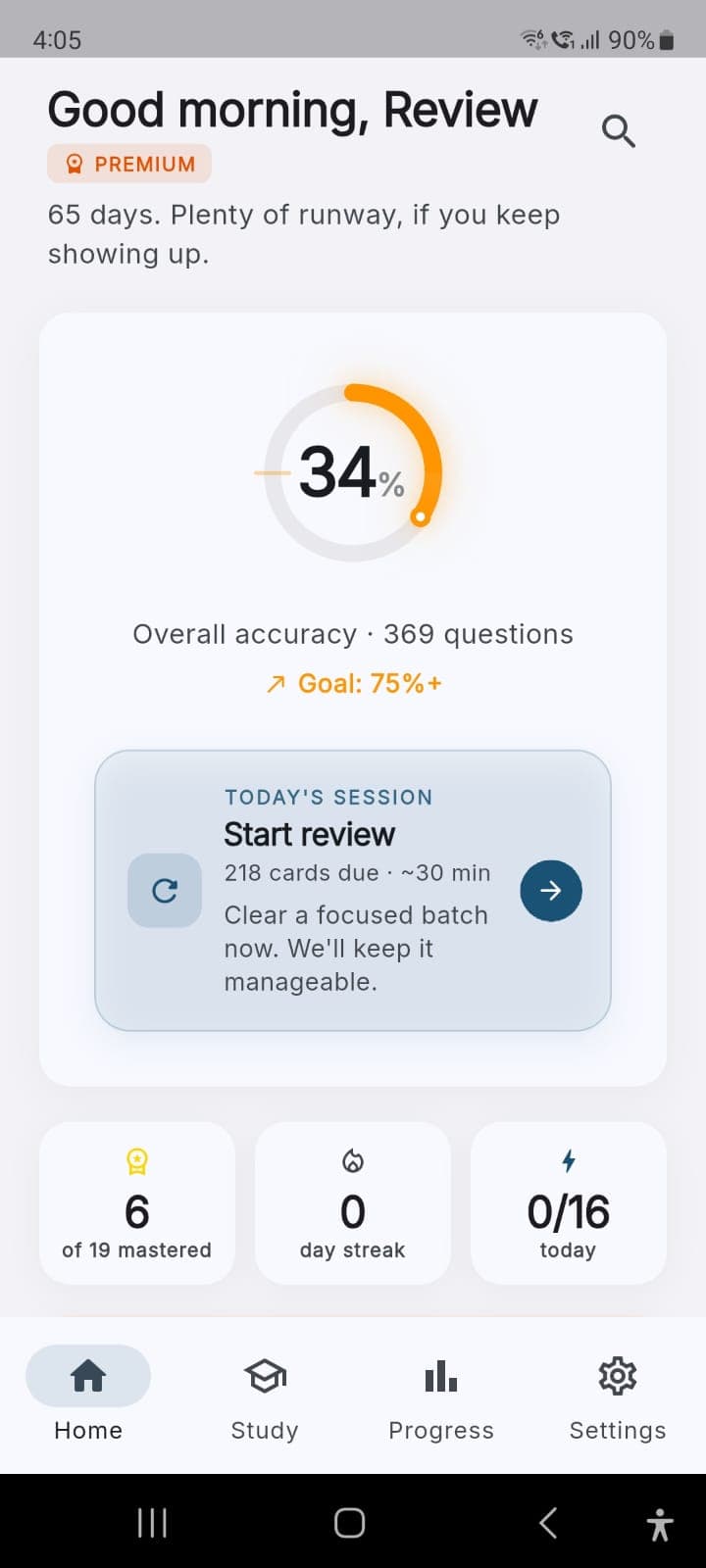
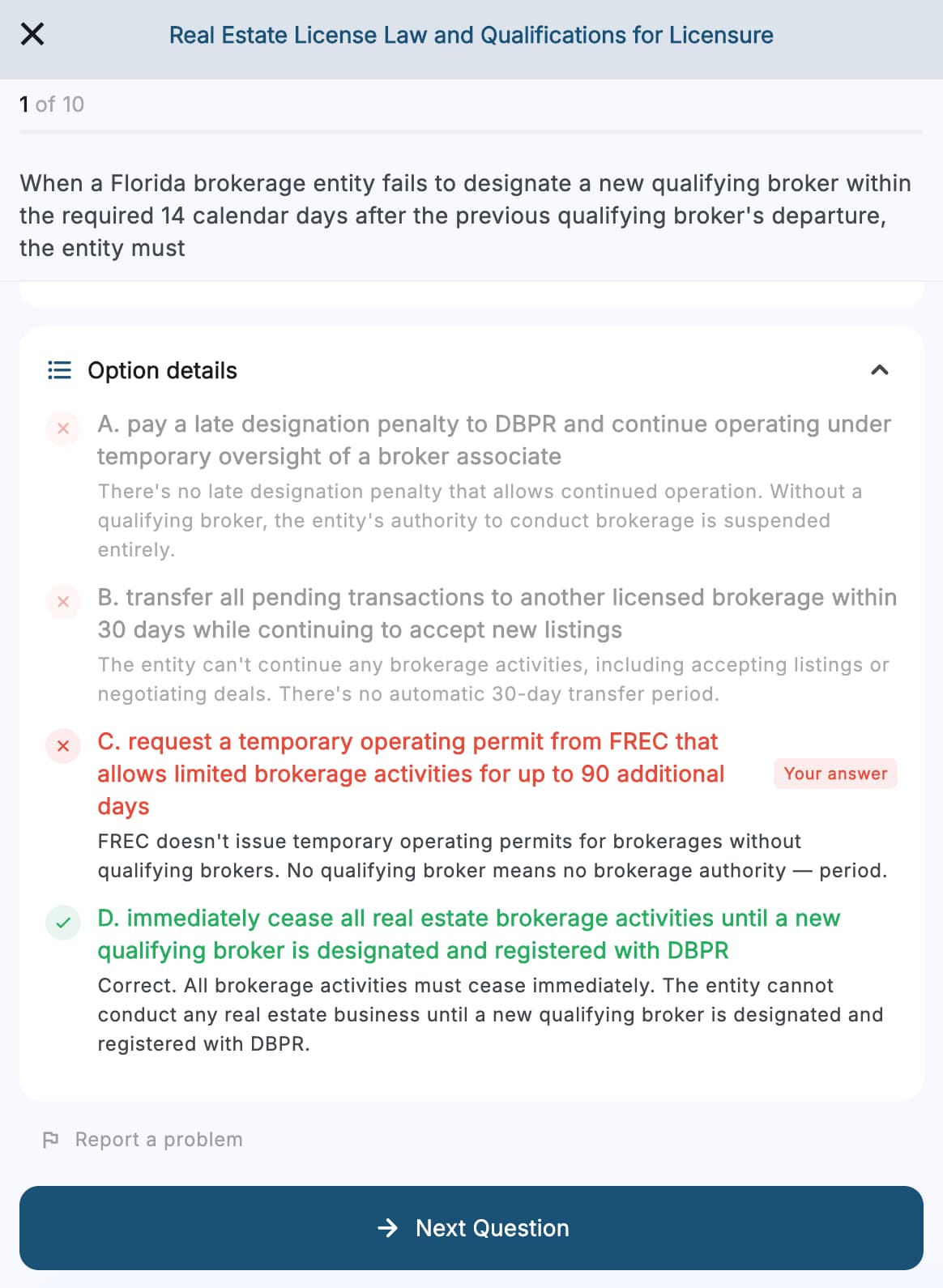
Start small today: try 5 Florida questions as the shared drill for your next session, check your readiness before booking an exam date, or download Pass Florida so every member is working from the same Florida-specific question bank.
Methodology
A study group is optional self-study methodology and is not part of the DBPR licensing process.
The 2-to-4-member group size, 60 to 90-minute session length, 2-per-week cadence, four-block agenda template (warm-up / teach-back / group drill / wrap), drill recipes (heavy topic / math / wording trap / timed mixed), 5-step peer teach-back protocol, 5-row miss classification (rule gap / application error / math setup / wording trap / timing or fatigue), accountability practices (written commitment / diagnostic check / rotating teach lead / quiet vote / external source check), three-session score movement test, online versus in-person comparison, 7-row failure-mode table, and "when to leave" signals are independent Pass Florida coaching pedagogy derived from observed patterns in Florida candidate self-study, not DBPR rules or Pearson VUE process documents. The Florida Real Estate Commission (FREC), which sits under DBPR, controls the broader licensing framework that the study group sits inside but does not regulate. Studying with a peer group should flex based on actual readiness data; the schedule is not the boss.
Product Note
Pass Florida publishes this guide and offers the exam-prep app linked on this page. Pass Florida is independent exam preparation, not a DBPR-approved pre-licensing course, a tutoring service, a study-group coordinator, a Pearson VUE scheduling tool, a licensing-activation service, a legal service, or a guarantee of passage.
Sources
- DBPR Real Estate Sales Associate Candidate Information Booklet, effective January 2025
- Pearson VUE Florida Real Estate and Appraisers licensing exams
- DBPR Real Estate Education Requirements
- F.S. Chapter 475, real estate brokers, sales associates, schools, and appraisers
- F.A.C. Division 61J2, Florida Real Estate Commission
- DBPR Candidate Information Booklets
This post is study-methodology content for Florida Real Estate Sales Associate candidates using peer study groups. It is not legal, licensing, tax, or professional advice. DBPR pre-licensing course requirements, the 19-content-area outline, the 75-points passing grade, exam-security rules, and Pearson VUE scheduling logistics can change between exam windows. A study group is an optional self-study supplement and is not part of the DBPR licensing process or any official requirement. Do not trade or reconstruct live exam questions. For your specific licensing path, verify against the current DBPR Candidate Information Booklet, the current Pearson VUE Florida Real Estate page, and your pre-license course provider. Studying with a peer group, Pass Florida, or any other exam-prep tool does not guarantee passage of the state exam.