QUICK ANSWER
The best ChatGPT prompt for Florida real estate exam prep names the topic, supplies a current source, requests a reviewable output, and asks it to flag unsupported claims. Start with: "Teach this Florida exam topic using only the source I provide. Ask application questions one at a time, cite the source for each answer, and flag anything the source does not establish." The 19 topic prompts below give you a starting task for each outline area; they are not an exhaustive syllabus.
A vague prompt produces a vague study session. "Quiz me on Florida real estate" does not define the license type, content area, source, difficulty, answer format, or accuracy boundary.
OpenAI's official prompting guidance recommends adding the goal, useful context, desired output, and important boundaries. Its exam-study workflow also recommends grounding practice in official learning objectives and source materials. Those ideas make the requested task easier to inspect. They do not guarantee a correct answer or a complete syllabus.
The Florida prompt formula
Use this reusable structure:
Goal: Help me study [Florida sales associate exam topic]. Context: Use only [current source or excerpt]. Output: [explanation, table, quiz, plan, or error review]. Boundaries: Do not invent a rule, fee, deadline, or exam claim. Cite the supplied source for each answer and flag missing support.
Add your current score, exam date, and available time only when they change the task. Do not bury the requested result under a long story.
PROMPT AFTER YOU DIAGNOSE
The best prompt starts with a real weak area.
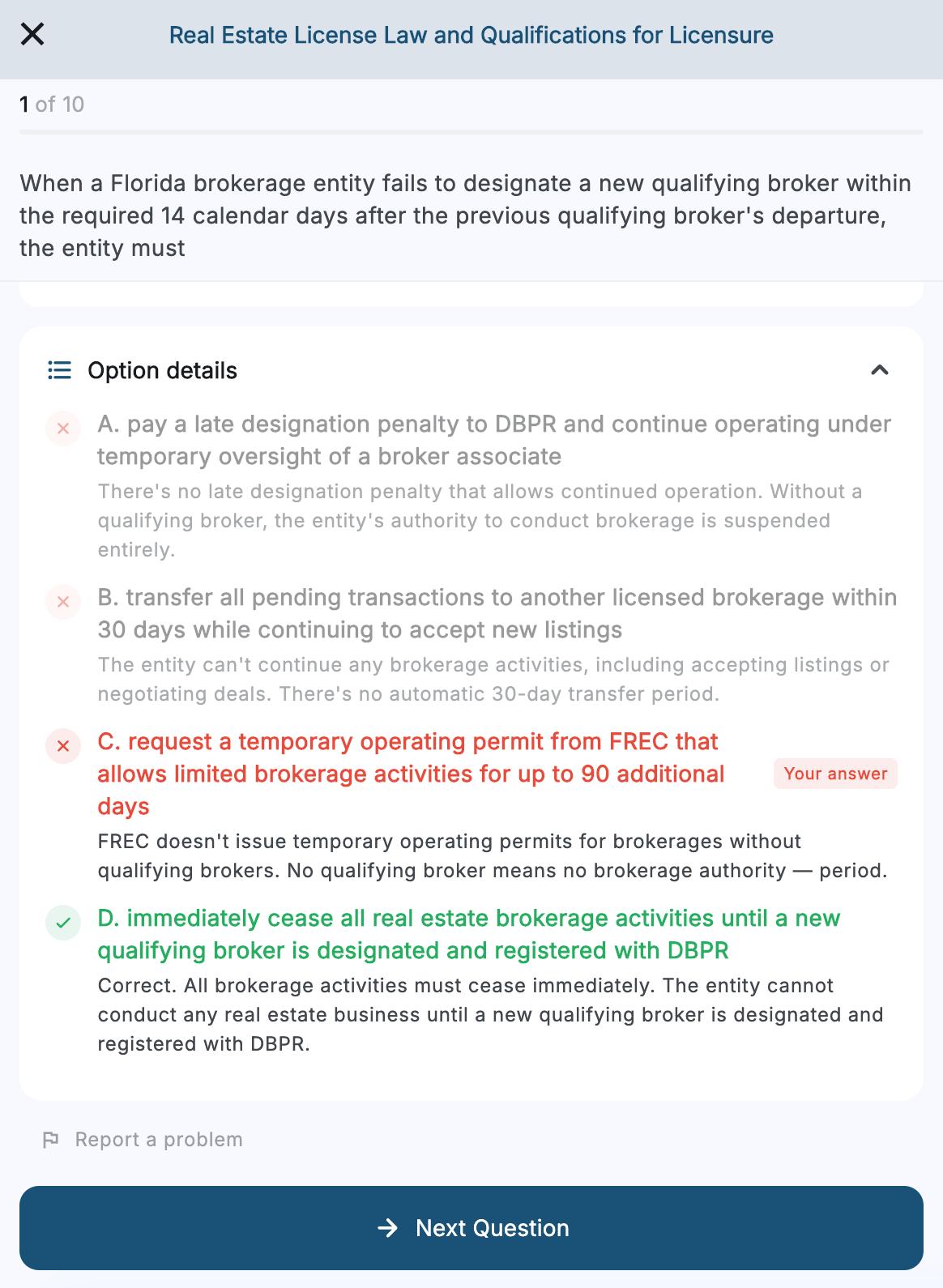
Take a Florida-specific diagnostic first. Then use ChatGPT to explain the rule behind a miss. Pass Florida maps 1,142 original questions to all 19 content areas so your AI session starts with evidence instead of a random topic.
Prepare a source packet before using a prompt
Provide the actual text or accessible material, its title, section, and date checked. A URL pasted into a chat does not establish that the tool has opened it. If it cannot access the page, supply a short permitted excerpt or choose a smaller task.
Use this common boundary with every prompt below:
If the supplied material does not establish a requested rule or cover a listed subtopic, mark it “not established.” Do not fill gaps from memory. Identify the source passage for each legal answer. Treat the question and answer key as a draft for review, not an official exam item. Wait for my answer before revealing feedback.
Open the cited passage yourself. A citation can point to a real page while failing to support the claim.
Run a one-question quiz and check its answer
Paste a short passage from your current course or an official source you’re allowed to use. Then ask:
Use only the passage below. Ask me one original Florida sales associate question with four choices. Wait for my answer and reason. Then show which words in the passage support the key and why the closest distractor fails. If the passage doesn’t settle it, say so. Change one fact and quiz me again.
Try the protocol with a calculation you can check yourself. A property has $24,000 in annual net operating income and a $300,000 value. The cap rate is 8%. Keep the income constant and change the value to $400,000. The answer should fall to 6%. If the model raises the rate or starts subtracting mortgage payments from the stated NOI, stop and fix the setup before continuing.
For a legal question, open the cited rule yourself. If the answer changes when challenged but the source and facts have not changed, discard that item. Use a fresh timed practice exam when you want to measure performance across topics instead of rehearsing a single rule.
19 topic prompts you can copy
Replace [SOURCE] with a current DBPR, Florida statute, FREC rule, or approved course excerpt. Ask for one question at a time when you want active recall.
| Outline area, shortened | Copy-ready prompt |
|---|---|
| Real estate brokerage activities and procedures | Using only [SOURCE], build six Florida brokerage scenarios covering compensation, advertising, escrow handling, listings, broker responsibility, and antitrust. Ask one at a time. After I answer, identify the controlling fact, cite the source, and explain each distractor. |
| Real estate contracts | Using only [SOURCE], compare valid, void, voidable, unenforceable, executed, and executory contracts. Then quiz me with five application scenarios. Do not introduce a contract rule that the source does not support. |
| Residential mortgages | Use [SOURCE] to teach note versus mortgage, lien theory, priority, default, foreclosure, acceleration, and defeasance. End with a comparison table and four application questions. |
| Property rights, estates, tenancies, condos, and HOAs | From [SOURCE], create a decision tree for freehold estates, leasehold estates, tenancy forms, condominium ownership, cooperative ownership, and HOA restrictions. Flag any Florida-law detail that needs another source. |
| Real estate appraisal | Use [SOURCE] to compare sales comparison, cost, and income approaches. Give one scenario for each, identify the best approach, and explain why the other approaches are weaker. |
| Authorized relationships, duties, and disclosures | Use [SOURCE] to compare transaction broker, single agent, and no brokerage relationship duties. Create scenarios that test confidentiality, loyalty, obedience, disclosure, and transition requirements. |
| Titles, deeds, and ownership restrictions | From [SOURCE], teach deed requirements, voluntary and involuntary alienation, recording, title evidence, liens, easements, and deed restrictions. Ask five best-answer questions one at a time. |
| License law and qualifications | Use [SOURCE] to build a checklist for age, education, application, fingerprints, pre-license course, examination, and activation. Mark every fee or deadline as verify-current instead of guessing. |
| Computations and closing transactions | Use [SOURCE] and the rates I provide to quiz me on commission, prorations, documentary stamps, mortgage stamps, intangible tax, and seller net. Show no formula until after I answer. |
| Legal descriptions | Teach metes and bounds, lot and block, and government survey from [SOURCE]. Give four recognition questions and four application questions, including acreage and section fractions. |
| Types of mortgages and financing sources | Use [SOURCE] to compare conventional, FHA, VA, purchase-money, package, blanket, open-end, construction, and reverse mortgages. Separate loan type, security instrument, and funding source. |
| Violations, penalties, and procedures | From [SOURCE], map complaint, investigation, probable cause, hearing, final order, and appeal stages. Then quiz me on which body acts at each stage. |
| Federal and state laws | Use [SOURCE] to create a table of the protected conduct, prohibited conduct, regulator, and exam trap for each law in the source. Do not add a statute or protected class from memory. |
| Taxes affecting real estate | Using [SOURCE], compare ad valorem tax, special assessment, homestead exemptions, documentary stamps, and nonrecurring intangible tax. Keep current rates separate from stable concepts. |
| FREC rules and commission authority | From [SOURCE], distinguish what FREC, DBPR, the Division of Real Estate, the Florida Legislature, and courts can do. Ask five "who has authority" scenarios. |
| Investments and business opportunity brokerage | Use [SOURCE] to teach NOI, cap rate, value, GRM, leverage, liquidity, risk, and business brokerage. Distinguish NOI before debt service from cash flow after debt service, and flag any unsupported formula. |
| The real estate business | Use [SOURCE] to compare brokerage, property management, appraisal, financing, development, counseling, and government roles. Ask which license or specialist fits each scenario. |
| Real estate markets and analysis | From [SOURCE], explain supply, demand, vacancy, price, sales volume, and building permits. Require compatible geography, property type, and time period before drawing a conclusion. |
| Planning and zoning | Use [SOURCE] to compare comprehensive plans, zoning, building codes, permits, variances, special exceptions, and nonconforming uses. Ask scenario questions that identify the controlling government action. |
These prompts request original study material. They do not prove alignment with every detail of the outline or force the model to follow the source. Check both the question and key before relying on them.
Prompts for a study plan
Use this when your exam date is fixed:
Build a [14-day or 30-day] study plan for the Florida sales associate exam. Use the DBPR 19-area weights I provide, my topic scores, and my available minutes each day. Put high-weight weak topics first. Include recurring math work where needed, later review of older topics, time for sustained mixed practice, and error-log review. If a full 210-minute simulation does not fit my available blocks, identify that scheduling gap rather than squeezing it into a shorter session. Do not invent a readiness guarantee. Show the plan in a day, task, time, and proof-of-completion table.
Use this when you are working full time:
Build a Florida real estate exam plan for someone with 30 minutes Monday through Friday and two hours on Saturday and Sunday. Use my topic scores and the official 19-area weights. Separate short recall tasks from calculator work and full timed practice. Do not plan reading or quiz interaction while driving. Give me one measurable result for each session.
Prompts for missed questions
Do not ask only, "Why was I wrong?" Give the model your reasoning so it can diagnose the error.
I chose [MY ANSWER] because [MY REASONING]. The keyed answer is [ANSWER], supported by [SOURCE]. Identify whether my miss came from a rule gap, reading error, math setup, timing, or distractor. Explain the smallest distinction I need to remember, then give one fresh scenario that tests the same distinction without copying the original wording.
For EXCEPT and NOT errors:
Restate the exact category this negative stem asks about before discussing the answer. Evaluate each choice against that category. If the question is ambiguous or LEAST asks for a relative fit, explain that rather than forcing a three-true-one-false pattern. Then create two new source-grounded EXCEPT questions and reveal the answer only after I respond.
Prompts for math practice
Keep current rates in the prompt instead of asking the model to remember them.
Create five Florida real estate exam problems using this formula and these rates: [FORMULA AND RATES]. Vary the numbers and missing variable. Ask one problem at a time. Do not reveal the formula direction until I answer. Afterward, show setup, substitution, arithmetic, units, rounding, and the most tempting wrong setup.
For prorations:
Create four property-tax proration problems. State the day-count convention, who owns the closing day, whether taxes are paid in arrears, the annual amount, and the closing date. After I answer, show seller days, daily rate, debit, credit, and a timeline check.
Prompts for the final week
Use this after a fresh timed exam:
Here are my scores by content area, pacing notes, confidence ratings, and missed-question causes: [DATA]. Build a seven-day repair plan. Prioritize high-weight weak topics, recurring math setup errors, and overconfident misses. Do not schedule a new full exam every day. Reserve review time after any full attempt and flag when the available calendar is too short to repair the observed gaps. Do not claim I will gain a fixed number of points.
Use this for a source audit:
Review this study sheet against the official sources I provide. Create three lists: supported, contradicted, and not established. Quote no more than the short phrase needed to identify the source. Do not repair an unsupported claim from memory. Tell me which official source I need next.
Prompt mistakes that waste study time
| Weak prompt | Problem | Better boundary |
|---|---|---|
| Quiz me on real estate | No state, license type, topic, or source | Name Florida sales associate, the topic, and the source |
| Give me actual exam questions | Invites unsupported or confidential-content claims | Request original practice based on the public outline |
| Tell me the current fee | Current fact can change | Require official verification; if browsing is unavailable, mark unverified |
| Make the questions very hard | Difficulty is undefined | Request application scenarios with close distractors and source citations |
| Score my readiness | Generated sets are not standardized | Treat the score as practice and check with separate fresh, source-checked practice |
| Explain everything | Output becomes too broad to review | Request one comparison, rule, or error pattern |
Frequently Asked Questions
What information should I include in a Florida exam prompt?
Include the Florida sales associate license type, one content area, the official or approved source, your goal, and the output you want. Add a boundary against invented rules, fees, deadlines, and exam claims.
Should I ask ChatGPT for sources?
Yes, but providing the controlling source is stronger than asking the model to find one from memory. For current information, ask it to search and link the official page, then open and inspect that page yourself.
Can ChatGPT create Florida real estate math questions?
Yes. Supply the formula, current rate, rounding convention, and problem type. Verify the answer key, then use a separate tracked drill to measure speed and consistency.
Does telling ChatGPT to use only my source guarantee accuracy?
No. It is a useful task boundary, not an enforcement mechanism. Verify the answer against the passage, check omitted conditions, and reject invented or unsupported citations.
What should I never ask AI to do for this exam?
Do not ask it to provide confidential state exam content, replace the 63-hour course, guarantee passage, or make a real licensing or legal decision. Use official sources for those boundaries.
Ready to turn prompts into a measured plan?
Start with a diagnostic, choose one weak content area, and run one source-first prompt. Then answer fresh questions to prove that the explanation changed performance.
Pass Florida includes 1,142 original Florida practice questions, 19 content areas, a 14-topic Math Coach, browser and mobile access, and one $39.99 purchase. No subscription. No copied exam questions.
Download Pass Florida | Try a free Florida question | Learn how ChatGPT can help | Use the ChatGPT quiz protocol
Generated study content can be incomplete, outdated, or wrong. Verify Florida rules, rates, deadlines, and testing procedures with current official sources. Respect course-provider copyrights and never share confidential exam content.
Methodology
This prompt library maps one prompt to each of the 19 content areas in the current DBPR Sales Associate Candidate Information Booklet. The prompt structure follows official OpenAI guidance to state a goal, provide useful context, define the output, and add boundaries. The source-grounding and verification requirements also follow OpenAI's exam-study workflow.
The specific prompt wording, error-review protocol, and final-week prompts are Pass Florida study methods. They are not official DBPR, FREC, Pearson VUE, or OpenAI questions. Sources were reviewed October 20, 2026. The prompts do not require a named model or paid subscription; actual access, upload support, browsing, and limits depend on the account and product.
Product note. Pass Florida publishes this page and sells the exam-prep product linked here. The relationship is disclosed. Pass Florida does not use copied exam questions, guarantee passage, or replace the required course.