QUICK ANSWER
Price per square foot equals price divided by square feet. To find total price, multiply square feet by the price per square foot. On the Florida sales associate exam, run the Same-Unit Gate before you calculate: convert acres to square feet (1 acre = 43,560 sq ft) if the units differ, label whether the stem asks for living area or land area, and only then choose divide or multiply. The most-tested trap is using the wrong denominator (lot square footage when the stem asked for living area, or the reverse).
WHO THIS GUIDE IS FOR
Florida sales associate exam candidates whose math misses concentrate in unit-control errors: dividing by the wrong square footage, forgetting to convert acres to square feet, mixing facts between two properties, or multiplying when the stem said "per." Useful whether you are first-time studying exam math, drilling EXCEPT/NOT questions that contain both a building size and a lot size, recovering from a Computations-topic miss on a practice exam (typically the living-area-vs-lot-area trap), or a retake candidate whose score report flagged math. Pair with the area and acreage convert-first guide for the broader unit-conversion framework, the section-township acreage guide for legal-description math, the appraisal guide for the comparable-sales context, the millage rate worked examples and commission math guide for sibling math archetypes, and the Florida real estate exam math formulas guide for the full archetype map. Not appraisal, valuation, pricing, brokerage, lending, tax, or licensing advice.
EXAM PREP ONLY
The Florida sales associate exam is a closed-book, computer-based licensing exam. DBPR's current Sales Associate CIB states 100 multiple-choice questions, three and a half hours, 19 content areas, and a passing grade of at least 75. The exam covers Florida real estate principles and practices, real estate law, real estate mathematics, F.S. Chapter 475 Part I, and F.A.C. Chapter 61J2. F.A.C. Rule 61J2-2.029 separately allocates 10 points to mathematics. This guide does not replace the required 63-hour FREC-approved pre-license course, DBPR application steps, Pearson VUE scheduling rules, fingerprinting, post-licensing, continuing education, legal advice, or official sources. Calculator allowances at Pearson VUE test centers are governed by published rules; verify current candidate materials before exam day.
Convert acres to square feet before a land price-per-square-foot calculation.
Living area, land area, garage area, and comparable area are not interchangeable.
The word "per" points to division unless the unit rate is already given and the question asks for total price.
Price-per-square-foot questions are easy until the stem gives both a house size and a lot size. Then many candidates divide by the wrong square footage and pick an answer that feels reasonable.
On the Florida sales associate exam, this is a unit-control problem. The formula is short. The hidden skill is deciding whether the question wants building area, land area, acreage conversion, or a comparison between properties.
DBPR and Pearson VUE candidate materials organize the sales associate exam as 100 multiple-choice questions across 19 weighted content areas. Topic 9, Real Estate Related Computations and Closing of Transactions, is weighted at 6%, and math also appears in appraisal, legal descriptions, taxes, and investments. Price-per-square-foot problems fit that same exam habit: identify the unit before you calculate.
This post is exam math content. It is not appraisal advice, pricing advice, brokerage advice, tax advice, lending advice, or a real-world valuation method.
What this guide covers
- Official source map
- Exam math vs real-world pricing
- The three-denominator decision
- Step 1: run the Same-Unit Gate
- Step 2: choose the formula
- Step 3: work the common setups
- When area math appears first
- Read the wrong answers
- Fast practice loop
- Exam-style question
- Key takeaway
- Frequently asked questions
Official Source Map
Use DBPR and F.A.C. sources for exam structure and math weighting, NIST for the acre conversion, and this guide only for exam-math coaching.
Use F.A.C. Rule 61J2-2.029 and the DBPR Sales Associate CIB for the exam structure and math weighting. Use the Same-Unit Gate, Formula Card, wrong-answer trap table, and fast practice loop in this guide as study coaching.
| Claim in this guide | Primary source | Why it matters |
|---|---|---|
| F.A.C. Rule 61J2-2.029 allocates 10 points to mathematics on the Florida sales associate examination | F.A.C. Rule 61J2-2.029, Examination Areas of Competency | The rule-level math weighting that anchors price-per-square-foot inside the broader Florida math allocation |
| The DBPR Sales Associate CIB lists Topic 9 (Real Estate Related Computations and Closing of Transactions) at 6% of the 100-question exam, with math also surfacing inside appraisal, legal descriptions, taxes, and investments | DBPR Sales Associate Candidate Information Booklet | The CIB topic-weighting that places price-per-square-foot inside Topic 9 and adjacent topics |
| The Florida sales associate exam is closed book, 100 multiple-choice questions, three and a half hours, 19 content areas, with a passing grade of at least 75 | DBPR Sales Associate CIB and DBPR Real Estate Sales Associate Requirements | Sets the test-day structure within which math execution happens |
| Pearson VUE administers scheduling, physical test-center delivery, calculator allowances, cancellation/rescheduling, and exam fee collection | Pearson VUE Florida Real Estate and Appraisers licensing exams and Pearson VUE Florida real estate candidate fact sheet PDF | Calculator allowances and test-day procedure are governed by Pearson VUE, not by DBPR coursework |
| One acre equals 43,560 square feet exactly | NIST Handbook 44, Appendix C, General Tables of Units of Measurement | The single load-bearing conversion fact for price-per-square-foot-of-land questions |
| Real estate brokerage law that frames the exam content is in F.S. Chapter 475, Part I | F.S. Chapter 475, Part I, Florida Statutes | Sets the statutory backbone for the exam math content area |
| The Same-Unit Gate, Formula Card, 8-row wrong-answer trap diagnostic, 5-question fast practice loop, and embedded exam-style question are exam-math study heuristics | Pass Florida coaching methodology | These are not DBPR, FREC, or Pearson VUE rules |
Exam Math vs Real-World Pricing
On the exam, price per square foot is arithmetic from the stem; in the real world, it is only one data point in a broader valuation analysis.
Before you calculate, separate the exam skill from real-world valuation.
| Situation | Number to trust | Why it matters |
|---|---|---|
| Florida exam-style math question | Use the price, square footage, acreage, and area labels in the stem | The exam tests setup discipline, not market judgment |
| Appraisal or CMA discussion | Use verified comparable sales, adjustments, condition, location, market data, and professional standards | Real-world value is not established by one price-per-square-foot number |
| Listing-price conversation | Use current brokerage policy, market evidence, seller goals, and licensed guidance | Price per square foot can support a conversation but does not replace pricing analysis |
| Study drill or practice exam | Label the requested denominator before touching the calculator | Most wrong answers come from using the wrong area |
On the exam, price per square foot is arithmetic. In the real world, price per square foot is only one comparison signal. A smaller renovated waterfront condo can have a higher price per square foot than a larger inland home; that does not mean one calculation is "wrong." It means valuation depends on more than area.
For exam prep, do not drift into appraisal judgment. The stem gives you the numbers. Your job is to choose the correct denominator and the correct operation.
The Three-Denominator Decision
Before calculating, identify whether the question wants living area, land area, building area, comparable area, or a total price from a unit rate.
Every price-per-square-foot question has a hidden denominator decision. If you pick the wrong denominator, the arithmetic can be perfect and the answer can still be wrong.
| Denominator the stem asks for | Use this area | Ignore these distractors unless asked |
|---|---|---|
| Price per square foot of living area | Heated/cooled living area or named interior square footage | Lot size, acreage, garage, porch, pool deck |
| Price per square foot of land | Lot square footage or acres converted to square feet | Building size, living area, number of bedrooms |
| Price per square foot of building area | Total building area if the stem says building area | Land area unless the question asks for land value |
| Price per square foot of a comparable | The comparable's price divided by the comparable's size | Subject property's size unless the stem asks you to apply the comp's rate to the subject |
| Total value from a unit rate | Subject square footage multiplied by the stated rate | Comparable sale price after the rate is already calculated |
Use this scratch-paper label before every calculation:
ASK: price per sq ft of ________
DENOMINATOR: ________ sq ft
OPERATION: divide / multiply
That small label stops the most expensive mistake in this topic: using the answer-choice denominator instead of the question's denominator.
Step 1: Run The Same-Unit Gate
Convert acres to square feet before dividing, and never mix land area with living area unless the stem asks for that comparison.
The Same-Unit Gate is the scratch-paper method for price-per-square-foot questions:
Find: price per square foot, total price, or square footage?
Price: ______
Area: ______ square feet
Convert: acres x 43,560 if needed
Use: divide for price per square foot, multiply for total price
Do not calculate while one number is in acres and another is in square feet. Do not use lot square footage when the stem asks for living-area price per square foot. The exam trap is usually a wrong denominator, not hard arithmetic.
Step 2: Choose The Formula
Divide to find price per square foot, multiply to find total price from a unit rate, and divide price by rate to find square footage.
Use the question's wording to choose the relationship.
| If the question asks for | Use | Trap |
|---|---|---|
| Price per square foot | price / square feet |
Dividing by lot area when living area was asked |
| Total price or value | square feet x price per square foot |
Dividing when you should multiply |
| Square footage | price / price per square foot |
Treating the dollar rate as total price |
| Price per acre | price / acres |
Converting when the ask already says per acre |
| Price per square foot of land | price / land square feet |
Forgetting acres x 43,560 |
| Comparable price per square foot | adjusted sale price / comparable square feet |
Mixing subject size with comparable price |
The word "per" usually signals division. Price per square foot means dollars divided by square feet. If the question gives the rate and asks for total price, reverse the relationship and multiply.
Step 3: Work The Common Setups
The common setups are unit price, total price, acre conversion, living-area traps, and comparing two properties by unit price.
The calculation changes depending on what is missing. Work the examples as setup drills, not as memorized answer patterns.
Worked Example 1: Find Price Per Square Foot
A house sells for $360,000 and has 2,400 square feet of living area. What is the price per square foot?
$360,000 / 2,400 sq ft = $150 per sq ft
Answer: $150 per square foot
The denominator is the living area because the question asks for price per square foot of the house.
Worked Example 2: Find Total Price
A property has 1,850 square feet and is priced at $220 per square foot. What is the total price?
1,850 sq ft x $220 = $407,000
Answer: $407,000
Do not divide in this setup. The question already gives the unit price and asks for the total.
Worked Example 3: Convert Acres First
A half-acre lot sells for $217,800. What is the price per square foot of land?
Step 1: Convert acres to square feet.
0.5 acre x 43,560 = 21,780 sq ft
Step 2: Divide price by square feet.
$217,800 / 21,780 sq ft = $10 per sq ft
Answer: $10 per square foot
The conversion is the whole problem. Once the land is in square feet, the formula is ordinary division.
Worked Example 4: Living Area vs Lot Area
A home sells for $444,600. It has 1,900 square feet of living area and sits on a 0.40-acre lot. What is the price per square foot of living area?
$444,600 / 1,900 sq ft = $234 per sq ft
Answer: $234 per square foot
The 0.40-acre lot is a distractor because the ask says living area. If the ask said land area, you would convert the lot size first.
Worked Example 5: Compare Two Properties
Property A sells for $351,000 and has 1,800 square feet. Property B sells for $388,500 and has 2,100 square feet. Which property has the lower price per square foot?
Property A:
$351,000 / 1,800 = $195 per sq ft
Property B:
$388,500 / 2,100 = $185 per sq ft
Answer: Property B has the lower price per square foot.
The lower total price is not always the lower unit price. Unit price lets you compare unlike sizes.
When Area Math Appears First
If the stem gives dimensions or acres, find square footage before doing the price-per-square-foot calculation.
Sometimes the exam makes you find square footage before the price-per-square-foot calculation.
| Shape or unit | Setup | Example |
|---|---|---|
| Rectangle | length x width |
60 ft x 120 ft = 7,200 sq ft |
| Square | side x side |
100 ft x 100 ft = 10,000 sq ft |
| Acre | acres x 43,560 |
0.25 x 43,560 = 10,890 sq ft |
| Multiple areas | Find each, then add | Building wing plus building wing |
| Price from unit rate | area x rate |
7,200 sq ft x $12 |
Pair this with the area and acreage guide if you miss the conversion step. Pair it with section-township acreage if the stem uses sections, quarters, or townships.
Read The Wrong Answers
Wrong choices usually reveal a wrong denominator, skipped acre conversion, decimal slip, or solving for total price instead of unit price.
Wrong answers in price-per-square-foot questions usually come from using the wrong square footage.
| Wrong answer pattern | What probably happened | Repair |
|---|---|---|
| Very low dollar per square foot | Divided by lot square footage instead of living area | Circle what the ask wants |
| Very high dollar per square foot | Dropped a zero from the square footage | Estimate before choosing |
| Price per acre answer | Divided by acres instead of square feet | Match the requested unit |
| Total price answer | Multiplied when the ask wanted per square foot | Look for the word "per" |
| Square footage answer | Solved for area instead of unit price | Re-read the find line |
| Comparable uses subject size | Mixed facts from two properties | Keep each property in its own row |
| Used 43,560 automatically | Converted even when the ask already used square feet | Convert only when units differ |
| Included garage or lot area | Used total area when living area was requested | Use the named area in the stem |
The wrong answer is often a correct calculation from the wrong denominator. That is why the Same-Unit Gate comes before the calculator.
Fast Practice Loop
These five drills test unit price, total price, acre conversion, living-area denominator control, and unit-price comparison.
Answer these like exam questions. Each wrong answer is a trap from the table above.
Question 1: Unit Price
A home sells for $333,500 and has 2,300 square feet of living area. What is the price per square foot?
A. $145
B. $14.50
C. 2,300 square feet
D. $333,500
Show answer
Correct answer: A. $333,500 / 2,300 = $145 per square foot.
Option B is a decimal-place miss. Option C gives the square footage instead of the unit price. Option D repeats the sale price and never divides.
Question 2: Total Price
A small commercial space has 3,750 square feet and is valued at $118 per square foot. What is the indicated value?
A. $442,500
B. $31.78
C. $118
D. 3,750 square feet
Show answer
Correct answer: A. 3,750 x $118 = $442,500.
Option B divides instead of multiplying. Option C repeats the unit rate. Option D repeats the area and does not answer the value question.
Question 3: Acre Conversion
A 0.30-acre parcel sells for $156,816. What is the price per square foot of land?
A. $12
B. $522,720
C. $3.60
D. 13,068 square feet
Show answer
Correct answer: A. 0.30 x 43,560 = 13,068 square feet, then $156,816 / 13,068 = $12 per square foot.
Option B is price per acre, not price per square foot. Option C divides by a full acre and ignores the 0.30-acre fact. Option D stops after the conversion and never divides price by area.
Question 4: Living Area Trap
A property sells for $486,200. It has 2,600 square feet of living area, a 500-square-foot garage, and a 0.20-acre lot. What is the price per square foot of living area?
A. $187
B. $156.84
C. $55.81
D. $11.16
Show answer
Correct answer: A. Use the living area because the question asks for living area: $486,200 / 2,600 = $187 per square foot.
Option B includes the garage: $486,200 / 3,100 = $156.84. Option C uses the lot size: 0.20 x 43,560 = 8,712, then $486,200 / 8,712 = $55.81. Option D divides by a full acre.
Question 5: Compare Unit Prices
Property A sells for $440,000 and has 2,500 square feet. Property B sells for $405,000 and has 2,100 square feet. Which has the lower price per square foot?
A. Property A, because it is $176 per square foot
B. Property B, because it has the lower sale price
C. They are the same because both are residential properties
D. You cannot compare them because the square footage differs
Show answer
Correct answer: A. Property A is $440,000 / 2,500 = $176 per square foot. Property B is $405,000 / 2,100 = $192.86 per square foot.
Option B chooses the lower total price instead of the lower unit price. Option C ignores the numbers. Option D is backwards: price per square foot exists so unlike sizes can be compared.
If you miss Questions 3 or 4, review area conversion. If you miss Question 5, drill comparison problems where total price and unit price point in different directions.
SAME UNITS BEFORE MATH
Drill price-per-square-foot traps before they cost you easy math points.
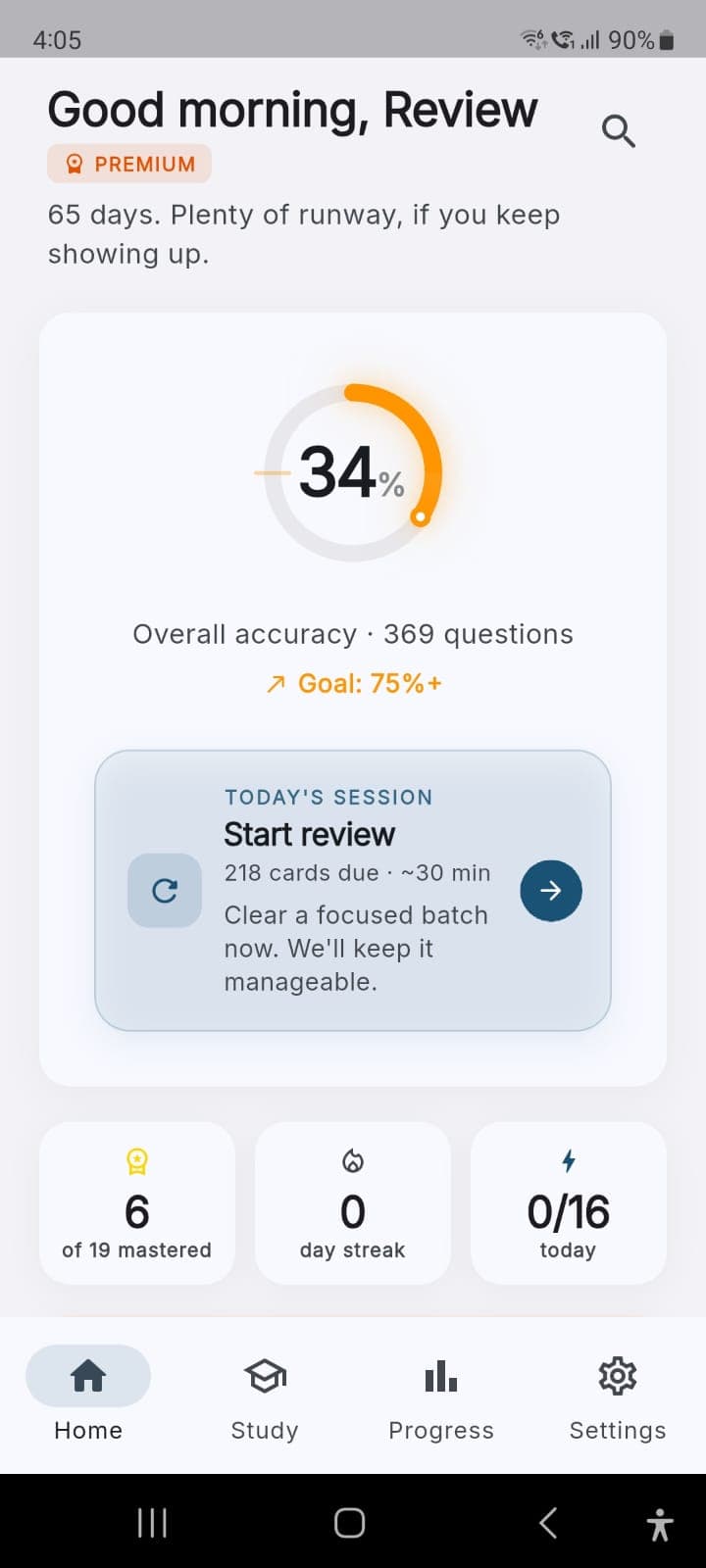
Pass Florida is exam prep only. Math Coach drills price per square foot, area conversion, section acreage, seller net, loan-to-value (LTV), and mixed math across the 14 Florida math calculation types. Trap Library helps you name whether the miss came from a wrong denominator, skipped conversion, extra facts, or multiplying when the ask said "per." The app includes 1,142 Florida-specific practice questions and does not replace the 63-hour course, DBPR processes, Pearson VUE scheduling, or licensed professional advice. No subscription. No copied exam questions.
Exam-Style Question
The correct answer uses living area only, because the stem asks for price per square foot of living area.
A property sells for $464,100. It has 2,100 square feet of living area, a 450-square-foot garage, and a 0.25-acre lot. What is the price per square foot of living area?
A. $221
B. $182
C. $42.62
D. $10.65
Show answer
Correct answer: A. The question asks for living area, so use 2,100 square feet: $464,100 / 2,100 = $221 per square foot.
Option B includes the garage: $464,100 / 2,550 = $182. Option C uses the lot size: 0.25 x 43,560 = 10,890, then $464,100 / 10,890 = $42.62. Option D divides by a full acre, which ignores the 0.25-acre fact and uses the wrong area.
Key Takeaway
Label the requested area, convert only when units differ, and keep each property's facts separate before touching the calculator.
Price per square foot is not hard because of the division. It is hard because the stem may give several possible denominators. Label the exact area requested, convert units only when needed, and keep each property's facts separate.
FAQ
How do you calculate price per square foot on the real estate exam?
Divide the price by the square footage requested in the question: price / square feet = price per square foot. If the question asks for living-area price per square foot, use living area. If it asks for land price per square foot, convert the land area to square feet first.
Is price per square foot on the Florida real estate exam?
It can appear as part of exam math, appraisal, comparison, area, or acreage questions. The exam may not label the topic for you, so look for wording like "per square foot," "living area," "lot size," "acre," or "compare the two properties."
How many math questions are on the Florida real estate exam?
The Florida sales associate exam is organized as 100 multiple-choice questions across 19 weighted content areas. Topic 9, Real Estate Related Computations and Closing of Transactions, is weighted at 6%, and math also appears in other topics such as appraisal, legal descriptions, taxes, and investments. Treat math as a cross-topic skill, not one isolated chapter.
How many square feet are in an acre?
One acre contains 43,560 square feet. Use this conversion when the stem gives acres but asks for price per square foot of land.
Do I use lot square footage or house square footage?
Use the square footage named in the ask. If it asks for price per square foot of living area, use the house's living area. If it asks for land, use the lot area.
Why do I get a very low price per square foot?
You may have divided by land square footage when the question asked for living area. Lot areas are often much larger than building areas, so that mistake produces a low-looking dollar amount.
Is price per square foot an appraisal method?
For exam purposes, treat this post as math setup only. Real-world valuation can require comparable sales, condition, location, market data, appraisal standards, and professional judgment.
Is price per square foot the same as price per acre?
No. Price per square foot uses square feet as the denominator. Price per acre uses acres as the denominator. The exam may ask either one, so match the requested unit.
Do I need a calculator for price-per-square-foot questions?
You should practice with a simple calculator because the arithmetic often involves division and unit conversion. DBPR test-center rules allow calculators only if they meet the published restrictions, so verify the current candidate materials before exam day. The bigger skill is still setup: a calculator cannot fix the wrong denominator.
Does Pass Florida replace my 63-hour course?
No. Pass Florida is exam preparation content, not a substitute for the FREC-approved 63-hour pre-license course, DBPR processes, Pearson VUE scheduling, or licensed professional advice. The app gives you 1,142 Florida-specific practice questions to help you prepare after and alongside your required coursework.
Ready to drill Florida exam math?
The next step is mixed math practice that uses the same convert-first, label-the-unit, and choose-the-operation routine.
The Same-Unit Gate is the single discipline that prevents most price-per-square-foot misses. The next score jump usually comes from drilling adjacent math archetypes (millage, commission, IRV, GRM, PITI, LTV) under the same convert-first / label-the-unit / pick-divide-or-multiply pattern.
- Pair with the broader archetype map: Florida real estate exam math formulas
- Drill convert-first reps: Area and acreage math: convert first
- Try Florida-specific Math Coach drills: Try 5 questions
Methodology
This guide uses official exam-structure sources for context and original Pass Florida drills for teaching wrong-denominator math traps.
This guide was written for Florida sales associate exam candidates. It focuses on how price per square foot, area conversion, acreage, living area, land area, and comparison traps appear in exam-style math questions, and it anchors the topic to the F.A.C. Rule 61J2-2.029 math-weighting allocation alongside the DBPR Sales Associate Candidate Information Booklet (CIB) Topic 9 framing.
The Same-Unit Gate, Formula Card, 8-row wrong-answer trap diagnostic, 5-question fast practice loop, and embedded exam-style question are Pass Florida observational coaching pedagogy and are not DBPR, FREC, or Pearson VUE process documents.
Pass Florida is not affiliated with DBPR, FREC, Pearson VUE, or any pre-license course provider, and Pass Florida does not guarantee passage of any state exam. Pass Florida does not replace the FREC-approved 63-hour pre-license course, DBPR application steps, Pearson VUE scheduling rules, fingerprinting, post-licensing, continuing education, or consultation with a qualified licensed professional. Its role is targeted practice with Florida-specific exam-style questions, not appraisal, pricing, valuation, lending, tax, brokerage, title, closing, or real-world transaction guidance.
Official sources are listed below where applicable. Requirements, policies, exam outlines, calculator allowances, and laws can change, so verify current details with the official source before making a real-world decision.
Product Note
Pass Florida is independent Florida sales associate exam prep with math drills and practice questions, not a DBPR course or guarantee of passing.
Pass Florida publishes this guide and offers the exam-prep app linked on this page. Pass Florida is not affiliated with DBPR, FREC, Pearson VUE, or any pre-license course provider, and Pass Florida does not guarantee passage of any state exam.
Sources
- F.A.C. Rule 61J2-2.029, Examination Areas of Competency
- DBPR Sales Associate Candidate Information Booklet PDF
- DBPR Candidate Information Booklets index
- DBPR Real Estate Sales Associate Requirements PDF
- Pearson VUE Florida Real Estate and Appraisers Licensing Exams
- Pearson VUE Florida real estate candidate fact sheet PDF
- NIST Handbook 44, Appendix C, General Tables of Units of Measurement
- F.S. Chapter 475, Real Estate Brokers, Sales Associates, Schools, and Appraisers, Florida Senate
- F.A.C. Chapter 61J2, Florida Real Estate Commission
This post is exam preparation content for the Florida Real Estate Sales Associate exam. It is not legal, tax, financial, lending, appraisal, brokerage, insurance, title, closing, valuation, pricing, or professional advice. Pass Florida is not affiliated with the Department of Business and Professional Regulation (DBPR), the Florida Real Estate Commission (FREC), Pearson VUE, or any pre-license course provider, and Pass Florida does not guarantee passage of any state exam. For real-world decisions, verify current requirements with the official source or consult a qualified licensed Florida professional.