VERIFY BEFORE RELYING
This is exam-prep math. The 43,560-square-feet-per-acre and 640-acres-per-square-mile figures are stable U.S. area conversions traced to NIST Handbook 44 Appendix C. The Florida exam context comes from Florida Administrative Code Rule 61J2-2.029 and the DBPR (Department of Business and Professional Regulation) Candidate Information Booklet for the Sales Associate exam. The conversions are stable; the exam topic outline can change between exam windows. For exam purposes, study the setup. For a real-world survey, legal description, parcel boundary, or transaction, verify against current official sources and consult a licensed Florida surveyor or attorney.
QUICK ANSWER
To solve area and acreage questions on the Florida real estate exam, convert all measurements to the same unit before calculating. Use length x width for rectangles, divide square feet by 43,560 to get acres, multiply acres by 43,560 to get square feet, and split irregular shapes into smaller rectangles first. Do not use 43,560 until you actually have square feet.
WHO THIS GUIDE IS FOR
Florida sales associate candidates who want to lock in the area and acreage math without getting trapped by mixed units. Useful whether math is your strongest topic and you want clean setups, or your weakest and you need a structured reference. Pair with the math formulas guide for the broader 14 calculation type math catalog, the legal descriptions guide when the stem uses sections and townships, and the price-per-square-foot guide when the stem adds a sale price. Not a substitute for a land surveying course or formal legal description training.
The Convert-Then-Calculate Method
Area and acreage math does not usually beat candidates because the arithmetic is hard. It beats them because the units are mixed before the calculator ever comes out.
On the Florida sales associate exam, a stem may give feet, square feet, acres, a section fraction, or an odd-shaped parcel. If you multiply too early, you may get a clean number that answers the wrong question.
For exam purposes, Florida does not add a special acreage conversion. The Florida-specific part is usually the exam context: legal descriptions, section fractions, parcel wording, and choosing the right unit under pressure.
The Convert-Then-Calculate Method keeps the order simple:
- Identify what the question asks for: square feet, acres, price, or missing dimension.
- Put every measurement into the same unit.
- Draw the shape if the parcel is not a simple rectangle.
- Calculate area.
- Convert only at the end if the answer needs a different unit.
The hidden skill is not memorizing more formulas. It is refusing to mix feet, square feet, and acres in the same step.
What this guide covers
- The Convert-Then-Calculate Method
- How to classify area questions (first-move matrix)
- The Core Conversion Map
- Square feet first, then acres
- Acres first, then square feet
- When the stem uses yards
- Government survey acreage
- Irregular shapes
- Missing dimensions
- Price per acre and price per square foot
- Scratch-paper setup
- Traps that cost points
- Five-question practice loop
- Exam-style question
- Read the wrong answers
- FAQ
How to classify area questions
The exam can dress area math in several different outfits. The first move changes with the stem.
| Question type | First move | Final move |
|---|---|---|
| Length and width in feet | Multiply to get square feet | Divide by 43,560 if the ask is acres |
| Acres given | Keep acres if the ask is acres | Multiply by 43,560 if the ask is square feet |
| Dimensions in yards | Find square yards first | Use 4,840 square yards per acre or convert square yards to square feet |
| Fraction of a section | Start with 640 acres | Multiply by every fraction in the legal description |
| Irregular parcel | Split into rectangles | Add or subtract pieces before converting |
| Price plus area | Solve the area unit first | Divide price by the unit the question asks for |
If you can name the question type before touching the calculator, the arithmetic gets much easier.
The Core Conversion Map
For exam purposes, memorize these relationships:
| Conversion | Exam move |
|---|---|
| 1 acre = 43,560 square feet | Divide square feet by 43,560 to find acres |
| 1 acre = 4,840 square yards | Useful when the stem gives yards |
| 1 square yard = 9 square feet | Use when the stem mixes yards and feet |
| 1 square mile = 640 acres | Use for government survey section math |
| 1 section = 640 acres | Start here for section fractions |
| Rectangle area = length x width | Use when both dimensions are in feet |
The common trap is using 43,560 before you have square feet. Length and width are linear measurements. Area is square measurement. You must multiply length by width first.
Square Feet First, Then Acres
When the stem gives length and width in feet, do not reach for 43,560 yet.
First find square feet:
Area = length x width
Then convert to acres:
Acres = square feet / 43,560
Worked example:
A rectangular parcel is 220 feet wide and 330 feet deep. How many acres is the parcel?
Step 1: Find square feet.
220 x 330 = 72,600 square feet
Step 2: Convert square feet to acres.
72,600 / 43,560 = 1.67 acres
Answer: 1.67 acres
The trap answer is often 72,600 acres, which treats square feet as acres. Another trap is 0.0067 acres, which comes from dividing one side length by 43,560 before finding area.
Acres First, Then Square Feet
If the stem gives acres and asks for square feet, reverse the conversion:
Square feet = acres x 43,560
Worked example:
A lot contains 2.5 acres. How many square feet are in the lot?
2.5 x 43,560 = 108,900 square feet
Answer: 108,900 square feet
This is a fast point if you keep the direction straight. Acres to square feet means multiply. Square feet to acres means divide.
When The Stem Uses Yards
Yard questions are still area questions. The trap is forgetting that square yards are already area units.
If both dimensions are in yards, multiply yards by yards to get square yards:
Square yards = length in yards x width in yards
Then convert square yards to acres:
Acres = square yards / 4,840
Worked example:
A rectangular parcel is 110 yards by 176 yards. How many acres is it?
Step 1: Find square yards.
110 x 176 = 19,360 square yards
Step 2: Convert square yards to acres.
19,360 / 4,840 = 4 acres
Answer: 4 acres
If the answer choices are in square feet instead, convert square yards to square feet:
19,360 x 9 = 174,240 square feet
The exam move is the same as before: label the unit you have, then convert only to the unit the question asks for.
Government Survey Acreage
Government survey math starts with a section.
One section contains 640 acres. If the question gives a fraction of a section, multiply the fractions.
Acres = 640 x fraction x fraction x fraction
Worked example:
How many acres are in the NE 1/4 of the SW 1/4 of Section 12?
640 x 1/4 x 1/4 = 40 acres
Answer: 40 acres
Three-fraction example:
How many acres are in the NE 1/4 of the SW 1/4 of the NE 1/4 of Section 12?
640 x 1/4 x 1/4 x 1/4 = 10 acres
Answer: 10 acres
For acreage only, the compass words tell you location, not size. NE, SW, N, and W matter for locating the parcel, but the acreage comes from the fractions.
If the question asks where the parcel is located, order matters and legal-description reading usually works from the end of the description back toward the beginning. If the question asks only how many acres, multiply the fractions.
CONVERT FIRST, EVERY TIME
Section fractions and square-foot conversions are free points once the unit is labeled.
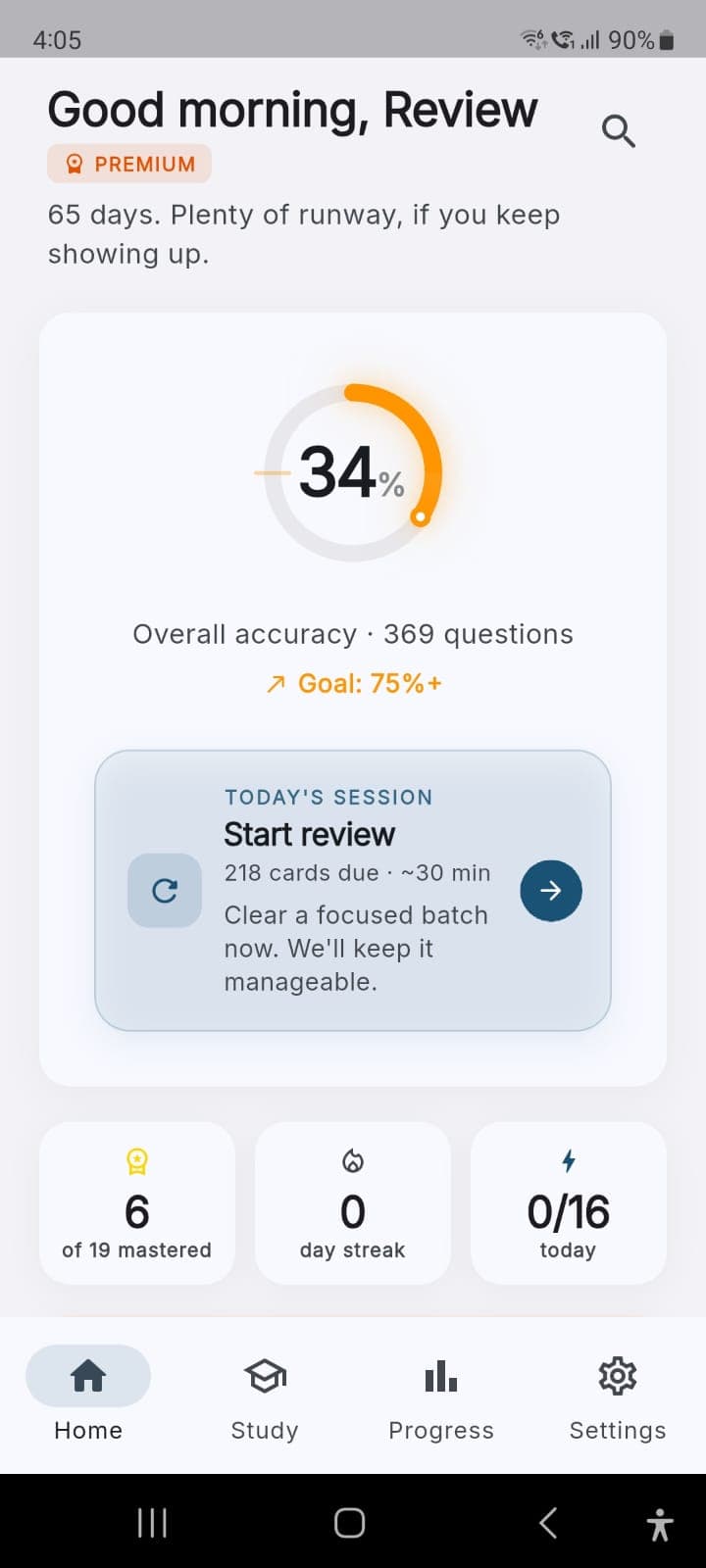
The skill is choosing the right unit before the calculator, and that comes from reps. Pass Florida drills area, acreage, and section math inside Math Coach across all 14 Florida calculation types, with Trap Library explanations that name whether a miss was a unit error or a shape error. The free area and acreage calculator checks your setup; the app gives you 1,142 Florida-specific questions for one $39.99 purchase. No subscription. No copied exam questions.
Open the area calculator · Drill it in Math Coach · Download Pass Florida
Irregular Shapes
Irregular shape questions are usually rectangle questions wearing a costume.
Split the shape into smaller rectangles, find each area, then add or subtract.
If the stem gives a sketch, redraw it as boxes. This version assumes the two rectangles touch but do not overlap:
+----------------------+
| Rectangle A | 300 ft
| 200 ft x 300 ft |
+--------------+-------+
 | Rect B| 150 ft
 |100x150|
 +-------+
Worked example:
An L-shaped parcel can be divided into two non-overlapping rectangles. Rectangle A is 200 feet by 300 feet. Rectangle B is 100 feet by 150 feet and is attached outside Rectangle A. What is the total acreage?
Step 1: Find each rectangle's square footage.
Rectangle A: 200 x 300 = 60,000 square feet
Rectangle B: 100 x 150 = 15,000 square feet
Step 2: Add the areas.
60,000 + 15,000 = 75,000 square feet
Step 3: Convert to acres.
75,000 / 43,560 = 1.72 acres
Answer: 1.72 acres
The exam may also describe a large rectangle with a smaller rectangle removed. In that version, find the large rectangle, find the missing piece, subtract, then convert.
Missing Dimensions
Some area questions test whether you know what cannot be solved.
If the stem says a rectangular parcel is 300 feet deep but does not give width, you cannot find the area. If the stem gives perimeter only, you usually cannot find area unless it also says the parcel is a square or gives enough dimensions to define the shape.
For exam purposes, do not invent missing dimensions. A real estate exam question may ask which additional fact is needed. That is still a math question, even if no arithmetic is required.
Use this quick check:
| Stem gives | Can you find area? | Why |
|---|---|---|
| Length and width | Yes | Multiply length x width |
| Square feet only | Yes | Area is already given |
| Acres only | Yes | Convert acres to square feet if needed |
| One side only | No | One dimension is missing |
| Perimeter only | Usually no | Different shapes can share a perimeter |
| Section fraction | Yes | Start with 640 acres and multiply fractions |
The exam-style trap is confidence. If the problem feels too easy, verify that you actually have two dimensions or a completed area value.
Price Per Acre and Price Per Square Foot
Area math often gets paired with price.
The price formula depends on the unit:
Price per acre = price / acres
Price per square foot = price / square feet
Worked example:
A 3-acre parcel sells for $210,000. What is the price per acre?
$210,000 / 3 = $70,000 per acre
If the question asks for price per square foot, convert first:
3 x 43,560 = 130,680 square feet
$210,000 / 130,680 = $1.61 per square foot
Same parcel. Same price. Different unit. That is why the Convert-Then-Calculate Method starts with the ask.
Scratch-Paper Setup
Use one small template for every area question:
Find: ____
Given unit: ____
Need unit: ____
Shape: ____
Area first: ____
Convert: ____
The "Find" line is the guardrail. If the question asks for acres, do not stop at square feet. If it asks for square feet, do not convert to acres just because 43,560 is in your memory.
Traps That Cost Points
Most misses come from a short list of habits.
| Trap | What it looks like | Repair |
|---|---|---|
| Converting too early | Dividing one side length by 43,560 | Find square feet first |
| Treating square feet as acres | Choosing the raw area as the acreage answer | Divide square feet by 43,560 |
| Ignoring an irregular shape | Multiplying only the largest rectangle | Split the shape and account for every part |
| Inventing a missing dimension | Assuming a parcel is square when the stem does not say so | Use only stated facts |
| Mixing section math with rectangle math | Using 640 acres when the stem gives feet | Match the formula to the stem |
The best repair is slow labeling. Write the unit next to every number before you calculate.
Pair area practice with legal descriptions when the stem uses sections, townships, ranges, or fractions, with price per square foot when it adds a sale price, and check your work against the area and acreage calculator only after the setup is done.
DRILL THE TRAPS
Learn what the wrong acreage answers are trying to catch.
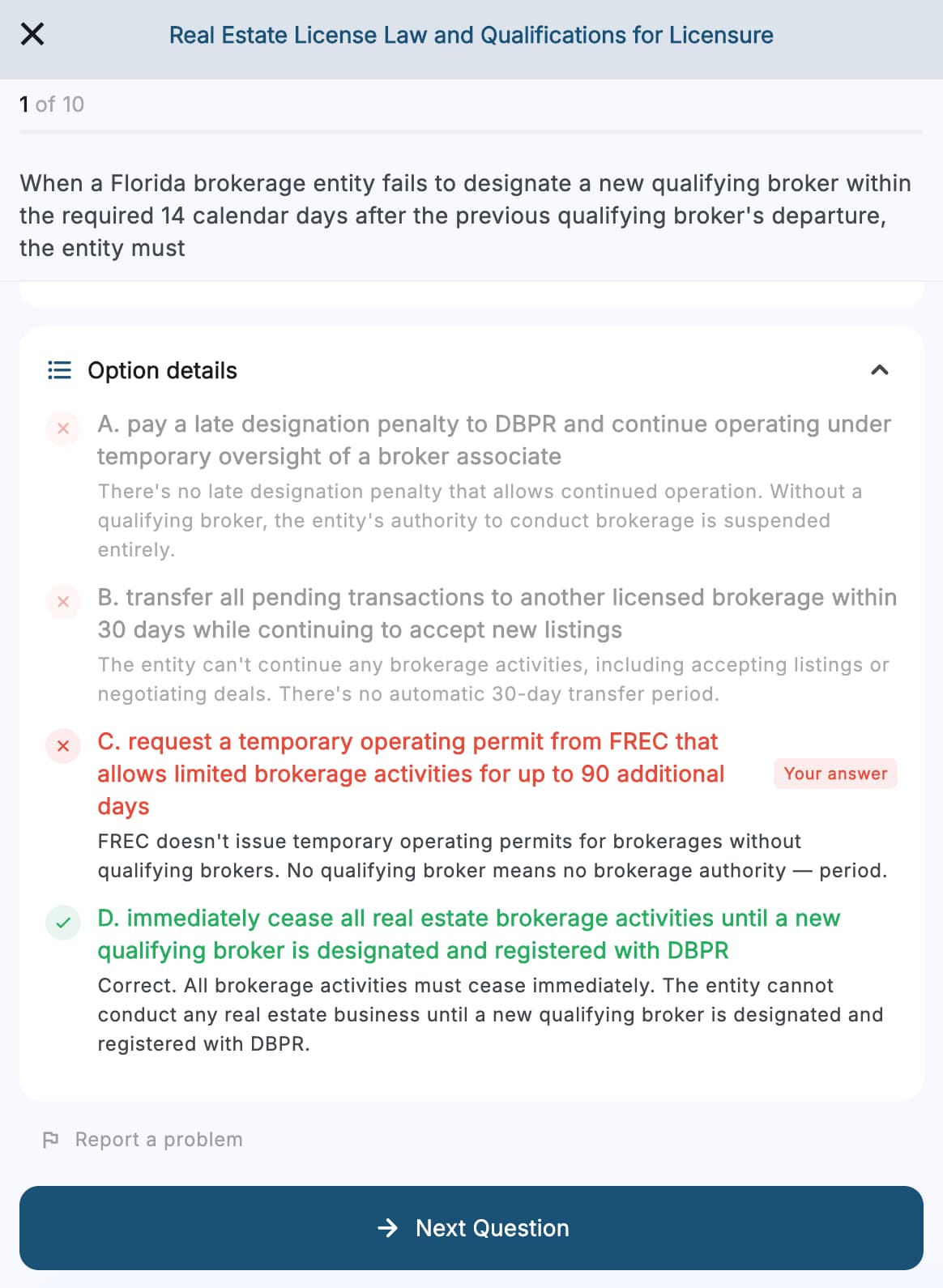
Trap answers are where the learning is. Pass Florida is exam prep only: Math Coach and Trap Library explanations show whether a miss came from unit choice, shape setup, fraction order, or calculation. The app includes 1,142 Florida-specific questions and costs $39.99 once, with no subscription and no copied exam questions.
Five-Question Practice Loop
Try these before the exam-style question.
Practice Rep 1
A parcel contains 87,120 square feet. How many acres is it?
Answer
87,120 / 43,560 = 2 acres. The trap is choosing 87,120 because it looks like the final answer. It is square feet, not acres.
Practice Rep 2
How many acres are in the N 1/2 of the NE 1/4 of the SW 1/4 of a section?
Answer
640 x 1/2 x 1/4 x 1/4 = 20 acres. The compass letters locate the parcel. The fractions create the acreage.
Practice Rep 3
A parcel contains 1.75 acres. How many square feet is it?
Answer
1.75 x 43,560 = 76,230 square feet. Acres to square feet means multiply. Dividing would make the answer impossibly small.
Practice Rep 4
A rectangular tract is 55 yards by 88 yards. How many acres is it?
Answer
55 x 88 = 4,840 square yards, and 4,840 / 4,840 = 1 acre. The trap is converting one side length instead of first creating a square unit.
Practice Rep 5
A rectangular lot is 160 feet deep. The question asks for acreage but gives no width. What should you do?
Answer
Do not calculate acreage. One side is missing. The correct exam move is to identify the missing dimension or choose the answer that says the information is insufficient.
Exam-Style Question
An L-shaped parcel is made from two non-overlapping rectangles. Rectangle A is 240 feet by 180 feet. Rectangle B is 120 feet by 90 feet and is attached outside Rectangle A. What is the parcel's approximate acreage?
A. 0.25 acres
B. 1.24 acres
C. 43,200 acres
D. 54,000 acres
Answer
Correct answer: B. Rectangle A is 240 x 180 = 43,200 square feet. Rectangle B is 120 x 90 = 10,800 square feet. Total area is 54,000 square feet. Convert to acres: 54,000 / 43,560 = 1.24 acres.
A uses only the smaller rectangle. C uses only the larger rectangle's square footage and treats it like acres. D adds the square feet correctly but never converts to acres.
Read The Wrong Answers
Area and acreage distractors are easy to diagnose if you know what they are trying to catch.
| Wrong-answer pattern | What it usually means |
|---|---|
| Raw large number | Square feet were not converted to acres |
| Very small acreage | Only one rectangle was used, or a linear measurement was divided by 43,560 |
| Clean whole number | The candidate rounded too early or stopped at a partial step |
| 640-based answer in a feet problem | Section math was used when rectangle math was needed |
| Price-per-unit answer in the wrong unit | The denominator was acres when the ask was square feet, or vice versa |
When you review an area problem, ask one question before rereading the explanation: "Was my mistake a unit mistake or a shape mistake?"
FAQ
How many square feet are in an acre for the real estate exam?
One acre is 43,560 square feet. For exam purposes, memorize that number cold. Square feet to acres means divide by 43,560, and acres to square feet means multiply by 43,560.
How do I calculate acreage from square feet?
Divide square feet by 43,560. For example, 87,120 square feet divided by 43,560 equals 2 acres. Keep the units written down so you do not stop at the square-foot number by mistake.
How do I calculate square feet from acres?
Multiply acres by 43,560. For example, 1.5 acres times 43,560 equals 65,340 square feet. This direction is a common trap because candidates sometimes divide both ways.
How many acres are in a section?
One section contains 640 acres. For a fraction of a section, multiply 640 by each fraction in the legal description. The NE 1/4 of the SW 1/4 is 640 x 1/4 x 1/4 = 40 acres.
What if the parcel is an irregular shape?
Split it into rectangles if the dimensions allow it. Find each rectangle's square footage, add or subtract the parts, then convert to acres if the question asks for acreage. Do not use only the largest rectangle.
Can I solve area if the question gives only one dimension?
Usually no. A rectangle needs length and width. If the stem gives only one side, perimeter only, or an incomplete sketch, the correct exam move may be to identify the missing information rather than force a calculation.
Do I need to memorize square yards for the Florida real estate exam?
You should know that 1 acre equals 4,840 square yards, but square feet and acres are more common in basic exam math. If the stem gives yards, convert yards to the unit the question asks for before selecting an answer.
Does Pass Florida replace the 63-hour course?
No. Pass Florida is exam preparation only. It does not replace the required 63-hour course, DBPR processes, Pearson VUE scheduling, or professional advice. Use it to practice Florida-style questions, math setup, and trap recognition after or alongside your required education.
Ready to lock in the unit-conversion routine?
Area and acreage become free points when the unit is labeled before the calculator comes out. The candidates who consistently answer correctly read the stem for the ask (acres vs square feet) first, write the conversion on scratch paper, and only then compute. Pass Florida drills those conversion decisions alongside the other Florida real estate math setups candidates see in mixed practice.
MAKE THE SETUP AUTOMATIC
Label the unit, find area, convert last. Then do it under time.
Reading the stem for the ask is a habit you build with reps, not a fact you memorize. Take the free timed practice exam to see area math in mixed pressure, or download Pass Florida for Math Coach, the 19-topic diagnostic, and the full Florida-specific question bank for one $39.99 purchase.
Methodology
This guide was written for Florida sales associate exam candidates. It focuses on how area, acreage, square-footage conversion, square-yard conversion, section fractions, and shape traps appear in exam-style questions. Pass Florida is exam preparation content and does not replace the Florida Real Estate Commission (FREC) approved 63-hour course, DBPR processes, Pearson VUE scheduling, land surveying, appraisal, brokerage, title, closing, or licensed professional consultation.
Product Note
Pass Florida publishes this guide and offers the exam-prep app linked on this page. Pass Florida is independent exam prep and is not a DBPR-approved 63-hour pre-license course or continuing education. It does not guarantee passage.
This post is exam preparation content for the Florida Real Estate Sales Associate exam. It is not legal, tax, financial, lending, appraisal, brokerage, insurance, title, closing, or professional advice. For real-world decisions, verify current requirements with the official source or consult a qualified licensed Florida professional. Studying with Pass Florida or any other exam-prep tool does not guarantee passage of the state exam.
Sources
- DBPR Real Estate Sales Associate Candidate Information Booklet
- Florida Administrative Code Rule 61J2-2.029, Examination Areas of Competency
- Pearson VUE Florida Real Estate and Appraisers Licensing Exams
- NIST Handbook 44 Appendix C, General Tables of Units of Measurement
- Florida Statutes Chapter 475, Real Estate Brokers, Sales Associates, Schools, and Appraisers