VERIFY BEFORE RELYING
This is exam-prep math. The millage formula (taxable value / 1,000 × mills), the just-value → assessed-value → taxable-value chain, the Save Our Homes 3%-or-CPI assessment limit, and the school-vs-non-school homestead exemption split are explained by the Florida Department of Revenue and grounded in F.S. 192.001 (mill definition), F.S. 196.031 (homestead), and F.S. 193.155 (Save Our Homes). The Chapter 196 additional homestead exemption amount is inflation-adjusted annually; FDOR lists a 2026 maximum additional amount of $26,411. For exam purposes, study the framework and use the exemption amount given in the stem. For a real-world property tax estimate, verify against the current Department of Business and Professional Regulation (DBPR) Sales Associate Candidate Information Booklet, the current Florida Department of Revenue homestead guide, and your county property appraiser's assessment.
QUICK ANSWER
To solve millage questions on the Florida real estate exam, find taxable value first: start with assessed value, subtract the correct exemption, then divide taxable value by 1,000 and multiply by mills. If the stem separates school and non-school mills, calculate each taxable value separately before adding the taxes. If a practice question gives a simplified exemption amount, use the stem; if it asks about current Florida law, verify the current FDOR amount.
WHO THIS GUIDE IS FOR
Florida sales associate candidates who keep losing points on property tax math by starting from the wrong value (just value instead of taxable value), treating mills as a percent, or applying the same homestead exemption to both school and non-school taxes. Useful whether millage is your strongest math archetype and you want to lock in the school-vs-non-school split, or your weakest and you need a structured reference for the value chain. Pair with the homestead exemption guide for the Chapter 196 deep dive, the math formulas guide for the broader math catalog, the proration guide for closing-side property tax math, and the documentary stamps guide for the transaction-tax sibling. Not property-tax-professional advice or a county-appraiser estimate.
What this guide covers
- The Taxable Value First Method
- The formula map
- The 2026 homestead update
- The two-office trap
- Just value, assessed value, taxable value
- Worked examples
- The trap table
The Taxable Value First Method
Millage math does not usually beat candidates because of arithmetic. It beats them because they start with the wrong value.
On the Florida sales associate exam, the stem may give just value, assessed value, taxable value, homestead exemption, school mills, non-school mills, and a final question that only asks for one piece. If you rush to multiply, the calculator will faithfully give you the wrong answer.
The Taxable Value First Method keeps the order clean:
- Identify the value you are allowed to tax.
- Apply only the exemption that fits that part of the tax.
- Convert mills by dividing taxable value by 1,000.
- Multiply by the millage rate.
- Stop at the number the question asks for.
The method matters because a millage question is really a setup question. The formula is short. The value choice is the test.
Use this as the broad starting value. In plain English, think market-style value.
Apply assessment limits first if the stem gives Save Our Homes or another cap fact.
Subtract the correct exemption, then apply mills only to the taxable value.
The Formula Map
For exam purposes, use this formula:
Property tax = taxable value / 1,000 x millage rate
Florida Statutes define a mill as one one-thousandth of a United States dollar. The Florida Department of Revenue's millage guide gives the same working equation: taxable value divided by 1,000, then multiplied by the millage rate.
That means 20 mills is not 20%. It is $20 per $1,000 of taxable value, which equals 2% when converted to a decimal.
| If the stem gives | What you do first |
|---|---|
| Taxable value | Use it directly in the millage formula |
| Assessed value and exemption | Subtract the exemption to get taxable value |
| Just value | Look for assessment limits before using it |
| School and non-school mills | Build two taxable values if homestead applies |
| Save Our Homes facts | Find assessed value before subtracting exemptions |
Do not let the word "value" do too much work. The exam wants you to know which value belongs in the formula.
The 2026 Homestead Update: Do Not Hard-Code $50,000
Older Florida exam prep often says, "Use $25,000 for school taxes and $50,000 for non-school taxes." That shortcut teaches the split, but it is no longer a safe current-law statement by itself.
F.S. 196.031 still gives the first homestead exemption of up to $25,000 for all taxation except assessments for special benefits. The additional homestead exemption applies to assessed value greater than $50,000 for levies other than school district levies, and the additional amount is now adjusted annually for inflation. FDOR's January 2026 adjustment document lists the 2026 maximum additional amount as $26,411.
For exam prep, that creates a simple rule:
| If the question says | What to do |
|---|---|
| "Use a $50,000 exemption for non-school taxes" | Use $50,000; the stem controls the math |
| "Use the 2026 additional homestead exemption amount" | Use the current FDOR amount supplied or verified for that year |
| "First $25,000 homestead exemption" | Apply it to school and non-school taxes unless the stem says otherwise |
| "Additional homestead exemption" | Add it to the first layer for non-school taxes only, subject to the assessed-value range |
| Real property tax estimate | Check the county property appraiser or TRIM notice |
The point is not to memorize a floating number forever. The point is to stop forcing an old shortcut into a question that is asking for a current-law number, while also avoiding the opposite mistake of changing a simplified practice stem that already gave you the amount to use.
The Two-Office Trap: Value Is Not Millage
The Florida Department of Revenue's millage guide separates two jobs that candidates often blend together. The property appraiser determines taxable value, approves exemptions, maintains property classification records, and prepares the TRIM notice. Taxing authorities, such as counties, municipalities, school boards, water management districts, and special districts, levy millage rates.
For exam purposes, keep the roles separate:
| Exam phrase | Who/what it points to | Why it matters in math |
|---|---|---|
| Just value, assessed value, exemption, taxable value | Property appraiser side | This tells you the value base |
| Millage rate, levy, school district mills, county mills | Taxing authority side | This tells you the rate |
| TRIM notice | Annual notice process | It shows proposed taxes, values, exemptions, caps, rates, and hearings |
| Non-ad valorem assessment | Separate charge | Do not mix it into ordinary millage unless the question tells you to |
That separation prevents a common error: adding all visible numbers together. Millage math is value times rate. Non-ad valorem assessments, special benefits, and unrelated closing costs only enter the calculation if the stem specifically asks for them.
Just Value, Assessed Value, Taxable Value
Here is the value chain the exam is usually testing:
Just value -> assessed value -> taxable value -> tax
Just value is the market-style value. It is the broad starting value.
If a course or practice question says "market value" in plain language, treat it as just value unless the stem creates a different fact. For exam purposes, the safer habit is to label the starting value as just value, then move through the Taxable Value First Method in order.
Assessed value is the value after assessment limitations, such as Save Our Homes, if the facts give one.
Taxable value is assessed value minus exemptions. This is the number that goes into the millage formula.
The Florida Department of Revenue explains the same chain as assessed value equals just value minus assessment limits, taxable value equals assessed value minus exemptions, and total tax liability equals taxable value multiplied by the millage rate.
For exam purposes, do not skip from just value to tax unless the question tells you there are no assessment limits and no exemptions.
Worked Example 1: Basic Millage
A property has a taxable value of $240,000. The millage rate is 18 mills. What is the annual property tax?
Step 1: Divide taxable value by 1,000.
$240,000 / 1,000 = 240
Step 2: Multiply by mills.
240 x 18 = $4,320
Answer: $4,320
This is the clean version. The stem already gave taxable value, so you did not need to subtract anything.
The trap answer is often $43,200, which comes from treating 18 mills like 18%. Another trap answer is $240,018, which comes from adding the millage rate as if it were a dollar charge.
Worked Example 2: Homestead With Non-School Millage
A homestead property has an assessed value of $225,000. The question is calculating a non-school tax and tells you to use a simplified $50,000 homestead exemption. The non-school millage rate is 16 mills. What is the property tax?
Step 1: Find taxable value.
$225,000 - $50,000 = $175,000
Step 2: Divide taxable value by 1,000.
$175,000 / 1,000 = 175
Step 3: Multiply by mills.
175 x 16 = $2,800
Answer: $2,800
This works because the question is only asking for the non-school tax and gives the exemption amount for that tax. If the question separates school and non-school taxes, do not use one taxable value for both. If the stem gives a current-year adjusted amount instead, use that current-year amount.
Worked Example 3: School vs Non-School Millage
Before the numbers, learn the split. The first $25,000 homestead layer applies to school and non-school taxes. The additional homestead layer applies to non-school taxes only, so a Florida exam-style question may require two taxable values.
A Florida homestead has an assessed value of $300,000. Use a $25,000 exemption for school taxes and a simplified $50,000 exemption for non-school taxes. School millage is 6 mills. Non-school millage is 12 mills. What is the total property tax?
Start with two taxable values.
School taxable value:
$300,000 - $25,000 = $275,000
School tax:
$275,000 / 1,000 x 6 = $1,650
Non-school taxable value:
$300,000 - $50,000 = $250,000
Non-school tax:
$250,000 / 1,000 x 12 = $3,000
Total tax:
$1,650 + $3,000 = $4,650
Answer: $4,650
This is the Florida-specific trap. If you apply the full non-school exemption to school taxes too, you get a lower answer that may look reasonable. It is still wrong when the stem separates school and non-school treatment. The exam lesson is the split; the current-law amount depends on the tax year or the number given in the question.
Worked Example 4: Save Our Homes Before Exemption
Save Our Homes is an assessment limit, not an exemption. For homesteaded property, Florida law generally limits the annual increase in assessed value to 3% or the change in the Consumer Price Index, whichever is lower. If the stem gives prior assessed value and a cap fact, find assessed value first, then subtract exemptions.
A homestead property has a current just value of $360,000. The stem says Save Our Homes limits the assessed value to $309,000 this year. The owner receives a simplified $50,000 exemption for the tax being calculated. The millage rate is 15 mills. What is the property tax?
Step 1: Use assessed value, not just value.
$309,000
Step 2: Subtract the exemption.
$309,000 - $50,000 = $259,000
Step 3: Apply mills.
$259,000 / 1,000 x 15 = $3,885
Answer: $3,885
The trap answer uses $360,000 because it is the larger, more visible number. For exam purposes, Save Our Homes is applied before exemptions. The question may hand you the assessed value directly, or it may make you calculate it from a cap fact.
The Trap Table
Most missed millage questions come from the same small set of errors.
| Trap | What it looks like | Repair |
|---|---|---|
| Using the starting value | The stem gives just value and assessed value, and you choose the bigger number | Use the Taxable Value First Method |
| Skipping exemptions | You apply mills to assessed value when the question gives homestead | Subtract the correct exemption first |
| Treating mills as percent | You multiply by 18% instead of 18 / 1,000 | Divide taxable value by 1,000, then multiply by mills |
| Applying full homestead to school taxes | You use the lower non-school taxable value for every millage rate | Separate school and non-school values |
| Hard-coding the old shortcut | You force $50,000 into a current-law stem that gives a different additional amount |
Use the number supplied in the question or verified for that tax year |
| Solving past the ask | The question asks for taxable value, but you calculate tax | Stop at the requested number |
The final trap is underrated. Some exam-style questions ask for taxable value, not tax. If the answer choices are values rather than tax amounts, stop before the millage step.
Quick Scratch-Paper Setup
Use a tiny template when the problem has several numbers:
JV: ____
AV: ____
School TV: ____
Non-school TV: ____
Exemption source: stem / current law
Mills: ____
Ask: ____
JV means just value. AV means assessed value. TV means taxable value.
The "Ask" line is what protects you from doing extra work. If the question asks for non-school taxable value, you do not need the final tax. If it asks for school tax, you do not need non-school tax unless it also asks for total.
What To Pair With Millage Practice
Millage should not live alone in your math prep. It should sit beside other setup-heavy topics.
| Pair it with | Why |
|---|---|
| Florida real estate exam math formulas | See the full formula family |
| Homestead exemption on the Florida exam | Review school and non-school exemption rules |
| Proration calculations | Property taxes also appear in closing math |
| Documentary stamps | Keep annual property taxes separate from closing taxes |
| Millage and property tax calculator | Change values and see the setup immediately |
The key distinction: millage is annual property tax. Documentary stamps are transaction taxes. Proration splits an expense between buyer and seller. Those topics can appear near each other, but they are not the same formula.
DRILL THE SETUP
Make taxable value automatic before exam day.
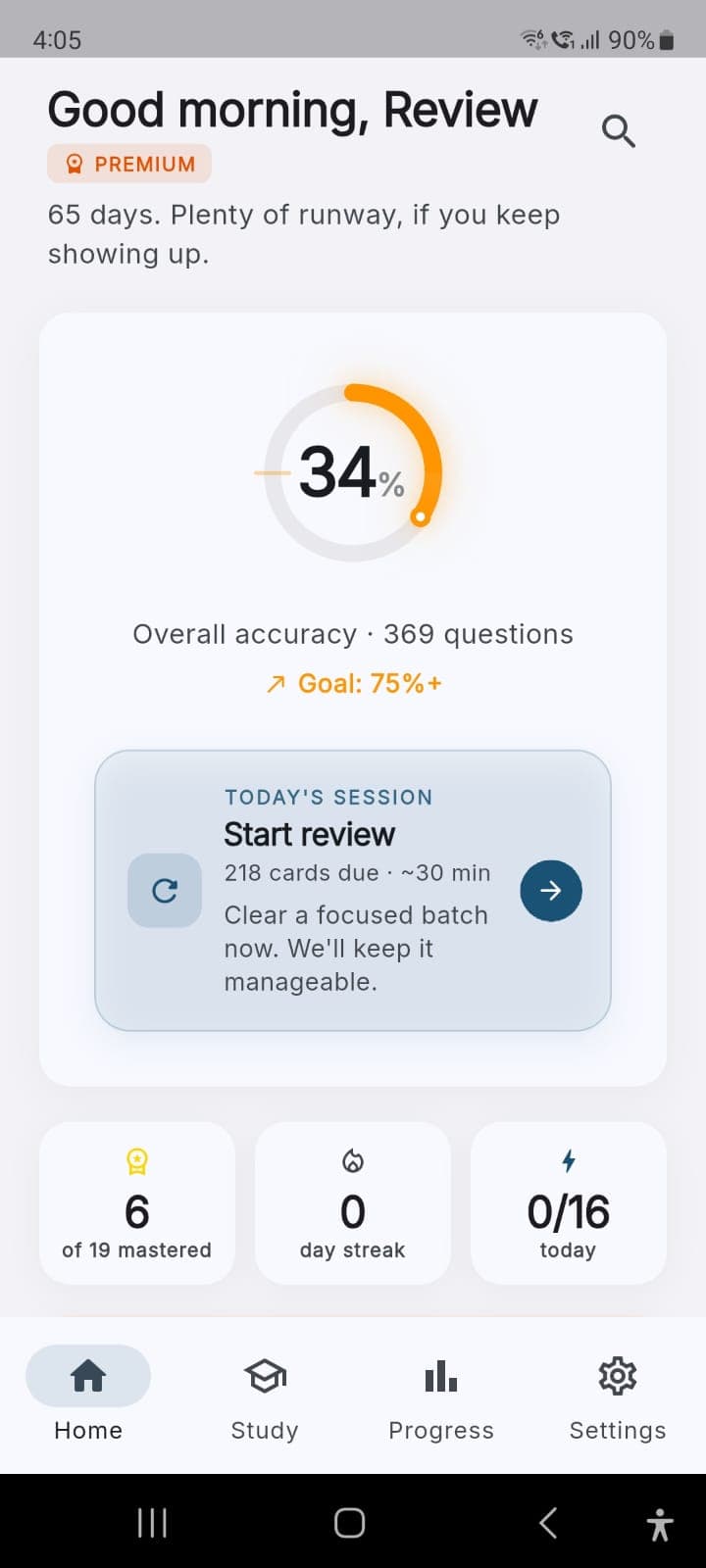
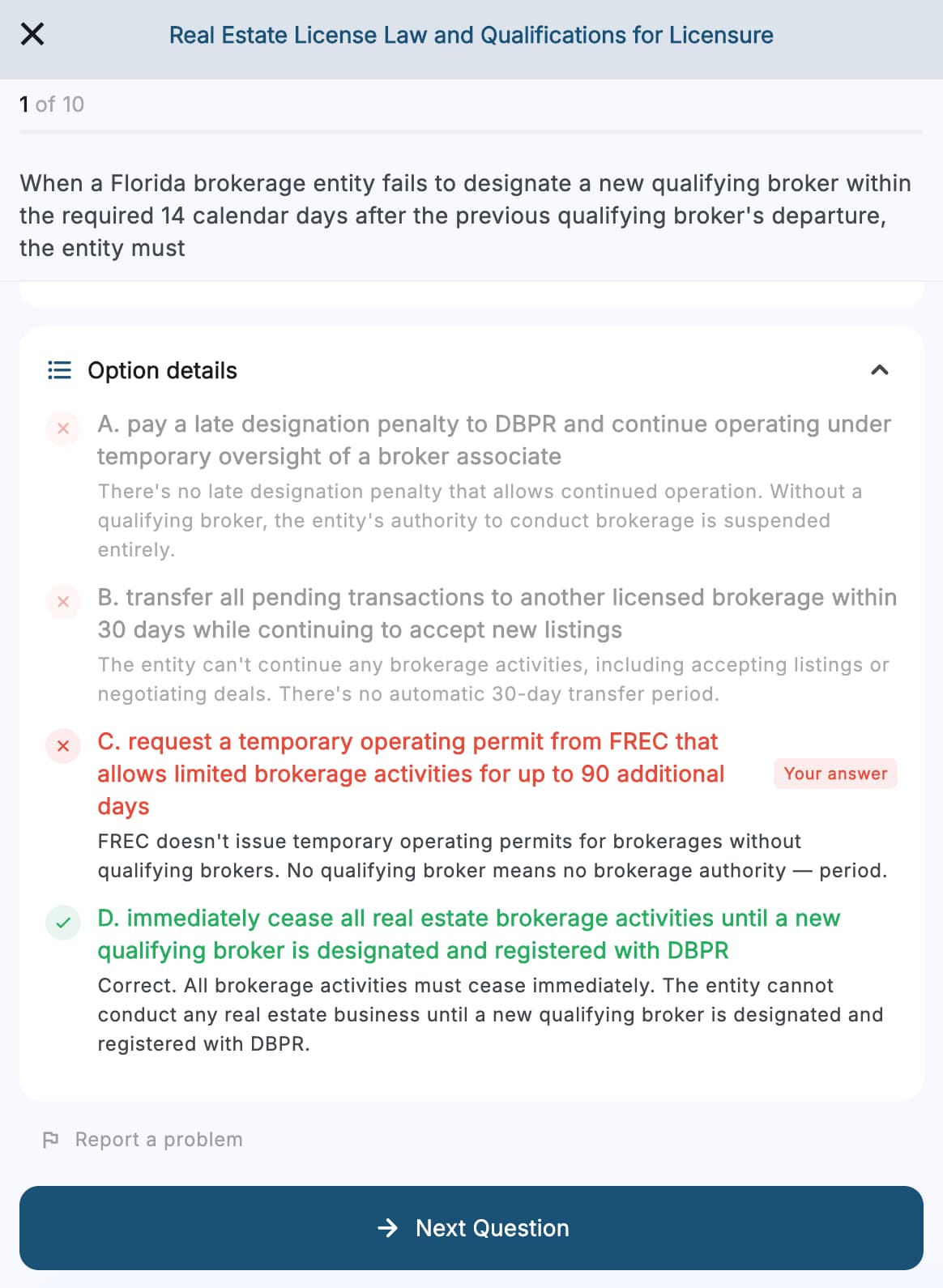
Pass Florida is exam prep only. Use Math Coach, Trap Library, the 19-topic diagnostic, and Confidence Calibration to drill Florida-specific property tax setups until taxable value feels automatic. $39.99 once. No subscription. No copied exam questions.
Exam-Style Questions
A homesteaded Florida property has an assessed value of $280,000. For this simplified question, the school taxable value uses a $25,000 exemption and the non-school taxable value uses a $50,000 exemption. The school millage rate is 7 mills and the non-school millage rate is 11 mills. What is the total property tax?
A. $4,140
B. $4,315
C. $5,040
D. $50,400
Answer
Correct answer: B. School taxable value is $280,000 - $25,000 = $255,000. School tax is $255,000 / 1,000 x 7 = $1,785. Non-school taxable value is $280,000 - $50,000 = $230,000. Non-school tax is $230,000 / 1,000 x 11 = $2,530. Total tax is $4,315.
A applies the full exemption too broadly. C uses assessed value without subtracting exemptions. D treats mills like a percentage.
Question 2
A 2026 current-law stem says to use a $25,000 first homestead exemption for school taxes and, for non-school taxes, the first $25,000 plus the 2026 FDOR-listed additional homestead amount of $26,411. A homesteaded property has an assessed value of $300,000. School millage is 6 mills. Non-school millage is 10 mills. What is the total property tax? Assume the answer is rounded to cents.
A. $3,977.42
B. $4,135.89
C. $4,150.00
D. $4,800.00
Answer
Correct answer: B. School taxable value is $300,000 - $25,000 = $275,000. School tax is $275,000 / 1,000 x 6 = $1,650. Non-school taxable value uses the first layer plus the adjusted additional amount: $300,000 - ($25,000 + $26,411) = $248,589. Non-school tax is $248,589 / 1,000 x 10 = $2,485.89. Total tax is $1,650 + $2,485.89 = $4,135.89.
A applies the full non-school exemption to school taxes too. C uses the older simplified $50,000 shortcut instead of the current-law number supplied in the stem. D uses assessed value and treats all 16 mills as if no exemption applies.
Read The Wrong Answers
Millage distractors are often diagnostic. If you know what mistake each answer represents, review becomes faster.
- A lower answer often means the exemption was over-applied.
- A middle-high answer often means assessed value was used instead of taxable value.
- A too-neat answer can mean the old
$50,000shortcut was used when the stem supplied an adjusted current-year number. - A wildly high answer often means mills were treated like a percent.
When you review practice questions, do not only ask "what was the answer?" Ask "what mistake was each wrong answer trying to catch?" Drill the full content area with the free taxes affecting real estate practice questions.
FAQ
How do you calculate millage on the Florida real estate exam?
Find taxable value first. Then divide taxable value by 1,000 and multiply by the millage rate. If the question separates school and non-school taxes, calculate each part separately.
What does one mill mean in property tax math?
One mill means $1 of tax for every $1,000 of taxable value. Florida Statutes define a mill as one one-thousandth of a United States dollar. In exam math, 20 mills equals $20 per $1,000, not 20%.
Do I use just value or assessed value for millage?
Use taxable value in the final formula. If the question gives assessed value and exemptions, subtract exemptions first. If the question gives just value, check whether an assessment limit, such as Save Our Homes, changes the assessed value before exemptions.
How does homestead exemption affect Florida property tax math?
Homestead can reduce taxable value before millage is applied. For many exam-style questions, the first $25,000 applies to school and non-school taxes, while the additional homestead layer applies to non-school taxes only. If the stem gives a specific exemption amount, use the number in the stem.
What is the difference between school and non-school millage?
School millage applies to the school taxable value. Non-school millage applies to the non-school taxable value. A homestead property can have different taxable values for those two parts, so do not automatically apply one taxable value to the full millage rate.
What is the biggest millage mistake on the Florida exam?
The biggest mistake is applying mills before finding taxable value. Candidates also treat mills like a percent or use just value when the question gives assessed value. The repair is always the same: taxable value first.
Should I memorize current Florida property tax numbers?
Memorize the structure more than a single floating number. Know what a mill means, how taxable value works, and why school and non-school homestead treatment can differ. As of FDOR's January 2026 adjustment, the additional non-school homestead amount is capped at $26,411, but that figure can change each year. If a question gives a current exemption amount, use that amount.
Does Pass Florida replace a property tax professional or county estimate?
No. Pass Florida is exam preparation only. It does not replace the 63-hour course, DBPR processes, a county property appraiser, a tax professional, or a live Florida tax estimate. Use it to practice exam-style math and verify real-world tax questions with official sources.
Ready to lock in the Taxable Value First habit?
Millage becomes free points when the value chain is automatic and the school-vs-non-school split is labeled before the calculator comes out. The candidates who consistently answer correctly identify whether the stem is asking for school tax, non-school tax, or total tax first, then build two taxable values when homestead applies, then divide and multiply. Pass Florida drills those setup switches alongside LTV, proration, and the other Florida math archetypes.
Methodology
The article focuses on how millage and property tax math appear in exam-style questions, especially value selection, homestead traps, school versus non-school taxable value, role confusion between property appraisers and taxing authorities, and setup errors under time pressure. The Taxable Value First Method, the 2026 homestead update table, and the Formula Map are independent Pass Florida pedagogy derived from common candidate mistakes, not an FDOR or county-appraiser process. The Florida Real Estate Commission (FREC), which sits under DBPR, controls the broader licensing framework that the property-tax math sits inside.
Pass Florida is exam preparation content and does not replace the FREC-approved 63-hour course, DBPR processes, Pearson VUE scheduling, a county property appraiser, or licensed professional consultation. Requirements, fees, policies, and laws can change, so verify current details with the official source before making a real-world decision.
Product Note
Pass Florida publishes this guide and offers the exam-prep app linked on this page. Pass Florida is independent exam preparation, not a DBPR-approved pre-licensing course, county property appraiser, tax professional, or guarantee of passage.
Sources
- Florida Department of Revenue: Property Tax System for Taxpayers
- Florida Department of Revenue: A Florida Homeowner's Guide: Millage
- Florida Department of Revenue: Additional Homestead Exemption Adjustment
- F.S. 192.001, definitions including mill and tax roll computation
- F.S. 196.031, homestead exemption
- F.S. 193.155, homestead assessments and Save Our Homes
- Pearson VUE Florida Real Estate testing page
- DBPR Real Estate Sales Associate Candidate Information Booklet
This post is exam preparation content for the Florida Real Estate Sales Associate exam. It is not legal, tax, financial, lending, appraisal, brokerage, insurance, title, closing, or property-tax-professional advice. F.S. Chapter 196 amendments, the inflation-adjusted additional homestead exemption amount, F.S. 193.155 Save Our Homes mechanics, Florida Department of Revenue forms, TRIM notice details, and county millage rates can change between exam windows. For a real property tax estimate, contact your county property appraiser. For real-world decisions, verify against the current primary source and consult a qualified licensed Florida professional. Studying with Pass Florida or any other exam-prep tool does not guarantee passage of the state exam.