Pick the approach before touching any formula. Comps point to sales comparison, income facts point to income, and special-purpose facts often point to cost.
Printable appraisal sheet
Florida real estate appraisal approaches cheat sheet
A printable appraisal-method sheet for choosing sales comparison, cost, or income approach before you calculate cap rate, GRM, GIM, depreciation, or comparable adjustments.
Read whether the stem gives gross or net income. Cap rate needs NOI. GRM and GIM use gross figures.
Adjust the comparable sale, never the subject. If the comp has something the subject lacks, subtract from the comp.
Approach picker
ApproachBest exam clueMain setup
Sales comparisonTypical residential property with comparable salesStart with comp sale price, then adjust for differences
CostNew, special-purpose, unique, or limited sales dataLand value + replacement cost new - depreciation
IncomeInvestment property, apartment, rent, NOI, cap rateValue = NOI / cap rate
GRMGross rent, price, quick income-property screenPrice / gross annual rent
GIMGross income, not only rentValue / gross annual income
Formula map
Formula familyFind thisExam setup
Cap rateValueNOI / cap rate
Cap rateNOIValue x cap rate
Cap rateRateNOI / value
GRMGRMPrice / gross annual rent
GRMPriceGRM x gross annual rent
GIMGIMValue / gross annual income
Cost approachDepreciated costReplacement cost new - depreciation
Sales comparisonAdjusted compComp price +/- adjustment
Worked examples
ProblemSetupAnswer
NOI $72,000, cap rate 8%$72,000 / 0.08$900,000 value
Price $480,000, gross annual rent $40,000$480,000 / $40,00012 GRM
Gross income $96,000, GIM 9.5$96,000 x 9.5$912,000 value
Land $90,000, building $360,000, depreciation $45,000$90,000 + ($360,000 - $45,000)$405,000 value
Quick self-test
Can you pick the approach cold?
Cover the answer key first. If you miss two or more, do not reread the whole sheet. Drill the family that caused the miss.
More practice: passfloridarealestate.com/math-drill
- 1Warm-up
An apartment building generates $84,000 NOI at a 7% cap rate. Find value.
- 2Approach pick
A 1990s single-family residence in a typical neighborhood. Which approach fits best?
- 3Gross vs net
A property has $48,000 gross rent and $36,000 NOI. Cap rate is 9%. Find value.
- 4Trap-aware
A comp sold for $400,000. The comp has a pool; the subject does not. Pool adjustment is $15,000. Find adjusted comp value.
- 5Approach mismatch
A vacant church property has limited comparable sales data. Which approach fits best, and why not the others?
Answer key: setup and math
- 1Setup: Cap rate value
$84,000 / 0.07 = $1,200,000
- 2Approach: Sales comparison
Typical residential property with comparable sales points to sales comparison.
- 3Setup: Cap rate value
$36,000 / 0.09 = $400,000
Trap watch: use NOI, not gross rent. The gross rent number is a distractor.
- 4Setup: Comp adjustment
$400,000 - $15,000 = $385,000
Trap watch: adjust the comp down because the comp has a feature the subject lacks.
- 5Approach: Cost
Special-purpose property with limited comparable sales points to cost.
Sales comparison needs comps. Income approach needs an income stream.
Try the setup
Use the calculators when cap rate, GRM, or GIM still feels slippery.
The sheet helps you choose the approach. The calculators help you test the setup before moving into mixed exam-style practice.
Florida appraisal anchors
Florida anchorExam-safe meaningTrap to avoid
Market value vs assessed valueAppraisal questions usually point to market value unless the stem says tax assessmentUsing assessed value when the stem asks for market value
CMA/BPO vs appraisalLicensees may estimate value in brokerage contexts, but an appraisal is a licensed appraisal serviceTreating every value opinion as a formal appraisal
FREC exam scopeFor the sales associate exam, focus on approach recognition, value terms, and math setupTurning appraisal prep into real-world appraisal advice
Wrong-answer traps
TrapWrong moveRepair
Gross vs netUsing gross rent in a cap-rate problemCap rate uses NOI, not gross rent
Percent formatDividing by 8 instead of 0.08Convert percent rates to decimals
Adjustment directionAdjusting the subject instead of the compAdjust the comparable sale price
Land depreciationDepreciating land in cost approachDepreciate improvements only
Approach mismatchUsing sales comparison for an apartment income questionLet the property type pick the approach
Optional email copy
Send this appraisal sheet to your inbox.
Want a copy for later? We will email this appraisal PDF link, the approach-first rule, and the common valuation traps. Downloading the PDF does not require an email.
After the PDF
Use the sheet for review, then drill the skill.
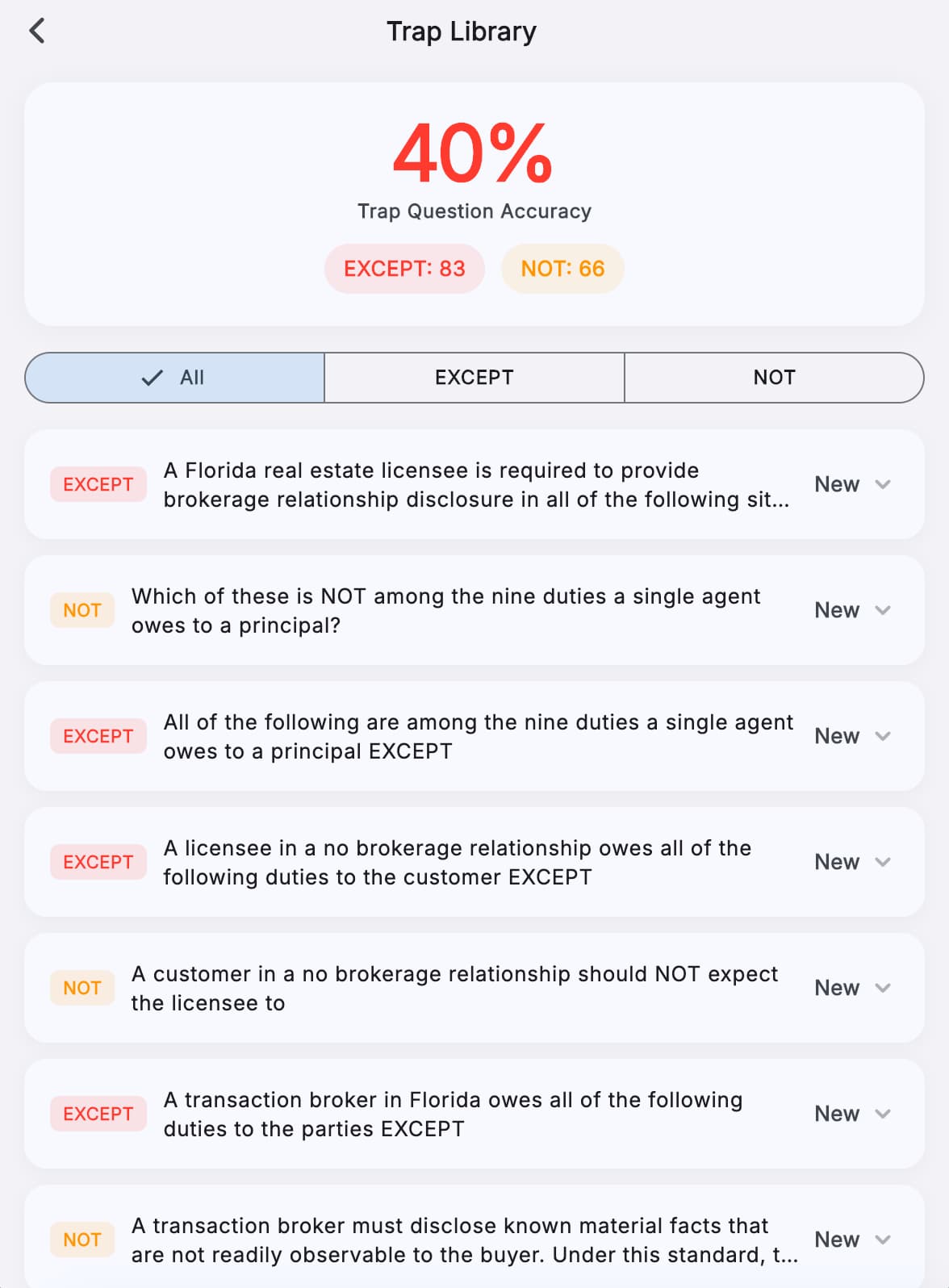
Printable PDFs are good for setup and recall. The app is where you turn those setups into mixed Florida-specific practice with Math Coach, Trap Library, and Confidence Calibration.
1,142 questionsMath CoachTrap Library$39.99 once
Exam prep only. Not a substitute for the 63-hour course, DBPR steps, or Pearson VUE scheduling.

FAQ
Valuation and appraisal questions
Which appraisal approaches are tested on the Florida exam?+
Expect sales comparison, cost, and income approach recognition. The exam may also test cap rate, GRM, GIM, depreciation, and comparable-sale adjustment setups.
When do I use cap rate instead of GRM?+
Use cap rate when the stem gives NOI or asks for income capitalization. Use GRM when the stem gives gross rent and price.
Does land depreciate in the cost approach?+
No. For exam math, depreciation applies to improvements, not land.
What is the biggest appraisal trap?+
Choosing the formula before identifying the approach. Read the property type and income label first, then calculate.
What is the difference between cap rate, GRM, and GIM?+
Cap rate uses NOI and value. GRM uses price and gross annual rent. GIM uses value and gross annual income, which can include more than rent.
How many appraisal questions are on the Florida real estate exam?+
DBPR topic weighting gives Real Estate Appraisal 8% of the 100-question Florida sales associate exam, so plan for about 8 appraisal-related questions across concepts and math.